Giuseppe
Emeritus
[Source: PLoS Pathogens, full text: (LINK). Abstract, edited.]
------
Research Article
Isolation of a Novel Swine Influenza Virus from Oklahoma in 2011 Which Is Distantly Related to Human Influenza C Viruses
Ben M. Hause, Mariette Ducatez, Emily A. Collin, Zhiguang Ran, Runxia Liu, Zizhang Sheng, Anibal Armien, Bryan Kaplan, Suvobrata Chakravarty, Adam D. Hoppe, Richard J. Webby, Randy R. Simonson, Feng Li
Affiliations: [Full list on source page.]
Abstract
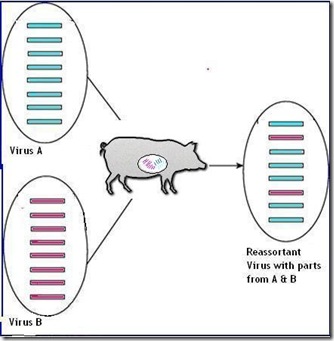
Of the Orthomyxoviridae family of viruses, only influenza A viruses are thought to exist as multiple subtypes and has non-human maintenance hosts. In April 2011, nasal swabs were collected for virus isolation from pigs exhibiting influenza-like illness. Subsequent electron microscopic, biochemical, and genetic studies identified an orthomyxovirus with seven RNA segments exhibiting approximately 50% overall amino acid identity to human influenza C virus. Based on its genetic organizational similarities to influenza C viruses this virus has been provisionally designated C/Oklahoma/1334/2011 (C/OK). Phylogenetic analysis of the predicted viral proteins found that the divergence between C/OK and human influenza C viruses was similar to that observed between influenza A and B viruses. No cross reactivity was observed between C/OK and human influenza C viruses using hemagglutination inhibition (HI) assays. Additionally, screening of pig and human serum samples found that 9.5% and 1.3%, respectively, of individuals had measurable HI antibody titers to C/OK virus. C/OK virus was able to infect both ferrets and pigs and transmit to naive animals by direct contact. Cell culture studies showed that C/OK virus displayed a broader cellular tropism than a human influenza C virus. The observed difference in cellular tropism was further supported by structural analysis showing that hemagglutinin esterase (HE) proteins between two viruses have conserved enzymatic but divergent receptor-binding sites. These results suggest that C/OK virus represents a new subtype of influenza C viruses that currently circulates in pigs that has not been recognized previously. The presence of multiple subtypes of co-circulating influenza C viruses raises the possibility of reassortment and antigenic shift as mechanisms of influenza C virus evolution.
Author Summary
Influenza C viruses infect most humans during childhood. Unlike influenza A viruses, influenza C viruses exhibit little genetic variability and evolve at a comparably slower rate. Influenza A viruses exist as multiple subtypes and cause disease in numerous mammals. In contrast, influenza C viruses are comprised of a single subtype in its primary human host. Here we characterize a novel swine influenza virus, C/swine/Oklahoma/1334/2011 (C/OK), having only modest genetic similarity to human influenza C viruses. No cross-reaction was observed between C/OK and human influenza C viruses. Antibodies that cross react with C/OK were identified in a significant number of swine but not human sera samples, suggesting that C/OK circulates in pigs. Additionally, we show that C/OK is capable of infecting and transmitting by direct contact in both pigs and ferrets. These results suggest that C/OK represents a new subtype of influenza C viruses. This is significant, as co-circulation of multiple subtypes of influenza allows for rapid viral evolution through antigenic shift, a property previously only shown for influenza A viruses. The ability of C/OK to infect ferrets along with the absence of antibodies to C/OK in humans, suggests that such viruses may become a potential threat to human health.
Citation: Hause BM, Ducatez M, Collin EA, Ran Z, Liu R, et al. (2013) Isolation of a Novel Swine Influenza Virus from Oklahoma in 2011 Which Is Distantly Related to Human Influenza C Viruses. PLoS Pathog 9(2): e1003176. doi:10.1371/journal.ppat.1003176
Editor: Ron A. M. Fouchier, Erasmus Medical Center, Netherlands
Received: August 29, 2012; Accepted: December 19, 2012; Published: February 7, 2013
Copyright: ? 2013 Hause et al. This is an open-access article distributed under the terms of the Creative Commons Attribution License, which permits unrestricted use, distribution, and reproduction in any medium, provided the original author and source are credited.
Funding: This work was funded by Newport Laboratories, SDSU AES 3AH-203 fund and the South Dakota 2010 Research Center, BCAPP (Biological Control and Analysis of Applied Photonics), and National Institute of Allergy and Infectious Diseases, National Institutes of Health, Department of Health and Human Services under Contract No. HHSN266200700005C. The funders had no role in study design, data collection and analysis, decision to publish, or preparation of the manuscript.
Competing interests: The authors have read the journal's policy and have the following conflicts: BMH, EAC and RRS are employed by Newport Laboratories, a company that produces swine influenza virus vaccines. This does not alter the authors' adherence to all the PLoS Journal policies on sharing data and materials.
-Isolation of a Novel Swine Influenza Virus from Oklahoma in 2011 Which Is Distantly Related to Human Influenza C Viruses
Ben M. Hause, Mariette Ducatez, Emily A. Collin, Zhiguang Ran, Runxia Liu, Zizhang Sheng, Anibal Armien, Bryan Kaplan, Suvobrata Chakravarty, Adam D. Hoppe, Richard J. Webby, Randy R. Simonson, Feng Li
Affiliations: [Full list on source page.]
Abstract
Of the Orthomyxoviridae family of viruses, only influenza A viruses are thought to exist as multiple subtypes and has non-human maintenance hosts. In April 2011, nasal swabs were collected for virus isolation from pigs exhibiting influenza-like illness. Subsequent electron microscopic, biochemical, and genetic studies identified an orthomyxovirus with seven RNA segments exhibiting approximately 50% overall amino acid identity to human influenza C virus. Based on its genetic organizational similarities to influenza C viruses this virus has been provisionally designated C/Oklahoma/1334/2011 (C/OK). Phylogenetic analysis of the predicted viral proteins found that the divergence between C/OK and human influenza C viruses was similar to that observed between influenza A and B viruses. No cross reactivity was observed between C/OK and human influenza C viruses using hemagglutination inhibition (HI) assays. Additionally, screening of pig and human serum samples found that 9.5% and 1.3%, respectively, of individuals had measurable HI antibody titers to C/OK virus. C/OK virus was able to infect both ferrets and pigs and transmit to naive animals by direct contact. Cell culture studies showed that C/OK virus displayed a broader cellular tropism than a human influenza C virus. The observed difference in cellular tropism was further supported by structural analysis showing that hemagglutinin esterase (HE) proteins between two viruses have conserved enzymatic but divergent receptor-binding sites. These results suggest that C/OK virus represents a new subtype of influenza C viruses that currently circulates in pigs that has not been recognized previously. The presence of multiple subtypes of co-circulating influenza C viruses raises the possibility of reassortment and antigenic shift as mechanisms of influenza C virus evolution.
Author Summary
Influenza C viruses infect most humans during childhood. Unlike influenza A viruses, influenza C viruses exhibit little genetic variability and evolve at a comparably slower rate. Influenza A viruses exist as multiple subtypes and cause disease in numerous mammals. In contrast, influenza C viruses are comprised of a single subtype in its primary human host. Here we characterize a novel swine influenza virus, C/swine/Oklahoma/1334/2011 (C/OK), having only modest genetic similarity to human influenza C viruses. No cross-reaction was observed between C/OK and human influenza C viruses. Antibodies that cross react with C/OK were identified in a significant number of swine but not human sera samples, suggesting that C/OK circulates in pigs. Additionally, we show that C/OK is capable of infecting and transmitting by direct contact in both pigs and ferrets. These results suggest that C/OK represents a new subtype of influenza C viruses. This is significant, as co-circulation of multiple subtypes of influenza allows for rapid viral evolution through antigenic shift, a property previously only shown for influenza A viruses. The ability of C/OK to infect ferrets along with the absence of antibodies to C/OK in humans, suggests that such viruses may become a potential threat to human health.
Citation: Hause BM, Ducatez M, Collin EA, Ran Z, Liu R, et al. (2013) Isolation of a Novel Swine Influenza Virus from Oklahoma in 2011 Which Is Distantly Related to Human Influenza C Viruses. PLoS Pathog 9(2): e1003176. doi:10.1371/journal.ppat.1003176
Editor: Ron A. M. Fouchier, Erasmus Medical Center, Netherlands
Received: August 29, 2012; Accepted: December 19, 2012; Published: February 7, 2013
Copyright: ? 2013 Hause et al. This is an open-access article distributed under the terms of the Creative Commons Attribution License, which permits unrestricted use, distribution, and reproduction in any medium, provided the original author and source are credited.
Funding: This work was funded by Newport Laboratories, SDSU AES 3AH-203 fund and the South Dakota 2010 Research Center, BCAPP (Biological Control and Analysis of Applied Photonics), and National Institute of Allergy and Infectious Diseases, National Institutes of Health, Department of Health and Human Services under Contract No. HHSN266200700005C. The funders had no role in study design, data collection and analysis, decision to publish, or preparation of the manuscript.
Competing interests: The authors have read the journal's policy and have the following conflicts: BMH, EAC and RRS are employed by Newport Laboratories, a company that produces swine influenza virus vaccines. This does not alter the authors' adherence to all the PLoS Journal policies on sharing data and materials.
------