

Mingus
Well-known member
Plague, pneumonic - Congo
Archive Number 20060614.1650
Published Date 14-JUN-2006
Subject PRO/AH/EDR> Plague, pneumonic - Congo DR (Ituri)
PLAGUE, PNEUMONIC - CONGO DR (ITURI)
***************************************
A ProMED-mail post
<http://www.promedmail.org>
ProMED-mail is a program of the
International Society for Infectious Diseases
<http://www.isid.org>
Date: Wed 14 Jun 2006
From: Marianne Hopp <mjhopp12@yahoo.com>
Source: WHO Outbreak Reports [edited]
<http://www.who.int/csr/don/2006_06_14/en/index.html>
As of 13 Jun 2006, WHO has received reports of 100 deaths of
suspected pneumonic plague, including 19 deaths in Ituri district,
Oriental province. Suspected cases of bubonic plague have also been
reported, but the total number is not known at this time. Preliminary
results from rapid diagnostic tests in the area confirm pneumonic
plague. Additional laboratory analysis, including tests by culture,
is ongoing on 18 samples.
Ituri is known to be the most active focus of human plague worldwide,
reporting around 1000 cases a year. The 1st cases in this outbreak
occurred in a rural area, in the Zone de Sante of Linga, in mid-May 2006.
A team from Medecins sans Frontieres (Switzerland), WHO and Ministry
of Health has been in the area to assess the situation and provide
support to the local health authorities. Isolation wards have been
established to treat patients; close contacts are being traced and
receiving chemoprophylaxis. However, control measures have been
difficult to implement because of security concerns in the area.
For more information, see the fact sheet on plague at
<http://www.who.int/mediacentre/factsheets/fs267/en/>.
--
ProMED-mail
<promed@promedmail.org>
[Primary pneumonic plague (one percent of natural plague
presentations) arises as a result of inhalation of plague bacilli in
infectious aerosols, such as would be produced when there are
secondary pneumonic complications in bubonic/septicemic plague.
Primary plague pneumonia has a short incubation period of 1-3 days,
after which there is sudden onset of flu-like symptoms including
fever, chills, headache, generalized body pains, weakness and chest
discomfort. A cough develops with sputum production, which may be
bloody, and increasing chest pain and difficulty in breathing. As the
disease progresses, hypoxia (low oxygen concentration in the blood)
and hemoptysis (coughing up blood) are prominent. The disease is
invariably fatal unless antimicrobial therapy commences within 24
hours of exposure.
Patients with primary pneumonic plague generate large quantities of
infectious aerosols that pose a significant risk to close contacts.
CDC guidelines identify contacts within 2 meters as being at greatest
risk and do not consider the organism likely to be carried through
air ducts or vents. Persons who have been in contact with pneumonic
plague patients or handling potentially infectious body fluids or
tissues without appropriate protection should receive preventive
antimicrobial therapy. The preferred antimicrobial agents for
prophylaxis are tetracyclines, quinolones, or chloramphenicol.
A map of Congo DR showing Oriental province, where Ituri is located,
can be found at:
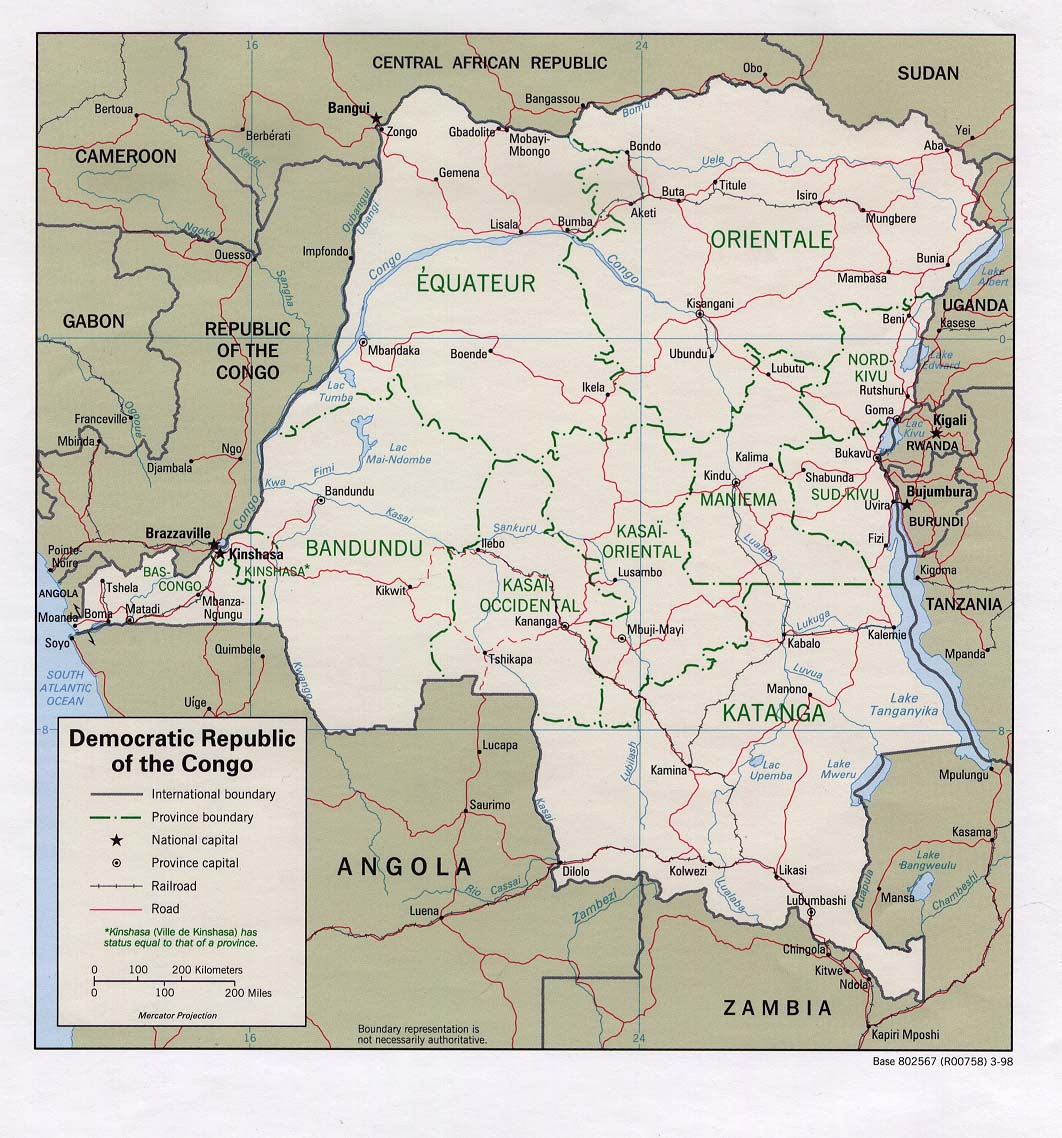 . - Mod.LL]
[Of note, this is the same general area where there was a major
outbreak of pneumonic and bubonic plague in 2005 (see prior
ProMED-mail postings listed below. - Mod.MPP]
[see also:
2005
----
Undiagnosed deaths - Congo DR (Maniema) (08): pneumonic plague susp
20050905.2625
Undiagnosed deaths - Congo DR (Maniema): hem fever susp, RFI 20050805.2274
Plague, pneumonic - Congo DR (07): (North East) 20050315.0754
Plague, pneumonic - Congo DR (Ituri) 20050218.0537
2004
----
Plague, fatal - China (Qinghai) 20041101.2948
Plague - Congo DR (Ituri): susp. 20040730.2083
Plague, fatal - Ecuador (Chimborazo) (02) 20040513.1288
Plague, fatal - Ecuador: RFI 20040510.1264
Plague - Uganda (Arua, Nebbi) 20040112.0128
2003
Archive Number 20060614.1650
Published Date 14-JUN-2006
Subject PRO/AH/EDR> Plague, pneumonic - Congo DR (Ituri)
PLAGUE, PNEUMONIC - CONGO DR (ITURI)
***************************************
A ProMED-mail post
<http://www.promedmail.org>
ProMED-mail is a program of the
International Society for Infectious Diseases
<http://www.isid.org>
Date: Wed 14 Jun 2006
From: Marianne Hopp <mjhopp12@yahoo.com>
Source: WHO Outbreak Reports [edited]
<http://www.who.int/csr/don/2006_06_14/en/index.html>
As of 13 Jun 2006, WHO has received reports of 100 deaths of
suspected pneumonic plague, including 19 deaths in Ituri district,
Oriental province. Suspected cases of bubonic plague have also been
reported, but the total number is not known at this time. Preliminary
results from rapid diagnostic tests in the area confirm pneumonic
plague. Additional laboratory analysis, including tests by culture,
is ongoing on 18 samples.
Ituri is known to be the most active focus of human plague worldwide,
reporting around 1000 cases a year. The 1st cases in this outbreak
occurred in a rural area, in the Zone de Sante of Linga, in mid-May 2006.
A team from Medecins sans Frontieres (Switzerland), WHO and Ministry
of Health has been in the area to assess the situation and provide
support to the local health authorities. Isolation wards have been
established to treat patients; close contacts are being traced and
receiving chemoprophylaxis. However, control measures have been
difficult to implement because of security concerns in the area.
For more information, see the fact sheet on plague at
<http://www.who.int/mediacentre/factsheets/fs267/en/>.
--
ProMED-mail
<promed@promedmail.org>
[Primary pneumonic plague (one percent of natural plague
presentations) arises as a result of inhalation of plague bacilli in
infectious aerosols, such as would be produced when there are
secondary pneumonic complications in bubonic/septicemic plague.
Primary plague pneumonia has a short incubation period of 1-3 days,
after which there is sudden onset of flu-like symptoms including
fever, chills, headache, generalized body pains, weakness and chest
discomfort. A cough develops with sputum production, which may be
bloody, and increasing chest pain and difficulty in breathing. As the
disease progresses, hypoxia (low oxygen concentration in the blood)
and hemoptysis (coughing up blood) are prominent. The disease is
invariably fatal unless antimicrobial therapy commences within 24
hours of exposure.
Patients with primary pneumonic plague generate large quantities of
infectious aerosols that pose a significant risk to close contacts.
CDC guidelines identify contacts within 2 meters as being at greatest
risk and do not consider the organism likely to be carried through
air ducts or vents. Persons who have been in contact with pneumonic
plague patients or handling potentially infectious body fluids or
tissues without appropriate protection should receive preventive
antimicrobial therapy. The preferred antimicrobial agents for
prophylaxis are tetracyclines, quinolones, or chloramphenicol.
A map of Congo DR showing Oriental province, where Ituri is located,
can be found at:
[Of note, this is the same general area where there was a major
outbreak of pneumonic and bubonic plague in 2005 (see prior
ProMED-mail postings listed below. - Mod.MPP]
[see also:
2005
----
Undiagnosed deaths - Congo DR (Maniema) (08): pneumonic plague susp
20050905.2625
Undiagnosed deaths - Congo DR (Maniema): hem fever susp, RFI 20050805.2274
Plague, pneumonic - Congo DR (07): (North East) 20050315.0754
Plague, pneumonic - Congo DR (Ituri) 20050218.0537
2004
----
Plague, fatal - China (Qinghai) 20041101.2948
Plague - Congo DR (Ituri): susp. 20040730.2083
Plague, fatal - Ecuador (Chimborazo) (02) 20040513.1288
Plague, fatal - Ecuador: RFI 20040510.1264
Plague - Uganda (Arua, Nebbi) 20040112.0128
2003

