
Laidback Al
Well-known member
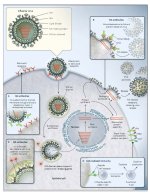
Structure and Replication Cycle of Influenza A Virus and Well-Characterized Adaptive Immune Responses.
<o > </o>
Eight gene segments code for 11 proteins, including <o></o>
hemagglutinin (HA) and neuraminidase (NA), which <o></o>
account for most of the known antigenic determinants. <o></o>
The portion of the matrix 2 (M2) protein outside the <o></o>
viral envelope is also antigenic. Adaptive immune re-<o></o>
sponses are shown in Panels A through D. In Panel A, <o></o>
the influenza HA protein mediates attachment of the <o></o>
virus to its host cell receptor. Antibodies directed <o></o>
against the HA protein block attachment of the virus to <o></o>
the host cell receptor or block fusion of the virus and <o></o>
host membrane. Antibodies generated against HA are <o></o>
correlated with vaccine protection against infection. In <o></o>
Panel B, antibodies generated against the NA protein <o></o>
do not prevent infection but limit the release of virus <o></o>
from infected cells. Antibodies directed against NA <o></o>
have been correlated with a reduction in disease sever-<o></o>
ity. In Panel C, antibodies generated against the highly <o></o>
conserved external domain of the M2 protein epitope <o></o>
interfere with virus assembly or constrain proton trans-<o></o>
port and are highly cross-reactive across virus sub-<o></o>
types. In Panel D, CD8+ T-cell responses to conserved <o></o>
inf luenza virus components have been correlated with <o></o>
enhanced clearance of virally infected cells; however, <o></o>
the exact degree to which they contribute to a reduc-<o></o>
tion in illness remains uncertain. NP denotes nucleo-<o></o>
protein, PA polymerase acidic protein, and PB2 poly-<o></o>
merase basic protein 2. Adapted from Kaiser <o></o>
6 and Subbarao et al.7
from: http://www.nejm.org/doi/pdf/10.1056/NEJMra1002842
Influenza Vaccines for the Future by Linda C. Lambert, Ph.D., and Anthony S. Fauci, M.D.
<o
> </o>Eight gene segments code for 11 proteins, including <o
></o>hemagglutinin (HA) and neuraminidase (NA), which <o
></o>account for most of the known antigenic determinants. <o
></o>The portion of the matrix 2 (M2) protein outside the <o
></o>viral envelope is also antigenic. Adaptive immune re-<o
></o>sponses are shown in Panels A through D. In Panel A, <o
></o>the influenza HA protein mediates attachment of the <o
></o>virus to its host cell receptor. Antibodies directed <o
></o>against the HA protein block attachment of the virus to <o
></o>the host cell receptor or block fusion of the virus and <o
></o>host membrane. Antibodies generated against HA are <o
></o>correlated with vaccine protection against infection. In <o
></o>Panel B, antibodies generated against the NA protein <o
></o>do not prevent infection but limit the release of virus <o
></o>from infected cells. Antibodies directed against NA <o
></o>have been correlated with a reduction in disease sever-<o
></o>ity. In Panel C, antibodies generated against the highly <o
></o>conserved external domain of the M2 protein epitope <o
></o>interfere with virus assembly or constrain proton trans-<o
></o>port and are highly cross-reactive across virus sub-<o
></o>types. In Panel D, CD8+ T-cell responses to conserved <o
></o>inf luenza virus components have been correlated with <o
></o>enhanced clearance of virally infected cells; however, <o
></o>the exact degree to which they contribute to a reduc-<o
></o>tion in illness remains uncertain. NP denotes nucleo-<o
></o>protein, PA polymerase acidic protein, and PB2 poly-<o
></o>merase basic protein 2. Adapted from Kaiser <o
></o>6 and Subbarao et al.7
from: http://www.nejm.org/doi/pdf/10.1056/NEJMra1002842
Influenza Vaccines for the Future by Linda C. Lambert, Ph.D., and Anthony S. Fauci, M.D.
