• FluTrackers.com Inc. does not provide medical advice. Information on this web site is collected from various internet resources, and the FluTrackers board of directors makes no warranty to the safety, efficacy, correctness or completeness of the information posted on this site by any author or poster. The information collated here is for instructional and/or discussion purposes only and is NOT intended to diagnose or treat any disease, illness, or other medical condition. Every individual reader or poster should seek advice from their personal physician/healthcare practitioner before considering or using any interventions that are discussed on this website. By continuing to access this website you agree to consult your personal physican before using any interventions posted on this website, and you agree to hold harmless FluTrackers.com Inc., the board of directors, the members, and all authors and posters for any effects from use of any medication, supplement, vitamin or other substance, device, intervention, etc. mentioned in posts on this website, or other internet venues referenced in posts on this website.
  • We are not asking for any donations. Do not donate to any entity who says they are raising funds for us.

Peruvians get sick from apparent meteorite crater

Gert van der Hoek

In Memoriam - Editor, Senior Moderator
Peruvians get sick from apparent meteorite crater

Tue Sep 18, 2007

By Teresa Cespedes

LIMA (Reuters) - Dozens of people living in a Peruvian town near Lake Titicaca reported vomiting and headaches after they went to look at a crater apparently left by a meteorite that crashed down over the weekend, health officials said on Tuesday.

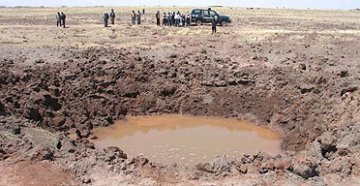
After hearing a loud noise, people went to see what had happened and found a crater 65 feet (20 metres) wide and 22 feet (7 metres) deep on an uninhabited plateau near Carancas in the Puno region.

Experts from Peru's Geophysical Institute are on their way to the area 800 miles (1,300 km) south of Lima to verify whether it was a meteorite.

"We've examined about 100 people who got near to the meteorite crater who have vomiting and headaches because of gasses coming out of there," Jorge Lopez, health director in Puno, told Reuters.

"People are scared," he said.

Lopez said people went to the site after hearing a crash that they thought might be an airplane.

"We ourselves went near the crater and now we've got irritated throats and itching noses," Lopez said.

The site is near the border with Bolivia and experts from San Andres university in La Paz said initial analyses of sand samples from the crater showed that it could be a meteorite, according to newspaper reports.

Luisa Macedo, a geologist with the Mining Geology and Metallurgy Institute in Lima, told Reuters the reaction between the elements in a meteorite and the Earth's surface can generate gases that then dissipate.

Meteorites fell in 2002 and 2004 in the Andean area of Arequipa in southern Peru, Hernando Tavera, head of the Peruvian Geophysical Institute, told Reuters.

http://uk.reuters.com/article/scienceNews/idUKN1843987520070918
 
Re: Peruvians get sick from apparent meteorite crater

A meteorite fell Saturday night in the Peruvian area of Puno, close to the border with Bolivia, forming a crater with a 30 meters diamater, and six meters in depth, the local press reported today.

A luminous object fell a little before midnight of the day before yesterday in the town of Carancas, in the province of Chucuito, about 1.300 kilometers to the south of Lima.
meteoriteperucrater324qghkj.webp
According to sources of the Territorial Direction of the Police, the alarmed inhabitants of the area heard a great noise, similar to that of an airplane falling.

Later, the witnesses saw a luminous object in fire in the sky that hit the ground, producing an explosion that left the earth charred.

The meteorite didn’t hurt anyone, but the authorities are investigating if the remains found in the area are of animals that may have died because of the explosion.

The farmers of the place fear the appearance of some disease, since chips of lead and silver were liberated in the shock of the meteor with the soil, the local broadcasting station “RPP” informed.

The member of the National Academy of Sciences, Modesto Montoya, told to the “Andean” state agency that the fall of meteorites in Peru doesn’t present any danger, unless they hit some structure.

“None of the several meteorites that fall in Peru and make perforations of varied sizes are harmful for people, unless they fall over a house”, Montoya said.

In June, another meteorite fell in the Mascapampa hill, in the province of Arequipa (south), leaving the population alarmed.
[source: EFE, UOL news]

http://forgetomori.com/2007/science/meteorite-makes-30-meter-crater-in-peru/
 
Re: Peruvians get sick from apparent meteorite crater

<small>18 September, 2007 [ 18:30 ]</small>
Scientist Confirms Meteorite in Puno, Peru is a Chondrite


meteor_2.jpg
(LIP-ir) -- Peru's official government news agency reported this afternoon that scientists which went to the town of Carancas in the Region of Puno, Peru, have confirmed that the glowing object which fell from the sky on Saturday afternoon was indeed a meteorite.

Volcanologist for Peru's Geological, Mining and Metallurgical Institute (INGEMMET), Luisa Macedo, confirmed that a chondrite meteorite had caused the 17 meter (55 foot) wide and 5 meter (16 foot) deep crater when it landed on earth.

It was reported that with the help of the Desaguadero Municipality, the water would be drained out of the crater to establish the exact size of the hole that was made by the chondrite meteorite.

Macedo explained that the chondrite was not radioactive and did not have any toxic gases or substances which could be harmful to peoples health. On the other hand, Macedo stated that it had not yet been established if the water supply in the province of Chucuito had been contaminated or not.

Aside from the analysis Macedo is performing, the National University of Altiplano, Peru's Nuclear Energy Institute, the National Institute of Natural Resources, the Ministry of Health and a Bolivian university are all taking part in the analysis of the area.

http://www.livinginperu.com/news-47...onfirms-meteorite-in-puno-peru-is-a-chondrite
 
Re: Peruvians get sick from apparent meteorite crater

<small>18 September, 2007 [ 15:00 ]</small>
Peru: Regional Health Director Reports on Health Near Meteorite Crash Site


(LIP-ir) -- Jorge López Tejada, the Regional Health Director for Puno, Peru has discarded that anyone was seriously affected or has contracted any serious illness because of the object that landed in the town of Carancas on Saturday afternoon.

According to Peru's Andina News Agency, López Tejada stated that there were currently 100 to 150 people being seen for headaches, nausea, dizziness and vomiting at a local medical center.

"There aren't any serious cases, but the substance from the object could affect (the people) in the long term, that's why apart from these tests, it will be necessary to follow up the cases in the next few months," said López Tejada.

The Regional Health Director stated that not only would the people living closest to where the supposed meteorite landed be observed, but that people in the surrounding areas would also be tested for illnesses.

In addition, it was reported that a health brigade arrived with personnel and medication today. The Regional Director is also expecting the arrival of specialists from Lima and Arequipa who are to evaluate the site where it is thought that the meteorite landed.

López Tejada, who is currently in Carancas, has confirmed that there are very strong odors coming from the supposed meteorite crash site. He has stated that despite the fact that masks are being worn, the odor causes throat irritation and nose itchiness.

Andina News Agency reported that the seven police officers which were hospitalized after collecting samples from the thought-to-be meteorite site, are recovering now that they have been seen by doctors.

http://www.livinginperu.com/news-47...r-reports-on-health-near-meteorite-crash-site
 
Re: Peruvians get sick from apparent meteorite crater

And for an alternative opinion ---

from a news feed at www.spaceweather.com

PERUVIAN METEORITE: There is much discussion on the Internet today concerning a reported meteorite impact in Peru which may have gouged a 10- to 30-meter wide crater. Bad-smelling fumes from the crater are said to have sickened dozens and perhaps hundreds of people in a nearby village. Could this be true? (continued below)
There is indeed a hole in the ground in Peru, pictured above, and by all accounts it smells bad, but it is not likely of cosmic origin. In order to blast a 30-meter crater, a meteorite would have to hit the ground with about as much energy as 1 kiloton of TNT--akin to a tactical nuclear weapon. This would leave a clear signal in worldwide seismic and infrasound records, but so far no such signals are being reported by authorities.
In short, we remain unconvinced. Stay tuned for updates.
 
Re: Peruvians get sick from apparent meteorite crater

This looks a lot like a type of volcanic-related feature called a phreatic eruption, which is where rising magma encounters groundwater, flashes to steam, blows a vent hole, then the water floods in and quenches the magma. Carbon dioxide gas and hydrogen sulfide are typical gases associated with this kind of eruption. The groundwater and the obvious volcanic rocks are dead giveaways. That sure doesn't look like a meteorite crater to me.

http://news.nationalgeographic.com/news/2006/04/0421_060421_volcano.html

lots of active volcanoes in southern Peru. Check out the picture, though, it's pretty apt.
 
Re: Peruvians get sick from apparent meteorite crater

http://ap.google.com/article/ALeqM5isWWHSxCh_u0yUNU9Gpk1qfg996A

Experts Confirm Meteorite Crash in Peru

By MONTE HAYES ? 1 hour ago


LIMA, Peru (AP) ? A fiery meteorite crashed into southern Peru over the weekend, experts confirmed on Wednesday. But they were still puzzling over claims that it gave off fumes that sickened 200 people.

Local residents told reporters that a fiery ball fell from the sky and smashed into the desolate Andean plain near the Bolivian border Saturday morning.
Jose Mechare, a scientist with Peru's Geological, Mining and Metallurgical Institute, said a geologist had confirmed that it was a "rocky meteorite," based on the fragments analyzed.

He said water in the meteorite's muddy crater boiled for maybe 10 minutes from the heat and could have given off a vapor that sickened people, and scientists were taking water samples.

"We are not completely certain that there was no contamination," Mechare said.

Jorge Lopez, director of the health department in the state where the meteorite crashed, told The Associated Press on Tuesday that 200 people suffered headaches, nausea and respiratory problems caused by "toxic" fumes emanating from the crater, which is some 65 feet wide and 15 feet deep.

But a team of doctors who reached the isolated site said Wednesday they found no evidence the meteorite had sickened people.

Doctors told an Associated Press Television News cameraman at the site that they had found no sign of radioactive contamination among families living nearby. But they said they had taken samples of blood, urine and hair to analyze.

Peasants living near the crater said they had smelled a sulfurous odor for at least an hour after the meteorite struck and that it had provoked upset stomachs and headaches.

But Jose Isisuka, a geologist for the institute who was studying the crater, said he doubted the reports of a sulfurous smell.

Modesto Montoya, a member of the medical team, was quoted by Lima daily El Comercio as saying fear may have provoked psychosomatic ailments.

"When a meteorite falls, it produces horrid sounds when it makes contact with the atmosphere," he told the paper. "It is as if a giant rock is being sanded. Those sounds could have frightened them."

Justina Limache, 74, told El Comercio that when she heard the thunderous roar from the sky, she abandoned her flock of alpacas and ran to her small home with her 8-year-old granddaughter. She said that after the meteorite struck, small rocks rained down on the roof of her house for several minutes and she feared the house was going to collapse.

Meteor expert Ursula Marvin said that if people were sickened, "it wouldn't be the meteorite itself, but the dust it raises."

A meteorite "wouldn't get much gas out of the earth," said Marvin, who has studied the objects since 1961 at the Smithsonian Astrophysical Observatory in Massachusetts. "It's a very superficial thing."

Three geologists from Peru's Geophysics Institute are expected to report on the incident on Thursday.

Hernando Tavera, a geophysicist at the institute, said similar cases were reported in 2002 and 2004 elsewhere in southern Peru but were never confirmed as meteorites.

Associated Press writer Edison Lopez contributed to this report from Lima, Peru.
 
Re: Peruvians get sick from apparent meteorite crater

Another version of the story...

American spy satellite downes in Peru as US nuclear attack on Iran thwarted

20.09.2007 Source: URL: http://english.pravda.ru/opinion/feedback/97410-american_spy_satellite-0

Russian Military Intelligence Analysts are reporting today that one of the United States most secretive spy satellites, the KH-13, targeting Iran was 'destroyed in its orbit' with its main power generator powered by the radioactive isotope Pu-238 surviving re-entry and crashing in a remote region of the South American Nation of Peru, and where hundreds are reported to be ill from radiation poisoning.

Western media reports are stating that the US spy satellite debris hitting Peru was caused by a meteor, but which, according to these reports, would be 'impossible' as the size of 30-meter crater, if caused by a meteorite, would have hit the ground with about as much energy as 1 kiloton tactical nuclear weapon, and which would have been recorded by the seismic stations around the World.

Most astonishing about these reports, however, are that they state that it was the Americans themselves who destroyed their own spy satellite with the attack upon it being made by the United States Air Forces' 30th Space Wing located at Vandenberg Air Force Base in California. This incident further fuels the intrigue involving the United States War Leaders plans to attack Iran in their attempt to engulf the entire Middle East in Total War, but, against which, according to Russian Military Intelligence Analysts, a 'high ranking and significant' faction of the American Military Establishment is opposed to.

This can be further evidenced by this past few weeks unprecedented announcement by the United States Air Force that 6 nuclear armed cruise missiles were removed, without authorization, from their secure holding facility, located in North Dakota at the Minot Air Force Base, and flown to Barksdale Air Force Base, located in Louisiana, where they were left 'unattended' for 'nearly 10 hours'.

It is interesting to note, too, that Barksdale Air Force Base is where the United States President was 'ordered' to report to on September 11, 2001 by the United States Air Force Strategic Command prior to his being 'transferred' under 'armed escort' to Offutt Air Force Base Strategic Command Center near Omaha, Nebraska, where the first 'truce' between Americas War Leaders and its Military Forces was 'negotiated' by billionaire Warren Buffett as intermediary between the rival power blocs.

Though the rival American power blocs do seem to have maintained their uneasy truce, and which have, to date, prevented further attacks within the United States itself, these latest events, according to these reports, appear to show that this truce is now breaking down over threats and planning by the American War Leaders to attack Iran, and which Russia has warned would be 'catastrophic'.


What remains unknown to us, at this time, is what counter-planning the American War Leaders have in store for furthering their war aims against Iran as the United States Military have 'clearly signaled' that it will not allow nuclear weapons to be used, even to the extent of denying to their War Leaders one of their most prized spy satellites used to guide their nuclear cruise missiles to their intended Iranian targets.

As the American peoples desire for war appears to be exhausted, and with new polls showing their President and Congress' approval ratings at 'record lows', these reports paint a frightening picture of an American War Leadership determined to engulf the entire World in Total War in order to perpetuate their hegemony.

Not since last century's German Nazi and Japanese Empire's has the World seen such naked aggression towards the capture of the Earth's resources, and which caused the deaths of nearly 100 million people, but which the United States and its Western Allies now seem determined to see through to its brutal, and bloody end.
 
Re: Peruvians get sick from apparent meteorite crater

The coordinates are about
16?34'12"S 69?2'59"W

Using Google Earth, this turns out to be right next to a volcanic island in Lake Titicaca, near the Peru-Boliva boundary. The feature is probably of volcanic origin.
 
Re: Peruvians get sick from apparent meteorite crater

Meteorite Likely Caused Crater In Peru

LIMA, Peru, Sep. 20, 2007

(AP) Peruvian astronomers said Thursday that evidence shows a meteorite crashed near Lake Titicaca over the weekend, leaving an elliptical crater and magnetic rock fragments in an impact powerful enough to register on seismic charts.

As other astronomers learned more details, they too said it appears likely that a legitimate meteorite hit Earth on Saturday _ an rare occurence.

The Earth is constantly bombarded with objects from outer space, but most burn up in the atmosphere and never reach the planet's surface. Only one in a thousand rocks that that people claim are meteorites turn out to be real, according to Jay Melosh, an expert on impact craters and professor of planetary science at the University of Arizona.

Melosh was skeptical at first, initially calling it a "non-meteorite" and suggesting that the crater might have possibly come from below as a volcanic eruption. Then scientists learned of more details about the crater, as well as witness descriptions of a thunderous roar and a rain of smaller rocks coming down.

"It begins to sound more likely to me that this object could indeed be a meteorite," Melosh said Thursday.

Such impacts are rare, and astronomists still want to do other tests to confirm the strike.

Other details don't add up, they said _ such as witness accounts of water in the muddy crater boiling for 10 minutes from the heat. Meteorites are actually cold when they hit Earth, astronomists say, since their outer layers burn up and fall away before impact.

Experts also puzzled over claims that 200 local residents were sickened by fumes from the crater. Doctors who examined them found no evidence of illness related to the meteorite, and one suggested a psychosomatic reaction to the sight and sound of the plunging meteor.

More details emerged when astrophysicist Jose Ishitsuka of Peru's Geophysics Institute reached the site about 6 miles from Lake Titicaca. He confirmed that a meteorite caused a crater 42 feet wide and 15 feet deep, the institute's president, Ronald Woodman, told The Associated Press on Thursday.

Ishitsuka recovered a 3-inch magnetic fragment and said it contained iron, a mineral found in all rocks from space. The impact also registered a magnitude-1.5 tremor on the institute's seismic equipment _ that's as much as an explosion of 4.9 tons of dynamite, Woodman said.

Local residents described a fiery ball falling from the sky and smashing into the desolate Andean plain.

Doctors told an Associated Press Television News cameraman at the site that they had found no sign of radioactive contamination among families living nearby. But they said they had taken samples of blood, urine and hair to analyze.

Peasants living near the crater said they had smelled a sulfurous odor for at least an hour after the meteorite struck and that it had provoked upset stomachs and headaches. But Ishitsuka said he doubts reports of a sulfurous smell.

Meteor expert Ursula Marvin said that if people were sickened, "it wouldn't be the meteorite itself, but the dust it raises."

A meteorite "wouldn't get much gas out of the earth," said Marvin, who has studied the objects since 1961 at the Smithsonian Astrophysical Observatory in Massachusetts. "It's a very superficial thing."

Peter Schultz, a meteor crater specialist at Brown University who is eager to visit the Peruvian site, said the latest details suggest this might be an unusual type of meteor strike, and that given the crater's size, the original meteoroid had to have been at least 10 feet in diameter before breaking up.

"With everything I see reported now, it seems to me like we just got hit," Schultz said.

Justina Limache, 74, told the Lima daily El Comercio that when she heard the thunderous roar from the sky, she abandoned her flock of alpacas and ran home with her 8-year-old granddaughter. She said that after the meteorite struck, small rocks rained don on the roof of her house for several minutes and she feared the house was going to collapse.

Modesto Montoya, a member of the medical team, told El Comercio that fear may have provoked psychosomatic ailments.

"When a meteorite falls, it produces horrid sounds when it makes contact with the atmosphere," he said. "It is as if a giant rock is being sanded. Those sounds could have frightened them."

http://www.cbsnews.com/stories/2007/09/20/ap/tech/printable3283795.shtml
 
Back
Top Bottom