http://www.portal.state.pa.us/portal/server.pt?open=514&objID=557490&mode=2
Summary of week 43 flu activity:
* Less than 1% of doctor-visits reported by physicians participating in the Pennsylvania influenza sentinel surveillance system were attributed to influenza-like illnesses (ILI), which is below the state baseline (2.4%).
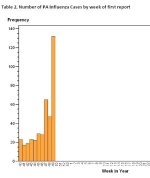
* 22 cases of lab positive influenza were reported to the PA Department of Health during week 43, up from 19 cases reported during week 42. Reported cases included:
?) Cases from 27 of 67 Pennsylvania counties
?) 47 influenza type A and 43 influenza type B
?) Cases in all age groups, with more than half (50%) of reported cases in persons between 25 and 64 years of age.
A majority of reported cases (>80%) tested positive by Rapid Influenza Diagnostic Tests (RIDT?s), which are not very accurate for detecting influenza early in the season (September through October). More reliable tests, such as rt-PCR are recommended for confirming influenza early season. Rt-PCR and other more accurate influenza diagnostic tests are now widely available at most hospital and commercial labs.
* The state lab confirmed influenza in 2% of respiratory samples that were submitted for confirmatory testing during week 42, which is below the state baseline of 10%.
?) A majority of respiratory illnesses at this time are caused by non-flu viruses, including human rhinovirus, human metapheuomovirus and adenovirus.
?) Influenza is only isolated in less than 2% of tested samples at the state lab, and include all sub types; influenza A/H1N1 and A/H3N2 and influenza type B.
?) More samples should be tested to confirm illness and determine what types of viruses are circulating. Healthcare providers are urged to submit samples to the state lab according to guidance issued by PADOH on September 27th 2013, posted at, http://www.portal.state.pa.us/portal/server.pt/document/1368788/2013-pahan-0268-9-27-adv_pdf.
* Two outbreaks of flu-related illnesses in long term care facilities (commonly known as nursing homes) have been reported in Pennsylvania this season.
Table 2: Influenza cases (positive by any test type) Reported in Pennsylvania by age-group, from week 40 (ending, 11/29/13) to week 42 (ending,10/26/13) [n=80]
Age Group in years, Reported Cases
0 to 4: 8
5 to 9: 2
10 to 18: 5
19 to 24: 7
25 to 49: 27
50 to 64: 16
Over 65: 15
Summary of week 43 flu activity:
* Less than 1% of doctor-visits reported by physicians participating in the Pennsylvania influenza sentinel surveillance system were attributed to influenza-like illnesses (ILI), which is below the state baseline (2.4%).
* 22 cases of lab positive influenza were reported to the PA Department of Health during week 43, up from 19 cases reported during week 42. Reported cases included:
?) Cases from 27 of 67 Pennsylvania counties
?) 47 influenza type A and 43 influenza type B
?) Cases in all age groups, with more than half (50%) of reported cases in persons between 25 and 64 years of age.
A majority of reported cases (>80%) tested positive by Rapid Influenza Diagnostic Tests (RIDT?s), which are not very accurate for detecting influenza early in the season (September through October). More reliable tests, such as rt-PCR are recommended for confirming influenza early season. Rt-PCR and other more accurate influenza diagnostic tests are now widely available at most hospital and commercial labs.
* The state lab confirmed influenza in 2% of respiratory samples that were submitted for confirmatory testing during week 42, which is below the state baseline of 10%.
?) A majority of respiratory illnesses at this time are caused by non-flu viruses, including human rhinovirus, human metapheuomovirus and adenovirus.
?) Influenza is only isolated in less than 2% of tested samples at the state lab, and include all sub types; influenza A/H1N1 and A/H3N2 and influenza type B.
?) More samples should be tested to confirm illness and determine what types of viruses are circulating. Healthcare providers are urged to submit samples to the state lab according to guidance issued by PADOH on September 27th 2013, posted at, http://www.portal.state.pa.us/portal/server.pt/document/1368788/2013-pahan-0268-9-27-adv_pdf.
* Two outbreaks of flu-related illnesses in long term care facilities (commonly known as nursing homes) have been reported in Pennsylvania this season.
Table 2: Influenza cases (positive by any test type) Reported in Pennsylvania by age-group, from week 40 (ending, 11/29/13) to week 42 (ending,10/26/13) [n=80]
Age Group in years, Reported Cases
0 to 4: 8
5 to 9: 2
10 to 18: 5
19 to 24: 7
25 to 49: 27
50 to 64: 16
Over 65: 15