It's not in Antarctica yet.
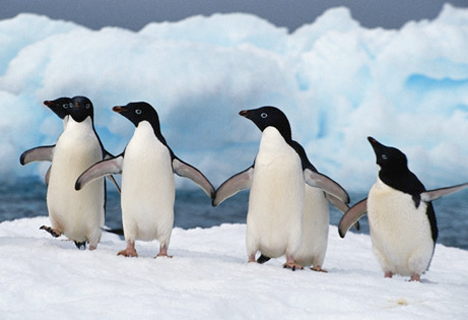
I saw a picture of a penguin sneezing yesterday...


Follow along with the video below to see how to install our site as a web app on your home screen.
Note: This feature may not be available in some browsers.
It's not in Antarctica yet.

Excuuussse me, but we French have a territory in Antartica. If the mission members in Terre Ad?lie catch swine flu from frozen chops, it's still France, so it's not global, so no level 6
Date: Wed 1 Apr 2009
From: Gary Miller <gdmiller@iinet.net.au>
[Re: ProMED-mail Undiagnosed die-off, penguins - Chile 20090331.1225]
----------------------------------------------------------------------
In [the posting] Moderator TG states that "...In the past, penguins
have died of malaria, influenza, and starvation. - Mod.TG"
I would also add to this list, avian cholera [_Pasteurella
multocida_], the largest outbreak being a die-off of 500-700
chinstrap penguins [_Pygoscelis antarctica_] on South Georgia
[island, British Overseas Territory] attributed to avian cholera in late 2004.
--
Gary Miller, PhD
Research Fellow
University of Western Australia
Discipline of Microbiology and Immunology
Crawley, Western Australia
<gdmiller@iinet.net.au>
Scientists are delving into dung dropped by Adelie penguins perhaps 8,000 years ago in the Antarctic to trace the history of influenza. The New Zealand government has committed $236,000 over three years to a research program to track the evolution of the disease.
Penguin dung was selected because the cold of Antarctica meant some fragments of the virus' RNA -- ribonucleic acid, or the active form of DNA -- was likely to be preserved in a meter thick layer of frozen guano under colonies on Ross Island, said Auckland University structural biologist Peter Metcalf. "These penguins are just sitting there in this same little patch of land where they've been doing it for thousands of years," he told news media on Monday. "We know that penguins do get flu but nobody has ever isolated a flu virus from them."

[1] Date: 30 Mar 2009
Source: The Scotsman [edited]
<http://thescotsman.scotsman.com/world/Experts-investigate-mass-penguin-deaths.5119975.jp>
Chilean authorities are investigating the deaths of nearly 1500
penguins. The dead birds were found on Saturday [28 Mar 2009] at
Caleta Queule, more than 1240 miles north of Antarctica. Experts from
the nearby University of Valdivia are working to determine what killed
them.
Navy Lt. Rodrigo Zambrano says experts from the nearby University of
Valdivia are working to determine what killed them. They did not know
immediately where the penguins were from.
University veterinarian Roberto Schlatter tells state television that
experts also are trying to establish the penguins' ages. It is not
unusual for some penguin species to migrate thousands of miles.
Valdivia
Masiva muerte de pingüinos en caleta Queule se debería a cólera aviar
Mass death of penguins in caleta Queule to be avian cholera
A un mes de que se encontraran más de 1.300 animales muertos se dieron a conocer exámenes realizados por la Universidad Austral.
A month before that were more than 1,300 animal carcasses were published reviews by the Universidad Austral.
VALDIVIA, abril 30.- A un mes del alarmante hallazgo de más de mil 300 pingüinos muertos en Caleta Queule, en la Región de los Ríos, investigadores de la Universidad Austral (UACH) dieron a conocer el informe de los exámenes post mortem realizados a 17 ejemplares, el que pretendía determinar la causa de muerte, además de analizar el estado y las condiciones en que se encontraban las aves, Los resultados revelaron que la muerte no fue provocada por intoxicación.
VALDIVIA, April 30 .- A month of the alarming discovery of more than 300 thousand dead penguins at Caleta Queule in Region de los Rios, researchers at the Universidad Austral (UACH) unveiled the report of post mortem examinations carried out 17 copies, which sought to determine the cause of death, also discussed the status and conditions they were birds, The results revealed that death was caused by poisoning.
En siete pingüinos se realizaron exámenes histopatológicos, constatándose lesiones necróticas hepáticas en todas las aves, las que son indicativas de un cuadro bacteriano infeccioso similar al Cólera aviar.
Penguins in seven histopathological examinations were performed, confirming necrotic liver in all birds, which are indicative of a pattern similar to bacterial infectious avian cholera.
Estos antecedentes deben verificarse con otros estudios en desarrollo.
This background should be checked with other studies in development.
El equipo de la UACH a cargo de la investigación estuvo compuesto por los académicos Roberto Schlatter y Germán Pequeño, del Instituto de Zoología de la Facultad de Ciencias, junto a Enrique Paredes de Anatomía Patológica y Jorge Ulloa de Patología Aviar, de la Facultad de Ciencias Veterinarias.
UACH the team in charge of the investigation was composed of academics and Roberto Schlatter Germán Pequeño, Institute of Zoology, Faculty of Science, along with Enrique Paredes of Pathology and Jorge Ulloa Avian Pathology, Faculty of Science Veterinarias.
Según antecedentes del diario local El Navehable, Schlatter indicó que con los estudios se determinó edad, estado nutricional, así como contenido estomacal, obteniéndose muestras de diferentes órganos y tejidos para su posterior análisis histopatológico.
According to local newspaper The background Naveh, Schlatter said that the studies identified age, nutritional status, and stomach contents, obtaining samples from various organs and tissues for subsequent histopathological analysis.
Asimismo, se congelaron muestras de hígado, pulmón y riñón de tres animales para posteriores análisis.
It also froze samples of liver, lung and kidney of three animals for subsequent analysis.
El informe señala que dos ejemplares fueron entregados al SAG-Valdivia para ver posibles enfermedades emergentes, un pingüino fue desechado por avanzado estado de descomposición, mientras que otro adulto se congeló para la nueva Colección de Aves del Instituto de Zoología de esta casa de estudios superiores.
The report states that two copies were delivered to the SAG-Valdivia to see any emerging disease, a penguin was rejected by an advanced state of decomposition, while another adult was frozen for the new Bird Collection of the Institute of Zoology of the house of higher learning .
Fuente: ORBE Source: ORBE
Warden Message: Dominican Republic Epidemiologic Alert Issued; No H1N1 Confirmed
U.S. Embassy Santo Domingo issued the following Warden Message on May 18:
The following Warden Message is being transmitted to give U.S. citizens in the Dominican Republic the latest information on H1N1 influenza A, formerly known as swine flu. Although the Ministry of Health has reported there are still no confirmed cases of H1N1 influenza A in the Dominican Republic, they have issued an epidemiologic alert and mobilized their units in the country’s eastern region after the Chilean Health Secretariat announced that two Chilean women, who had visited Punta Cana last week, have confirmed cases of the virus.
The two Chileans left the Dominican Republic via Las Americas airport on May 15. One of the women was reported to have stayed at a hotel in Punta Cana. Soon after the information was received from the Chilean government, local health authorities in the Punta Cana region began to contact the people the woman had been in touch with during her stay in the Dominican Republic.
https://www.osac.gov/Reports/report.cfm?contentID=102278
Mass mortality of harbor seals: pneumonia associated with influenza A virus
Geraci JR, DJ St Aubin, IK Barker, RG Webster, VS Hinshaw, WJ Bean, HL Ruhnke, JH Prescott, G Early, AS Baker, S Madoff, and RT Schooley
More than 400 harbor seals, most of them immature, died along the New England coast between December 1979 and October 1980 of acute pneumonia associated with influenza virus, A/Seal/Mass/1/180 (H7N7). The virus has avian characteristics, replicates principally in mammals, and causes mild respiratory disease in experimentally infected seals. Concurrent infection with a previously undescribed mycoplasma or adverse environmental conditions may have triggered the epizootic. The similarities between this epizootic and other seal mortalities in the past suggest that these events may be linked by common biological and environmental factors.
link
ABSTRACT: The aim of this work was to detect serologic evidence of influenza virus infections in South American fur seals (Arctocephalus australis) that inhabit the Uruguayan coast. In 29 of 37 serum samples that were analyzed, we identified antibodies to at least one of the following antigens: H1N1 (A/NewCaledonia/20/99), B/Beijing/184/93-like viruses, B/Hong Kong/330/01, and B/Sichuan/379/99 by means of the hemagglutination inhibition assay (HAI). Results confirmed that influenza A viruses circulate in marine mammals and also showed, for the first time, indirect evidence of influenza B infections in Arctocephalus australis.
Key words: Arctocephalus australis, hemagglutination inhibition assay, influenza virus, South American fur seals, Uruguay.
http://www.jwildlifedis.org/cgi/content/abstract/45/2/519
Influenza B Virus in Seals
A. D. M. E. Osterhaus, 12* G. F. Rimmelzwaan, 1 B. E. E. Martina, 2 T. M. Bestebroer, 1 R. A. M. Fouchier 1
Influenza B virus is a human pathogen whose origin and possible reservoir in nature are not known. An influenza B virus was isolated from a naturally infected harbor seal (Phoca vitulina) and was found to be infectious to seal kidney cells in vitro. Sequence analyses and serology indicated that influenza virus B/Seal/Netherlands/1/99 is closely related to strains that circulated in humans 4 to 5 years earlier. Retrospective analyses of sera collected from 971 seals showed a prevalence of antibodies to influenza B virus in 2% of the animals after 1995 and in none before 1995. This animal reservoir, harboring influenza B viruses that have circulated in the past, may pose a direct threat to humans.
1 National Influenza Center, Department of Virology, Erasmus University, Doctor Molewaterplein 50, 3015 GE Rotterdam, Netherlands.
2 Seal Rehabilitation and Research Center, Hoofdstraat 94a, 9968 AG Pieterburen, Netherlands.
* To whom correspondence should be addressed. E-mail: osterhaus@viro.fgg.eur.nl
Mass mortalities due to disease outbreaks have recently affected major taxa in the oceans. For closely monitored groups like corals and marine mammals, reports of the frequency of epidemics and the number of new diseases have increased recently...
Several criteria have been proposed (4) to distinguish new diseases affecting humans. Criteria applicable to disease of nonhuman hosts include novelty of disease symptoms and rapid increases in disease prevalence and virulence...
New symptoms. Marked by two large-scale epidemics with significant community level impacts, the Caribbean basin has emerged as a disease hot spot...
Host shifts. It appears that most new diseases are not caused by new micro-organisms, but rather by known agents infecting new or previously unrecognized hosts. Evidence for this is persuasive in studies of morbilliviral diseases of marine mammals, which indicate that some severe outbreaks have been caused by introduction from terrestrial or other aquatic mammalian reservoir species. For instance, canine distemper virus (CDV) was thought to be introduced into crab-eating seals in Antarctica by contacts with infected sled dogs used during an antarctic expedition (20). Similarly, CDV isolated from Lake Baikal seals (Phoca sibirica) was genetically identical to CDV present in domestic dogs in Siberia (21) suggesting that the seal die-off was caused by direct or indirect contacts with domestic dogs. A closely related morbillivirus--phocine distemper virus (PDV)--that previously had not been recognized, was identified as the cause of another mass mortality that occurred in the late 1980s among harbor seals (Phoca vitulina) and grey seals (Halichoris gryphus) inhabiting the coastal waters of northwestern Europe (22). Soon after, infections with two other newly recognized morbilliviruses, dolphin morbillivirus (DMV) and porpoise morbillivirus (PMV), were shown to be the cause of mass mortalities and disease outbreaks among dolphins, porpoises, and other cetacean species all over the world (23). PDV was thought to be transmitted to the previously unexposed seals of northwestern Europe by infected harp seals, which migrated toward Europe in response to food shortages due to overfishing around Greenland in the late 1980s (24). Serological studies have shown also that morbilliviruses like DMV and PMV are ubiquitous among cetaceans and are probably transmitted periodically between species (25). A recent survey conducted among terrestrial and aquatic carnivores of Alaska showed that both CDV and PDV are endemic in these populations (26). Recently, DMV- and PMV-like viruses were found in the highly endangered Mediterranean monk seals, which had died either during a mass mortality off the coast of Mauritania or as individually dispersed animals found in Greek waters (27) (Fig. 2). In addition, influenza viruses that had spilled over from aquatic or migratory avian reservoirs have caused mortality among seals and whales (28).
forget the penguins etc. forget flu-B forget Sibirian ice
How this particular new mixture arose is still a mystery, the researcher said.
"Several scenarios exist, including reassortment in Asia or the Americas, for the events that have lead to the genesis of the novel A(H1N1) virus," they wrote.
It is possible another animal acted as the so-called reservoir, which means an animal that can be infected by a pathogen but does not get sick from it.
http://www.reuters.com/article/healthNews/idUSTRE54L4KH20090522
Lethal red tide threatens south shores of Chile
Region V health authorities have prohibited the harvest, consumption and sale of all shellfish found between Queil?n and Quellon in the Ays?n region. The decision was made after water samples showed a concentration of ?red tide,? the deadly micro algae Alexandrium catenella, which was ten times the level tolerated by the human system.

Chile?s Navy on March 26 confiscated 12.5 tons of contaminated shell fish from three different boats.
The red tide toxins were first detected in Ays?n and killed two people in 15 days. The paralyzing algae bloom has spread to the Quellon region of Island Chilo?, a phenomenon that H?ctor Morales, vice president of the Provincial Council of Fishermen in Chilo?, hoped would not occur, especially in light of the world economic crisis and the troubled salmon industry.
Six patients poisoned by the red tide were admitted to the hospital in Castro, Chilo?, last week and four of those are in critical condition. Five of the intoxicated patients are workers for a company which collects the nets used at cultivation centres of shellfish in the Region XI.
The workers consumed shellfish which contained more than 8,000 micrograms of the toxicant, when the maximum that can be safely consumed is 80 micrograms for every 100 grams of meat. (Santiago Times)

 But, wow, OK, maybe it wasn't soooo much of a stretch after all.