• FluTrackers.com Inc. does not provide medical advice. Information on this web site is collected from various internet resources, and the FluTrackers board of directors makes no warranty to the safety, efficacy, correctness or completeness of the information posted on this site by any author or poster. The information collated here is for instructional and/or discussion purposes only and is NOT intended to diagnose or treat any disease, illness, or other medical condition. Every individual reader or poster should seek advice from their personal physician/healthcare practitioner before considering or using any interventions that are discussed on this website. By continuing to access this website you agree to consult your personal physican before using any interventions posted on this website, and you agree to hold harmless FluTrackers.com Inc., the board of directors, the members, and all authors and posters for any effects from use of any medication, supplement, vitamin or other substance, device, intervention, etc. mentioned in posts on this website, or other internet venues referenced in posts on this website.
  • We are not asking for any donations. Do not donate to any entity who says they are raising funds for us.

Pediatrics: Influenza-Associated Pediatric Deaths in the United States, 2004?2012

tetano

Editor, Senior Moderator
Influenza-Associated Pediatric Deaths in the United States, 2004–2012

Karen K. Wong, MD, MPHa,
Seema Jain, MDb,
Lenee Blanton, MPHb,
Rosaline Dhara, MPHb,
Lynnette Brammer, MPHb,
Alicia M. Fry, MD, MPHb, and
Lyn Finelli, DrPHb

aEpidemic Intelligence Service assigned to Influenza Division, and
bInfluenza Division, Centers for Disease Control and Prevention, Atlanta, Georgia

Abstract

BACKGROUND: Influenza-associated deaths in children occur annually. We describe the epidemiology of influenza-associated pediatric deaths from the 2004–2005 through the 2011–2012 influenza seasons.

METHODS: Deaths in children <18 years of age with laboratory-confirmed influenza virus infection were reported to the Centers for Disease Control and Prevention by using a standard case report form to collect data on demographic characteristics, medical conditions, clinical course, and laboratory results. Characteristics of children with no high-risk medical conditions were compared with those of children with high-risk medical conditions.

RESULTS: From October 2004 through September 2012, 830 pediatric influenza–associated deaths were reported. The median age was 7 years (interquartile range: 1–12 years). Thirty-five percent of children died before hospital admission. Of 794 children with a known medical history, 43% had no high-risk medical conditions, 33% had neurologic disorders, and 12% had genetic or chromosomal disorders. Children without high-risk medical conditions were more likely to die before hospital admission (relative risk: 1.9; 95% confidence interval: 1.6–2.4) and within 3 days of symptom onset (relative risk: 1.6; 95% confidence interval: 1.3–2.0) than those with high-risk medical conditions.

CONCLUSIONS: Influenza can be fatal in children with and without high-risk medical conditions. These findings highlight the importance of recommendations that all children should receive annual influenza vaccination to prevent influenza, and children who are hospitalized, who have severe illness, or who are at high risk of complications (age <2 years or with medical conditions) should receive antiviral treatment as early as possible.


http://pediatrics.aappublications.org/content/early/2013/10/23/peds.2013-1493
 
Re: Pediatrics: Influenza-Associated Pediatric Deaths in the United States, 2004?2012

Pediatrics: Influenza-Associated Pediatric Deaths


image%25255B4%25255D.png

Credit CDC FluView

# 7908

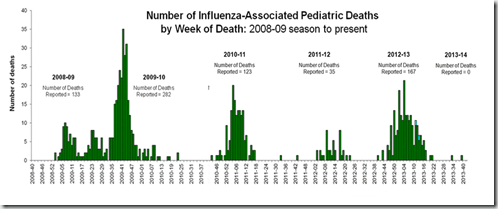
Since reporting became mandatory in 2004, yearly pediatric influenza deaths have ranged from a low of 35 during the 2011-2012 flu season to a high of 282 during the 2009?2010 pandemic. The number of flu-related pediatric deaths displayed in the chart above is likely under stated since only those patients who are tested for influenza, test positive, and then are subsequently reported to the CDC are counted.

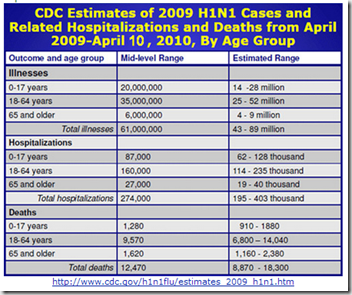
In the aftermath of the H1N1 pandemic of 2009, the CDC estimated that the likely number of pediatric deaths in the United States ranged from 910 to 1880, or anywhere from 3 to 6 times higher than reported.

Regardless of the true number, influenza exacts a tragic toll each year among children in the United States (and around the world).

Today, scientists from the Influenza Division and Epidemic Intelligence Service of the Centers for Disease Control and Prevention (CDC) have published a review of pediatric deaths related to influenza infection over the past 8 years in the Journal Pediatrics.

Influenza-Associated Pediatric Deaths in the United States, 2004?2012
Karen K. Wong, MD, MPH, Seema Jain, MD, Lenee Blanton, MPH, Rosaline Dhara, MPH, Lynnette Brammer, MPH, Alicia M. Fry, MD, MPH, and Lyn Finelli, DrPH
ABSTRACT (Excerpts)
RESULTS: From October 2004 through September 2012, 830 pediatric influenza?associated deaths were reported. The median age was 7 years (interquartile range: 1?12 years). Thirty-five percent of children died before hospital admission. Of 794 children with a known medical history, 43% had no high-risk medical conditions, 33% had neurologic disorders, and 12% had genetic or chromosomal disorders. Children without high-risk medical conditions were more likely to die before hospital admission (relative risk: 1.9; 95% confidence interval: 1.6?2.4) and within 3 days of symptom onset (relative risk: 1.6; 95% confidence interval: 1.3?2.0) than those with high-risk medical conditions.
CONCLUSIONS: Influenza can be fatal in children with and without high-risk medical conditions. These findings highlight the importance of recommendations that all children should receive annual influenza vaccination to prevent influenza, and children who are hospitalized, who have severe illness, or who are at high risk of complications (age <2 years or with medical conditions) should receive antiviral treatment as early as possible.
(Continue . . . )

We?ve looked at other studies on influenza in pediatric patients in recent years, including:

BMJ: Risk Factors For Children With Pandemic Flu which identified some predictors of severe H1N1 infection and potentially fatal outcomes in children:

  • History of chronic lung disease
  • History of cerebral palsy/developmental delay
  • Signs of chest retractions (difficulty breathing)
  • Signs of dehydration
  • Requires oxygen to keep blood levels normal
  • Heart rate that exceeds normal range (tachycardia) relative to age

A report from last spring from the CDC: About 90% Of Pediatric Flu Fatalities Were Unvaccinated in the 2012-2013 flu season (to that date).

And yet another study in the Journal Pediatrics from August of 2012 (see Study: Kids, Underlying Conditions, And The 2009 Pandemic Flu) that found a high number of fatalities among kids with underlying neurologic conditions.

And lastly, in 2011 in MMWR: Influenza-Associated Pediatric Deaths 2010-2011 we looked at the first non-pandemic flu season after the end of the 2009 pandemic. As with today?s study, they found just under half (49%) of these pediatric deaths occurred in children who had no ACIP defined high risk medical conditions. These children also saw a shorter interval between illness onset and death (4 days versus 7 days), and were more likely to die at home or in the emergency department.

While the flu vaccine admittedly delivers lower protection ? particularly among the elderly ? than we?d like, among children its effectiveness appears higher. CIDRAP?s 2011 meta-analysis (see CIDRAP: A Comprehensive Flu Vaccine Effectiveness Meta-Analysis) found:

TIV showed efficacy in preventing influenza during 8 of 12 flu seasons (67%) with a combined efficacy of 59% among healthy adults (aged 18?65 years).
And among children aged 2-7, the LAIV proved even more protective, showing efficacy in 9 out of 12 flu seasons (75%) with a pooled efficacy of 83%.
Last year, the the CDC has estimated flu vaccine effectiveness in children at 64% (aged 6 months to 17 years old). While lower than hoped for, this is still a moderate level of protection. Which is why the CDC states:

CDC recommends annual flu vaccination as the first and best step in preventing influenza. CDC recommends antiviral drugs as a second line of defense against flu for those people who are seriously ill and those who are at high risk of flu complications, even if they have been vaccinated.
To this I would add rigorous `flu hygiene? ? particularly during the flu season, but applicable year round; frequent handwashing, avoiding touching your face, covering coughs & sneezes, and staying home if sick. For the latest updated information from the CDC about the current flu season, you may wish to visit:

Posted by Michael Coston at <a class="timestamp-link" href="http://afludiary.blogspot.com/2013/10/pediatrics-influenza-associated.html" rel="bookmark" title="permanent link"><abbr class="published" itemprop="datePublished" title="2013-10-28T07:29:00-04:00">7:29 AM</abbr>
 
Back
Top Bottom