• FluTrackers.com Inc. does not provide medical advice. Information on this web site is collected from various internet resources, and the FluTrackers board of directors makes no warranty to the safety, efficacy, correctness or completeness of the information posted on this site by any author or poster. The information collated here is for instructional and/or discussion purposes only and is NOT intended to diagnose or treat any disease, illness, or other medical condition. Every individual reader or poster should seek advice from their personal physician/healthcare practitioner before considering or using any interventions that are discussed on this website. By continuing to access this website you agree to consult your personal physican before using any interventions posted on this website, and you agree to hold harmless FluTrackers.com Inc., the board of directors, the members, and all authors and posters for any effects from use of any medication, supplement, vitamin or other substance, device, intervention, etc. mentioned in posts on this website, or other internet venues referenced in posts on this website.
  • We are not asking for any donations. Do not donate to any entity who says they are raising funds for us.

Paris Olympic and Paralympic Games: Public Health France is mobilizing and strengthening its surveillance

Pathfinder

Editor, Senior Moderator
Translation Google
Paris Olympic and Paralympic Games: Public Health France is mobilizing and strengthening its surveillance

On the occasion of the 2024 Olympic and Paralympic Games, Public Health France will be fully mobilized as part of its missions of health monitoring, surveillance and protection of the health of the population.

Published on June 21, 2024
...

The Paris Olympic and Paralympic Games (JOP) will welcome millions of visitors this summer. This unifying event also raises health issues which are accompanied by increased vigilance, particularly in Île-de-France and in the regions hosting the competitions. Thus, Public Health France is fully mobilized to implement a reinforced health monitoring and epidemiological surveillance system, raise awareness and prevent risks to the health of populations and be able to alert and provide an operational response through mobilization of strategic stocks of health products or the health reserve. From July 8 to September 15, in collaboration with its partners, Public Health France will deploy its usual measures at the national level during the summer season, enriched with information feedback from pre-hospital actors (SAMU, firefighters, first aiders) and international monitoring of infectious risks.

A map of potential health risks

Any gathering of the population can cause an increase in health risks. Public Health France agents, in conjunction with their international counterparts and partners, have identified potential health events that could occur during the Paris 2024 Olympic Games. The agency has therefore produced a risk map based on:
  1. scientific literature documenting health events linked to large gatherings,
  2. the local, national and international epidemiological situation concerning different infectious pathologies,
  3. environmental conditions.
These risks have been prioritized according to their severity and their probability of occurrence during the summer period, taking into account future population flows. Among the main risks identified are:
  1. infectious risks: collective food poisoning, arboviruses, measles, etc.
  2. natural and environmental risks: heatwave, air or water pollution, floods;
  3. trauma, particularly those linked to crowd movements.
Our previous experiences in the surveillance of large gatherings (Rouen Armada, COP21, Euro football 2016, etc.) as well as feedback from the London Olympic Games in 2012 have shown the importance of having reactive surveillance systems, capable of to ensure daily feedback of information.

New surveillance systems mobilized for the JOP2024

Public Health France is developing its monitoring and alert system in collaboration with its partners. New systems will be put in place to complement existing systems and strengthen the capacity to detect any unusual event having an impact on health and limit health risks on French territory:
  • international monitoring of infectious signals ensured with the support of the ECDC ;
  • a monitoring system based on SAMU data which will make it possible to monitor the volume of all-cause calls and the support provided by SAMUs in connection with the progress of the JOP 2024;
  • non-specific surveillance carried out in partnership with the Paris Fire Brigade (BSPP). It will make it possible to collect data on the treatment of victims in Paris and the inner suburbs (departments 92, 93 and 94) for different clinical conditions (trauma, breathing difficulties, vomiting and/or diarrhea, chest pain, alcohol consumption). or illicit substance, general symptoms, drowning, etc.);
  • non-specific surveillance deployed with the main associations of first aiders (predictive emergency systems), around the competition sites and on certain festivities sites in Île-de-France, which will allow, as for the BSPP, monitoring of the management burden of victims for similar clinical pictures.
Mobilization of devices used routinely and seasonal devices

Surveillance is at the heart of Public Health France’s action. Throughout the year, it relies on robust systems used routinely, some of which are capable of ensuring daily feedback of information, such as:
  • The SurSaUD® syndromic surveillance system (SURveillance SANitaire des Emergencies et des Décés), to identify in near real time an unexpected event in data from hospital emergencies, SOS Médecins associations or mortality and assess the impact (or absence impact) of a potential threat to the use of care and the health of the population. A management support tool, it contributes in particular to the reactive implementation of public health actions.
  • The notifiable disease (MDO) surveillance system to comprehensively identify and describe cases of 38 infectious diseases. In the context of JOPs, this involves detecting as early as possible any situation likely to evolve into a cluster or epidemic in order to implement control and prevention measures.
  • The microbiological surveillance systems carried out by the National Reference Centers (CNR) to ensure missions of expertise, advice, contribution to epidemiological surveillance and alert. Twenty CNRs covering the infectious agents selected during risk mapping will contribute to surveillance.
  • Surveillance systems from networks of laboratories (3Labos), doctors (Sentinel Network) and voluntary hospital services (pediatric nephrology and pediatric hospital services), which can generate signals and alerts.
  • The Emergen Consortium as part of the genomic surveillance of SARS-CoV-2 to identify emerging variants in the territory.
  • The SUM'EAU device to detect the presence (or absence) of viruses in wastewater and the evolution of detection trends for the Covid-19 virus in a given territory.
Seasonal monitoring devices are also activated:
  • The heatwave and health alert system (Sacs), managed by Public Health France, whose objective is to anticipate heat waves likely to have a major health impact and to enable the rapid implementation of preventive measures and event management. It is operational each year between June 1 and September 15 and is triggered when at least one department enters orange vigilance.
  • Monitoring of drownings in France, from June 1 to September 30, coordinated by Santé Publique France and the National Observation System for the Safety of Nautical Activities (SNOSAN). It makes it possible to collect and analyze data concerning drownings, followed by deaths or not.
  • Surveillance of arboviruses ( dengue , chikungunya and Zika ) which is based on mandatory declaration with reporting of any biologically documented case. This surveillance is reinforced from May 1 to November 30 throughout France with the aim of allowing rapid intervention by public mosquito control operators.
The results of the JOP health surveillance will be reported from the week of July 15, 2024, via the national and regional weekly bulletins published each week on our site and available in the space dedicated to the JOP2024.


https://www.santepubliquefrance.fr/...rance-se-mobilise-et-renforce-sa-surveillance
 
Translation Google

Paris 2024: How laboratories are preparing for epidemic and biological risks

Published: July 24, 2024 11:04am EDT

Elodie Alessandri-Gradt
MCU-PH in virology, Rouen University Hospital, University of Rouen Normandy

Marie Gueudin
University of Rouen Normandy​​

file-20240716-17-f3bpvf.jpeg

In the virology laboratory at the Institute of Clinical Biology at Rouen University Hospital, an operator is wearing specific personal protective equipment to ensure his safety. @CHU Rouen Normandie , Author provided (no reuse)

During major international gatherings (official ceremonies, sporting events such as the Olympic Games , religious events, etc.), the identification and tracking of emerging viruses with epidemic potential are crucial to prevent the epidemic or even pandemic spread of pathogenic agents.

This is the role specifically assigned by the health authorities to a few laboratories in France. However, the organization of this sentinel role is not left to chance: the training of teams, the recurrence of training and the maintenance of cutting-edge equipment are an integral part of the practices of these laboratories authorized to manage emerging biological risks.

We take you to one of these high-security laboratories to discover the meticulous organization of the teams trained in epidemic biological risk.

A regulatory framework to address epidemic biological risks

Although there are several definitions of epidemic biological risk, international authorities agree that it is a danger to the health of living beings resulting from repeated or increased and unexpected exposure to a source already identified, or unknown if it is then an emerging risk .
...
Consequently, this risk poses a threat to public health since it is likely to generate an increase in demand for care which will then disrupt the current organization.


This risk is generally identified by health authorities, such as regional health agencies (ARS) in France and the World Health Organization (WHO) internationally, following reports sent by healthcare teams or by alerts from epidemiological surveillance networks.

In France, regulations ( article L. 3131-11 of the Public Health Code and decree no. 2024-8 of January 3, 2024 ) establish the organization of the health system to respond to exceptional health situations.

Called "ORSAN" , the government system aims to adapt the organization of care to deal with exceptional large-scale health situations according to the different types of risks (nuclear, chemical, climatic, medical-psychological, etc.) including biological risk.

This planning is implemented nationally and regionally by regional health agencies. It is based on identified centers that are reference health establishments, backed by university hospital centers (CHU).

Their missions are related to the management of this risk . This is why laboratories are identified within each establishment for their technical competence in the diagnosis of high epidemic risk infections.

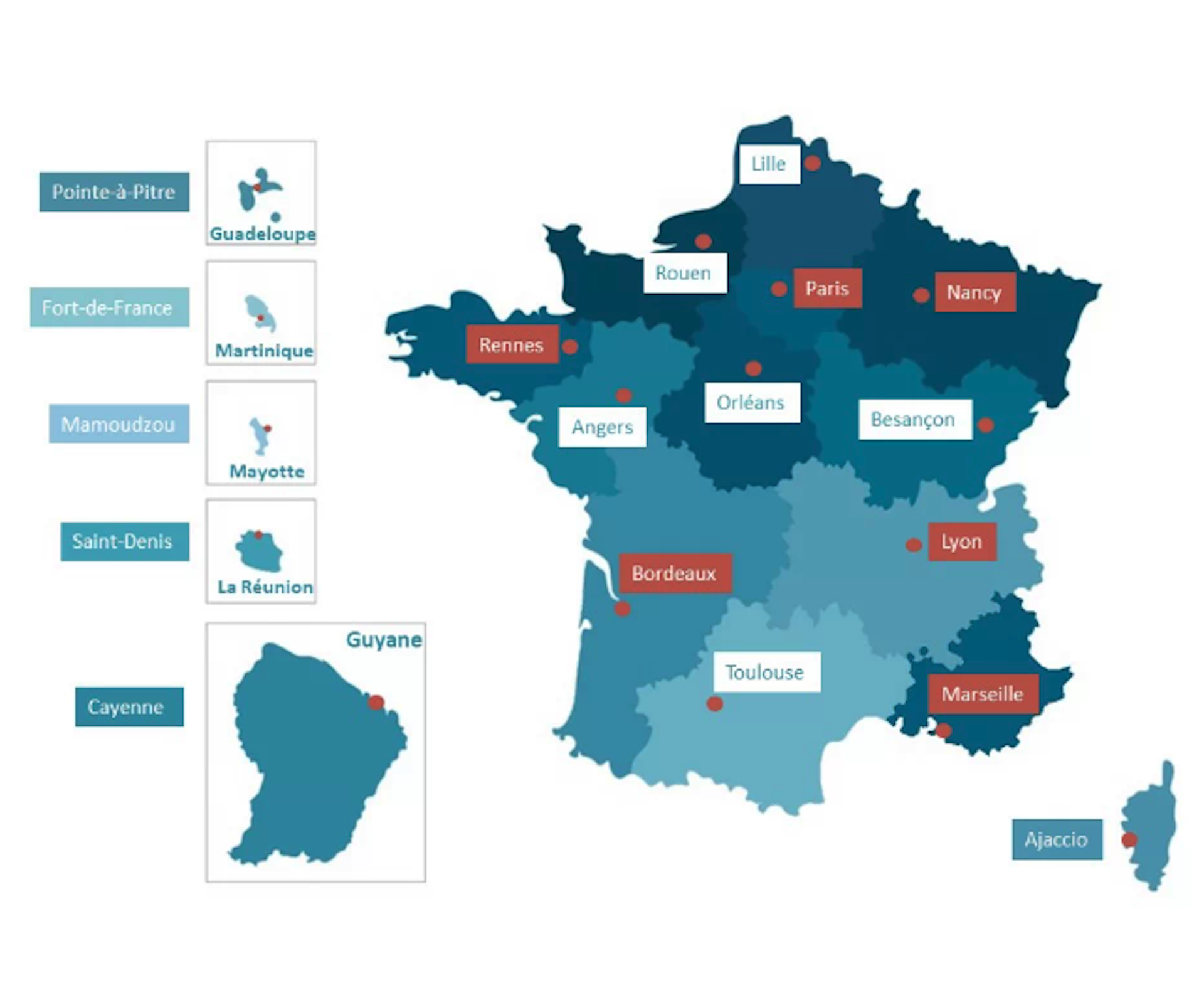
Map of reference health establishments

Sources: Operational coordination of epidemiological and biological risk – COREB – national mission (clickable map).

6 reference establishments have national missions (red boxes), 12 establishments have regional missions in Metropolitan France (6), Corsica (1) and Overseas (5).

Laboratories are also integrated into a global risk management chain within the hospital establishment on which they depend, which goes from the reception of patients to the identification of the risk, the alert and the prevention strategies to be applied.

Specific protective equipment for operators

Laboratories authorized for epidemiological and biological risks or "REB" have a level 3 containment laboratory designed and provided to protect operators when handling microorganisms at risk of level 3 (or 4 by exemption). Note that the different risk levels are defined by decree (decree no. 2008-244 of March 7, 2008 relating to the Labor Code .

Risk level 3 includes:
"biological agents that can cause serious illness in humans and pose a serious hazard to workers. Their spread in the community is possible, but there is usually effective prophylaxis or treatment"

In practice, entry into this laboratory is via airlocks that allow the operator to put on personal protective equipment to ensure their safety. This outfit consists of a full protective suit made of a material that is impermeable to liquids and that offers maximum protection against dangerous pathogens. It covers the entire body, including the head with a hood.

Within the laboratory, a very controlled environment

The laboratory environment is also controlled. The air circulates at a lower pressure than the outside air to confine any microorganisms present in the air within the laboratory enclosure, and filters (Hepa) ensure minimal risk of leakage in the event of a pressure break.

Agents authorized to carry out manipulations in this laboratory therefore have training in the use of personal protective equipment, in the rules for using the laboratory and specific authorization depending on the manipulations.

The handling of infectious agents of risk group 4 ( Ebola virus type ), by exemption, requires increasing the level of security by using a class III biological safety cabinet, maintained at a negative pressure (-300 Pa) in the laboratory itself and ensuring maximum protection of users.
Read more: How firefighters prepare for atypical biological hazards
The samples to be analyzed are sent to the laboratory in “triple packaging”. The sample is placed in a specific plastic box (with absorbent paper for possible liquid spills and a screw lid), itself in a cardboard box meeting packaging standards.

Simulations around victim management and “biotox” exercises

Inter-crisis management consists of maintaining the level of skills and operational capacity to react in the event of an alert. It is based on rigorous and coordinated preparation of the various actors involved. A national mission for Operational Coordination of Epidemic and Biological Risks (COREB mission) provides support for the development of this inter-crisis management (recommendations, technical guides, preparatory meetings, etc.).

Also, each institution conducts “white plan” type exercises that focus on victim management and the collection chain. They involve realistic simulations that help identify weaknesses and improve procedures.

Finally, the "biotox" exercises, piloted at the national level, allow laboratories to put themselves in a real-life situation. They are characterized by timed scenarios, received by each participating laboratory jointly with a package of samples to be identified. They offer a valuable opportunity for real-life situations and debriefing.

Anthrax, hemorrhagic fever… crisis situations in “real” life

Crisis management is based on a comprehensive support chain involving various stakeholders. The role of laboratories in reference health establishments (ESR) is to identify the pathogen in question and carry out standard biological analyses of potentially infected patients.

In practice, 3 distinct situations can lead to the activation of an alert:
  • Suspicion of infection by a pathogen with high epidemic risk, in a person who has traveled to a region endemic for this pathogen and presents compatible clinical signs.
A recent example is that of a case of Lassa fever (caused by the Lassa virus responsible for hemorrhagic fevers) diagnosed in the Paris region. In these cases, the National Reference Center for Hemorrhagic Fever makes the diagnosis, while the laboratory of the reference health establishment carries out all other biological analyses necessary for monitoring the patient.
  • The suspicion of bioterrorism agents (plague, anthrax, viruses such as smallpox, etc.). These risks are taken very seriously by the authorities, as in 2001 in the United States where a series of anthrax attacks caused five deaths and contaminated more than twenty people.
  • The emergence of a new agent of rapid propagation and of unknown danger, as with the emergence of H1N1 in 2009 or MERS-CoV .
In these situations, responsiveness and resource mobilization are crucial. It is therefore imperative to anticipate in real time what may hinder operational progress, such as laboratory closures for maintenance, reagent supply disruptions and automation failures. Learning from real-life situations also allows for continuous improvement of strategies and practices through feedback.

...

https://theconversation.com/paris-2...aux-risques-epidemiques-et-biologiques-234531
 
Translation Google
Paris 2024 Olympic and Paralympic Games. Update as of July 24, 2024.


Published on July 24, 2024
Updated on July 24, 2024


Key points

Syndromic surveillance
  • In consultations with SOS Médecins associations and emergency services, there has been an increase in appeals for all ages linked to summer conditions, at levels usually observed for the season (burns, hyperthermia/heat stroke, dermatological manifestations).
Wastewater monitoring
  • In terms of wastewater, the downward trend in the level of SARS-CoV-2 circulation continued in week 29, with a situation that nevertheless remained heterogeneous across the territory.
In Île-de-France
  • The activities of the Paris Fire Brigade show a decrease in the number of cases taken in compared to the previous week. There was a moderate increase in the number of people taken in for illness during periods of heat.
Summary of SAMU data analyses (for the 42 participating SAMUs)
  • Before the official opening of the Olympic Games on Friday, July 26, 2024, this bulletin offers a retrospective analysis of the SAMU support in connection with the Olympic torch relay, from May 8 to July 21, 2024.
Learn more about the mobilization of Public Health France within the framework of the JOP2024.


DOWNLOAD
PDF 1.33 MB

https://www.santepubliquefrance.fr/...ympiques-paris-2024.-point-au-24-juillet-2024
 
Back
Top