• FluTrackers.com Inc. does not provide medical advice. Information on this web site is collected from various internet resources, and the FluTrackers board of directors makes no warranty to the safety, efficacy, correctness or completeness of the information posted on this site by any author or poster. The information collated here is for instructional and/or discussion purposes only and is NOT intended to diagnose or treat any disease, illness, or other medical condition. Every individual reader or poster should seek advice from their personal physician/healthcare practitioner before considering or using any interventions that are discussed on this website. By continuing to access this website you agree to consult your personal physican before using any interventions posted on this website, and you agree to hold harmless FluTrackers.com Inc., the board of directors, the members, and all authors and posters for any effects from use of any medication, supplement, vitamin or other substance, device, intervention, etc. mentioned in posts on this website, or other internet venues referenced in posts on this website.
  • We are not asking for any donations. Do not donate to any entity who says they are raising funds for us.

Pandemic threat-level market indicators

Re: Pandemic threat-level market indicators

Christian Rivers said:
Binkerbear
So are you :eek: yet ?
C R
Not at all, not yet anyway. It's now just another drift in that direction but, when TS really HTF, I'm thinking the financial markets will know well in advance of any WHO announcement or MSM warnings. I'm thinking that there will be an upward spike for a lot of these stocks and a H-U-G-E down move for the market in general at that time. Luskin's index is great particularly showing how the flu biotechs have recently outperformed all other biotechs. I'll start worrying when this index starts approaching its' old highs of last April. When it suddenly spikes up and the markets spike down, then: :eek:
 
Re: Pandemic threat-level market indicators

Existing home sales lowest since January 2004
WASHINGTON (Reuters) - The pace of existing home sales in the United States fell a sharper-than-expected 4.1 percent in July to their lowest level since January 2004 as the downturn in the U.S. housing sector accelerated, the National Association of Realtors said on Wednesday.

Sales of existing U.S. homes fell for a fourth consecutive month to a seasonally adjusted annual rate of 6.33 million units in July from a downwardly revised 6.60 million unit pace in June. The July pace was 11.2 percent below the July 2005 pace of 7.13 million.

Analysts had expected home resales to slow to a 6.55 million unit pace from June's originally reported rate of 6.62 million units.

The national median existing home price for all housing types was $230,000 in July, up 0.9 percent from the July 2005, in the slowest year-on-year price gain since May 1995.

The supply of homes for sale at the end of July jumped sharply by 3.2 percent to 3.86 million units. This represented a 7.3 months' supply, the highest since April 1993.

Economists were caught off guard by the severity of the drop and said the slowdown in sales activity and the associated wealth effect on consumers could drag down the overall economy.

"This is another step down on the staircase, and we have a number of steps to go. I'd still use the word orderly, but we keep descending," said Stuart Hoffman, chief economist at PNC Financial Services Group in Pittsburgh.

He said the number could influence the Fed's future interest rate decisions because it will be a drag on economic growth.

NAR Chief Economist David Lereah said the increase in the supply of available homes so far this year was the sharpest on record.

"What we are experiencing right now is an inventory and price adjustment," Lereah said. The housing market is in transition, he said, "and there is pain in that transition."

Lereah said the slowdown represented both cooling of overheated high-priced markets and sales declines in some markets that were struggling with a slowing economy, such as Midwest manufacturing cities.

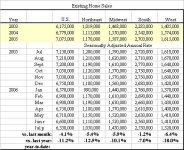
Existing home sales in West dropped 6.4 percent to an annual pace of 1.32 million in July and were down 18.0 percent from a year earlier. The July median price in the West fell 0.3 percent from a year ago to $348,000.

In the Midwest, they fell 5.9 percent to a 1.43 million unit pace, as the median price fell 0.6 to $178,000. Sales in the Northeast fell 5.4 percent to an annual sales pace of 1.05 million units as the median price fell 2.1 percent from July 2005.

Sales in the South slipped just 1.2 percent to a pace of 2.53 million units, while the median price rose 3.2 percent $192,000.

Single-family home sales dropped 5 percent to a seasonally adjusted annual rate of 5.51 million in July from 5.8 million in June. The median existing single-family home price was $231,200, up 1.5 percent from a year earlier.

Existing condominium sales, however, rose 2.8 percent to a seasonally adjusted annual rate of 818,000 units from 796,000 in June. The median condo price was $225,600 in July, down 1 percent from a year earlier.

 
Re: Pandemic threat-level market indicators

Table of Existing Home Sales decline. The West had the greatest decline at -6.4% for last month and -18.0% compared to last year.

Clipboard02.jpg


Source:
http://www.realtor.org/Research.nsf/files/EHSreport.XLS/$FILE/EHSreport.XLS
 
Re: Housing Market

Re: Housing Market

And from the New York Times

August 23, 2006


........ Economic expansion in the second quarter slowed to a 2.5 percent annual rate, down from 5.6 percent in the first quarter. Because housing has been so central to the overall health of the nation?s economy in recent years, forecasters are concerned that a steep decline in home sales may help push the economy into a recession.

But so far, many economists are predicting a slowdown, not a collapse. ?The trend here is one of stabilizing prices after the sharp gains seen for many years,? said Joshua Shapiro, chief United States economist with MFR. ?While certainly a change in trend, so far the official data are not corroborating some of the more alarmist stories being bandied about recently.?

http://www.nytimes.com/2006/08/23/business/23cnd-econ.html?ex=1313985600&en=74834417e7104be0&ei=5089&partner=rssyahoo&emc=rss


GR, have you been bandying about alarmist stories about real estate???:D
</NYT_TEXT>
 
Re: Pandemic threat-level market indicators

Most of the flu-related biotechs were up today and several were up HUGE including NVAX. Wonder if there's some news forthcoming ?
 
Re: Pandemic threat-level market indicators

Not much really of note going through on these. A few days ago SVA went up but that appears to be due to media reports of their vax testing reasonably well.

At the end of August the minor bio-flu went up together on the days you mentioned but no consistent pattern since.

hypothesis: some speculative money went into these stocks on basis the flu stories would mount as we approach the northern hemisphere winter?
 
Re: Pandemic threat-level market indicators

doe22 said:
... hypothesis: some speculative money went into these stocks on basis the flu stories would mount as we approach the northern hemisphere winter?

Welcome doe22. I think that now is the time for speculators to dive into the bio-flu stocks, just before the fall flu season starts.
 
Re: Pandemic threat-level market indicators

Thanks for the welcome.

Today the bf related stocks I watch seem to be split into two camps. The more (arguably) established stocks

GILD, MEDI, BAX were generally a bit down

While the more rag tag stocks

AVII +2.22%
VRA +2.63%
PPHM +1.67%
NVAX +2.51%
SVA +1.11%
VICL -0.21%

healthy but not extravagant rises. Generally the market had a mixed day so its a little strange that all these (arguably) second line stocks did well?

Generally ROG.VX and GSK.L are not good indicators since they have wide portfolio's of drugs and are influenced by many factors.
 
Re: Pandemic threat-level market indicators

Generally ROG.VX and GSK.L are not good indicators since they have wide portfolio's of drugs and are influenced by many factors. Doe22

IMO, MEDI, BAX, and GILD also belong in that camp. Your rag tag flu-biotechs are exactly the ones that I follow plus a few others particularly BCRX.

Eric Bolling from CNBC's 'Fast Money' tonight did pick GILD as his play on bird flu because of Tamiflu. <!-- / message -->
 
Re: Pandemic threat-level market indicators

Binkerbear said:
MEDI, BAX, and GILD also belong in that camp.

They are too large and have too many other profit lines? Maybe true. Their charts since June 2005 display similarities to the more pure bioflu stocks in that they showed signficant run ups last jul-oct ( but to less extent ).

I also watch solvay and crucell in Europe but they do not seem to have such a clear cut pattern.
 
Re: Pandemic threat-level market indicators

BCRX up ~ 10% today on high volume?
Crucell +10.42%

These two could be company specific news coming out soon? We will see in a few days.

AVII +1.46%
VRA -2.78%
PPHM -2.22%
NVAX +3.03%
SVA +1.15%
VICL +6.94%

Market was up a bit and these are mixed but generally up?

My personal theory is these sort of stocks will rise as BF enters the market consciousness as a future threat requiring a direction of money into a new technologies as a magic bullet.
However several of them do not have approved products or mass production capacity yet, as a pandemic becomes more certain it is possible that some will soar as some will bomb as the weaker prospects for the magic bullet are discarded.

My personal watch is airline stocks like BAY.L. When the bioflu rise becomes rocky (some up some down) the airlines drop like a stone and "safe havens" (even gold perhaps?) start to climb then we may have the market signal for the first wave?

(of course the signal could be wrecked by a stampede of hedge funds exiting commodities and driving down gold by accident )
 
Re: Pandemic threat-level market indicators

FluTrackers.com Inc., and its directors, officers, moderators, and members do not endorse any of the opinions expressed here.

This is for entertainment uses only. Trade at your own risk.
 
Re: Pandemic threat-level market indicators

As for me, I'm not trading any of these stocks. I'm watching for up moves in this sector (flu biotech) as a warning to do last minute prepping before the news goes mainsteam.
 
Re: Pandemic threat-level market indicators

Binkerbear, I think we have had this discussion before. I think doe22 is right that as we enter the flu season bird flu consciousness will rise and speculators will drive up prices.

I don't believe that the stock market has or will have insider knowledge about the start of pandemic, though. You are more likely to hear it here first. In fact, global traders may be tracking the cluster threads here at FluTrackers very closely to help them make their own buy/sell decisions. It is hard to believe but maybe this is the first time us common people (investors) have an inside track. :eek:
</IMG>
 
Re: Pandemic threat-level market indicators

BCRX up ~ 10% today on high volume? - doe22

Somebody obviously knew about this yesterday:

7:32AM BioCryst Pharm announces it will present positive data from preclinical testing of its potent neuraminidase inhibitor, peramivir (BCRX) 11.35 : Co announced that it will present positive data from preclinical testing of its potent neuraminidase inhibitor, peramivir, at the 46th Annual Interscience Conference on Antimicrobial Agents and Chemotherapy in San Francisco, California on Saturday, September 30, 2006 at 10:00 a.m. Pacific Time. The data will be presented in a late-breaker poster session. The research to be presented was performed at the University of Texas Medical Branch at Galveston and was funded by the National Institute of Allergy and Infectious Diseases, a part of the U.S. National Institutes of Health. Titled, "Injectable Peramivir Promotes Survival in Mice and Ferrets Infected with Highly Pathogenic Avian Influenza A/Vietnam/1203/04 (H5N1)," the poster describes the studies in the mouse and ferret models of influenza caused by a strain of avian influenza virus (H5N1) that caused fatal human illness. These are the first data to be presented describing the activity of peramivir in an established animal model using this highly pathogenic strain of H5N1.
 
Re: Pandemic threat-level market indicators

Laidback Al said:
Binkerbear, I think we have had this discussion before. I think doe22 is right that as we enter the flu season bird flu consciousness will rise and speculators will drive up prices.

I don't believe that the stock market has or will have insider knowledge about the start of pandemic, though. You are more likely to hear it here first. In fact, global traders may be tracking the cluster threads here at FluTrackers very closely to help them make their own buy/sell decisions. It is hard to believe but maybe this is the first time us common people (investors) have an inside track. :eek:
</IMG>
Good point, Al and I hope that you're right. Still, in a contest for timely info, I can't believe the big-money guys (Soros, Goldman-Sachs, etc.) won't beat us little guys to the punch. :mad:
 
Re: Market movement on BF fears

Re: Market movement on BF fears

Posted by Hawkeye at

http://www.flutrackers.com/forum/showthread.php?t=10959


Sydney BF Scare Fallout
<HR style="COLOR: #cccccc" SIZE=1><!-- / icon and title --><!-- message -->Dollar falls in light trade
THE dollar was lower at noon after trading in a tight range in the morning session, with much of the market focussed on a fall in the New Zealand dollar.
At 1200 AEST the local currency was trading at $US0.7515/20, slightly down from yesterday's close of $US0.7543/48. During the morning session it reached a low of $US0.7505 and a high of $US0.7527.

St George head of foreign exchange Glen Whittingslow said dealing were very subdued with most of the focus on the New Zealand dollar.

The New Zealand dollar fell against the US dollar after comments by NZ finance minister Michael Cullen were interpreted as suggesting interest rates in the country would not rise any further.

Mr Whittingslow also said reports today that a passenger travelling from Vietnam to Sydney had a suspected case of bird flu could have given the local unit "a little nick".

However, health experts stated it was unlikely the diagnosis would be avian influenza.

Mr Whittingslow said the overall outlook for the dollar was positive.

"If you look at last night, the euro, sterling and the kiwi ... all came under pressure and the Aussie has performed relatively well," he said.

"We have to continue to play the ranges, which is frustrating people.

"If you look at where volatility levels, if you take the kiwi out of play, most currencies have got 12-month and longer lows, which is a dangerous recipe when the market gets complacent.
 
Re: Pandemic threat-level market indicators

Florida1 said:
...do not endorse any of the opinions expressed here.
This is for entertainment uses only. Trade at your own risk.

Apologies my post was too close to an endorsement

Most/All these stocks are trash and will in time be trashed. If you touch them expect to lose all/most of your money.

In terms of market moves predicting pandemic I am still enamoured with these points

1. The bioflu stocks may rise on stories that indicate that the threat is returning to the markets awareness.

2. However the stocks will be mainly driven by stock specific stories. eg bcrx However the companies themselves may be engaging in pumping (IMHO) stories to push their own stock price up. These stories may cause a short term push to that stocks price. History indicates may of these rises will not be maintained.

3. The main drivers for these stocks are (arguably) momentum and (possibly irrational) exuberance.

A better scheme for imminent pandemic signal in the markets may be

1. Many of the bioflu stocks crash as time will have run out for their products to make it.
2. Sensitive stocks (airlines are the cliche) fall
3. Liquidity preference becomes extreme

I suppose this is all too obvious to you folks?
 
Back
Top