• FluTrackers.com Inc. does not provide medical advice. Information on this web site is collected from various internet resources, and the FluTrackers board of directors makes no warranty to the safety, efficacy, correctness or completeness of the information posted on this site by any author or poster. The information collated here is for instructional and/or discussion purposes only and is NOT intended to diagnose or treat any disease, illness, or other medical condition. Every individual reader or poster should seek advice from their personal physician/healthcare practitioner before considering or using any interventions that are discussed on this website. By continuing to access this website you agree to consult your personal physican before using any interventions posted on this website, and you agree to hold harmless FluTrackers.com Inc., the board of directors, the members, and all authors and posters for any effects from use of any medication, supplement, vitamin or other substance, device, intervention, etc. mentioned in posts on this website, or other internet venues referenced in posts on this website.
  • We are not asking for any donations. Do not donate to any entity who says they are raising funds for us.

Pakistan: Human H5N1 Cluster December 2007

Re: Pakistan: December 18+, WHO Begins Investigations

Re: Pakistan: December 18+, WHO Begins Investigations

Some of the confusion over the family relationship of cases could be attributed to the translation of kin terms. The English term 'cousin' does not have an equivalent Pukhto term rather, as noted in the quote below, male and female cousins are generically called ror or khor; "brother" and "sister" respectively.
I believe the Bloomberg article specifically said four brothers and two cousins should be five brothers and one cousin (and this doen't include the brother in the US).
 
Re: Pakistan: December 18+, WHO Begins Investigations

Re: Pakistan: December 18+, WHO Begins Investigations

<TABLE id=table4 cellSpacing=0 cellPadding=0 border=0><TBODY><TR><TD class=Heading>Investigation launched into possible transfer of bird flu among humans

</TD></TR><TR><TD>
AP
Last updated: December 19, 2007, 00:32
</TD></TR><TR><TD class=ArticleBody>
Islamabad: A World Health Organisation team began piecing together Pakistan's first human bird flu cases on Tuesday to try and determine whether human-to-human transmission may have occurred.
The health experts visited a hospital in the northwestern city Peshawar that treated many of the eight patients suspected of being infected with the H5N1 bird flu virus.
They were working with doctors and nurses on how to handle suspected cases and improve infection control measures.
"They want to go through the records in the hospital for the last month or two to see if there's been any upsurge in respiratory cases that weren't identified as H5N1 but which could actually be," said Gregory Hartl, a WHO spokesman in Geneva.
They were expected to visit the other affected areas on Wednesday, he said. Pakistan has also requested additional supplies of the antiviral Tamiflu as a precaution.
Four brothers and two cousins fell ill last month in Abbotabad, north of Islamabad, while other people, who slaughtered poultry in the same area and a nearby town, tested positive for the H5N1 bird flu virus this month.
Two of the brothers died, but specimens were collected from only one.
The cases were positive for H5N1 in initial government testing, but WHO will conduct further analysis to confirm the results.
The WHO team will work to determine which patients could have been exposed to the virus by infected birds and were investigating whether human-to-human transmission could have occurred.
Potential sources
One of the brothers who survived said he was hospitalised with flu symptoms after slaughtering chickens suspected of carrying bird flu without wearing protective clothing last month.
The siblings who died were both studying at an agricultural college in the northwestern city of Peshawar, did not accompany him to the farm, but visited him in a hospital, Mohammad Ishtiaq said.

It was unclear if they had other contact with poultry or another potential sources of infection. Hartl said no new cases have been discovered, but increased awareness has led to more people being checked.

http://www.gulfnews.com/world/Pakistan/10175879.html
</TD></TR></TBODY></TABLE>​
 
Re: Pakistan: December 18+, WHO Begins Investigations

Re: Pakistan: December 18+, WHO Begins Investigations

<TABLE><TBODY><TR><TD>
People urged to take steps against H5N1
</TD></TR><TR><TD>
</TD></TR><TR><TD>Staff Reporter
</TD></TR><TR><TD>PESHAWAR: The Khyber Medical University, Directorate of Research and Development, has informed the general public that bird flu virus, in the absence of its arrest, becomes highly infectious and spreads easily from one person to another.

The directorate said efforts were made in their awareness drive to educate the NWFP people regarding the simple precautionary measures to contain bird flu influenza, adding the transmission of the H5N1 was from poultry to human beings and direct contact with infected poultry, their nasal secretions, or surfaces and the objects contaminated by their faces was presently considered the main cause of human infection.

"If this mode of transmission is not contained, there is a risk of the virus mutating to a form that is highly infectious for humans and spreads easily from one person to another which will lead to a worldwide epidemic, adding that products from the areas experiencing outbreaks could be safely consumed provided these items were properly handled during food preparation and thoroughly cooked.

The directorate added that H5N1 was sensitive to heat and thorough cooking of poultry at high temperatures would kill the virus and persons handling the poultry either in the poultry farm or in the kitchen needed to wash their hands thoroughly with soap and hot water.

It further said in the event of any person suffering from flu like symptoms (runny nose, nasal congestion, chest congestion, fever etc), especially poultry farm workers, should immediately contact physicians, saying "If it is avian influenza, early detection and management through treatment with oseltamivir and Zanamivir may reduce the severity of the illness and improve prospects of survival if administered early."


http://thepost.com.pk/NatNews.aspx?dtlid=134881&catid=2
</TD></TR></TBODY></TABLE>
 
Re: Pakistan: December 18+, WHO Begins Investigations

Re: Pakistan: December 18+, WHO Begins Investigations

INTERVIEW-Mixed scenario seen behind Pakistan birdflu spread
18 Dec 2007 18:52:43 GMT
<!-- 18 Dec 2007 18:52:43 GMT ## for search indexer, do not remove -->Source: Reuters

<!-- AN5.0 article title end -->
<SCRIPT language=JavaScript src="/bin/js/article.js"></SCRIPT>
</SPAN><!-- INTERVIEW-Mixed scenario seen behind Pakistan birdflu spread --><!-- Reuters -->By Stephanie Nebehay
GENEVA, Dec 18 (Reuters) -

Eight people have tested positive for the H5N1 bird flu virus in North West Frontier Province since late October, and one of the confirmed cases has died. A brother of the dead man also died, but was never tested, so is not counted among them.

H5N1 is mainly an animal disease, but experts fear it could mutate into a form that could spread easily between people, causing a pandemic which could kill millions of people.

In Thailand, a mother was killed by the virus in 2004 after cradling her dying infected daughter all night. The largest known cluster of human bird flu cases worldwide occurred in May 2006 in Indonesia's North Sumatra province, where as many as seven people in an extended family died.

Three WHO experts, led by Hassan El-Bushra of its regional Cairo office, is in Pakistan helping investigate the outbreak.

"This type of close contact we know can result in human to human transmission sometimes," he said.

The WHO uses a series of six phases of pandemic alert to gauge the level of threat. The world is currently in phase 3, a new influenza virus subtype is causing disease in humans, but is not yet spreading efficiently and sustainably among humans.

A team from the U.S. Naval Medical Research Unit NAMRU-3 laboratory in Cairo was expected in Pakistan on Wednesday to carry out further tests on the samples from the suspect cases. (Editing by Sami Aboudi)

http://www.alertnet.org/thenews/newsdesk/L18866730.htm
<!-- news ## for search indexer, do not remove -->


Since Ke?ji Fukuda is a man of few words and my Mentor here is highlighted his wording.

Keiji Fukuda, coordinator of WHO's global influenza programme, said while unconfirmed, any human to human spread seemed similar to previous outbreaks in Thailand and Indonesia -- affecting close family members caring for sick loved ones.

(snip)

There was no immediate cause for alarm and the United Nations agency was not raising its level of pandemic alert for the time being, he said, adding it was very reassuring that "we are not seeing large increases in the number of cases".

"Right now it doesn't look like pure human to human transmission.

It looks like the veterinarian, who was the index case, and a number of other suspect cases had poultry exposure," Fukuda told Reuters in an interview.

"It is definitely possible that we have a mixed scenario where we have poultry to human infection and possible human to human transmission within a family, which is not yet verified."

But human to human transmission "would not be particularly surprising or unprecedented," he added.

(snip)

The "index" case, who recovered, is a veterinarian who helped with culling operations and it is his two brothers who died after taking care of the ill man, according to Fukuda.

(snip)

"This type of close contact we know can result in human to human transmission sometimes," he said.

"Right now, based on the information we have, the investigation going on and the feedback from the field team, we don't have anything pointing to push the alarm bells or increase the (pandemic alert) phase," he added.

(snip)

"In terms of public health implications, we are looking for human to human transmission where casual contact can lead to infections and allow big outbreaks in communities," Fukuda said.
 
Re: Pakistan: December 18+, WHO Begins Investigations

Re: Pakistan: December 18+, WHO Begins Investigations

... adding the transmission of the H5N1 was from poultry to human beings and direct contact with infected poultry, their nasal secretions, or surfaces and the objects contaminated by their faces was presently considered the main cause of human infection.

Surely they meant feces? A translational error?
 
Re: Pakistan: December 18+, WHO Begins Investigations

Re: Pakistan: December 18+, WHO Begins Investigations

First human bird flu cases in Pakistan

<!-- google_ad_section_end --><!--endclickprintinclude--><!--startclickprintinclude-->
  • <LI class=cnnHiliteHeader _extended="true">Story Highlights<!-- google_ad_section_start --> <LI _extended="true">Eight cases of bird flu among people confirmed in Pakistan by the WHO
    <LI _extended="true">WHO checking whether any human-to-human transmission
    <LI _extended="true">Scientists fear possible pandemic if virus mutates into more transmissable form
    <LI _extended="true">Since 2003, 341 recorded cases among people in 14 nations; 210 were fatal
    <!-- google_ad_section_end --><!--startclickprintexclude-->
  • Next Article in World ?<SCRIPT type=text/javascript _extended="true">if(window.location.pathname.indexOf('/2007/WORLD/asiapcf/12/18/skorea.election/index.html')!=-1){var nxtStryCSIMgr = CSIManager.getInstance().call('/.element/ssi/auto/2.0/sect/WORLD/nextStory0.exclude.html','','cnnNextStoryCSI');} if(window.location.pathname.indexOf('/2007/WORLD/africa/12/18/safrica.anc.ap/index.html')!=-1){var nxtStryCSIMgr = CSIManager.getInstance().call('/.element/ssi/auto/2.0/sect/WORLD/nextStory1.exclude.html','','cnnNextStoryCSI');} if(window.location.pathname.indexOf('/2007/WORLD/meast/12/18/turkey.kurds/index.html')!=-1){var nxtStryCSIMgr = CSIManager.getInstance().call('/.element/ssi/auto/2.0/sect/WORLD/nextStory2.exclude.html','','cnnNextStoryCSI');} if(window.location.pathname.indexOf('/2007/WORLD/asiapcf/12/18/pakistan.sharif.ap/index.html')!=-1){var nxtStryCSIMgr = CSIManager.getInstance().call('/.element/ssi/auto/2.0/sect/WORLD/nextStory3.exclude.html','','cnnNextStoryCSI');} if(window.location.pathname.indexOf('/2007/WORLD/meast/12/18/yemen.drownings/index.html')!=-1){var nxtStryCSIMgr = CSIManager.getInstance().call('/.element/ssi/auto/2.0/sect/WORLD/nextStory4.exclude.html','','cnnNextStoryCSI');} if(window.location.pathname.indexOf('/2007/WORLD/meast/12/18/taliban.ambush/index.html')!=-1){var nxtStryCSIMgr = CSIManager.getInstance().call('/.element/ssi/auto/2.0/sect/WORLD/nextStory5.exclude.html','','cnnNextStoryCSI');} if(window.location.pathname.indexOf('/2007/WORLD/meast/12/18/gaza.airstrikes/index.html')!=-1){var nxtStryCSIMgr = CSIManager.getInstance().call('/.element/ssi/auto/2.0/sect/WORLD/nextStory6.exclude.html','','cnnNextStoryCSI');} if(window.location.pathname.indexOf('/2007/WORLD/meast/12/17/saudi.rape/index.html')!=-1){var nxtStryCSIMgr = CSIManager.getInstance().call('/.element/ssi/auto/2.0/sect/WORLD/nextStory7.exclude.html','','cnnNextStoryCSI');} if(window.location.pathname.indexOf('/2007/WORLD/europe/12/17/palestinian.conf/index.html')!=-1){var nxtStryCSIMgr = CSIManager.getInstance().call('/.element/ssi/auto/2.0/sect/WORLD/nextStory8.exclude.html','','cnnNextStoryCSI');} if(window.location.pathname.indexOf('/2007/WORLD/meast/12/17/iraq.main/index.html')!=-1){var nxtStryCSIMgr = CSIManager.getInstance().call('/.element/ssi/auto/2.0/sect/WORLD/nextStory9.exclude.html','','cnnNextStoryCSI');} </SCRIPT> <!--endclickprintexclude-->
<!--endclickprintinclude-->
1.gif

corner_dg_BL.gif

corner_dg_TL.gif

<!-- google_ad_section_start --><!-- CONTENT --><!-- REAP --><!-- PURGE --><!-- KEEP --><!--startclickprintinclude--><SCRIPT language=JavaScript type=text/javascript _extended="true">var clickExpire = "-1";</SCRIPT><!--startclickprintexclude--><!--endclickprintexclude--><!--startclickprintexclude-->
text_size.gif

txt_minus.gif
txt_minus_dn_.gif

txt_plus.gif
txt_plus_dn.gif


<!--endclickprintexclude--><!--startclickprintexclude--><!--endclickprintexclude-->(CNN) -- Eight cases of bird flu among people have been confirmed in Pakistan, the first such cases in the country, the World Health Organization said Tuesday.
<!--startclickprintexclude--><!-- PURGE: /2007/WORLD/asiapcf/12/18/pakistan.bird.flu/art.bird.flu.ap.jpg --><!-- KEEP --><!----><!--===========IMAGE============-->
art.bird.flu.ap.jpg
<!--===========/IMAGE===========--> <!--===========CAPTION==========-->Customers look at chickens at a street stall in Rawalpindi, Pakistan, on Tuesday.<!--===========/CAPTION=========-->


corner_wire_BL.gif


<!-- /PURGE: /2007/WORLD/asiapcf/12/18/pakistan.bird.flu/art.bird.flu.ap.jpg --><!--endclickprintexclude-->The cases of H5N1 avian influenza were confirmed in Pakistan's remote North-West Frontier province, WHO spokesman Greg Hartl told CNN in a telephone interview.
One patient died, six recovered and one remained under medical supervision in the cities of Abbotabad and Mansehra, he said.
Patients were taken to medical facilities after presenting with the flu-like symptoms typical of avian flu. Health officials believe that another person's death was likely caused by bird flu, but has not been confirmed.
Some of the deaths occurred within a single family, raising concern -- but no proof -- that the disease may have spread through human-to-human contact, said officials, who called for further analysis.
"We would be remiss if we didn't investigate further, " said Hartl from the WHO headquarters in Geneva. "Our concern is that once this virus remains in the animal population, it mutates into a more transmissible form. And the more they (the viruses) stay in the animal population, then we have a panic situation."
<!--startclickprintexclude-->Special Report

? Bird flu: What you need to know
? Interactive: What is influenza?
? Health Library
? Latest news on bird flu
? Special report


<!--endclickprintexclude-->Public health officials worry that, should the virus gain the ability to transmit easily among humans, a pandemic could occur. Given that the disease is often fatal, the impact could be catastrophic, they contend.
Hartl praised Pakistan's Ministry of Health for investigating the outbreak in hospitals in remote areas.
Though this marks Pakistan's first outbreak of bird flu among people, several outbreaks of H5N1 influenza have occurred among poultry in Pakistan, and it spread to the country's wild birds earlier this year, the WHO said.
Some cases among birds have been reported in the capital city of Islamabad, but most have been reported in Pakistan's "poultry belt" in the North-West Frontier province.
In another part of Asia, Indonesia's Ministry of Health announced Tuesday the death of a 47-year-old man from Banten Province, who died December 13.
Of the 115 confirmed cases in Indonesia, 93 have been fatal, according to WHO.
Since 2003, the health agency has tallied 341 cases among people in 14 countries, 210 of them fatal.<!--startclickprintexclude-->

http://edition.cnn.com/2007/WORLD/asiapcf/12/18/pakistan.bird.flu/<!--endclickprintexclude-->

 
Re: Pakistan: December 18+, WHO Begins Investigations

Re: Pakistan: December 18+, WHO Begins Investigations

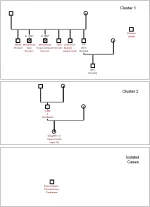
I believe the Bloomberg article specifically said four brothers and two cousins should be five brothers and one cousin (and this doen't include the brother in the US).

New Chart -

Cluster 1
Six brothers - 4 tested postive (with one dead), one dead (not tested but suspected positive), and one tested negative.
One cousin of the six brothers tested positive.

Cluster 2
Culler tested postive.
Daughter/Niece (10F) tested postive.

Isolated Case
Riaz Hussain tested postive.

Red names are postive or suspected human H5N1 cases.
View attachment 2131
 

Attachments

  • Pakistan cluster 20071217b.jpg
    Pakistan cluster 20071217b.jpg
    67.4 KB · Views: 1
Re: Pakistan: Bird Flu claims 2 lives; more suspects

Re: Pakistan: Bird Flu claims 2 lives; more suspects

Commentary

H5N1 Onset Dates in Pakistan Remain Murky

Recombinomics Commentary
December 18, 2007

Ministry of Health spokesman Orya Maqbool Jan Abbasi said the first man to catch avian influenza had been working culling poultry. He recovered but the two men who died were his brothers.

But Abbasi and other health officials said there was no suggestion of human to human transmission.

"Absolutely not," said Health Secretary Khushnood Akhtar Lashari. "The WHO is looking into all the things but whatever we have at the moment there's nothing to suggest that, remotely."

Lashari said the man who had been culling poultry might have inadvertently brought the virus back to his home, where his brothers fell sick.

"He took his equipment along and the suspicion is the virus was in the equipment he was carrying," Lashari said. "These are conjectures. It will be established when they do the sequencing test of the virus."

The above comments raise serious questions regarding the most basic understanding of evidence related to human-to-human transmission of H5N1. The sequencing data does not distinguish between a common source, such as the equipment above, and transmission from the index case, who organized the culling, and infection of four of his brothers, a cousin, and a health care worker.

The most important data sets involve the disease onset dates as well as the contact information, including dates of contact. Human-to-human transmission generates gaps in disease onset dates, which appear to be significant based on reports that the index case developed symptoms on October 25, while the two fatal cases died on November 19 and November 29. Moreover the number of family members involved, along with a positive result for a health care worker, and another familial cluster involving a culler and his daughter or niece, further suggest human-to-human transmission.

Each member in the cluster is expected to be linked to a similar sequence, but the isolation of H5N1 from cluster member is hampered by a reported burial prior to collection of samples, as well as treatment with Tamiflu prior to the collection of samples.

However, the key data points are not the sequences, but the disease onset dates, which should be known almost seven weeks after this disease onset date for the index case.

The comment that there is no evidence to suggest human-to-human transmission is cause for concern, as is the six week delay making the cluster public as well as the continued withholding of disease onset dates.

.
 
Re: Pakistan: December 18+, WHO Begins Investigations

Re: Pakistan: December 18+, WHO Begins Investigations

Commentary

H5N1 Human to Human Tranmission in Pakistan

Recombinomics Commentary
December 18, 2007

[Another version of events with the added information that the 2 deceased brothers and an H5N1-positive man and his H5N1-positive niece all lived in the same town (Abbottabad), and all worked on the same farm (previously located in Mansera). Circumstances consistent with infection from a common source rather than by person-to-person transmission of virus. - Mod.CP]

The above Promed commentary on the recent update of the H5N1 cases in Pakistan, is among the most curious to date. The chief data point that distinguishes a cluster due to a common source verses human-to-human (H2H) transmission is disease onset date. Clusters of clusters do not reduce the likelihood of H2H transmission. Instead they increase the likelihood, especially for an agent like H5N1, which historically is not efficiently passed to humans. The presence of two familial clusters in the same geographical area signals a more efficient transmission of H5N1 to humans, and the clustering within families raises the possibility of H2H, but the key determinate is the time between disease onset dates.

The above commentary, like the earlier comments from Pakistan suggesting that sequence data would support a common source, fails convey the key parameter in a transmission chain, which is a gap in disease onset dates. The gaps are due to the incubation time between an infection and symptoms. For H5N1, which is not efficiently transmitted, there is an additional period required for H5N1 titers to rise and for exposure of the contact.

Most of the H2H transmission to date for H5N1 has involved family members who were infected while caring for a relative, or a health care worker, while caring for a patient. This close contact creates a transmission opportunity because contact is over an extended time period, and H5N1 can be found in several bodily fluids.

Most H2H H5N1 clusters are small and involve only two family members. There is no absolute proof for a small cluster of two, but when there is a 5-10 day gap between disease onset dates, H2H is likely. These likely transmissions are not absolute, because there frequently is a potential common source. However, infections due to common sources usually do not have a large gap between onset dates because most patients show symptoms 2-4 days after exposure.

When there are multiple transmissions involving three or more patients, or when the contact is a health care worker, H2H is more likely. In the past there have been multiple clusters of three or more cases, which were relatives or health care workers, but the chains have not clearly extended beyond H2H2H.

In the Pakistan clusters, disease onset dates have not been released. However, the index case for the larger cluster was likely infected during a cull on October 21-23. Media reports indicated his disease onset date was October 25. Four of his brothers were either H5N1 confirmed or died with H5N1 symptoms, strongly suggesting that he infected them because the two that died were students and did not participate in the cull, and another H5N1 confirmed brother was a teacher.

Moreover, the dates of death have been reported as November 19 and 29. so the gap between the dates of death, as well as the extended time after the disease onset date for the index case support H2H or H2H2H. Moreover, reports of lab confirmation in a health care worker raises the possibility of H2H2H2H, which would be the longest transmission chain reported to date. Verifying this chain however, requires disease onset dates, contact dates, and confirmation of infections, although the absence of a sample from one of the deceased brother should not exclude him from the chain.


The details on the laboratory confirmed cases would be useful. Evidence reported to date strongly supports some H2H transmission, clusters of clusters, and sequence data, not withstanding.


.
 
Re: Pakistan: December 18+, WHO Begins Investigations

Re: Pakistan: December 18+, WHO Begins Investigations

Commentary

Evidence for H5N1 Human to Human Tranmission in Pakistan

Recombinomics Commentary
December 18, 2007

The eight suspect human bird cases in Pakistan are likely a combination of infections from poultry and limited person to person transmission due to close contact, a top World Health Organisation expert said on Tuesday. Keiji Fukuda, coordinator of WHO's global influenza programme, said while unconfirmed, any human to human spread seemed similar to previous outbreaks in Thailand and Indonesia -- affecting close family members caring for sick loved ones.

Eight people have tested positive for the H5N1 bird flu virus in North West Frontier Province since late October, and one of the confirmed cases has died. A brother of the dead man also died, but was never tested, so is not counted among them.

The "index" case, who recovered, is a veterinarian who helped with culling operations and it is his two brothers who died after taking care of the ill man, according to Fukuda.

The above comments confirm the consensus media reports and leave little doubt that the large familial H5N1 cluster in Pakistan involved human to human (H2H) transmission. Similar transmission may also be present in the smaller familial cluster. The clustering of clusters is cause for concern, as is the size of the larger cluster, which involves the index case, four brothers, a cousin, and possibly a health care worker and a brother residing in Nassau county, New York. Although the brother in New York tested negative in the United States, the use of Tamiflu on patients prior to the collection of samples raises concerns of false negatives. Similarly, reports that a health care worker also tested positive, raises concerns that the transmission chain is the longest reported to date for H5N1.

The consensus media reports indicated the veterinarian was the index case for the larger cluster. He organized a cull on October 21-23 and developed symptoms on October 25. Disease onset dates have not been released, but media reports indicate the two brothers died on November 19 and 29. The spread between the disease onset date of the index case and the later date of death for the H5N1 confirmed brother supports one or two rounds of human-to-human transmission. Moreover, the lab confirmation of H5N1 in the health care workers suggests the transmission extended outside of the family members. The disease onset dates for the other two brothers and cousin are unknown, but those dates may support additional chains of H2H transmission.

The long delay between initial the initial onset date of October 25, and more details on onset dates remains a cause for concern. Efficient H2H transmission is the chief concern with regard to an H5N1 pandemic, and these delays, as well as collection of samples after the stat of Tamiflu treatment, limit the analysis of transmission and monitoring of H5N1 spread.

Details on disease onset dates, Tamiflu treatment dates, and sequence data, would be useful.


.
 
Re: Pakistan: December 18+, WHO Begins Investigations

Re: Pakistan: December 18+, WHO Begins Investigations

Holidays cancelled over bird flu threat
ISLAMABAD: Dr Saeed Ahmed, senior director of the Capital Development Authority CDA, and District Health Services (DHS) has cancelled Eid holidays of the staff concerned because of threat of bird flu.

In a statement issued here on Wednesday, Dr Saeed said that directives had been issued to the staff concerned about cancellation of their holydays. The DHS has also launched a special fumigation campaign against the disease in various sectors of the city.

He said 35 poultry shops had been fumigated and an awareness campaign against the disease had been on, focusing on poultry farm workers and shopkeeper. He said poultry shops and kitchens in hotels should be covered up to keep flies away. He said the DHA had issued notices to 58 poultry shopkeepers because of poor hygienic condition and asked them to keep their shops clean. staff report

http://www.dailytimes.com.pk/default.asp?page=2007\12\19\story_19-12-2007_pg11_9
 
Re: Pakistan: December 18+, WHO Begins Investigations

Re: Pakistan: December 18+, WHO Begins Investigations

another story

http://www.gulf-times.com/site/topi...=190830&version=1&template_id=41&parent_id=23

WHO probes Pakistan?s first bird flu death
spacer.gif
<table border="0" cellpadding="0" cellspacing="0" width="430"><tbody><tr><td class="dates" id="hDate" height="27">Published: Wednesday, 19 December, 2007, 01:42 AM Doha Time

</td></tr></tbody></table>ISLAMABAD: Pakistani authorities and World Health Organisation experts were trying to determine yesterday whether bird flu had passed from human to human after the country reported its first human death from the virus.
Pakistani health officials confirmed at the weekend that eight people had tested positive for the H5N1 bird flu virus in North West Frontier Province since late October, and one of the confirmed cases had died.
A brother of the dead man, who had not been tested, also died. It was not yet clear if he was a victim of bird flu.
Ministry of Health spokesman Orya Maqbool Jan Abbasi said the first man to catch avian influenza had been working culling poultry. He recovered but the two men who died were his brothers.
But Abbasi and other health officials said there was no suggestion of human to human transmission.
"Absolutely not," said Health Secretary Khushnood Akhtar Lashari. "The WHO is looking into all the things but whatever we have at the moment there's nothing to suggest that, remotely."

Humans rarely contract H5N1, which is mainly an animal disease. Experts fear the strain could spark a global pandemic and kill millions of it mutates to a form that spreads more easily.
Lashari said the man who had been culling poultry might have inadvertently brought the virus back to his home, where his brothers fell sick.
"He took his equipment along and the suspicion is the virus was in the equipment he was carrying," Lashari said."These are conjectures. It will be established when they do the sequencing test of the virus."

The area of the outbreak, near the towns of Mansehra and Abbottabad, about 60km north of the capital, Islamabad, is in the foothills of the Himalayas.
Partly forested slopes are dotted with villages and small chicken farms.
Abasi said 100 people with symptoms of flu living in the vicinity had been checked but all tested negative.
The last human case was reported on November 23, he said.
Of the seven people confirmed to be sick with avian influenza, six had recovered while one was being treated, a provincial health official said.
A three-member WHO team, joined by officials from the Pakistan National Institute of Health, travelled on Monday to Peshawar, the province's capital where the patients were treated. A second WHO team was due to arrive today
 
Re: Pakistan: December 18+, WHO Begins Investigations

Re: Pakistan: December 18+, WHO Begins Investigations

<TABLE cellSpacing=0 cellPadding=0 width="100%" border=0><TBODY><TR><TD>Nothing on birds or human bf..

Warden Notice 27/2007

12/18/2007</TD></TR><TR><TD class=content vAlign=top>
This warden message is being issued to alert Americans to safety concerns during the upcoming holidays and elections scheduled for January 8th. Historically, the holiday season is a time when the number of terrorist incidents worldwide increases. This year, the confluence of holidays and the elections in Pakistan...
</TD></TR></TBODY></TABLE>
:tiphat: http://peshawar.usconsulate.gov/peshawar/wn07121801.html
 
Re: Pakistan: December 18+, WHO Begins Investigations

Re: Pakistan: December 18+, WHO Begins Investigations

<TABLE cellSpacing=0 cellPadding=0 width="96%" align=center border=0><TBODY><TR bgColor=#f4faff><TD class=small_txt height=20>CDA takes precautionary measures to avert Bird Flu</TD></TR><TR><TD>
shim.gif
</TD></TR><TR><TD bgColor=#efefef>
shim.gif
</TD></TR><TR><TD>
shim.gif
</TD></TR><TR><TD class=small_txt>Wednesday, December 19, 2007
Islamabad

Following the threat of Bird Flu in the country especially in Islamabad, the Directorate of Health Services of the Capital Development Authority has taken strict immediate preventive precautionary measures against spread of the disease.

The Eidul Azha holidays for the concerned staff has been cancelled and the Authority has launched a special spray and fogging campaign in the different areas of the city usually being used for poultry business.

For this purpose, the federal capital has been divided into six zones and poultry shops of all the markets of the Capital City were properly sprayed and fogged with special anti-virus chemical.

A comprehensive awareness campaign has also been launched for the public, especially for the people attached with the poultry business and provided them proper guideline to avoid the spread and to combat the disease efficiently.

The shopkeepers and poultry businessmen have been advised to cover the eatable items properly and must be made their shops complete fly proofs and put the meat inside the shops.

The people concerning poultry, meat and hotels/motels:confused: have been advised for proper vaccination from Vaccination Section (DHS).:tiphat: </TD></TR></TBODY></TABLE>
http://thenews.jang.com.pk/daily_detail.asp?id=87089
 
Re: Pakistan: December 18+, WHO Begins Investigations

Re: Pakistan: December 18+, WHO Begins Investigations

Theresa42's comments about cousin marriage above are very important. English translation of the kinship term "cousin" does not distinguish between cross and parallel cousins. Right now there is no data available to link the family cases patrilaterally or matrilaterally.
Apart from trying to sort out the relationships of all these people (thanks Al and everyone who's been working on that!), the cousin-marriage thing is pretty important, I think, in relation to the some-families-seem-to-be-more-susceptible question.

Chances are very good that spouses are cousins in this area of Pakistan -- so when we see, for instance, only the brothers getting infected as seems to be the case here, one has to wonder why not their wives (if they're married) who would share (at least*) 1/8th of their genes with their husbands if they're 1st cousins, and (at least*) 1/32nd of their genes if they're 2nd cousins? If there are wives and they're not infected, that might debunk the some-families-seem-to-be-more-susceptible theory.

On the other hand, if we should happen to see husbands and wives infected in Pakistan or some other country where cousin-marriage is prevalent (it is actually rather common amongst the Kurds in eastern Turkey), that might support the some-families-seem-to-be- more-susceptible theory.

[*The relationships are actually closer in Pakistan because people there have been practicing cousin-marriage for many generations.]
 
Re: Pakistan: December 18+, WHO Begins Investigations

Re: Pakistan: December 18+, WHO Begins Investigations

The genetics are probably even more closely linked than that Theresa. You have to assume they have inter-married for generations not just one. First cousins marrying first cousins for hundreds if not thousands of years. Which makes me wonder if they have done genetics studies on populations here? There would have to be some interesting diseases in this part of the world. Rather like the Amish in Pennsylvania.
 
Re: Pakistan: December 18+, WHO Begins Investigations

Re: Pakistan: December 18+, WHO Begins Investigations

The genetics are probably even more closely linked than that Theresa. You have to assume they have inter-married for generations not just one. First cousins marrying first cousins for hundreds if not thousands of years. Which makes me wonder if they have done genetics studies on populations here? There would have to be some interesting diseases in this part of the world. Rather like the Amish in Pennsylvania.
Not sure about Pakistan, but I know there are lots of genetic studies done on Saudis who have similarly high levels of cousin marriage -- lots of birth defects and genetic illnesses there.

http://query.nytimes.com/gst/fullpage.html?sec=health&res=980DE0DF1F3DF932A35756C0A9659C8B63
 
Re: Pakistan: December 18+, WHO Begins Investigations

Re: Pakistan: December 18+, WHO Begins Investigations

There may be other issues beside genetics at work here. Of the 310 WHO confirmed cases, it is about equally divided between male (49%) and female (50%). Of the eight case in Pakistan so far, only one is a female. A small sample, but 90% of the human cases in Pakistan are male.
 
Back
Top