

Shiloh
Editor, Senior Moderator
Source: https://www.paho.org/en/documents/e...luenza-ah5n1-americas-region-24-november-2025
Epidemiological Update Avian Influenza A(H5N1) in the Americas Region - 24 November 2025
[TABLE="class: table table-hover table-striped"]
[TR="class: document-row"]
[TD="class: views-field views-field-field-image views-align-left views-field-field-documento-1 views-field-nothing"]
Download[/TD]
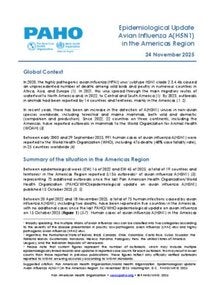
[TD="class: views-field views-field-body"]In 2020, the highly pathogenic avian influenza (HPAI) virus subtype H5N1 clade 2.3.4.4b caused an unprecedented number of deaths among wild birds and poultry in numerous countries in Africa, Asia, and Europe. In 2021, this virus spread through the main migratory routes of waterfowl to North America and, in 2022, to Central and South America.
By 2023, outbreaks in animals had been reported by 14 countries and territories, mainly in the Americas. In recent years, there has been an increase in the detection of A(H5N1) viruses in non-avian species worldwide, including terrestrial and marine mammals, both wild and domestic (companion and production).
Since 2022, 22 countries on three continents, including the Americas, have reported outbreaks in mammals to the World Organization for Animal Health (WOAH). Between early 2003 and 29 September 2025, 991 human cases of avian influenza A(H5N1) were reported to the World Health Organization (WHO), including 476 deaths (48% case fatality rate), in 25 countries worldwide.[/TD]
[/TR]
[/TABLE]
Epidemiological Update Avian Influenza A(H5N1) in the Americas Region - 24 November 2025
[TABLE="class: table table-hover table-striped"]
[TR="class: document-row"]
[TD="class: views-field views-field-field-image views-align-left views-field-field-documento-1 views-field-nothing"]
Download[/TD]
[TD="class: views-field views-field-body"]In 2020, the highly pathogenic avian influenza (HPAI) virus subtype H5N1 clade 2.3.4.4b caused an unprecedented number of deaths among wild birds and poultry in numerous countries in Africa, Asia, and Europe. In 2021, this virus spread through the main migratory routes of waterfowl to North America and, in 2022, to Central and South America.
By 2023, outbreaks in animals had been reported by 14 countries and territories, mainly in the Americas. In recent years, there has been an increase in the detection of A(H5N1) viruses in non-avian species worldwide, including terrestrial and marine mammals, both wild and domestic (companion and production).
Since 2022, 22 countries on three continents, including the Americas, have reported outbreaks in mammals to the World Organization for Animal Health (WOAH). Between early 2003 and 29 September 2025, 991 human cases of avian influenza A(H5N1) were reported to the World Health Organization (WHO), including 476 deaths (48% case fatality rate), in 25 countries worldwide.[/TD]
[/TR]
[/TABLE]