• FluTrackers.com Inc. does not provide medical advice. Information on this web site is collected from various internet resources, and the FluTrackers board of directors makes no warranty to the safety, efficacy, correctness or completeness of the information posted on this site by any author or poster. The information collated here is for instructional and/or discussion purposes only and is NOT intended to diagnose or treat any disease, illness, or other medical condition. Every individual reader or poster should seek advice from their personal physician/healthcare practitioner before considering or using any interventions that are discussed on this website. By continuing to access this website you agree to consult your personal physican before using any interventions posted on this website, and you agree to hold harmless FluTrackers.com Inc., the board of directors, the members, and all authors and posters for any effects from use of any medication, supplement, vitamin or other substance, device, intervention, etc. mentioned in posts on this website, or other internet venues referenced in posts on this website.
  • We are not asking for any donations. Do not donate to any entity who says they are raising funds for us.

Outbreak of viral deer disease that leads to die-offs reported in Southwest Michigan - EHD confirmed in one

Mary Wilson

Well-known member
Published: Sep. 06, 2024, 10:12 a.m.​
By Lucas Smolcic Larson

ST. JOSEPH COUNTY, MI - A common viral disease that can lead to localized die-offs of deer has been confirmed in Southwest Michigan, with early reports indicating 2024 could see a “significant outbreak” in pockets of the deer population, state wildlife officials say.

The Michigan Department of Natural Resources confirmed a case of epizootic hemorrhagic disease, or EHD, in a free-ranging white-tailed deer in St. Joseph County, south of Kalamazoo, ending a three-year hiatus in the county for EHD, the agency announced on Friday, Sept. 6.

The DNR has also received reports of over 120 probable cases of EHD in the past several weeks, primarily from counties in the southwestern Lower Peninsula, and several are awaiting lab confirmation, officials said. ...

https://www.mlive.com/environment/2...-die-offs-reported-in-southwest-michigan.html
 
Epizootic hemorrhagic disease confirmed in white-tailed deer in 11 southwest Michigan counties

​October 03, 2024
Department of Natural Resources

Since early September, the Michigan Department of Natural Resources Wildlife Health Section has confirmed epizootic hemorrhagic disease, or EHD, in the wild deer population across 11 counties in southwest Michigan. The affected counties include Barry, Berrien, Branch, Calhoun, Cass, Hillsdale, Kalamazoo, Kent, Ottawa, St. Joseph and Van Buren.​ ...

https://www.michigan.gov/dnr/about/...tailed-deer-in-11-southwest-michigan-counties
 
Epizootic Hemorrhagic Disease (EHD) in White-Tailed Deer

Department of Natural Resources

Description
Epizootic hemorrhagic disease (EHD) is an acute, infectious, often fatal viral disease of some wild ruminants. This malady, characterized by extensive hemorrhages, has been responsible for significant epizootics in deer in the northern United States and southern Canada. A similar hemorrhagic disease called bluetongue also occurs throughout the U.S. and Canada. The two diseases are antigenically different. ...

Clinical Signs
Clinical signs of EHD and bluetongue are very similar.

White-tailed deer develop signs of illness about 7 days after exposure. A constant characteristic of the disease is its sudden onset. Deer initially lose their appetite and fear of humans, grow progressively weaker, often salivate excessively, develop a rapid pulse and respiration rate, and fever (affected animals frequent bodies of water to lie in to reduce their body temperature) and finally become unconscious. Hemorrhage and lack of oxygen in the blood results in a blue appearance of the oral mucosa, hence the name 'bluetongue'. Eight to 36 hours following the onset of observable signs, deer pass into a shock-like state, become prostrate and die. ...

Treatment and Control
There is no known effective treatment or control of EHD. Theoretically, an oral vaccine could be developed for administration through a supplementary winter-feeding program, but this is presently impossible, impractical and unwarranted.

Significance
Because of its very high mortality rate, EHD can have a significant effect upon the deer population in a given area, reducing numbers drastically. A common observation in outbreaks involving large numbers of deer is that they are single epizootics which do not recur. Die-offs involving small numbers of deer occur almost annually, and the disease appears to be enzootic in these areas.


Photos

edema_ehd.jpg
hemorrhages_ehd.jpg

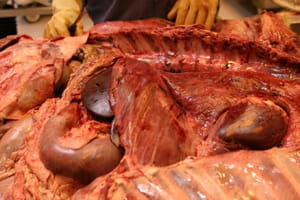
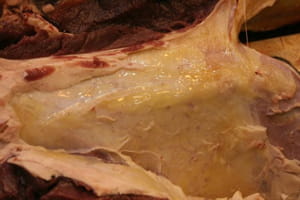
First figure: Edema (yellowish fluid) underneath the skin. Second figure: Hemorrhages on the organs, diaphragm, and musculature.

https://www.michigan.gov/dnr/managing-resources/wildlife/wildlife-disease/wdm/ehd


Back
Top