The number hospitalized however is still small (n=14 in report). Maybe because of case time lag, more youthful case incidence, and protective effects of high vaccination levels? I think more hospitalization cases are needed before drawing any type of statistically firm conclusions.

Install the app
How to install the app on iOS
Follow along with the video below to see how to install our site as a web app on your home screen.
Note: This feature may not be available in some browsers.
-
FluTrackers.com Inc. does not provide medical advice. Information on this web site is collected from various internet resources, and the FluTrackers board of directors makes no warranty to the safety, efficacy, correctness or completeness of the information posted on this site by any author or poster. The information collated here is for instructional and/or discussion purposes only and is NOT intended to diagnose or treat any disease, illness, or other medical condition. Every individual reader or poster should seek advice from their personal physician/healthcare practitioner before considering or using any interventions that are discussed on this website. By continuing to access this website you agree to consult your personal physican before using any interventions posted on this website, and you agree to hold harmless FluTrackers.com Inc., the board of directors, the members, and all authors and posters for any effects from use of any medication, supplement, vitamin or other substance, device, intervention, etc. mentioned in posts on this website, or other internet venues referenced in posts on this website.
-
We are not asking for any donations. Do not donate to any entity who says they are raising funds for us.
You are using an out of date browser. It may not display this or other websites correctly.
You should upgrade or use an alternative browser.
You should upgrade or use an alternative browser.
Omicron - COVID-19 Variant (B.1.1529) a "Variant of Concern" & BA.2 sub-variant, XE
- Thread starter kiwibird
- Start date
Yes, the number of cases is small, I was looking at table 6 that shows the cumulative Omicron cases as 28 (Tested positive prior or within
48 hrs after admission), or 0.8% of Omicron cases vs. 0.7% for other variants.
There are still many confounding factors though - perhaps people seek care more quickly when they are informed they have a novel strain; perhaps the omicron cases don't progress to higher levels of care; perhaps the younger age of the patients comes in to play.
48 hrs after admission), or 0.8% of Omicron cases vs. 0.7% for other variants.
There are still many confounding factors though - perhaps people seek care more quickly when they are informed they have a novel strain; perhaps the omicron cases don't progress to higher levels of care; perhaps the younger age of the patients comes in to play.

Emily
Editor, Senior Moderator
https://twitter.com/tomhcalver/statu...64449773133824

Tom Calver @tomhcalver
South Africa's case fatality rate falls again to 0.5%. The theory that Omicron causes milder symptoms is becoming very hard to ignore...

12:06 PM · Dec 13, 2021·Twitter Web App
Tom Calver @tomhcalver
South Africa's case fatality rate falls again to 0.5%. The theory that Omicron causes milder symptoms is becoming very hard to ignore...
12:06 PM · Dec 13, 2021·Twitter Web App
Emily
Editor, Senior Moderator
Video of interview with Dr Angelique Coetzee at link. Says it is generally mild for everyone, whether vaccinated or not, young or old.
https://twitter.com/statsjamie/statu...93515157819398

Jamie Jenkins
@statsjamie
Can we have Dr Angelique Coetzee on with Boris tonight at 8pm "There's no reason why you can't trust us when we say to you 'it's mild disease!'" Works for the South African Medical Association with details of the Omicron situation in the country
SA Medical Association head
From LBC
12:09 PM · Dec 12, 2021·Twitter for iPad
https://twitter.com/statsjamie/statu...93515157819398
Jamie Jenkins
@statsjamie
Can we have Dr Angelique Coetzee on with Boris tonight at 8pm "There's no reason why you can't trust us when we say to you 'it's mild disease!'" Works for the South African Medical Association with details of the Omicron situation in the country
SA Medical Association head
From LBC
12:09 PM · Dec 12, 2021·Twitter for iPad

sharon sanders
Editor-in-Chief & President
Mia Malan 
3 hours ago, 25 tweets, 8 min readRead on Twitter BREAKING [Thread]: 1. SA’s first real-world data on #Pfizer’s #COVID19 jab’s protection @ #Omicron infection + hospitalisation via @Discovery_SA + @MRCza
Note: This is data from the 1st 3 weeks of the outbreak, so it might change - regard it as preliminary real-world data

2. What data are findings based on?
1. @Discovery_SA = SA’s largest health insurer (3.7 mil members)
2. They used 211,000 positive #COVID19 PCR tests of adults (18+)
3. 41% of 211,000 + tests = received 2 doses of #Pfizer


3. Here is how #Omicron has progressed in SA:
#Omicron = now 90% of #COVID infections in SA


4. How effective is #Pfizer’s jab @ hospitalisation due 2 #Omicron?
1. 2 doses of #Pfizer’s jab makes vaccinated people 70% less likely 2 get hospitalised vs. unvaccinated people
2. This = lower than 93% protection the jab gave in SA’s #Delta wave (93% = @Discovery_SA data)

5. Protection of 2 doses of #Pfizer @ hospital admission due to #Omicron is maintained across all ages (18-79 years), but slightly lower for older age groups:
18-29: 92%
30-39: 75%
40-49: 82%
50-59: 74%
60-69: 67%
70-79: 59%
6. Important to note that the lower protection (down from 93% to 70%) against hospitalisation because of #Omicron could be because older people were vaccinated first in SA, so there has been a longer period for vaccine-derived immunity to wane than with younger age groups
7. 70% protection for vaccinated people @ hospital admission = still a high level of protection. WHO regards a #COVID19 vaccine effective if it provides 50% protection: bit.ly/325K60Y...
8. What about the risk of hospitalisation due to #Omicron infection compared to the variant (D614G) which dominated SA’s 1st #COVID wave?
Adults (18+) infected with #Omicron = 29% less likely to be hospitalised vs. infection with other variants

9. What are confounding factors for #Omicron real-life hospital admission data in SA?
High seroprevalence #SARS-CoV2 antibody levels in SA population (so antibodies due to previous #COVID19 infection) - in Gauteng = as high as 70% + of people
10. Hospital admissions (anecdotal data):
1. Most #Omicron admissions = unvaccinated people (16% of ICU admissions = vaccinated)
2. High % of incidental admissions (people going 2 hospital 4 things other than #COVID + test 4 admission + find out they have #COVID)

11. Out of hospital data (anecdotal):
1. @Discovery_SA is seeing milder illness with #Omicron (early data) with recoveries within 3 days
2. Higher reinfections (so people who've had #COVID19 get infected again) and breakthrough infections (vaccinated people getting infected)

12. #Omicron cases are growing much faster than during the #Delta wave, but hospitalisations slower. For the Omicron wave, SA has reached 60% of cases reached during the #Delta peak but we have reached only 20% of the hospital admissions of the Delta wave.

13. Children and #Omicron:
1. Main diagnoses 4 kids who get hospitalised = bronchiolitis and pneumonia, often with severe gastrointestinal symptoms + dehydration
2. Most kids = not hospitalised = mild symptoms (sore throat, nasal congestion, headache, fever, resolves in 3 days)

14.
1. Kids below 18 infected with #Omicron = 20% higher risk of admission 4 #COVID19 complications vs. 1st wave
2. This aligns with the 3rd #Delta wave (June-Sep 2021) when an increase in pediatric admissions (0-5 yrs) = also seen (so 4th wave risk = similar to 3rd wave risk)
15. To date, kids below 5 = higher admission risk than adults, but this could be driven by incidental admissions. This trend is starting to change: it looks like fewer children and more adults are starting to get admitted (@nicd_sa = similar findings).

16. NB data to point out re children:
1. The risk of kids testing + for #COVID19 because of #Omicron = 51% lower compared to adults
2. @nicd_sa/@MRCza data from Tswhane show most kids = admitted 2 hospital = incidental admissions
17. Vaccinated people = 33% less likely 2 get infected with #Omicron than unvaccinated people (this is a drop from 80% protection during the #Delta wave)
Here's how #Pfizer protection @ infection wanes 4 Omicron:
1. 2-4 wks after 2nd dose: 56%
2. 3-4 mnths after 2nd dose: 25%

18. What about the risk of reinfection?
1. People infected with #Delta = 40% relative risk of reinfection with #Omicron
2. People infected with Beta = 60% relative risk of infection with Omicron

19. More data on the reinfection risk with #Omicron:
@SACEMAdirector et al. in SA found the relative risk of reinfection with #Omicron for people who previously had #COVID and get exposed again = 3 times higher than for reinfection with #Delta/#Beta:
20. Two shots of #Pfizer continues to provide good protection @ hospitalisation, but protection has dropped from 93% with #Delta to 70% with #Omicron.

21. The protection @ hospitalisation that 2 shots of #Pfizer provide @ #Omicron infection for different ages:
- Highest protection = 18-29 yrs
- Lowest protection in 70-79 yrs
(Could be because 70-79 = vaccinated before 18-29, so = been more time for 70-79's immunity 2 wane)

22. This graph shows that #Omicron infection is associated with a 29% lower risk of hospital admission for adults compared to the 1st wave, but children have a 20% higher admission risk (but as mentioned previously, looks like it's starting to change).

23. Although excess deaths were high for the week of 28 Nov, it's still much lower than in previous #COVID19 waves (this correlates with lower #Omicron death rate data in hospitals, but it's early times)

24. How did @Discovery_SA obtain #PCR test data?
1. Results from @LancetLab_ZA [private lab] (45%)
2. Gauteng test results 55%
3. Results from hospital patients 8%

25. Summary:
1. Vaccination continues to provide significant protection @ falling seriously ill with #COVID (although reduced to 70%)
2. High nrs of breakthrough infections in vaccinated people (protection @ infections reduced from 80% to 33%)
3. Reinfection risk = increased

3 hours ago, 25 tweets, 8 min readRead on Twitter
BREAKING [Thread]: 1. SA’s first real-world data on #Pfizer’s #COVID19 jab’s protection @ #Omicron infection + hospitalisation via @Discovery_SA + @MRCzaNote: This is data from the 1st 3 weeks of the outbreak, so it might change - regard it as preliminary real-world data
2. What data are findings based on?
1. @Discovery_SA = SA’s largest health insurer (3.7 mil members)
2. They used 211,000 positive #COVID19 PCR tests of adults (18+)
3. 41% of 211,000 + tests = received 2 doses of #Pfizer
3. Here is how #Omicron has progressed in SA:
#Omicron = now 90% of #COVID infections in SA
4. How effective is #Pfizer’s jab @ hospitalisation due 2 #Omicron?
1. 2 doses of #Pfizer’s jab makes vaccinated people 70% less likely 2 get hospitalised vs. unvaccinated people
2. This = lower than 93% protection the jab gave in SA’s #Delta wave (93% = @Discovery_SA data)
5. Protection of 2 doses of #Pfizer @ hospital admission due to #Omicron is maintained across all ages (18-79 years), but slightly lower for older age groups:
18-29: 92%
30-39: 75%
40-49: 82%
50-59: 74%
60-69: 67%
70-79: 59%
6. Important to note that the lower protection (down from 93% to 70%) against hospitalisation because of #Omicron could be because older people were vaccinated first in SA, so there has been a longer period for vaccine-derived immunity to wane than with younger age groups
7. 70% protection for vaccinated people @ hospital admission = still a high level of protection. WHO regards a #COVID19 vaccine effective if it provides 50% protection: bit.ly/325K60Y...
8. What about the risk of hospitalisation due to #Omicron infection compared to the variant (D614G) which dominated SA’s 1st #COVID wave?
Adults (18+) infected with #Omicron = 29% less likely to be hospitalised vs. infection with other variants
9. What are confounding factors for #Omicron real-life hospital admission data in SA?
High seroprevalence #SARS-CoV2 antibody levels in SA population (so antibodies due to previous #COVID19 infection) - in Gauteng = as high as 70% + of people
10. Hospital admissions (anecdotal data):
1. Most #Omicron admissions = unvaccinated people (16% of ICU admissions = vaccinated)
2. High % of incidental admissions (people going 2 hospital 4 things other than #COVID + test 4 admission + find out they have #COVID)
11. Out of hospital data (anecdotal):
1. @Discovery_SA is seeing milder illness with #Omicron (early data) with recoveries within 3 days
2. Higher reinfections (so people who've had #COVID19 get infected again) and breakthrough infections (vaccinated people getting infected)
12. #Omicron cases are growing much faster than during the #Delta wave, but hospitalisations slower. For the Omicron wave, SA has reached 60% of cases reached during the #Delta peak but we have reached only 20% of the hospital admissions of the Delta wave.
13. Children and #Omicron:
1. Main diagnoses 4 kids who get hospitalised = bronchiolitis and pneumonia, often with severe gastrointestinal symptoms + dehydration
2. Most kids = not hospitalised = mild symptoms (sore throat, nasal congestion, headache, fever, resolves in 3 days)
14.
1. Kids below 18 infected with #Omicron = 20% higher risk of admission 4 #COVID19 complications vs. 1st wave
2. This aligns with the 3rd #Delta wave (June-Sep 2021) when an increase in pediatric admissions (0-5 yrs) = also seen (so 4th wave risk = similar to 3rd wave risk)
15. To date, kids below 5 = higher admission risk than adults, but this could be driven by incidental admissions. This trend is starting to change: it looks like fewer children and more adults are starting to get admitted (@nicd_sa = similar findings).
16. NB data to point out re children:
1. The risk of kids testing + for #COVID19 because of #Omicron = 51% lower compared to adults
2. @nicd_sa/@MRCza data from Tswhane show most kids = admitted 2 hospital = incidental admissions
17. Vaccinated people = 33% less likely 2 get infected with #Omicron than unvaccinated people (this is a drop from 80% protection during the #Delta wave)
Here's how #Pfizer protection @ infection wanes 4 Omicron:
1. 2-4 wks after 2nd dose: 56%
2. 3-4 mnths after 2nd dose: 25%
18. What about the risk of reinfection?
1. People infected with #Delta = 40% relative risk of reinfection with #Omicron
2. People infected with Beta = 60% relative risk of infection with Omicron
19. More data on the reinfection risk with #Omicron:
@SACEMAdirector et al. in SA found the relative risk of reinfection with #Omicron for people who previously had #COVID and get exposed again = 3 times higher than for reinfection with #Delta/#Beta:
20. Two shots of #Pfizer continues to provide good protection @ hospitalisation, but protection has dropped from 93% with #Delta to 70% with #Omicron.
21. The protection @ hospitalisation that 2 shots of #Pfizer provide @ #Omicron infection for different ages:
- Highest protection = 18-29 yrs
- Lowest protection in 70-79 yrs
(Could be because 70-79 = vaccinated before 18-29, so = been more time for 70-79's immunity 2 wane)
22. This graph shows that #Omicron infection is associated with a 29% lower risk of hospital admission for adults compared to the 1st wave, but children have a 20% higher admission risk (but as mentioned previously, looks like it's starting to change).
23. Although excess deaths were high for the week of 28 Nov, it's still much lower than in previous #COVID19 waves (this correlates with lower #Omicron death rate data in hospitals, but it's early times)
24. How did @Discovery_SA obtain #PCR test data?
1. Results from @LancetLab_ZA [private lab] (45%)
2. Gauteng test results 55%
3. Results from hospital patients 8%
25. Summary:
1. Vaccination continues to provide significant protection @ falling seriously ill with #COVID (although reduced to 70%)
2. High nrs of breakthrough infections in vaccinated people (protection @ infections reduced from 80% to 33%)
3. Reinfection risk = increased
sharon sanders
Editor-in-Chief & President
bump this

Pathfinder
Editor, Senior Moderator
World Health Organization (WHO)
@WHO
·
33m
"77 countries have now reported cases of Omicron, and the reality is that Omicron is probably in most countries, even if it hasn’t been detected yet. Omicron is spreading at a rate we have not seen with any previous variant"-
@DrTedros
#COVID19
...
"We’re concerned that people are dismissing Omicron as mild.Surely, we have learned by now that we underestimate this virus at our peril. Even if Omicron does cause less severe disease, the sheer number of cases could once again overwhelm unprepared health systems"-
@DrTedros
...
"I need to be very clear: vaccines alone will not get any country out of this crisis.
Countries can – and must – prevent the spread of Omicron with measures that work today"-
@DrTedros
#COVID19
...
"It’s not vaccines instead of masks.
It’s not vaccines instead of distancing.
It’s not vaccines instead of ventilation or hand hygiene.
Do it all. Do it consistently. Do it well"-
@DrTedros
#COVID19
@WHO
·
33m
"77 countries have now reported cases of Omicron, and the reality is that Omicron is probably in most countries, even if it hasn’t been detected yet. Omicron is spreading at a rate we have not seen with any previous variant"-
@DrTedros
#COVID19
...
"We’re concerned that people are dismissing Omicron as mild.Surely, we have learned by now that we underestimate this virus at our peril. Even if Omicron does cause less severe disease, the sheer number of cases could once again overwhelm unprepared health systems"-
@DrTedros
...
"I need to be very clear: vaccines alone will not get any country out of this crisis.
Countries can – and must – prevent the spread of Omicron with measures that work today"-
@DrTedros
#COVID19
...
"It’s not vaccines instead of masks.
It’s not vaccines instead of distancing.
It’s not vaccines instead of ventilation or hand hygiene.
Do it all. Do it consistently. Do it well"-
@DrTedros
#COVID19

gsgs
Registered User
WHO becomes less and less competent.
What is this based upon ? Are there any studies or is it just
Tedros' personal opinion ?
Who else says this ?
Most competent seems to be UK, currently (?) UKHSA,nhs.uk,gov.uk,SAGE,NERVTAG,
USA-CDC has lost some reputation recently too.
Maybe rely on ECDC ? RKI ? Macron ? #Topol,Balloux,Ward,Ding,Malan,Chise,...
So,vaccines, masks, distancing, ventilation, _and_ hand-hygiene
But countries do work_from_home, lockdown, 2g , vaccine passports, travel restrictions,
cancelling events, boosters.
What is this based upon ? Are there any studies or is it just
Tedros' personal opinion ?
Who else says this ?
Most competent seems to be UK, currently (?) UKHSA,nhs.uk,gov.uk,SAGE,NERVTAG,
USA-CDC has lost some reputation recently too.
Maybe rely on ECDC ? RKI ? Macron ? #Topol,Balloux,Ward,Ding,Malan,Chise,...
So,vaccines, masks, distancing, ventilation, _and_ hand-hygiene
But countries do work_from_home, lockdown, 2g , vaccine passports, travel restrictions,
cancelling events, boosters.
sharon sanders
Editor-in-Chief & President
bump this
Pathfinder
Editor, Senior Moderator
Omicron ‘probably the most significant threat’ since start of the pandemic, British health chief says
PUBLISHED WED, DEC 15 20211:27 PM EST
Matt Clinch
LONDON — Jenny Harries, CEO of the U.K. Health Security Agency, has given a stark warning of the threat that the new heavily mutated Covid-19 omicron variant poses to the country.
...
“I’m sure for example the numbers that we see on data over the next few days will be quite staggering compared to the rate of growth that we’ve seen in cases for previous variants,” she told a committee of British lawmakers on Wednesday.
“The real potential risk here — and I would underline that because we are still learning a lot about the variant — is in relation to its severity, clinical severity, and therefore whether those cases turn into severe disease, hospitalizations and deaths. We’re still at too early stage for that. In fact, the world probably is still at too early stage to be clear,” she added.
...
Harries also said Wednesday: “We don’t know what’s going to happen. But at the moment the indications are it could be as big or even bigger than the previous wave this time last year. So we’re preparing for that.”
https://www.cnbc.com/2021/12/15/omi...f-the-pandemic-british-health-chief-says.html
PUBLISHED WED, DEC 15 20211:27 PM EST
Matt Clinch
LONDON — Jenny Harries, CEO of the U.K. Health Security Agency, has given a stark warning of the threat that the new heavily mutated Covid-19 omicron variant poses to the country.
...
“I’m sure for example the numbers that we see on data over the next few days will be quite staggering compared to the rate of growth that we’ve seen in cases for previous variants,” she told a committee of British lawmakers on Wednesday.
“The real potential risk here — and I would underline that because we are still learning a lot about the variant — is in relation to its severity, clinical severity, and therefore whether those cases turn into severe disease, hospitalizations and deaths. We’re still at too early stage for that. In fact, the world probably is still at too early stage to be clear,” she added.
...
Harries also said Wednesday: “We don’t know what’s going to happen. But at the moment the indications are it could be as big or even bigger than the previous wave this time last year. So we’re preparing for that.”
https://www.cnbc.com/2021/12/15/omi...f-the-pandemic-british-health-chief-says.html
Pathfinder
Editor, Senior Moderator
Scientists see a ‘really, really tough winter’ with Omicron
Another major pandemic wave seems inevitable. The big question is how much severe disease it will bring
14 DEC 20214:05 PMBYKAI KUPFERSCHMIDT
...
Even if Omicron causes milder disease, as some scientists hope, the astronomical case projections mean the outlook is grim, warns Emma Hodcroft, a virologist at the University of Bern. “A lot of scientists thought Delta was already going to make this a really, really tough winter,” she says. “I’m not sure the message has gotten across to the people who make decisions, how much tougher Omicron is going to make this.”
...Harvard University epidemiologist William Hanage says the question of severity is still impossible to answer. ...By chance, many of the early cases in South Africa happened to be in younger people, who are less likely to develop severe disease. And even if the variant turns out to be inherently milder, the volume of cases will likely overwhelm health systems. “A colleague put it really well in one of our little depressing Slack channels,” Hanage says: “There’s not much that can spread this fast and be benign to a society that’s already got full hospitals without it.”
Scientists also worry Omicron—which represented a massive leap from known variants in genomic terms—may bring other, unpleasant evolutionary surprises. For instance, roughly one-tenth of Omicron genomes sequenced so far have an additional mutation in the spike protein called 346K that is predicted to make it even better at evading the immune system. “Omicron has most of the greatest hits for antibody escape already, so there aren’t a ton of additions that it could make, but 346K is one of them,” says Stephen Goldstein, a virologist at the University of Utah. “We have to keep an eye on it.”
...
https://www.science.org/content/article/scientists-see-really-really-tough-winter-omicron
Another major pandemic wave seems inevitable. The big question is how much severe disease it will bring
14 DEC 20214:05 PMBYKAI KUPFERSCHMIDT
...
Even if Omicron causes milder disease, as some scientists hope, the astronomical case projections mean the outlook is grim, warns Emma Hodcroft, a virologist at the University of Bern. “A lot of scientists thought Delta was already going to make this a really, really tough winter,” she says. “I’m not sure the message has gotten across to the people who make decisions, how much tougher Omicron is going to make this.”
...Harvard University epidemiologist William Hanage says the question of severity is still impossible to answer. ...By chance, many of the early cases in South Africa happened to be in younger people, who are less likely to develop severe disease. And even if the variant turns out to be inherently milder, the volume of cases will likely overwhelm health systems. “A colleague put it really well in one of our little depressing Slack channels,” Hanage says: “There’s not much that can spread this fast and be benign to a society that’s already got full hospitals without it.”
Scientists also worry Omicron—which represented a massive leap from known variants in genomic terms—may bring other, unpleasant evolutionary surprises. For instance, roughly one-tenth of Omicron genomes sequenced so far have an additional mutation in the spike protein called 346K that is predicted to make it even better at evading the immune system. “Omicron has most of the greatest hits for antibody escape already, so there aren’t a ton of additions that it could make, but 346K is one of them,” says Stephen Goldstein, a virologist at the University of Utah. “We have to keep an eye on it.”
...
https://www.science.org/content/article/scientists-see-really-really-tough-winter-omicron
Pathfinder
Editor, Senior Moderator
Stay Calm, Don’t Panic, Says South African Doctor
December 15, 2021 12:16 PM
Jamie Dettmer
...
The head of the South African Medical Association says there is a major difference between the delta and omicron variants of the coronavirus and warns politicians against hyping the threat from the new strain.
...
Coetzee told Britain’s Sky News that delta was heart-breaking and that her patients who contracted it were “extremely, extremely sick” and when opening the door to them “you just knew they were in trouble,” she explained.
But nearly a month into the omicron wave in South Africa, she says she has not seen similar grim scenes and that her omicron patients are suffering much milder symptoms. Apart from one, who had HIV and other comorbidities, none have died.
...
https://www.voanews.com/a/stay-calm-don-t-panic-says-south-african-doctor-/6356014.html
December 15, 2021 12:16 PM
Jamie Dettmer
...
The head of the South African Medical Association says there is a major difference between the delta and omicron variants of the coronavirus and warns politicians against hyping the threat from the new strain.
...
Coetzee told Britain’s Sky News that delta was heart-breaking and that her patients who contracted it were “extremely, extremely sick” and when opening the door to them “you just knew they were in trouble,” she explained.
But nearly a month into the omicron wave in South Africa, she says she has not seen similar grim scenes and that her omicron patients are suffering much milder symptoms. Apart from one, who had HIV and other comorbidities, none have died.
...
https://www.voanews.com/a/stay-calm-don-t-panic-says-south-african-doctor-/6356014.html
Emily
Editor, Senior Moderator
UK?
https://www.breitbart.com/europe/20...umber-uk-omicron-hospitalised-revised-250-10/
Project Fear: Number of UK Omicron Hospitalised Revised from 250 to 10
https://www.breitbart.com/europe/20...umber-uk-omicron-hospitalised-revised-250-10/
Project Fear: Number of UK Omicron Hospitalised Revised from 250 to 10
Emily
Editor, Senior Moderator
https://voiceforscienceandsolidarity.substack.com/p/to-all-those-who-believe-omicron
To all those who believe Omicron is signaling the transition of the pandemic into endemicity
Geert Vanden Bossche
Back in July 2021, many scientists had the ill-founded view that the C-19 pandemic was dying out and entering an endemic state. Based on my understanding of the interplay between the virus and the immune system, I knew that this was not going to be the case and reacted immediately to this misinterpretation (https://www.voiceforscienceandsolida...is-toning-down). Once again, many scientists find themselves with the belief that the emergence of the Omicron variant announces the end of the pandemic and the virus’ transition into endemicity. Their prediction is largely based upon the initial observation that Omicron seems to be causing rather mild disease symptoms which they interpret as being indicative of a virus that—although more infectious—is now becoming less virulent and, therefore, increasingly featuring endemic behavior. I am afraid that once again, I don’t agree—a pandemic can only be tamed by herd immunity. Given the high vaccine coverage rates in most industrialized countries, we have generated anything but herd immunity. I also have yet to hear any compelling evidence concerning significant mutations in the genes that determine SARS-CoV-2’s virulence. Perhaps we should think twice before making statements that are not supported by immunological evidence...
To all those who believe Omicron is signaling the transition of the pandemic into endemicity
Geert Vanden Bossche
Back in July 2021, many scientists had the ill-founded view that the C-19 pandemic was dying out and entering an endemic state. Based on my understanding of the interplay between the virus and the immune system, I knew that this was not going to be the case and reacted immediately to this misinterpretation (https://www.voiceforscienceandsolida...is-toning-down). Once again, many scientists find themselves with the belief that the emergence of the Omicron variant announces the end of the pandemic and the virus’ transition into endemicity. Their prediction is largely based upon the initial observation that Omicron seems to be causing rather mild disease symptoms which they interpret as being indicative of a virus that—although more infectious—is now becoming less virulent and, therefore, increasingly featuring endemic behavior. I am afraid that once again, I don’t agree—a pandemic can only be tamed by herd immunity. Given the high vaccine coverage rates in most industrialized countries, we have generated anything but herd immunity. I also have yet to hear any compelling evidence concerning significant mutations in the genes that determine SARS-CoV-2’s virulence. Perhaps we should think twice before making statements that are not supported by immunological evidence...
gsgs
Registered User
it seems to peak already in Gauteng
https://twitter.com/tomtom_m/status/1471361441244626945
and i.e. in Tshwane : http://magictour.free.fr/tsh49.GIF
hospitalisations are still going up, they should peak next week
http://magictour.free.fr/hospgt.GIF
currently 3086 are in hospital in Gauteng with COVID, up from 1990 7 days ago.
The peak in wave 2 was at 8792
https://twitter.com/tomtom_m/status/1471361441244626945
and i.e. in Tshwane : http://magictour.free.fr/tsh49.GIF
hospitalisations are still going up, they should peak next week
http://magictour.free.fr/hospgt.GIF
currently 3086 are in hospital in Gauteng with COVID, up from 1990 7 days ago.
The peak in wave 2 was at 8792
Pathfinder
Editor, Senior Moderator
LATEST CONFIRMED CASES OF COVID-19 IN SOUTH AFRICA (16 DECEMBER 2021)
...
THE 7-DAY MOVING AVERAGE NUMBER OF NEW CASES BY PROVINCE
The proportion of positive new cases/total new tested today is 30.9% which is lower than yesterday (32.2%). The 7-day average is 28.1% today, which is higher than yesterday (28.0%).
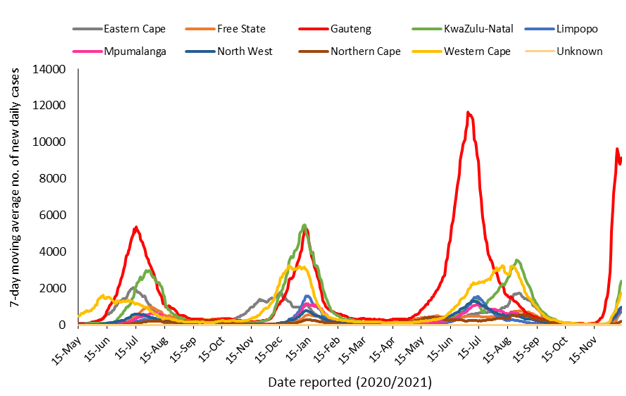
For more detailed information, visit the GIS Dashboard.
...
https://www.nicd.ac.za/latest-confir...december-2021/
...
THE 7-DAY MOVING AVERAGE NUMBER OF NEW CASES BY PROVINCE
The proportion of positive new cases/total new tested today is 30.9% which is lower than yesterday (32.2%). The 7-day average is 28.1% today, which is higher than yesterday (28.0%).
For more detailed information, visit the GIS Dashboard.
...
https://www.nicd.ac.za/latest-confir...december-2021/
Pathfinder
Editor, Senior Moderator
Hat tip Tetano
https://flutrackers.com/forum/forum...micron-variant-cases-in-denmark-december-2021
Epidemiological characterisation of the first 785 SARS-CoV-2 Omicron variant cases in Denmark, December 2021
...
Characterisation of cases
As per 9 December 2021, 785 cases of SARS-CoV-2 Omicron have been registered in Denmark. As there is a few days' lag from sampling to test result, the latest sampling date was 7 December. Daily case counts rose quickly (Figure 1), with daily increases of more than 40% from 4 December. In total, 143 (18%) have so far been confirmed by WGS. The age of cases ranged between 2 and 95 years (median: 32) and 433 (55%) were male (Table 2). Nine cases (1.2%) are or have been hospitalised, one case so far has received intensive care treatment and no cases have died. Cases were identified widespread across the country, but most were clustered in two main epicentres in the western part of Denmark and in the area of the Capital. A total of 599 (76%) cases were fully vaccinated and an additional 56 (7.1%) had received full vaccination plus a booster dose. Number and proportions of cases with the SARS-CoV-2 Delta variant (B.1.617.2 and sublineages) in the same period are also shown in Table 2 for reference.
...
Conclusion
We show a rapid increase and spread of the SARS-CoV-2 Omicron variant in Denmark, a European country with high testing capacity, high vaccination coverage and limited natural immunity through SARS-CoV-2 infection. The introduction and spread occurred despite an early and comprehensive public health response. Spread was catalysed by superspreading events and challenges further epidemic control. Information from the earlier travel-related cases, with no travel history to Africa, suggests that community transmission is more widespread than reported. The high proportion of fully vaccinated Omicron cases is a concern, the implications are still being described. It is too early to draw conclusions on the severity of Omicron compared to previous SARS-CoV-2 variants, analyses on this are ongoing.
https://flutrackers.com/forum/forum...micron-variant-cases-in-denmark-december-2021
Epidemiological characterisation of the first 785 SARS-CoV-2 Omicron variant cases in Denmark, December 2021
...
Characterisation of cases
As per 9 December 2021, 785 cases of SARS-CoV-2 Omicron have been registered in Denmark. As there is a few days' lag from sampling to test result, the latest sampling date was 7 December. Daily case counts rose quickly (Figure 1), with daily increases of more than 40% from 4 December. In total, 143 (18%) have so far been confirmed by WGS. The age of cases ranged between 2 and 95 years (median: 32) and 433 (55%) were male (Table 2). Nine cases (1.2%) are or have been hospitalised, one case so far has received intensive care treatment and no cases have died. Cases were identified widespread across the country, but most were clustered in two main epicentres in the western part of Denmark and in the area of the Capital. A total of 599 (76%) cases were fully vaccinated and an additional 56 (7.1%) had received full vaccination plus a booster dose. Number and proportions of cases with the SARS-CoV-2 Delta variant (B.1.617.2 and sublineages) in the same period are also shown in Table 2 for reference.
...
Conclusion
We show a rapid increase and spread of the SARS-CoV-2 Omicron variant in Denmark, a European country with high testing capacity, high vaccination coverage and limited natural immunity through SARS-CoV-2 infection. The introduction and spread occurred despite an early and comprehensive public health response. Spread was catalysed by superspreading events and challenges further epidemic control. Information from the earlier travel-related cases, with no travel history to Africa, suggests that community transmission is more widespread than reported. The high proportion of fully vaccinated Omicron cases is a concern, the implications are still being described. It is too early to draw conclusions on the severity of Omicron compared to previous SARS-CoV-2 variants, analyses on this are ongoing.