
Install the app
How to install the app on iOS
Follow along with the video below to see how to install our site as a web app on your home screen.
Note: This feature may not be available in some browsers.
-
FluTrackers.com Inc. does not provide medical advice. Information on this web site is collected from various internet resources, and the FluTrackers board of directors makes no warranty to the safety, efficacy, correctness or completeness of the information posted on this site by any author or poster. The information collated here is for instructional and/or discussion purposes only and is NOT intended to diagnose or treat any disease, illness, or other medical condition. Every individual reader or poster should seek advice from their personal physician/healthcare practitioner before considering or using any interventions that are discussed on this website. By continuing to access this website you agree to consult your personal physican before using any interventions posted on this website, and you agree to hold harmless FluTrackers.com Inc., the board of directors, the members, and all authors and posters for any effects from use of any medication, supplement, vitamin or other substance, device, intervention, etc. mentioned in posts on this website, or other internet venues referenced in posts on this website.
-
We are not asking for any donations. Do not donate to any entity who says they are raising funds for us.
You are using an out of date browser. It may not display this or other websites correctly.
You should upgrade or use an alternative browser.
You should upgrade or use an alternative browser.
Omicron - COVID-19 Variant (B.1.1529) a "Variant of Concern" & BA.2 sub-variant, XE
- Thread starter kiwibird
- Start date
Re. Omicron
There is not enough data to say anything very definitive about this variant yet - not that that will stop the media from writing exciting headlines and worst case scenarios.
Speculation is all we have so lets look at what we know and what it is reasonable to infer.
It was first found less than a month ago - Given that very few positive test are fully sequenced it is very likely to have been circulating below the radar for some time and is likely to have spread to several other areas/countries by now so travel restrictions will probably not delay international spread by much.
It has a bucket load of AA changes many in the Spike - This is unusual, while the virus will be continuously making small changes in any infection most will be weeded out in that host with only one or two making it to the next host. Viruses with this many changes as a single jump are almost always dead ends except where the host is immunocompromised allowing 'damaged' viruses to keep on adding mutations until a new viable progeny is achieved. The high HIV prevalence is a suspect here but we will never be able to pinpoint the index case.
These Spike changes are almost definitely going to reduce vaccine efficacy to some degree which will increase relative viral fitness in areas with high vaccine coverage. If the virus is relying on this to out perform the Delta variant it will spread well in high vaccine/prior infection areas but not in countries that are naive.
As we have never seen all these changes in one variant before there is no way of guessing what impact they will have on transmission, virulence or other properties of the phenotype we are just going to have to wait and watch.
As with the Alpha variant it is easier to pick up by rt PCR as the Spike probe (normally 1 of 3 probes) gives a reduced signal which in turn tends to lead to more full sequencing of that hosts viral genome which will skew the data compared to random sequencing so be wary of the relative numbers of sequences deposited at GISAID.
As far as the impact on health services is concerned the key here is if, in people whose immune system is primed, there is adequate protection to limit the replication in the host sufficiently for somatic hyper-mutation to adjust the B cells' antibodies to the new virus (I wrote an explanation of B cell maturation here https://flutrackers.com/forum/forum/...701#post907701). In countries with high vaccination/prior infection rates (like mine, the UK) people have dropped their guard and are tolerating very high infection rates as it is only producing low hospitalisations. If this strain has retained its virulence and drifted away from vaccine strains enough to allow significantly more hospitalisation and we do not change our behaviour, physical distancing and masking, then our health systems hospitals are going to get swamped and will cause more lockdowns.
A first look personal opinion only based on very little information - caveat emptor.
There is not enough data to say anything very definitive about this variant yet - not that that will stop the media from writing exciting headlines and worst case scenarios.
Speculation is all we have so lets look at what we know and what it is reasonable to infer.
It was first found less than a month ago - Given that very few positive test are fully sequenced it is very likely to have been circulating below the radar for some time and is likely to have spread to several other areas/countries by now so travel restrictions will probably not delay international spread by much.
It has a bucket load of AA changes many in the Spike - This is unusual, while the virus will be continuously making small changes in any infection most will be weeded out in that host with only one or two making it to the next host. Viruses with this many changes as a single jump are almost always dead ends except where the host is immunocompromised allowing 'damaged' viruses to keep on adding mutations until a new viable progeny is achieved. The high HIV prevalence is a suspect here but we will never be able to pinpoint the index case.
These Spike changes are almost definitely going to reduce vaccine efficacy to some degree which will increase relative viral fitness in areas with high vaccine coverage. If the virus is relying on this to out perform the Delta variant it will spread well in high vaccine/prior infection areas but not in countries that are naive.
As we have never seen all these changes in one variant before there is no way of guessing what impact they will have on transmission, virulence or other properties of the phenotype we are just going to have to wait and watch.
As with the Alpha variant it is easier to pick up by rt PCR as the Spike probe (normally 1 of 3 probes) gives a reduced signal which in turn tends to lead to more full sequencing of that hosts viral genome which will skew the data compared to random sequencing so be wary of the relative numbers of sequences deposited at GISAID.
As far as the impact on health services is concerned the key here is if, in people whose immune system is primed, there is adequate protection to limit the replication in the host sufficiently for somatic hyper-mutation to adjust the B cells' antibodies to the new virus (I wrote an explanation of B cell maturation here https://flutrackers.com/forum/forum/...701#post907701). In countries with high vaccination/prior infection rates (like mine, the UK) people have dropped their guard and are tolerating very high infection rates as it is only producing low hospitalisations. If this strain has retained its virulence and drifted away from vaccine strains enough to allow significantly more hospitalisation and we do not change our behaviour, physical distancing and masking, then our health systems hospitals are going to get swamped and will cause more lockdowns.
A first look personal opinion only based on very little information - caveat emptor.
Mary Wilson
Well-known member
Tracking COVID-19 variant Omicron
https://bnonews.com/index.php/2021/11/omicron-tracker/
BREAKING: England reports first 2 cases of new coronavirus variant
NEW: Czech Republic reports first suspected case of new coronavirus variant in returnee from Egypt
NEW: Germany reports probable case of new coronavirus variant in returnee from South Africa
https://bnonews.com/index.php/2021/11/omicron-tracker/
BREAKING: England reports first 2 cases of new coronavirus variant
NEW: Czech Republic reports first suspected case of new coronavirus variant in returnee from Egypt
NEW: Germany reports probable case of new coronavirus variant in returnee from South Africa
Mary Wilson
Well-known member
What we know about Omicron variant that has sparked global alarm
Clive Cookson and Oliver Barnes in London
YESTERDAY
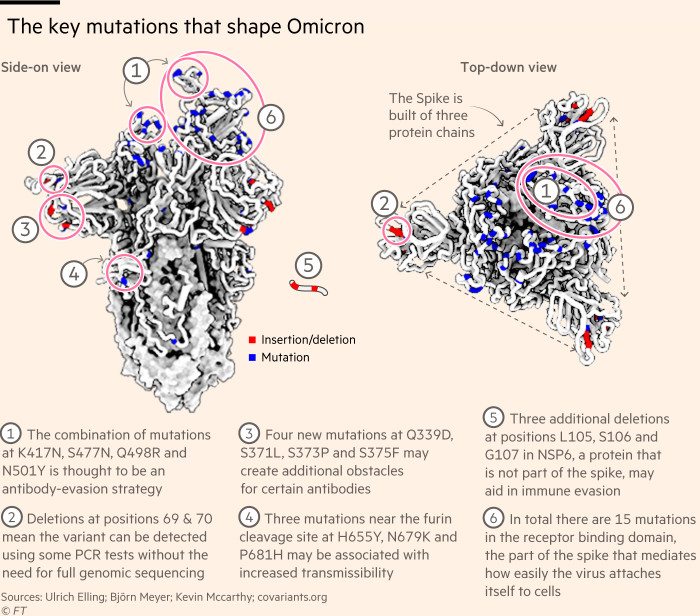
... Slawomir Kubik, a genomics research expert at Geneva-based biotech Sophia Genetics, said many of Omicron’s mutations came “completely out of the blue” and had not been observed before in other strains. Therefore, scientists “have very little visibility on what these new mutations are doing to how the virus works”, he explained, adding that once it begins to spread more widely its “true fitness” will become clear. Some of the mutations indicate increased transmissibility, while changes in the genetic code make it harder for the immune system, trained by existing vaccinations or prior infection with another variant, to tackle a new strain. But it will take researchers several weeks or months to work out the interactions between them and their cumulative impact.
https://www.ft.com/content/42c5ff3d-e676-4076-9b9f-7243a00cba5e
Clive Cookson and Oliver Barnes in London
YESTERDAY
... Slawomir Kubik, a genomics research expert at Geneva-based biotech Sophia Genetics, said many of Omicron’s mutations came “completely out of the blue” and had not been observed before in other strains. Therefore, scientists “have very little visibility on what these new mutations are doing to how the virus works”, he explained, adding that once it begins to spread more widely its “true fitness” will become clear. Some of the mutations indicate increased transmissibility, while changes in the genetic code make it harder for the immune system, trained by existing vaccinations or prior infection with another variant, to tackle a new strain. But it will take researchers several weeks or months to work out the interactions between them and their cumulative impact.
https://www.ft.com/content/42c5ff3d-e676-4076-9b9f-7243a00cba5e

Emily
Editor, Senior Moderator
https://www.voiceforscienceandsolidarity.org/scientific-blog/my-opinion-on-the-new-african-variants
November 27, 2021
My opinion on the new African variants
Geert Vanden Bossche
The world may be taken by surprise but that doesn't include us. It remains to be seen whether Omicron can outcompete Delta (to be confirmed). If that’s the case, we're definitely not in good shape.
In case of CoV, innate immunity protects the individual and the 'herd' ( sterilizing immunity, no natural selection pressure, herd immunity) whereas adaptive immunity induced with leaky vaccines has exactly the opposite effect.
THE big Q is whether such an immune escape variant could even resist naturally acquired Abs in people who recovered from C19 disease. I am, indeed, cautious and worried about ADE, even in the unvaccinated who recovered from C-19 disease as they may no longer be able to control viral infection. ADE would equal ‘enhanced virulence’. Difficult to predict.
Mass vaccination has compressed the evolutionary trajectory of the virus from a few hundred years (?) down to one year. Hope that naturally primed individuals can deal with that speed.
November 27, 2021
My opinion on the new African variants
Geert Vanden Bossche
The world may be taken by surprise but that doesn't include us. It remains to be seen whether Omicron can outcompete Delta (to be confirmed). If that’s the case, we're definitely not in good shape.
In case of CoV, innate immunity protects the individual and the 'herd' ( sterilizing immunity, no natural selection pressure, herd immunity) whereas adaptive immunity induced with leaky vaccines has exactly the opposite effect.
THE big Q is whether such an immune escape variant could even resist naturally acquired Abs in people who recovered from C19 disease. I am, indeed, cautious and worried about ADE, even in the unvaccinated who recovered from C-19 disease as they may no longer be able to control viral infection. ADE would equal ‘enhanced virulence’. Difficult to predict.
Mass vaccination has compressed the evolutionary trajectory of the virus from a few hundred years (?) down to one year. Hope that naturally primed individuals can deal with that speed.

kiwibird
Editor, Senior Moderator
https://www.telegraph.co.uk/global-...r-raised-alarm-omicron-variant-says-symptoms/
Emphasis mine. The article further states that Dr. Coetzee was concerned for the six year old child but within two days the little girl was much better. This was nearly ten days ago and the variant must have been circulating in the community for longer than that. The people quarantined in Schiphol who were interviewed were not symptomatic.
https://www.telegraph.co.uk/news/20...hitty/?li_source=LI&li_medium=liftigniter-rhr
New Covid variant is less worrying than delta, says Prof Chris Whitty
A graph of South African deaths has not shown a dramatic spike. IMO the bottom line is you do not want to get Covid - whichever variant it is.
The first South African doctor to alert the authorities about patients with the omicron variant has told The Telegraph that the symptoms of the new variant are unusual but mild.
Dr Angelique Coetzee said she was first alerted to the possibility of a new variant when patients in her busy private practice in the capital Pretoria started to come in earlier this month with Covid-19 symptoms that did not make immediate sense.
They included young people of different backgrounds and ethnicities with intense fatigue and a six-year-old child with a very high pulse rate, she said. None suffered from a loss of taste or smell.
“Their symptoms were so different and so mild from those I had treated before,” said Dr Coetzee, a GP for 33 years who chairs the South African Medical Association alongside running her practice.
On November 18, when four family members all tested positive for Covid-19 with complete exhaustion, she informed the country’s vaccine advisory committee.
Emphasis mine. The article further states that Dr. Coetzee was concerned for the six year old child but within two days the little girl was much better. This was nearly ten days ago and the variant must have been circulating in the community for longer than that. The people quarantined in Schiphol who were interviewed were not symptomatic.
https://www.telegraph.co.uk/news/20...hitty/?li_source=LI&li_medium=liftigniter-rhr
New Covid variant is less worrying than delta, says Prof Chris Whitty
TChief Medical Officer urges calm in face of warnings around omicron mutation, saying concern should focus on ‘immediate threats’
A graph of South African deaths has not shown a dramatic spike. IMO the bottom line is you do not want to get Covid - whichever variant it is.
kiwibird
Editor, Senior Moderator
https://www.cnbc.com/2021/11/27/the...k-reports-cases-of-omicron-covid-variant.html
This is 7 days before Dr Coetzee notified the South African Medical Association.
An Italian who had traveled to Mozambique on business landed in Rome on Nov. 11 and returned to his home near Naples. He and five family members, including two school-age children, have since tested positive, the Italian news agency LaPresse said. All are isolating in the Naples suburb of Caserta in good condition with light symptoms.
This is 7 days before Dr Coetzee notified the South African Medical Association.

Commonground
Senior Moderator
Trevor Bedford
@trvrb
·
Nov 26
You can see the striking accumulation of mutations in the S1 domain of the spike protein just by plotting S1 mutations against time and coloring by clade (https://nextstrain.org/ncov/gisaid/africa?l=scatter&scatterY=S1_mutations…). Omicron viruses bear many more S1 mutations than previously circulating variants. 7/16
The way I read this ‘family tree’ it’s like someone reached all the way back to April 2020, plucked out an existing variant (having only the D614G mutation in common with every other clade & variant) and then somehow, magically, all by itself, came up with not one, not two, not ‘a few,’ but twenty new mutations never before seen in any other variant of concern.
https://twitter.com/trvrb/status/146...243457/photo/1
PH Dependency Question: Is there any evidence that the PH Dependency related to endocytosis has changed in this new variant? Is there any suggestion that any of the specific Spike mutations would affect Ph Dependency? Any links / resources specific to this subject in Covid? Wondering if there is any specific ph range that is more optimum for endocytosis, what the trigger ph levels at which cell penetration is mitigated? Working on some research. Any guidance / feedback appreciated.

gsgs
Registered User
some links to SA online-newspapers, sorted by my quick first impression of omicron-coverage
https://www.timeslive.co.za/
https://www.citizen.co.za/
https://www.businesslive.co.za/bd/
https://www.sowetanlive.co.za/
https://www.iol.co.za/the-star
https://en.wikipedia.org/wiki/List_o...n_South_Africa
daily numbers:
https://www.nicd.ac.za/latest-confirmed-cases-of-covid-19-in-south-africa-27-november-2021/
[edit the date in the URL]
https://www.timeslive.co.za/
https://www.citizen.co.za/
https://www.businesslive.co.za/bd/
https://www.sowetanlive.co.za/
https://www.iol.co.za/the-star
https://en.wikipedia.org/wiki/List_o...n_South_Africa
daily numbers:
https://www.nicd.ac.za/latest-confirmed-cases-of-covid-19-in-south-africa-27-november-2021/
[edit the date in the URL]
David I am not sure the pH is of much relevance in SARS-CoV-2 as the bulk of the fusion is occurring at the surface membrane due to the S1/S2 polybasic cleavage site (AKA furin cleavage site) allowing TMPRSS2 access to the S2' cleavage site at the cell surface. The increasing pH will become relevant for cathepsin-L cleavage for any uncleaved S1/S2 that does end up in an endosomic vesicle.
See https://journals.plos.org/plospathog...l.ppat.1009212
I note Omicron has a couple of deletions near the N terminal domain fusion peptide which may effect fusion there are some changes near S1/S2 but I doubt they will change balance between the two entry routes as this site is on an exposed loop giving easy access to a range of proteases.
See https://journals.plos.org/plospathog...l.ppat.1009212
I note Omicron has a couple of deletions near the N terminal domain fusion peptide which may effect fusion there are some changes near S1/S2 but I doubt they will change balance between the two entry routes as this site is on an exposed loop giving easy access to a range of proteases.
kiwibird
Editor, Senior Moderator
https://www.cp24.com/world/south-afr...ease-1.5684008
South African doctors seeing younger COVID-19 patients with more severe disease
SA testing
A person queues to be tested for COVID-19 in Johannesburg, South Africa, Saturday Nov. 26, 2021. As the world grapples with the emergence of the new variant of COVID-19, scientists in South Africa — where omicron was first identified — are scrambling to combat its spread across the country. (AP Photo/Jerome Delay)
Andrew Meldrum, The Associated Press
Published Saturday, November 27, 2021 10:47AM EST
Last Updated Saturday, November 27, 2021 10:48AM EST
JOHANNESBURG (AP) -- Worried scientists in South Africa are scrambling to combat the lightning spread across the country of the new and highly transmissible omicron COVID-19 variant as the world grapples with its emergence.
South African doctors seeing younger COVID-19 patients with more severe disease
SA testing
A person queues to be tested for COVID-19 in Johannesburg, South Africa, Saturday Nov. 26, 2021. As the world grapples with the emergence of the new variant of COVID-19, scientists in South Africa — where omicron was first identified — are scrambling to combat its spread across the country. (AP Photo/Jerome Delay)
Andrew Meldrum, The Associated Press
Published Saturday, November 27, 2021 10:47AM EST
Last Updated Saturday, November 27, 2021 10:48AM EST
JOHANNESBURG (AP) -- Worried scientists in South Africa are scrambling to combat the lightning spread across the country of the new and highly transmissible omicron COVID-19 variant as the world grapples with its emergence.
.moreIn the space of two weeks, the omicron variant has sent South Africa from a period of low transmission to rapid growth of new confirmed cases. The country's numbers are still relatively low, with 2,828 new confirmed cases recorded Friday, but omicron's speed in infecting young South Africans has alarmed health professionals.
“We're seeing a marked change in the demographic profile of patients with COVID-19,” Rudo Mathivha, head of the intensive care unit at Soweto's Baragwanath Hospital, told an online press briefing.
“Young people, in their 20s to just over their late 30s, are coming in with moderate to severe disease, some needing intensive care. About 65% are not vaccinated and most of the rest are only half-vaccinated,” said Mathivha. “I'm worried that as the numbers go up, the public health care facilities will become overwhelmed.”
She said urgent preparations are needed to enable public hospitals to cope with a potential large influx of patients needing intensive care.
“We know we have a new variant,” said Mathivha. “The worst case scenario is that it hits us like delta ... we need to have critical care beds ready.”
What looked like a cluster infection among some university students in Pretoria ballooned into hundreds of new cases and then thousands, first in the capital city and then to nearby Johannesburg, South Africa's largest city.
Studying the surge, scientists identified the new variant that diagnostic tests indicate is likely responsible for as many as 90% of the new cases, according to South Africa's health officials. Early studies show that it has a reproduction rate of 2 - meaning that every person infected by it is likely to spread it to two other people.
The new variant has a high number of mutations that appear to make it more transmissible and help it evade immune responses. The World Health Organization looked at the data on Friday and named the variant omicron, under its system of using Greek letters, calling it a highly transmissible variant of concern.
“It's a huge concern. We all are terribly concerned about this virus,” Professor Willem Hanekom, director of the Africa Health Research Institute, told The Associated Press
kiwibird
Editor, Senior Moderator
https://twitter.com/itosettiMD_MBA/status/1464932270469525506
Question answered - Rapid tests pick up Omicron variant.
Sandra Ciesek
@CiesekSandra
Auch wichtig- die Antigentests (3 verschiedene von Roche, Siemens und Flowflex) sind auch bei Omicron positiv und funktionieren!
Translated from German by
Also important - the antigen tests (3 different ones from Roche, Siemens and Flowflex) are also positive and work at Omicron!
Question answered - Rapid tests pick up Omicron variant.
Sandra Ciesek
@CiesekSandra
Auch wichtig- die Antigentests (3 verschiedene von Roche, Siemens und Flowflex) sind auch bei Omicron positiv und funktionieren!
Translated from German by
Also important - the antigen tests (3 different ones from Roche, Siemens and Flowflex) are also positive and work at Omicron!

sharon sanders
Editor-in-Chief & President
The New York Times
@nytimes
·
5m
At least 13 cases of the Omicron coronavirus variant were found among passengers on two flights on Friday from South Africa to the Netherlands. Health officials in Australia and Denmark on Sunday also confirmed cases of the variant in recent travelers.
@nytimes
·
5m
At least 13 cases of the Omicron coronavirus variant were found among passengers on two flights on Friday from South Africa to the Netherlands. Health officials in Australia and Denmark on Sunday also confirmed cases of the variant in recent travelers.
sharon sanders
Editor-in-Chief & President
This is pretty much the understanding of everyone I have talked to. The experts do not know much yet.
Dr. Tom Frieden
@DrTomFrieden
·
31m
Data suggests Omicron may be even more easily spread than Delta (which was already 2X more transmissible than the original strain.) We don’t have data yet on whether or not Omicron causes more severe or less severe illness or can escape existing immunity. 5/
----------------------------------------------------------
I have seen online a lot of theories about whether this variant is "real" or some ploy by governments, pharma, etc.
I hope we have encouraged everyone to think for themselves on this site. We do not do mantras or cancel culture.
Stay aware of the developing Omicron situation. Monitor hospitalization rates. As the northern hemisphere gets colder with Winter approaching, stay aware of the Delta variant in your area.
Always use at least two sources for your information. Stay in touch with friends to see what they are experiencing. If you are questioning what is going on locally, one idea is to drive by your local hospital to see what is going on there (i.e. morgue trucks, lines of people, triage/treatment tents outside).
Do not take any medical advice from the internet. If you have any medical questions, contact your medical practitioner.
Only you can take care of you.
Dr. Tom Frieden
@DrTomFrieden
·
31m
Data suggests Omicron may be even more easily spread than Delta (which was already 2X more transmissible than the original strain.) We don’t have data yet on whether or not Omicron causes more severe or less severe illness or can escape existing immunity. 5/
----------------------------------------------------------
I have seen online a lot of theories about whether this variant is "real" or some ploy by governments, pharma, etc.
I hope we have encouraged everyone to think for themselves on this site. We do not do mantras or cancel culture.
Stay aware of the developing Omicron situation. Monitor hospitalization rates. As the northern hemisphere gets colder with Winter approaching, stay aware of the Delta variant in your area.
Always use at least two sources for your information. Stay in touch with friends to see what they are experiencing. If you are questioning what is going on locally, one idea is to drive by your local hospital to see what is going on there (i.e. morgue trucks, lines of people, triage/treatment tents outside).
Do not take any medical advice from the internet. If you have any medical questions, contact your medical practitioner.
Only you can take care of you.

Shiloh
Editor, Senior Moderator
Source: https://www.bnnbloomberg.ca/omicron-pretty-mild-so-far-south-african-health-expert-says-1.1688159
18m ago
Omicron ‘Pretty Mild’ So Far, South African Health Expert Says
Loni Prinsloo, Bloomberg News
(Bloomberg) -- Symptoms linked to the omicron coronavirus variant have been “pretty mild” so far, according to a Covid-19 adviser to the South Africa government.
While South Africa, which first identified the new variant, currently has 3,220 people with the coronavirus infection overall, there’s been no real uptick in hospitalizations, Barry Schoub, chairman of the Ministerial Advisory Committee on Vaccines, told Sky News on Sunday.
“The cases that have occurred so far have all been mild cases, mild-to-moderate cases and that’s a good sign,” said Schoub, adding that it was still early days and nothing was certain yet...
18m ago
Omicron ‘Pretty Mild’ So Far, South African Health Expert Says
Loni Prinsloo, Bloomberg News
(Bloomberg) -- Symptoms linked to the omicron coronavirus variant have been “pretty mild” so far, according to a Covid-19 adviser to the South Africa government.
While South Africa, which first identified the new variant, currently has 3,220 people with the coronavirus infection overall, there’s been no real uptick in hospitalizations, Barry Schoub, chairman of the Ministerial Advisory Committee on Vaccines, told Sky News on Sunday.
“The cases that have occurred so far have all been mild cases, mild-to-moderate cases and that’s a good sign,” said Schoub, adding that it was still early days and nothing was certain yet...
gsgs
Registered User
Most were men aged under 40. Just under half were vaccinated.
They also had mild muscle aches, a “scratchy throat” and dry cough, she said.
Only a few had a slightly high temperature.
These very mild symptoms were different to other variants,
which gave more severe symptoms.
Coetzee alerted health officials of a “clinical picture that doesn’t fit Delta”
on November 18, when she received the first seven of her 30-odd patients.
They also had mild muscle aches, a “scratchy throat” and dry cough, she said.
Only a few had a slightly high temperature.
These very mild symptoms were different to other variants,
which gave more severe symptoms.
Coetzee alerted health officials of a “clinical picture that doesn’t fit Delta”
on November 18, when she received the first seven of her 30-odd patients.
sharon sanders
Editor-in-Chief & President
See new TweetsConversation

Christian Althaus
@C_Althaus
·
5h
The mutational profile of Omicron suggests a potentially significant transmission advantage. But can we already say something about increased transmissibility or immune evasion? I'll give it a try. Warning: Preliminary and based on VERY limited data. 1/15

14
199
366
Christian Althaus
@C_Althaus
·
5h
The observed rapid replacement of Delta by Omicron in the province of Gauteng in South Africa is suggestive of a transmission advantage. 2/15
Quote Tweet

Tulio de Oliveira
@Tuliodna
· Nov 25
This new variant, B.1.1.529 seems to spread very quick! In less than 2 weeks now dominates all infections following a devastating Delta wave in South Africa (Blue new variant, now at 75% of last genomes and soon to reach 100%)
Show this thread

3
9
48
Christian Althaus
@C_Althaus
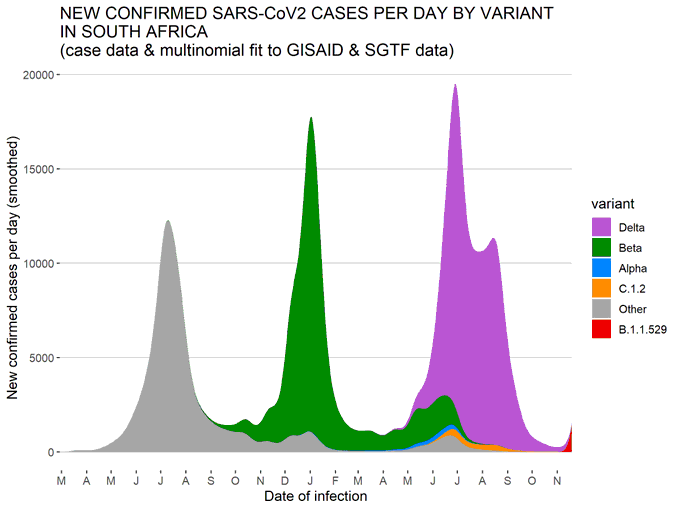
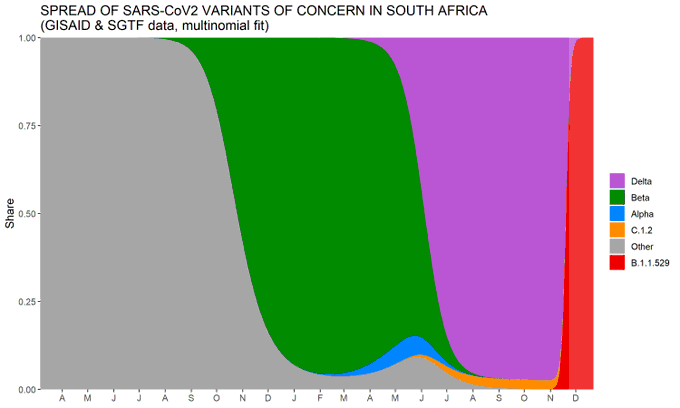
Fitting a multinomial logistic regression model to the proportion of different variants in South Africa results in an estimated growth advantage of Omicron of 0.43 (95% CI: 0.15-0.72) per day compared to Delta. 3/15

6:42 AM · Nov 28, 2021·Twitter for Mac
12
Retweets
3
Quote Tweets
57
Likes

Tweet your reply
Reply
Christian Althaus
@C_Althaus
·
5h
Replying to
@C_Althaus
.
@TWenseleers
obtained a similar estimate of 0.38 per day. There are lots of caveats: Targeted sequencing, stochastic effects in low incidence settings, and successive superspreading events could significantly bias these estimates. But let’s continue from here. 4/15
Quote Tweet

Tom Wenseleers
@TWenseleers
· 21h
Replying to @Emmanuel_microb
I also don't believe it is less severe. The growth rate advantage of Omicron vs Mu based on GISAID & SGTF data works out at 0.38/day [0.33-0.43] 95% CLs, which would correspond to it infecting ca. exp(0.38*4.7)=6.0 [4.7-7.5] x more people than Delta within one GT of the virus.


Christian Althaus
@C_Althaus
·
5h
The mutational profile of Omicron suggests a potentially significant transmission advantage. But can we already say something about increased transmissibility or immune evasion? I'll give it a try. Warning: Preliminary and based on VERY limited data. 1/15
14
199
366
Christian Althaus
@C_Althaus
·
5h
The observed rapid replacement of Delta by Omicron in the province of Gauteng in South Africa is suggestive of a transmission advantage. 2/15
Quote Tweet
Tulio de Oliveira
@Tuliodna
· Nov 25
This new variant, B.1.1.529 seems to spread very quick! In less than 2 weeks now dominates all infections following a devastating Delta wave in South Africa (Blue new variant, now at 75% of last genomes and soon to reach 100%)
Show this thread
3
9
48
Christian Althaus
@C_Althaus
Fitting a multinomial logistic regression model to the proportion of different variants in South Africa results in an estimated growth advantage of Omicron of 0.43 (95% CI: 0.15-0.72) per day compared to Delta. 3/15
6:42 AM · Nov 28, 2021·Twitter for Mac
12
Retweets
3
Quote Tweets
57
Likes
Tweet your reply
Reply
Christian Althaus
@C_Althaus
·
5h
Replying to
@C_Althaus
.
@TWenseleers
obtained a similar estimate of 0.38 per day. There are lots of caveats: Targeted sequencing, stochastic effects in low incidence settings, and successive superspreading events could significantly bias these estimates. But let’s continue from here. 4/15
Quote Tweet
Tom Wenseleers
@TWenseleers
· 21h
Replying to @Emmanuel_microb
I also don't believe it is less severe. The growth rate advantage of Omicron vs Mu based on GISAID & SGTF data works out at 0.38/day [0.33-0.43] 95% CLs, which would correspond to it infecting ca. exp(0.38*4.7)=6.0 [4.7-7.5] x more people than Delta within one GT of the virus.