

Commonground
Senior Moderator
June 3, 2025
Every five years, the Health Department assesses and ranks public health hazards based on their likelihood, potential severity, and the city’s readiness to respond.
June 3, 2025 — Today, the New York City Health Department (NYC Health Department) released a report on the top public health hazards that could impact New Yorkers in order to inform and improve how the city prepares for future public health emergencies. Conducted every five years, the Jurisdictional Risk Assessment (JRA) collects information about public health hazards, analyzes them, and identifies the most severe threats based on how likely they are to create a public health disaster. Top hazards include flooding, infectious disease outbreak, cyberattack, coastal storm, and a pandemic.
"Public health is preventative health – and this includes identifying and preventing emergencies before they impact New Yorkers,” said Acting Health Commissioner Dr. Michelle Morse. “The Public Health Jurisdictional Risk Assessment is a vital initiative that allows us to identify, evaluate, and address potential health threats proactively. By using data-driven insights and collaboration with our New York City agency and community partners, we can enhance preparedness, strengthen response efforts, and build more resilient communities."
“We appreciated collaborating with DOHMH on this report, as it aligns with our mission to prepare before, during and after emergencies for all hazard types,” said New York City Emergency Management Commissioner Zach Iscol. As the coordinating agency for all events, we are always looking for resources to create a risk-informed response to ensure we are helping the most vulnerable communities. The JRA helps us better understand public health impacts and strategies to reduce strain on public health services.”
Public health hazards are defined as events that can cause widespread illness or adverse health effects, whether naturally occurring – such as coastal storms or extreme heat – or human-made – such as hazardous material releases or cyberattacks. These hazards challenge the city’s routine operation and emergency capabilities and impact the health of New Yorkers.
For the 2024 JRA, ten key hazards were identified and assessed using an evidence-based public health risk assessment tool. This tool enabled hundreds of New York City emergency response teams, health care systems and professionals, and community partners to provide input on how significant the city would be impacted by these hazards. This information allows the Health Department to prepare for emergencies that are informed by those with firsthand experience protecting public health.
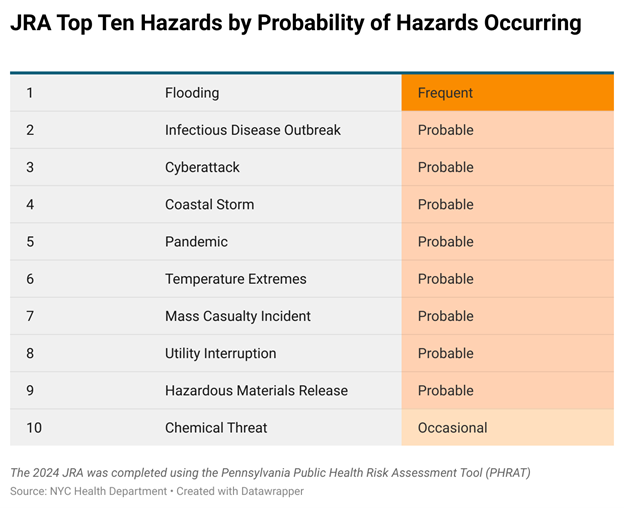
Flooding was identified as the most pressing public health hazard to NYC. Rising sea levels and intensifying storms due to climate change are expected to make flooding a more frequent occurrence and significant risk to New Yorkers. The overall ranking of public health hazards from the 2024 JRA is included in the chart below.
The assessment defined hazard frequency in the following ways:
The report also provides an in-depth look at each hazard, along with mitigation strategies to help minimize risks and protect public health. Recommendations include:
Using a multiagency approach, the Health Department prepares for all hazards that may impact New Yorkers by planning for emergency scenarios, training and exercising staff, evaluating progress and repeating the process to ensure the safety and health of New Yorkers. In order to rapidly respond to public health threats and protect the health of New Yorkers, the NYC Health Department’s capabilities include:
https://www.nyc.gov/site/doh/about/...es-top-public-health-hazards-new-yorkers.page
Every five years, the Health Department assesses and ranks public health hazards based on their likelihood, potential severity, and the city’s readiness to respond.
June 3, 2025 — Today, the New York City Health Department (NYC Health Department) released a report on the top public health hazards that could impact New Yorkers in order to inform and improve how the city prepares for future public health emergencies. Conducted every five years, the Jurisdictional Risk Assessment (JRA) collects information about public health hazards, analyzes them, and identifies the most severe threats based on how likely they are to create a public health disaster. Top hazards include flooding, infectious disease outbreak, cyberattack, coastal storm, and a pandemic.
"Public health is preventative health – and this includes identifying and preventing emergencies before they impact New Yorkers,” said Acting Health Commissioner Dr. Michelle Morse. “The Public Health Jurisdictional Risk Assessment is a vital initiative that allows us to identify, evaluate, and address potential health threats proactively. By using data-driven insights and collaboration with our New York City agency and community partners, we can enhance preparedness, strengthen response efforts, and build more resilient communities."
“We appreciated collaborating with DOHMH on this report, as it aligns with our mission to prepare before, during and after emergencies for all hazard types,” said New York City Emergency Management Commissioner Zach Iscol. As the coordinating agency for all events, we are always looking for resources to create a risk-informed response to ensure we are helping the most vulnerable communities. The JRA helps us better understand public health impacts and strategies to reduce strain on public health services.”
Public health hazards are defined as events that can cause widespread illness or adverse health effects, whether naturally occurring – such as coastal storms or extreme heat – or human-made – such as hazardous material releases or cyberattacks. These hazards challenge the city’s routine operation and emergency capabilities and impact the health of New Yorkers.
For the 2024 JRA, ten key hazards were identified and assessed using an evidence-based public health risk assessment tool. This tool enabled hundreds of New York City emergency response teams, health care systems and professionals, and community partners to provide input on how significant the city would be impacted by these hazards. This information allows the Health Department to prepare for emergencies that are informed by those with firsthand experience protecting public health.
Flooding was identified as the most pressing public health hazard to NYC. Rising sea levels and intensifying storms due to climate change are expected to make flooding a more frequent occurrence and significant risk to New Yorkers. The overall ranking of public health hazards from the 2024 JRA is included in the chart below.
The assessment defined hazard frequency in the following ways:
- Occasional: The hazard is likely to occur at least once within a 100-year timespan
- Probable: The hazard is likely to occur several times within a 100-year timespan
- Frequent: That hazard is likely to occur repeatedly, even annually, within a 100-year timespan
The report also provides an in-depth look at each hazard, along with mitigation strategies to help minimize risks and protect public health. Recommendations include:
- Flooding
- Use backwater valves to prevent sewer backups.
- Build rain gardens to absorb stormwater and reduce runoff.
- Promo green space stewardship for stormwater management
- Infectious Disease Outbreak
- Strengthen disease surveillance to catch outbreaks early.
- Enhance public health communication for prevention and treatment.
- Ensure hospitals can scale up care during outbreaks
- Cyberattacks
- Enhance cybersecurity across City agencies with regular updates
- Train employees to detect and respond to threats
- Develop backup systems for critical infrastructure
Using a multiagency approach, the Health Department prepares for all hazards that may impact New Yorkers by planning for emergency scenarios, training and exercising staff, evaluating progress and repeating the process to ensure the safety and health of New Yorkers. In order to rapidly respond to public health threats and protect the health of New Yorkers, the NYC Health Department’s capabilities include:
- Electronic surveillance systems and trained disease detectives that quickly detect disease outbreaks, identify infected individuals for treatment, and help prevent disease spread.
- Public health laboratory supplies, equipment and experienced laboratorians who use diagnostic tools to rapidly identify diseases, from influenza and COVID-19, to emerging infectious diseases like avian influenza (H5N1) and Ebola
- Medical countermeasure storage and dispensing capacity and expertise that made it possible to rapidly vaccinate over 100,000 New Yorkers during the 2023 mpox outbreak and over 5.2 million New Yorkers during the COVID-19 pandemic
- Risk communication materials and expert communicators who provide information and guidance to the public to keep themselves safe from health threats
- Strong relationships with local community members and organizations to enhance the capacity of communities to make emergency plans and share resources so they recover faster and stronger
- Emergency managers who make emergency plans, train the workforce on how to respond, and are the glue that connects this infrastructure together for an effective and efficient response
https://www.nyc.gov/site/doh/about/...es-top-public-health-hazards-new-yorkers.page