• FluTrackers.com Inc. does not provide medical advice. Information on this web site is collected from various internet resources, and the FluTrackers board of directors makes no warranty to the safety, efficacy, correctness or completeness of the information posted on this site by any author or poster. The information collated here is for instructional and/or discussion purposes only and is NOT intended to diagnose or treat any disease, illness, or other medical condition. Every individual reader or poster should seek advice from their personal physician/healthcare practitioner before considering or using any interventions that are discussed on this website. By continuing to access this website you agree to consult your personal physican before using any interventions posted on this website, and you agree to hold harmless FluTrackers.com Inc., the board of directors, the members, and all authors and posters for any effects from use of any medication, supplement, vitamin or other substance, device, intervention, etc. mentioned in posts on this website, or other internet venues referenced in posts on this website.
  • We are not asking for any donations. Do not donate to any entity who says they are raising funds for us.

numbers of migrant birds that move between Asia and Alaska

AlaskaDenise

In Memoriam
Newest data (4/1/2008)

Approximate numbers of migrant birds that move between Asia and Alaska

<TABLE cellSpacing=0 cellPadding=5 border=1><TBODY><TR height=17><TD height=17> </TD><TD>Number</TD><TD>Percent of Total </TD></TR><TR height=17><TD height=17>Waterfowl</TD><TD align=right>561,000</TD><TD align=right>8.5%</TD></TR><TR height=17><TD height=17>Loons</TD><TD align=right>55,000</TD><TD align=right>0.8%</TD></TR><TR height=17><TD height=17>Shorebirds/Gulls</TD><TD align=right>1,226,000</TD><TD align=right>18.5%</TD></TR><TR height=17><TD height=17>Landbirds</TD><TD align=right>4,745,000</TD><TD align=right>71.8%</TD></TR><TR height=17><TD height=17>Raptors/Owls</TD><TD align=right>25,000</TD><TD align=right>0.4%</TD></TR><TR height=17><TD height=17>Totals</TD><TD align=right>6,612,000</TD><TD align=right>100%</TD></TR></TBODY></TABLE>

<TABLE cellSpacing=0 cellPadding=5 border=1><TBODY><TR><TD colSpan=2>Waterfowl</TD><TD colSpan=2>Shorebirds/Gulls</TD></TR><TR><TD>King eider</TD><TD align=right>200,000</TD><TD>Dunlin</TD><TD align=right>500,000</TD></TR><TR><TD>Brant</TD><TD align=right>10,000</TD><TD>Sharp-tailed sandpiper</TD><TD align=right>25,000</TD></TR><TR><TD>Steller's eider</TD><TD align=right>10,000</TD><TD>Bar-tailed godwit</TD><TD align=right>135,000</TD></TR><TR><TD>Emperor goose</TD><TD align=right>5,000</TD><TD>Ruddy turnstone</TD><TD align=right>15,000</TD></TR><TR><TD>Mallard</TD><TD align=right>100,000</TD><TD>Pectoral sandpiper</TD><TD align=right>200,000</TD></TR><TR><TD>Pintail</TD><TD align=right>100,000</TD><TD>Pacific golden-plover</TD><TD align=right>40,000</TD></TR><TR><TD>Eurasian widgeon</TD><TD align=right>1,000</TD><TD>Buff-breasted sandpiper</TD><TD align=right>3,000</TD></TR><TR><TD>Long-tailed duck</TD><TD align=right>100,000</TD><TD>Western sandpiper</TD><TD align=right>105,000</TD></TR><TR><TD>Red-breasted merganser</TD><TD align=right>10,000</TD><TD>Baird's sandpiper</TD><TD align=right>3,000</TD></TR><TR><TD>Harlequin duck</TD><TD align=right>20,000</TD><TD>Red knot</TD><TD align=right>37,500</TD></TR><TR><TD>Common eider</TD><TD align=right>5,000</TD><TD>Long-billed dowitcher</TD><TD align=right>125,000</TD></TR><TR><TD colSpan=2>Loons</TD><TD>Rock sandpiper</TD><TD align=right>12,500</TD></TR><TR><TD>Yellow-billed loon</TD><TD align=right>5,000</TD><TD>Aleutian tern</TD><TD align=right>10,000</TD></TR><TR><TD>Red-throated loon</TD><TD align=right>10,000</TD><TD>Glaucous gull</TD><TD align=right>10,000</TD></TR><TR><TD>Pacific loon</TD><TD align=right>40,000</TD><TD>Glaucous-winged gull</TD><TD align=right>5,000</TD></TR><TR><TD colSpan=2>Landbirds</TD><TD colSpan=2>Raptors/Owls</TD></TR><TR><TD>Arctic warbler</TD><TD align=right>2,700,000</TD><TD>Gyrfalcon</TD><TD align=right>5,000</TD></TR><TR><TD>Bluethroat</TD><TD align=right>100,000</TD><TD>Peregrin falcon</TD><TD align=right>5,000</TD></TR><TR><TD>White wagtail</TD><TD align=right>10,000</TD><TD>Snowy owl</TD><TD align=right>5,000</TD></TR><TR><TD>Eastern yellow wagtail</TD><TD align=right>1,400,000</TD><TD>Short-eared owl</TD><TD align=right>10,000</TD></TR><TR><TD>Northern wheatear</TD><TD align=right>300,000</TD><TD colSpan=2 rowSpan=5> </TD></TR><TR><TD>Red-throated pipit</TD><TD align=right>5,000</TD></TR><TR><TD>Redpoll species</TD><TD align=right>120,000</TD></TR><TR><TD>Lapland longspur</TD><TD align=right>100,000</TD></TR><TR><TD>Snow bunting</TD><TD align=right>10,000</TD></TR></TBODY></TABLE>


http://alaska.usgs.gov/science/biology/avian_influenza/migrants_tables.html
 
Re: numbers of migrant birds that move between Asia and Alaska

Confirmed bird flu in Hokkaido, Japan is closest reported to North America to date.
 
Re: numbers of migrant birds that move between Asia and Alaska

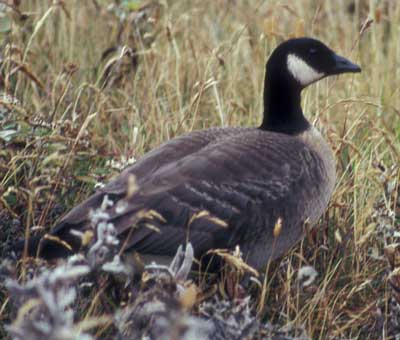
TAXON: Aleutian Cackling Geese, Branta hutchinsii leucopareia
ACGO_DDewhurst.jpg
Justification: A portion of the population of Aleutian Cackling Geese breeding on the Aleutian Islands may winter in Japan where they could possibly contract Asian H5N1, and the majority of geese breeding in the western Aleutians occupy islands visited by hundred of direct Asiatic migrant birds of a number of species directly from Asia annually.
Background:
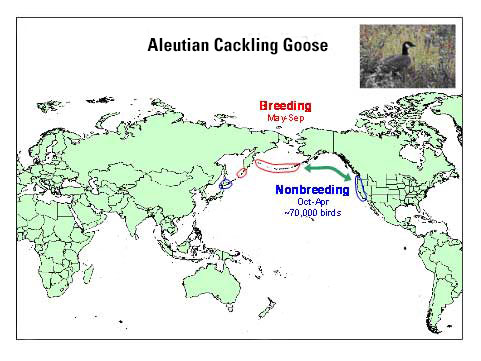
Aleutian Cackling Geese breed on the western end of the Aleutian Islands (Byrd 1998). An eastern Asia taxon, formerly identified as a separate subspecies, B. c. asiatica, reportedly bred in the Komandorski and Kuril islands and wintered in Japan, but the population was wiped out by the 1940?s (Mowbray et al. 2002). Based on only a few specimens, asiatica is now considered identical, by several authorities synonymous, with B. h. leucopareia. Since the middle of the 20th century, only vagrant individuals of B. h. leucopareia and B. h. minima from North America have occurred in Korea and Japan. However breeding stock of B. h. leucopareia that originated from Buldir Island, have been reintroduced to the Kuril Islands and have been recorded wintering in Japan (N. Gerasimov, unpubl. data). The Aleutian Cackling Goose is of low rank of waterfowl species to make the final list of 26 species of concern for Asian H5N1 transmission in the National Plan, primarily because we have a poor understanding of movements between Alaska and Asia. Nevertheless, the likelihood of secondary contact with Asian H5N1 is high, given the plethora of Asian birds using the western Aleutians (25 species are annual through migrants, and more than 90 species occur less than annually). Like nearly every other species of waterfowl considered, the main threat of contacting the Asian H5N1 virus is from other species, or populations of the same species coming directly from Asia and carrying the virus to the continental U.S. Aleutian Cackling geese winter in California.​
Ranking Score: 11.0
Methods:
No. of samples: Total of 400 samples, including 200 fecal samples from nesting birds and 200 cloacal swabs from brood flocks.
Sampling locations: Samples will be collected at different Islands in the Aleutian chain, including Buldir, Shemya and Agattu where Alaska Maritime NWR will have crews in place for seabird monitoring.
Sampling timeframe: Primary time frames will be late May to early June when birds are on nests, and late July and early August when adults with young are flightless.
Sample demographics: Geese of all age and sex classes will be sampled. Fecal samples of nesting birds will only include adults.
Methods of capture: Samples of nesting birds will likely be restricted to fecal specimens obtained in areas where nesting birds have recently foraged. Flightless birds will be captured be a field crew on Buldir Island by using long-handled nets.
Other targeted species: Sampling during the nesting period on Agattu will be done in conjunction with sampling for Common Eiders. Asiatic species are abundant on the Aleutian Islands and it may be possible to obtain fecal samples from a number of them.​
Principal Investigator(s):
U.S. Fish and Wildlife Service
Alaska Maritime NWR
Contact: Vernon Byrd

U.S. Geological Survey
Alaska Science Center
Contact: Margaret Petersen
Literature Cited:
Byrd, G. V. 1998. Current breeding status of the Aleutian Canada Goose, a recovering endangered species. Pp. 21-28 In Biology and management of Canada Geese (D.H. Rusch, M.D. Samuel, D. D. Humburg, and B. D. Sullivan, eds.). Mowbray, T. B., C. R. Ely, J. S. Sedinger, and R. E. Trost. 2002. Canada Goose (Branta canadensis). In The Birds of North America, No. 682 (A. Poole and F. Gill, eds.). The Birds of North America, Inc., Philadelphia, PA.
Asian H5N1 ranking criteria for Aleutian Cackling Geese, Branta hutchinsii leucopareia.​
<table border="1" width="100%"> <tbody><tr valign="top"> <td>
Total of partial
contact with Asia<sup>1</sup>​
</td> <td>
Contact with
known "hot spot"<sup>2</sup>​
</td> <td>
Habitat used in
Asia<sup>3</sup>​
</td> <td>
Pop. in Alaska<sup>4</sup>​
</td> <td>
Can samples be
obtained?​
</td> <td>
Score​
</td> </tr> <tr> <td>
1.0​
</td> <td>
1.0​
</td> <td>
4.0​
</td> <td>
3.0​
</td> <td>
2.0​
</td> <td>
11.0​
</td> </tr> <tr> <td>
Small numbers breed on Commander Islands and winter in Asia​
</td> <td>
No known use of AI-infected areas​
</td> <td>
Breeds on Aleutian Islands in wet, grassy freshwater meadows​
</td> <td>
Approximately 70,000 birds in fall population​
</td> <td>
Could be difficult to obtain target number in Alaska​
</td> <td>
</td> </tr> </tbody></table>

Distribution Map:
Aleutian-Cackling-Geese-Map.jpg


http://alaska.usgs.gov/science/biology/avian_influenza/species/species.php?code=ACGO
 
Re: numbers of migrant birds that move between Asia and Alaska

No. of samples: Total of 400 samples, including 200 fecal samples from nesting birds and 200 cloacal swabs from brood flocks.
Sampling locations: Samples will be collected at different Islands in the Aleutian chain, including Buldir, Shemya and Agattu where Alaska Maritime NWR will have crews in place for seabird monitoring.
Sampling timeframe: Primary time frames will be late May to early June when birds are on nests, and late July and early August when adults with young are flightless.
Sample demographics: Geese of all age and sex classes will be sampled. Fecal samples of nesting birds will only include adults.
Methods of capture: Samples of nesting birds will likely be restricted to fecal specimens obtained in areas where nesting birds have recently foraged. Flightless birds will be captured be a field crew on Buldir Island by using long-handled nets.
Other targeted species: Sampling during the nesting period on Agattu will be done in conjunction with sampling for Common Eiders. Asiatic species are abundant on the Aleutian Islands and it may be possible to obtain fecal samples from a number of them.

Detection of clade 2.2 in fecal or cloacal samples is in the abysmal range.
 
Re: numbers of migrant birds that move between Asia and Alaska

Originally Posted by Sally
Why is a sample from the throat better than a sample from the butt?
niman said:
PB2 E627K
That's a Willie Sutton question.
Thank you.

niman said:
http://www.flutrackers.com/forum/showpost.php?p=72266&postcount=3 Briefly, PB2 E627K is a mammalian polymophism. Every H1, H2, or H3 isolated from a human going back to 1918 has E627K. It was in a few H5N1 human cases in 1997, then the only H7N7 fatality in 2003, then in more H5N1 cases in Vietnam and Thailand. Almost all human cases that were not H1, H2, or H3 that had E627k died as did the tigers and domestic cats in Thailand.

Sutton's law http://en.wikipedia.org/wiki/Sutton's_law


Re: numbers of migrant birds that move between Asia and Alaska

Thank you.


Sutton's law http://en.wikipedia.org/wiki/Sutton's_law
The law is named after the bank robber Willie Sutton, who supposedly answered a reporter inquiring why he robbed banks by saying "because that's where the money is."

The above is why nasal swabs should be collected when looking for H5N1 clade 2.2 (which is the H5N1 in migratory birds in South Korea, Japan, and Russia).
 
Re: numbers of migrant birds that move between Asia and Alaska

PB2 E627K is a mammalian polymorphism because it creates higher polymerase activity at lower temperatures. The activity of E627 is highest at 41 C, the body temperature of a bird. The activity of E627K is highest at 33 C, the temperature of a human nose. In a wild bird, the throat and nasal temperature will be lower and closer to 33 C, leading to higher levels of H5N1 in isolates with E627K. The vast majority of clade 2.2 H5N1 isolates have E627K. It has been known for some time that clade 2.2 is much more easily detected in nasal swabs, yet the screening in Alaska targets cloacal swabs, which will generate a vast over abundance of false negatives.

Conservation groups have described the screening of 350,000 fecal samples from wild birds. Not surprisingly, the vast majority were negative.

Conservation groups, including those in Alaska, looking for H5N1 in healthy wild birds is well into the "fox guarding the hen house" category.
 
Re: numbers of migrant birds that move between Asia and Alaska

Since the testing has not begun, it's not too late for the issue of their testing methods to be addressed. The document linked below has really good information and photos of how testing is done. Each chapter can be downloaded individually.

From FOA's WILD BIRDS AND AVIAN INFLUENZA
An introduction to applied field research
and disease sampling techniques

5. Disease sampling procedures-
- Tracheal and cloacal swabs
- Blood sampling
- Faecal sampling
- References and information sources

TRACHEAL AND CLOACAL SWABS
Swabs taken from the cloaca (vent) or trachea can be used for viral cultures or reversetranscription polymerase chain reaction (RT-PCR) to test for the presence of many viral pathogens, including AI viruses. While non-pathogenic AI viruses replicate primarily in the avian intestinal tract, recent strains of H5N1 HPAI viruses have been detected both from cloacal and tracheal/oropharyngeal samples. Research has revealed that, unlike other AI viruses, the H5N1 HPAI subtype replicates to higher levels and for longer periods in the respiratory tract compared to the gastrointestinal tract (Sturm-Ramirez et al. 2004, Hulse-Post et al. 2005). Furthermore, after experimental exposure, higher concentrations of the virus have been found in tracheal samples than in cloacal samples on any given day. Therefore, tracheal and cloacal swabs are currently the preferred samples for H5N1 surveillance in
wild birds.
http://www.fao.org/docrep/010/a1521e/a1521e00.htm
 
Re: numbers of migrant birds that move between Asia and Alaska

Since the testing has not begun, it's not too late for the issue of their testing methods to be addressed. The document linked below has really good information and photos of how testing is done. Each chapter can be downloaded individually.

From FOA's WILD BIRDS AND AVIAN INFLUENZA
An introduction to applied field research
and disease sampling techniques

5. Disease sampling procedures-
- Tracheal and cloacal swabs
- Blood sampling
- Faecal sampling
- References and information sources

TRACHEAL AND CLOACAL SWABS
Swabs taken from the cloaca (vent) or trachea can be used for viral cultures or reversetranscription polymerase chain reaction (RT-PCR) to test for the presence of many viral pathogens, including AI viruses. While non-pathogenic AI viruses replicate primarily in the avian intestinal tract, recent strains of H5N1 HPAI viruses have been detected both from cloacal and tracheal/oropharyngeal samples. Research has revealed that, unlike other AI viruses, the H5N1 HPAI subtype replicates to higher levels and for longer periods in the respiratory tract compared to the gastrointestinal tract (Sturm-Ramirez et al. 2004, Hulse-Post et al. 2005). Furthermore, after experimental exposure, higher concentrations of the virus have been found in tracheal samples than in cloacal samples on any given day. Therefore, tracheal and cloacal swabs are currently the preferred samples for H5N1 surveillance in
wild birds.
http://www.fao.org/docrep/010/a1521e/a1521e00.htm
None of this is new, and the groups collecting wild bird samples are well aware of this data. However, their recent presentation in Bangkok was on 350,000 FECAL samples, which was used to spoon feed media the nonsense on no H5N1 in wild birds.

H5N1 in wild birds REMAINS a political issue and the propaganda campaign has been active since Qingahi Lake (May, 2005).

This is a VERY old story.
 
Re: numbers of migrant birds that move between Asia and Alaska

None of this is new, and the groups collecting wild bird samples are well aware of this data. However, their recent presentation in Bangkok was on 350,000 FECAL samples, which was used to spoon feed media the nonsense on no H5N1 in wild birds.

H5N1 in wild birds REMAINS a political issue and the propaganda campaign has been active since Qingahi Lake (May, 2005).

This is a VERY old story.

Does no one ask them openly why they are doing this? Surely there were people there who *knew* they were being fed nonsense.
The issue is too serious for dishonesty to be accepted.

Otoh, I'm rather impressed with their world-wide organization (propaganda campaign). Maybe we can enlist them to work on the food crisis :)
 
Back
Top