

Michael Coston
Editor, Senior Moderator
#NPM26: It's a 12 Volt Life

CDC Infographic
Note: This is the 20th day of National Preparedness Month. Follow this year’s campaign on Twitter by searching for the #NatlPrep #BeReady or #PrepMonth hashtags.
#19,341This month, as part of NPM26, I’ll be rerunning some updated preparedness essays, along with some new ones.
Most disasters boil down to unscheduled camping - for days, or sometimes weeks - in your home, in a community shelter, or possibly even in your own backyard.
But, as anyone who has ever tried to buy a loaf of bread or a gallon of milk after a hurricane or blizzard warning has been issued already knows, prepping has to be done well before a disaster looms.Preparedness can not only make that process possible, it can make it far less miserable as well.
If you have unlimited funds, and plenty of room, you can prep in style. But most people are constrained by limited budgets, and other restraints, and so this list is primarily for them.And quite frankly, given the rates of inflation and other global uncertainties, it seems likely that whatever you'd pay today for prep items will be higher in the future. And that assumes they will still be available.
Living in hurricane country, my biggest concerns revolve around prolonged power outages, which also can impact other utilities (including water, sewer, and internet).
- Following last 2024's one-two punch from Hurricanes Helene & Milton, I got my power back after only 4 days (although internet took a week). Before that, I went nearly a week without power following Irma in 2017, but many people had it far worse (most of Puerto Rico was without power for months after hurricane Maria in 2017).
- Not quite five years ago, in February of 2021, 3 successive winter storms swept across Texas, Louisiana, and Oklahoma, causing the worst collapse of the Texas energy grid on record (see Texas: The Latest - But Not The Last - Grid Down Crisis), resulting in hundreds of deaths (see City of Austin & Travis County 2021 WINTER STORM URI AFTER-ACTION REVIEW).
- And just last July, the U.S. Department of Energy published a 73-page report that warns that if current schedules for retirement of reliable power generation (especially baseload) continue, without enough firm replacement, the risk of blackouts in 2030 could increase by 100× over current levels.
The following is an example of how one can put together a basic plug-and-play mini solar power system for around $100; one that will keep phones, lanterns, and some mini-fans charged and running for days.My minimum goal is to have enough sustainable power for lights, radio, phone charging, a personal MP3 player, and fans. Trying to run appliances, HVAC, or other high-draw devices is simply beyond my budget (but if you have enough money . . . . it can be done ).

While I'm not recommending specific brands or suppliers, these photos are all typical of items I've purchased and used myself.
This is my `bug out' solar kit; What I would grab if I had to abandon my home - and the bulk of my preps - in a hurry (note: I have 2 rechargeable USB batteries and an MP3 player). It all fits in a tiny duffle bag that weighs less than 5lbs.
For a bit more money you could go for a slightly bigger solar panel, additional USB battery banks, and maybe a personal MP3 player, walkie-talkies, and an emergency radio. As the following photo illustrates, this type of modular system can be expanded over time.

The biggest downside to these types of setups is you are limited to USB (typically 5 volt) appliances. Fine for flashlights, phones, and MP3 players, but not nearly as versatile as a 12 volt system.
For 12v/110v power, you could opt to buy a Jackery, Bluetti, EcoFlow, or similar `Solar Battery' setup, but it would set you back $400 -$1000+ (plus solar panel). And if it breaks, you don't have many options beyond sending it back for repair.
However, if you build your own - and keep a few spare parts on hand - you should be able to to keep it running yourself. (note: If you aren't comfortable working with these types of components, get help from someone who is).
In 2024 I described building a rudimentary LiFePo4 power station (see picture below), which packed a decent 600 Watt/hour capacity. LiFePo4 batteries are lighter than lead/acid, are far less dangerous, and can be charged and discharged (fully) thousands of times.

My system featured dual 12V Car Cigarette Lighter Sockets (for CPAP, Electric cooler/fridge, or Inverter), 2 USB outlets, and I added a small 110v inverter. It is recharged by a 100 watt solar panel (shown on left).
After my last hurricane I endeavored to improve my 12-volt battery bank (for build details, see Post-Milton Improvements To My Power Preps)
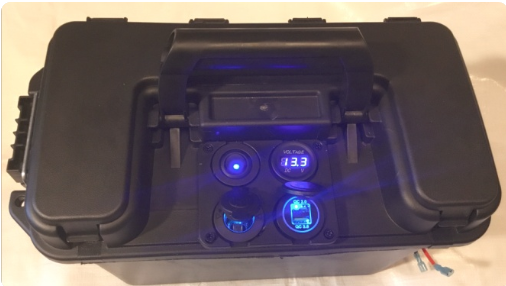
Weighing in at less than 15 lbs, this 50 amp/hr (600 watt/hour) setup is self contained, with storage for cables, a wall charger, and a small 110v inverter. All you need to add is a solar panel (100 watt or better).
All in, including taxes, this can be assembled in a couple of hours for less than $200. I built a second, lighter weight and smaller version using a 20 amp/hr LiFePo4 battery (240 watt/hours) for less than $140. Something to keep on the bedside table.The plastic carrying case was $12 at Harbor Freight, the 50 amp/hr battery was $109 on Amazon, and the rest of the build (solar charge controller, cables, lighted output panel, inverter) added about $60.
Even without the 110 volt output, which on small systems provides limited value, these setups can power a lot of useful items.Whether home built, or store bought, these `solar generators' can greatly expand what you can do during a prolonged blackout. They can recharge any USB item, run most 12 volt appliances, and some can power small 110 volt appliances for a short period of time.
Two years ago I purchased some very nice 4-packs of LED lanterns, and some USB battery powered water pumps that attach as a faucet to large water jugs. Just three days after they arrived I endured a 3-day water outage at home, and found the faucets actually worked pretty well.

Every home should have a battery operated radio (with NWS weather band), yet many do not. Some are available with crank or solar charging, but most have rechargeable batteries via a USB port.

A 12 volt system (of sufficient size) can power a mini-fridge, or electric cooler, and can not only keep food from spoiling, and drinks cold, it can keep medications like insulin cool.

As for entertainment - which should not be discounted during a prolonged power outage - while a USB setup will power and charge a personal MP3 player, a 12 volt system can run a DVD player.

As an aside - I've collected (public domain) OTR (Old Time Radio) shows since the early 1990s, and have literally thousands of hours stored on CDs in MP3 format. The Internet Archive has a huge repository where you can download them for free, along with thousands of audiobooks.
Over the years I've bought several cheap MP3 players ($20-$30) and filled them with thousands of hours of these shows (mostly from the 1940s and 1950s), giving them as gifts. And the nice thing is, you don't have to wait for an emergency to enjoy them.I keep a couple of MP3 players filled with these shows and with audiobooks in my bug-out bag. When the power and internet were down, they have provided me with hours of entertainment.
But despite its obvious limitations, it sure beats cursing the darkness.Admittedly, since I lived happily for nearly 15 years aboard boats (2 sailboats, 1 power boat) here in Florida - where 12 volts ran just about everything - I may be a bit more amenable to the 12 volt life than others.
https://afludiary.blogspot.com/2026/09/npm26-its-12-volt-life.html