

Michael Coston
Editor, Senior Moderator
Norwegian Veterinary Institute : More HPAI (H5N5 & H5N1) Detected In Arctic (Svalbard)
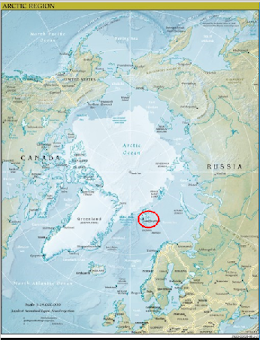
Location of Svalbard in the Arctic Ocean
#16,878
Roughly 3 weeks ago we saw the first report from the Norwegian Veterinary Institute confirming the first detection of HPAI (Highly Pathogenic Avian Influenza) in the arctic (Svalbard Island). I've reproduced the summary below:
The Veterinary Institute has detected contagious bird flu (highly pathogenic avian influenza virus - HPAI) in a polar gull that was found dead at the quay in Longyearbyen in June. Bird flu has never been detected in Svalbard before, and as far as the Veterinary Institute is aware, this is the first detection of the virus in the Arctic.
Unsurprisingly, today they have announced the detection of at least 5 more infected birds with two different subtypes (H5N1 and H5N5) of HPAI. First their translated announcement, then I'll return with more.
Bird flu detected in storjo on Svalbard
Published 12.07.2022 Modified 13.07.2022
The Norwegian Veterinary Institute has detected highly pathogenic avian influenza virus (HPAI, bird flu) in five large years that were found dead on Hermansenøya on Svalbard in early July. Two different virus variants were detected, mainly H5N5 and H5N1.
Storjo (Stercorarius skua). Photo: Colourbox
An abnormally high mortality rate was reported among nesting storks (Stercorarius skua) on Hermansenøya during a census earlier in July. Several of the birds were sent to the Veterinary Institute by Børge Moe from NINA (Norwegian Institute for Natural Research) on behalf of the Norwegian Food Safety Authority, for sampling and analysis. The Veterinary Institute detected highly pathogenic avian influenza virus H5N5 in four of the storks and H5N1 in one storjo.
Earlier this summer, we were diagnosed with bird flu on polar gulls (H5N5) on Svalbard, and several cases on m.a. osprey, seagulls and sea eagles along the coast of mainland Norway.
It is very rare for humans to be infected with bird flu. On a general basis, one should avoid touching sick or dead birds without protective equipment. The public is asked to contact the Governor in the event of the discovery of a dead wild bird on Svalbard.
In case of finding weak, sick or dead wild ducks, geese, swans, waders, seagulls, crows and birds of prey in mainland Norway, the Veterinary Institute recommends that the public immediately report to the Norwegian Food Safety Authority by email (postmottak@mattilsynet.no), so that it can be taken. out samples from the birds.
(Continue . . . )
Between 2014 and early 2021, the primary clade 2.3.4.4b HPAI H5 virus in circulation was H5N8, with a smattering of H5N6, H5N1, and H5N5 reassortants created when H5N8 co-infected a host which was carrying a different (usually LPAI) avian flu virus.

In 2021, subtype dominance shifted to primarily H5N1, but with sporadic detections of H5Nx viruses as well. This past winter, particularly in Northern Europe, H5N5 has been reported a number of times.
During the European epizootic of 2016-17, Germany's Friedrich-Loeffler-Institut (FLI) described an emerging H5N5 virus as:
Since mid-December 2016 a further subtype, H5N5, has been circulating in wild birds, which now has first been introduced into a poultry holding. This virus is is likely to be a reassortant based on the original H5N8. Mixed viruses, so-called reassortants, of avian influenza viruses are generated, if several virus subtypes are present in one infected animal and exchange genetic material during replication. Generation of reassortants must be expected when different high and low pathogenic influenza viruses are circulating in one population.
It is entirely possible that we could seen another shift - from H5N1 to H5N5, or to some other n-type, in the months or years ahead. We could also see a new clade emerge in Europe, just as we've seen repeatedly in Asia, Africa, and the Middle East.
Avian flu is highly mutable, and we should expect more surprises along the way.
https://afludiary.blogspot.com/2022/07/norwegian-veterinary-institute-more.html
Location of Svalbard in the Arctic Ocean
#16,878
Roughly 3 weeks ago we saw the first report from the Norwegian Veterinary Institute confirming the first detection of HPAI (Highly Pathogenic Avian Influenza) in the arctic (Svalbard Island). I've reproduced the summary below:
The Veterinary Institute has detected contagious bird flu (highly pathogenic avian influenza virus - HPAI) in a polar gull that was found dead at the quay in Longyearbyen in June. Bird flu has never been detected in Svalbard before, and as far as the Veterinary Institute is aware, this is the first detection of the virus in the Arctic.
Unsurprisingly, today they have announced the detection of at least 5 more infected birds with two different subtypes (H5N1 and H5N5) of HPAI. First their translated announcement, then I'll return with more.
Bird flu detected in storjo on Svalbard
Published 12.07.2022 Modified 13.07.2022
The Norwegian Veterinary Institute has detected highly pathogenic avian influenza virus (HPAI, bird flu) in five large years that were found dead on Hermansenøya on Svalbard in early July. Two different virus variants were detected, mainly H5N5 and H5N1.
Storjo (Stercorarius skua). Photo: Colourbox
An abnormally high mortality rate was reported among nesting storks (Stercorarius skua) on Hermansenøya during a census earlier in July. Several of the birds were sent to the Veterinary Institute by Børge Moe from NINA (Norwegian Institute for Natural Research) on behalf of the Norwegian Food Safety Authority, for sampling and analysis. The Veterinary Institute detected highly pathogenic avian influenza virus H5N5 in four of the storks and H5N1 in one storjo.
Earlier this summer, we were diagnosed with bird flu on polar gulls (H5N5) on Svalbard, and several cases on m.a. osprey, seagulls and sea eagles along the coast of mainland Norway.
It is very rare for humans to be infected with bird flu. On a general basis, one should avoid touching sick or dead birds without protective equipment. The public is asked to contact the Governor in the event of the discovery of a dead wild bird on Svalbard.
In case of finding weak, sick or dead wild ducks, geese, swans, waders, seagulls, crows and birds of prey in mainland Norway, the Veterinary Institute recommends that the public immediately report to the Norwegian Food Safety Authority by email (postmottak@mattilsynet.no), so that it can be taken. out samples from the birds.
(Continue . . . )
Between 2014 and early 2021, the primary clade 2.3.4.4b HPAI H5 virus in circulation was H5N8, with a smattering of H5N6, H5N1, and H5N5 reassortants created when H5N8 co-infected a host which was carrying a different (usually LPAI) avian flu virus.
In 2021, subtype dominance shifted to primarily H5N1, but with sporadic detections of H5Nx viruses as well. This past winter, particularly in Northern Europe, H5N5 has been reported a number of times.
During the European epizootic of 2016-17, Germany's Friedrich-Loeffler-Institut (FLI) described an emerging H5N5 virus as:
Since mid-December 2016 a further subtype, H5N5, has been circulating in wild birds, which now has first been introduced into a poultry holding. This virus is is likely to be a reassortant based on the original H5N8. Mixed viruses, so-called reassortants, of avian influenza viruses are generated, if several virus subtypes are present in one infected animal and exchange genetic material during replication. Generation of reassortants must be expected when different high and low pathogenic influenza viruses are circulating in one population.
It is entirely possible that we could seen another shift - from H5N1 to H5N5, or to some other n-type, in the months or years ahead. We could also see a new clade emerge in Europe, just as we've seen repeatedly in Asia, Africa, and the Middle East.
Avian flu is highly mutable, and we should expect more surprises along the way.
https://afludiary.blogspot.com/2022/07/norwegian-veterinary-institute-more.html