

Pathfinder
Editor, Senior Moderator
WEEKLY BULLETIN ON OUTBREAKS
AND OTHER EMERGENCIES
Week 15: 7 to 13 April 2025
Data as reported by: 17:00; 13 April 2025
...
Niger
Ascites of undetermined aetiology
253 Cases
8 Deaths
3.2% CFR
EVENT DESCRIPTION
A new cluster of cases presenting with ascites, fluid
buildup in the abdomen, have been reported in the Dosso
and Maradi regions of Niger. The affected individuals
have abdominal distension accompanied by symptoms
such as abdominal pain, vomiting, and fever, with no
underlying causes yet identified. In epidemiological
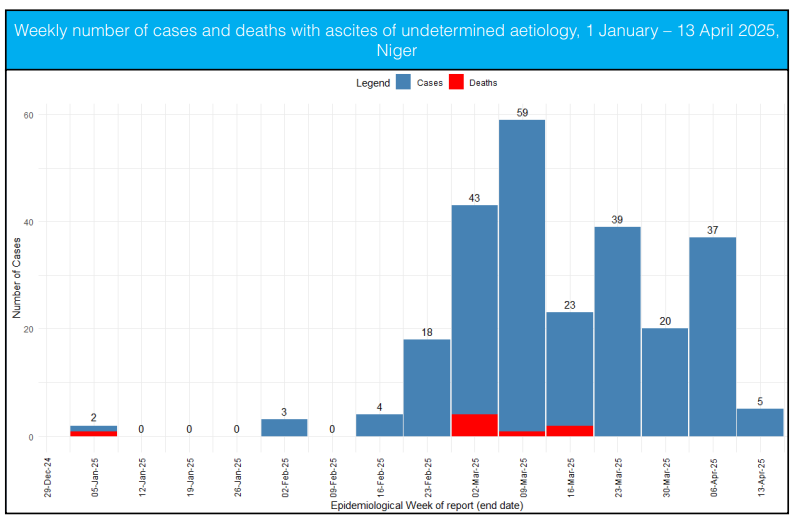
week 15 (week ending 13 April 2025), five new cases
with zero deaths were reported. Similar clusters were first
identified in Nigeria and Niger in 2024.
From 1 January – 13 April 2025, a cumulative total of
253 cases with eight (8) deaths (CFR 3.2%) have been
reported from four districts in the Dosso and Maradi
regions. The majority of cases are concentrated in
Dogondoutchi (n=132) and Tibiri (n=103) districts in
the Dosso Region, accounting for 92.9% of the total
caseload. The other districts with cases are Guidan
Roumdji (n=16) and Dioundiou (n=2) in the Maradi and
Dosso regions respectively. All eight deaths occurred
in Dogondoutchi (n=7) and Tibiri (n=1) districts. The
median age of affected individuals is 8 years. The age
group 5 – 14 years is the most affected, accounting for
69.2% (n=175) of the reported cases. Children under
five years account for 18.2% (n=46) of cases and 50.0%
(n=4) of the reported deaths.
Between April and early June 2024, Niger reported a
similar cluster of cases across six regions—Dosso,
Tahoua, Maradi, Zinder, Tillaberi and Niamey—involving
a total of 60 cases with one death. Molecular analyses,
including real-time polymerase chain reaction (RT-PCR)
and metagenomic sequencing, were conducted at
Institut Pasteur in Dakar on 11 July 2024 on samples
(9 serum, 10 pleural fluid, and 1 stool) collected. No
infectious agents were identified in the investigated
cases.
In the current outbreak, several hypotheses remain
under consideration, including exposure to aflatoxins,
heavy metal poisoning, formaldehyde contamination,
and natural toxins, particularly pyrrolizidine alkaloids.
Investigations are ongoing to identify the aetiology and
guide appropriate public health interventions.
PUBLIC HEALTH ACTIONS
An initial field investigation was conducted in affected
areas, and a report was disseminated to national
stakeholders. Human samples were collected from
hospitalized patients and transported to laboratories
in Niamey for preliminary analysis. During the same
investigation, community reports highlighted illness and
mortality in dogs, with two canine deaths confirmed.
A second, more comprehensive multidisciplinary
investigation is being planned, involving epidemiologists,
environmental health experts, veterinarians,
entomologists, and toxicologists. This will include
extensive field sampling and post-mortem sampling
where feasible. This will also include shipment of samples
to reference laboratories for testing.
As part of the enhanced clinical investigation, a cohort
of approximately 12 patients will be referred to two major
hospitals in Niamey for in-depth evaluation. These cases
will be selected to represent different age groups and
sexes to support a broad clinical and epidemiological
understanding.
A draft protocol for case management has been
developed, and medication has been mobilized for
supportive and symptomatic management of cases.
With support from WHO and partners, public health
authorities have activated field teams to conduct
community-based investigations, enhance surveillance,
and engage local leaders in risk communication.
SITUATION INTERPRETATION
The recurrence of ascitic syndrome in Niger,
predominantly affecting children and adolescents,
highlights a growing and unresolved public health
threat with potentially environmental or toxicological
origins. The recurrence of new cluster of cases in 2025
underscores ongoing exposure risks and suggests a
complex, possibly localized source of contamination.
This event demands urgent attention, particularly as
the cause remains unknown and national diagnostic
capacity is limited. The absence of confirmed infectious
agents points to the need for robust environmental health
investigations and toxicological analyses. Effective
public health action now hinges on accelerating a
coordinated, multidisciplinary response, enhancing
national capacity, and mobilizing international technical
support to identify the aetiological agent and prevent
further illnesses and deaths.
...
https://www.afro.who.int/countries/...and-other-emergencies-week-15-7-13-april-2025
AND OTHER EMERGENCIES
Week 15: 7 to 13 April 2025
Data as reported by: 17:00; 13 April 2025
...
Niger
Ascites of undetermined aetiology
253 Cases
8 Deaths
3.2% CFR
EVENT DESCRIPTION
A new cluster of cases presenting with ascites, fluid
buildup in the abdomen, have been reported in the Dosso
and Maradi regions of Niger. The affected individuals
have abdominal distension accompanied by symptoms
such as abdominal pain, vomiting, and fever, with no
underlying causes yet identified. In epidemiological
week 15 (week ending 13 April 2025), five new cases
with zero deaths were reported. Similar clusters were first
identified in Nigeria and Niger in 2024.
From 1 January – 13 April 2025, a cumulative total of
253 cases with eight (8) deaths (CFR 3.2%) have been
reported from four districts in the Dosso and Maradi
regions. The majority of cases are concentrated in
Dogondoutchi (n=132) and Tibiri (n=103) districts in
the Dosso Region, accounting for 92.9% of the total
caseload. The other districts with cases are Guidan
Roumdji (n=16) and Dioundiou (n=2) in the Maradi and
Dosso regions respectively. All eight deaths occurred
in Dogondoutchi (n=7) and Tibiri (n=1) districts. The
median age of affected individuals is 8 years. The age
group 5 – 14 years is the most affected, accounting for
69.2% (n=175) of the reported cases. Children under
five years account for 18.2% (n=46) of cases and 50.0%
(n=4) of the reported deaths.
Between April and early June 2024, Niger reported a
similar cluster of cases across six regions—Dosso,
Tahoua, Maradi, Zinder, Tillaberi and Niamey—involving
a total of 60 cases with one death. Molecular analyses,
including real-time polymerase chain reaction (RT-PCR)
and metagenomic sequencing, were conducted at
Institut Pasteur in Dakar on 11 July 2024 on samples
(9 serum, 10 pleural fluid, and 1 stool) collected. No
infectious agents were identified in the investigated
cases.
In the current outbreak, several hypotheses remain
under consideration, including exposure to aflatoxins,
heavy metal poisoning, formaldehyde contamination,
and natural toxins, particularly pyrrolizidine alkaloids.
Investigations are ongoing to identify the aetiology and
guide appropriate public health interventions.
PUBLIC HEALTH ACTIONS
An initial field investigation was conducted in affected
areas, and a report was disseminated to national
stakeholders. Human samples were collected from
hospitalized patients and transported to laboratories
in Niamey for preliminary analysis. During the same
investigation, community reports highlighted illness and
mortality in dogs, with two canine deaths confirmed.
A second, more comprehensive multidisciplinary
investigation is being planned, involving epidemiologists,
environmental health experts, veterinarians,
entomologists, and toxicologists. This will include
extensive field sampling and post-mortem sampling
where feasible. This will also include shipment of samples
to reference laboratories for testing.
As part of the enhanced clinical investigation, a cohort
of approximately 12 patients will be referred to two major
hospitals in Niamey for in-depth evaluation. These cases
will be selected to represent different age groups and
sexes to support a broad clinical and epidemiological
understanding.
A draft protocol for case management has been
developed, and medication has been mobilized for
supportive and symptomatic management of cases.
With support from WHO and partners, public health
authorities have activated field teams to conduct
community-based investigations, enhance surveillance,
and engage local leaders in risk communication.
SITUATION INTERPRETATION
The recurrence of ascitic syndrome in Niger,
predominantly affecting children and adolescents,
highlights a growing and unresolved public health
threat with potentially environmental or toxicological
origins. The recurrence of new cluster of cases in 2025
underscores ongoing exposure risks and suggests a
complex, possibly localized source of contamination.
This event demands urgent attention, particularly as
the cause remains unknown and national diagnostic
capacity is limited. The absence of confirmed infectious
agents points to the need for robust environmental health
investigations and toxicological analyses. Effective
public health action now hinges on accelerating a
coordinated, multidisciplinary response, enhancing
national capacity, and mobilizing international technical
support to identify the aetiological agent and prevent
further illnesses and deaths.
...
https://www.afro.who.int/countries/...and-other-emergencies-week-15-7-13-april-2025