
Install the app
How to install the app on iOS
Follow along with the video below to see how to install our site as a web app on your home screen.
Note: This feature may not be available in some browsers.
-
FluTrackers.com Inc. does not provide medical advice. Information on this web site is collected from various internet resources, and the FluTrackers board of directors makes no warranty to the safety, efficacy, correctness or completeness of the information posted on this site by any author or poster. The information collated here is for instructional and/or discussion purposes only and is NOT intended to diagnose or treat any disease, illness, or other medical condition. Every individual reader or poster should seek advice from their personal physician/healthcare practitioner before considering or using any interventions that are discussed on this website. By continuing to access this website you agree to consult your personal physican before using any interventions posted on this website, and you agree to hold harmless FluTrackers.com Inc., the board of directors, the members, and all authors and posters for any effects from use of any medication, supplement, vitamin or other substance, device, intervention, etc. mentioned in posts on this website, or other internet venues referenced in posts on this website. -
We are not asking for any donations. Do not donate to any entity who says they are raising funds for us.
- Home
- Forums
- Forum
- Canada
- All avian flu tracking including: H5N1, H5N5, H5N8
- Newfoundland and Labrador
You are using an out of date browser. It may not display this or other websites correctly.
You should upgrade or use an alternative browser.
You should upgrade or use an alternative browser.
Newfoundland and Labrador - Avian influenza in poultry 2025
- Thread starter Lance
- Start date

Pathfinder
Editor, Senior Moderator
/https://en.wikipedia.org/wiki/Gander_Bay
------------------------------------
https://inspection.canada.ca/en/ani...-bird-flu-situation/investigations-and-orders
---------------------------------------------------------
Public Advisory: Poultry Owners Urged to Protect Commercial and Backyard Flocks from Avian Influenza
Fisheries, Forestry and Agriculture
February 14, 2025
Animal health officials with the Department of Fisheries, Forestry and Agriculture have reported two suspected cases of highly pathogenic avian influenza (H5) in backyard poultry flocks in Central Newfoundland to the Canadian Food Inspection Agency.
Avian influenza continues to circulate in wild birds since an original outbreak in late 2021, with ongoing risk to the poultry sector. The Canadian Food Inspection Agency is leading the investigation and providing updates at Latest Bird Flu Situation.
Commercial poultry producers follow strict biosecurity plans and procedures to prevent the spread of avian influenza and other disease. All commercial and backyard poultry producers, regardless of the size of their flocks, are urged to review the Canadian Food Inspection Agency’s biosecurity measures to ensure flocks are protected from exposure to wild birds.
Signs of bird flu include:
- Lack of energy, movement or appetite.
- Decreased egg production.
- Swelling around the head, neck and eyes.
- Coughing, gasping for air or sneezing.
- Nervous signs, tremors or lack of coordination.
- Diarrhea.
- Sudden death.
- Canadian Food Inspection Agency: 709-772-4424; or
- Provincial Animal Health Division:
- St. John’s: 709-729-6879/after-hours 709-729-6899
- Clarenville 24-hours: 709-466-2808
- Pynn’s Brook 24-hours: 709-686-2672
- Prevent contact between poultry and wild birds or other animals.
- Frequently clean coops, feeders and waterers, and your clothing and boots.
- Watch for signs of avian influenza and report them.
- Limit visitors to your property.
- Keep new birds separate from your flock for at least 30 days to avoid introducing disease.
Provincial officials are working with federal agencies including the Canadian Food Inspection Agency and Environment and Climate Change Canada to help limit the spread of avian influenza in Newfoundland and Labrador. If you find a dead, injured or sick wild bird, report it to Canadian Wildlife Health Cooperative online, call 1-866-544-4744 or email atlantic@cwhc-rcsf.ca. Do not touch or handle dead, sick or injured birds.
Avian influenza viruses rarely infect humans, but people in close contact with infected birds may be at increased risk. Consult the Public Health Agency of Canada publication, Human health issues related to avian influenza in Canada for more information.
– 30 –
2025 02 14 12:26 pm
https://www.gov.nl.ca/releases/2025/ffa/0214n01/
Pathfinder
Editor, Senior Moderator
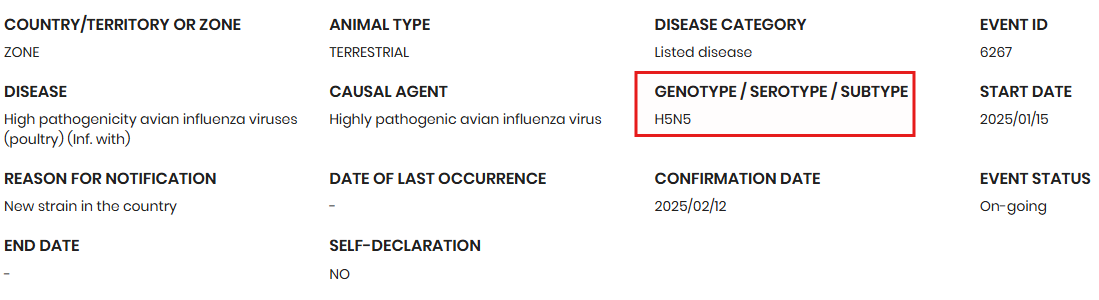
More from the WOAH report posted by Lance:
...
EPIDEMIOLOGICAL COMMENTS
On January 24, 2025, the Canadian Food Inspection Agency (CFIA) was notified of mortality in a non-commercial backyard layer poultry farm in Newfoundland and Labrador. The CFIA National Centre for Foreign Animal Disease has confirmed on February 12, 2025 that the virus was H5N5. The HA of the H5 virus from the samples belongs to Eurasian Gs/GD lineage HPAI H5N1 (2.3.4.4b) with cleavage site motif of “PLREKRRKR/GLF”, compatible with HPAI viruses. The sample contained AI virus similar to European like - H5N5 (2023) viruses which came to Canada via the Atlantic flyway. The viruses contained wholly Eurasian H5N5 genome segments. The CFIA has immediately quarantined the IP and is implementing strict movement controls and a stamping out policy. Primary control zone (PCZ) has been put in place around the IP. Surveillance is ongoing in the affected areas. WOAH data on poultry and non-poultry can be visualized and extracted on the AI dashboard in domestic birds available at https://cahss.ca/cahss-networks/poultry-new (select poultry categories to show data related to HPAI poultry events 4294, 5229, 6003, and 6267). Wildlife surveillance as well as the Canadian Notifiable Avian Influenza Surveillance System (CanNAISS) activities for poultry are ongoing in Canada.
...
...
EPIDEMIOLOGICAL COMMENTS
On January 24, 2025, the Canadian Food Inspection Agency (CFIA) was notified of mortality in a non-commercial backyard layer poultry farm in Newfoundland and Labrador. The CFIA National Centre for Foreign Animal Disease has confirmed on February 12, 2025 that the virus was H5N5. The HA of the H5 virus from the samples belongs to Eurasian Gs/GD lineage HPAI H5N1 (2.3.4.4b) with cleavage site motif of “PLREKRRKR/GLF”, compatible with HPAI viruses. The sample contained AI virus similar to European like - H5N5 (2023) viruses which came to Canada via the Atlantic flyway. The viruses contained wholly Eurasian H5N5 genome segments. The CFIA has immediately quarantined the IP and is implementing strict movement controls and a stamping out policy. Primary control zone (PCZ) has been put in place around the IP. Surveillance is ongoing in the affected areas. WOAH data on poultry and non-poultry can be visualized and extracted on the AI dashboard in domestic birds available at https://cahss.ca/cahss-networks/poultry-new (select poultry categories to show data related to HPAI poultry events 4294, 5229, 6003, and 6267). Wildlife surveillance as well as the Canadian Notifiable Avian Influenza Surveillance System (CanNAISS) activities for poultry are ongoing in Canada.
...

Shiloh
Editor, Senior Moderator
Source: https://vocm.com/2025/03/15/avian-influenza-hits-domestic-flock-in-nl/
Avian Influenza Hits Domestic Flock in NL
Mar 15, 2025 | 3:14 PM
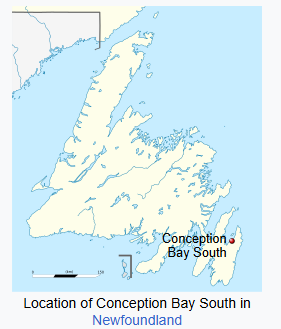
A case of avian influenza has turned up in a domestic flock in Conception Bay South.
The highly pathogenic virus continues to circulate in wild birds since an original outbreak in 2021, with ongoing risk to the poultry sector.
The Canadian Food Inspection Agency is leading the investigation..
Avian Influenza Hits Domestic Flock in NL
Mar 15, 2025 | 3:14 PM
A case of avian influenza has turned up in a domestic flock in Conception Bay South.
The highly pathogenic virus continues to circulate in wild birds since an original outbreak in 2021, with ongoing risk to the poultry sector.
The Canadian Food Inspection Agency is leading the investigation..
Pathfinder
Editor, Senior Moderator
/https://en.wikipedia.org/wiki/Conception_Bay_South
----------------------------------------------------------------
Public Advisory: Poultry Owners Urged to Protect Commercial and Backyard Flocks from Avian Influenza
March 14, 2025
Animal health officials with the Department of Fisheries, Forestry and Agriculture have reported a suspected case of highly pathogenic avian influenza (H5) in a domestic flock in Conception Bay South to the Canadian Food Inspection Agency.
Avian influenza continues to circulate in wild birds since an original outbreak in late 2021, with ongoing risk to the poultry sector. The Canadian Food Inspection Agency is leading the investigation and providing updates at Latest Bird Flu Situation.
Commercial poultry producers follow strict biosecurity plans and procedures to prevent the spread of avian influenza and other disease. All commercial and backyard poultry producers, regardless of the size of their flocks, are urged to review the Canadian Food Inspection Agency’s biosecurity measures to ensure flocks are protected from exposure to wild birds.
Signs of bird flu include:
Provincial officials are working with federal agencies including the Canadian Food Inspection Agency and Environment and Climate Change Canada to help limit the spread of avian influenza in Newfoundland and Labrador. If you find a dead, injured or sick wild bird, report it to Canadian Wildlife Health Cooperative online, call 1-866-544-4744 or email atlantic@cwhc-rcsf.ca. Do not touch or handle dead, sick or injured birds.
Avian influenza viruses rarely infect humans, but people in close contact with infected birds may be at increased risk. Consult the Public Health Agency of Canada publication, Human health issues related to avian influenza in Canada for more information.
-30-
2025 03 14 8:40 pm
https://www.gov.nl.ca/releases/2025/ffa/0314n05/
/https://en.wikipedia.org/wiki/Conception_Bay_South
----------------------------------------------------------------
Public Advisory: Poultry Owners Urged to Protect Commercial and Backyard Flocks from Avian Influenza
March 14, 2025
Animal health officials with the Department of Fisheries, Forestry and Agriculture have reported a suspected case of highly pathogenic avian influenza (H5) in a domestic flock in Conception Bay South to the Canadian Food Inspection Agency.
Avian influenza continues to circulate in wild birds since an original outbreak in late 2021, with ongoing risk to the poultry sector. The Canadian Food Inspection Agency is leading the investigation and providing updates at Latest Bird Flu Situation.
Commercial poultry producers follow strict biosecurity plans and procedures to prevent the spread of avian influenza and other disease. All commercial and backyard poultry producers, regardless of the size of their flocks, are urged to review the Canadian Food Inspection Agency’s biosecurity measures to ensure flocks are protected from exposure to wild birds.
Signs of bird flu include:
- lack of energy, movement or appetite
- decreased egg production
- swelling around the head, neck and eyes
- coughing, gasping for air or sneezing
- nervous signs, tremors or lack of coordination
- diarrhea
- sudden death
- Canadian Food Inspection Agency: 709-772-4424 or
- Provincial Animal Health Division
- St. John’s: 709-729-6879/after-hours 709-729-6899
- Clarenville 24-hours: 709-466-2808
- Pynn’s Brook 24-hours: 709-686-2672
- Prevent contact between poultry and wild birds or other animals.
- Frequently clean coops, feeders and waterers, clothing and boots.
- Watch for and report signs of avian influenza and report.
- Limit visitors to your property.
- Keep new birds separate from your flock for at least 30 days to avoid introducing disease.
Provincial officials are working with federal agencies including the Canadian Food Inspection Agency and Environment and Climate Change Canada to help limit the spread of avian influenza in Newfoundland and Labrador. If you find a dead, injured or sick wild bird, report it to Canadian Wildlife Health Cooperative online, call 1-866-544-4744 or email atlantic@cwhc-rcsf.ca. Do not touch or handle dead, sick or injured birds.
Avian influenza viruses rarely infect humans, but people in close contact with infected birds may be at increased risk. Consult the Public Health Agency of Canada publication, Human health issues related to avian influenza in Canada for more information.
-30-
2025 03 14 8:40 pm
https://www.gov.nl.ca/releases/2025/ffa/0314n05/