

Michael Coston
Editor, Senior Moderator
#NatlPrep: Preparing For Extreme Space Weather

Credit NOAA
Note: This is the 15th day of National Preparedness Month. Follow this year’s campaign on Twitter by searching for the #NatlPrep #BeReady or #PrepMonth hashtags.
#18,299
Despite some of the more hyperbolic headlines I'm seeing on social media and on YouTube videos this morning, yesterday's CME producing X4.5 solar flare is only likely to deliver a moderate, glancing blow the earth (probably tomorrow).
NOAA's forecast (see below) calls for strong G3 geomagnetic storm conditions, which could have some negative impacts on the power grid, communications, and other electrical systems. Not insignificant, but not catastrophic either.
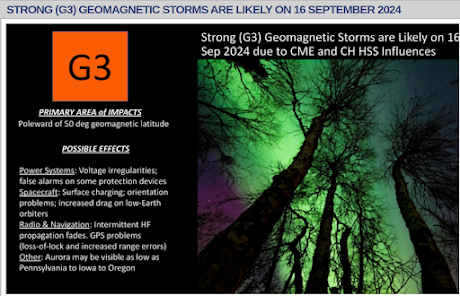
That said, we are approaching the peak of solar maximum, and additional eruptive flares are possible from this sunspot (3825) as it transits into a more earth-directed position in the days ahead. Multiple CMEs (Coronal Mass Ejections) can also sometimes combine, to make a more powerful impact.
And of course, 3825 is just one of hundreds of sunspots that will form on the sun's surface over the remainder of solar cycle 25, any of which could produce a much larger eruption.
No one can predict when the next major solar storm will strike earth, but in 2012 the earth narrowly missed being hit by a massive solar storm, one that - had it been earth-directed - could have caused extensive damage to our electrical grid and electronic infrastructure (see NASA: The Solar Super Storm Of 2012).
In 2014, NASA produced a 4-minute video on this close-call, along with a history of great solar storms and their probable effects on our modern infrastructure. Highly recommended.

Solar flares the size of the 1859 `Carrington Event’ or the 2012 CME don't happen very often, and in order to affect earth, the flare or CME must be directed towards earth.
Still, in 1989 a geomagnetic storm fried several large power transformers in Quebec, causing a province-wide blackout. And in 2003, a number of satellites were severely damaged by an extremely powerful CME that also caused some power outages in Europe.
Over the past couple of decades we’ve become increasingly dependent upon computers, the Internet, cell phones, electronic devices, and of course . . . the electrical grid.
So with each passing year our vulnerability to the effects of these storms increases.
Whether due to an earthquake, a hurricane, or even a solar storm - a certain amount of preparedness just makes good sense.
So . . . if a disaster struck your region today, and the power went out, stores closed their doors, and water stopped flowing from your kitchen tap for the next 7 to 14 days . . . do you already have:
A good place to get started is by visiting Ready.gov, which has their own page devoted to preparing for severe space weather.
.
https://afludiary.blogspot.com/2024/09/natlprep-preparing-for-extreme-space.html
Credit NOAA
Note: This is the 15th day of National Preparedness Month. Follow this year’s campaign on Twitter by searching for the #NatlPrep #BeReady or #PrepMonth hashtags.
This month, as part of NPM24, I’ll be rerunning some updated preparedness essays, along with some new ones.
#18,299
Despite some of the more hyperbolic headlines I'm seeing on social media and on YouTube videos this morning, yesterday's CME producing X4.5 solar flare is only likely to deliver a moderate, glancing blow the earth (probably tomorrow).
NOAA's forecast (see below) calls for strong G3 geomagnetic storm conditions, which could have some negative impacts on the power grid, communications, and other electrical systems. Not insignificant, but not catastrophic either.
That said, we are approaching the peak of solar maximum, and additional eruptive flares are possible from this sunspot (3825) as it transits into a more earth-directed position in the days ahead. Multiple CMEs (Coronal Mass Ejections) can also sometimes combine, to make a more powerful impact.
And of course, 3825 is just one of hundreds of sunspots that will form on the sun's surface over the remainder of solar cycle 25, any of which could produce a much larger eruption.
No one can predict when the next major solar storm will strike earth, but in 2012 the earth narrowly missed being hit by a massive solar storm, one that - had it been earth-directed - could have caused extensive damage to our electrical grid and electronic infrastructure (see NASA: The Solar Super Storm Of 2012).
In 2014, NASA produced a 4-minute video on this close-call, along with a history of great solar storms and their probable effects on our modern infrastructure. Highly recommended.
Solar flares the size of the 1859 `Carrington Event’ or the 2012 CME don't happen very often, and in order to affect earth, the flare or CME must be directed towards earth.
Still, in 1989 a geomagnetic storm fried several large power transformers in Quebec, causing a province-wide blackout. And in 2003, a number of satellites were severely damaged by an extremely powerful CME that also caused some power outages in Europe.
Over the past couple of decades we’ve become increasingly dependent upon computers, the Internet, cell phones, electronic devices, and of course . . . the electrical grid.
So with each passing year our vulnerability to the effects of these storms increases.
- In 2017, in USGS: Preparing The Nation For Severe Space Weather, we saw an analysis that suggests Extreme space weather-induced electricity blackouts could cost U.S. more than $40 billion daily, potentially trillions over a year.
- Eighteen months ago, in FEMA: Preparing the Nation for Space Weather Events, we looked at a a free online training course - for emergency managers and the general public - on preparing the nation for space weather events.
- In 2023, the UK's 2023 Edition Of the National Risk Register For Civil Emergencies, estimated there was a 5-25% chance of seeing a `significant'solar storm event' in the next 5 years. The scenario they used was not the `worst case', but rather one based on the 1859 Carrington event.
Whether due to an earthquake, a hurricane, or even a solar storm - a certain amount of preparedness just makes good sense.
So . . . if a disaster struck your region today, and the power went out, stores closed their doors, and water stopped flowing from your kitchen tap for the next 7 to 14 days . . . do you already have:
- A battery operated NWS Emergency Radio to find out what was going on, and to get vital instructions from emergency officials
- A decent first-aid kit, so that you can treat injuries
- Enough non-perishable food and water on hand to feed and hydrate your family (including pets) for the duration
- A way to provide light when the grid is down.
- A way to cook safely without electricity
- A way to purify or filter water
- A way to stay cool (fans) or warm when the power is out.
- A small supply of cash to use in case credit/debit machines are not working
- An emergency plan, including meeting places, emergency out-of-state contact numbers, a disaster buddy, and in case you must evacuate, a bug-out bag
- Spare supply of essential prescription medicines that you or your family may need
- A way to entertain yourself, or your kids, during a prolonged blackout
A good place to get started is by visiting Ready.gov, which has their own page devoted to preparing for severe space weather.
.
https://afludiary.blogspot.com/2024/09/natlprep-preparing-for-extreme-space.html