
• FluTrackers.com Inc. does not provide medical advice. Information on this web site is collected from various internet resources, and the FluTrackers board of directors makes no warranty to the safety, efficacy, correctness or completeness of the information posted on this site by any author or poster. The information collated here is for instructional and/or discussion purposes only and is NOT intended to diagnose or treat any disease, illness, or other medical condition. Every individual reader or poster should seek advice from their personal physician/healthcare practitioner before considering or using any interventions that are discussed on this website. By continuing to access this website you agree to consult your personal physican before using any interventions posted on this website, and you agree to hold harmless FluTrackers.com Inc., the board of directors, the members, and all authors and posters for any effects from use of any medication, supplement, vitamin or other substance, device, intervention, etc. mentioned in posts on this website, or other internet venues referenced in posts on this website.
  • We are not asking for any donations. Do not donate to any entity who says they are raising funds for us.

Nat Commun . Human neutralizing antibodies target a conserved lateral patch on H7N9 hemagglutinin head

tetano

Editor, Senior Moderator
Nat Commun


. 2024 May 27;15(1):4505.
doi: 10.1038/s41467-024-48758-4. Human neutralizing antibodies target a conserved lateral patch on H7N9 hemagglutinin head

Manxue Jia[SUP] #[/SUP][SUP] 1 [/SUP], Hanjun Zhao[SUP] #[/SUP][SUP] 2 3 [/SUP], Nicholas C Morano[SUP] #[/SUP][SUP] 1 4 [/SUP], Hong Lu[SUP] 1 [/SUP], Yin-Ming Lui[SUP] 2 [/SUP], Haijuan Du[SUP] 5 [/SUP], Jordan E Becker[SUP] 1 4 [/SUP], Kwok-Yung Yuen[SUP] 2 3 6 [/SUP], David D Ho[SUP] 1 [/SUP], Peter D Kwong[SUP] 1 5 [/SUP], Lawrence Shapiro[SUP] 1 4 5 [/SUP], Kelvin Kai-Wang To[SUP] 7 8 9 [/SUP], Xueling Wu[SUP] 10 [/SUP]


Affiliations
Abstract

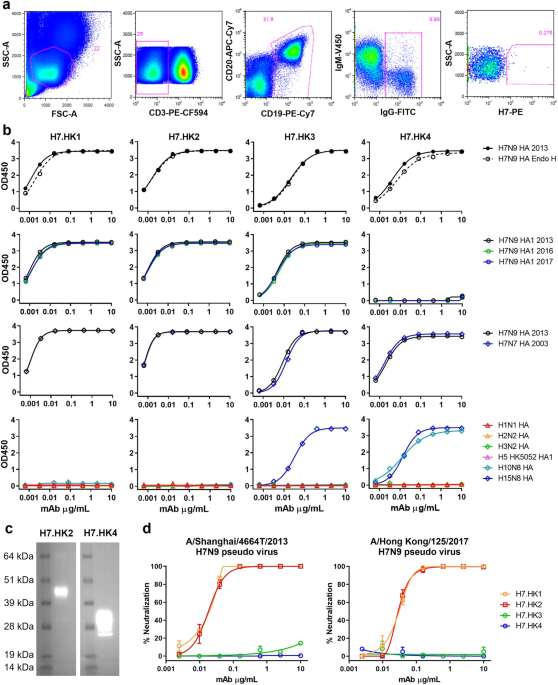
Avian influenza A virus H7N9 causes severe human infections with >30% fatality. Currently, there is no H7N9-specific prevention or treatment for humans. Here, from a 2013 H7N9 convalescent case in Hong Kong, we isolate four hemagglutinin (HA)-reactive monoclonal antibodies (mAbs), with three directed to the globular head domain (HA1) and one to the stalk domain (HA2). Two clonally related HA1-directed mAbs, H7.HK1 and H7.HK2, potently neutralize H7N9 and protect female mice from lethal H7N9/AH1 challenge. Cryo-EM structures reveal that H7.HK1 and H7.HK2 bind to a β14-centered surface and disrupt the 220-loop that makes hydrophobic contacts with sialic acid on an adjacent protomer, thereby blocking viral entry. Sequence analysis indicates the lateral patch targeted by H7.HK1 and H7.HK2 to be conserved among influenza subtypes. Both H7.HK1 and H7.HK2 retain HA1 binding and neutralization capacity to later H7N9 isolates from 2016-2017, consistent with structural data showing that the antigenic mutations during this timeframe occur at their epitope peripheries. The HA2-directed mAb H7.HK4 lacks neutralizing activity but when used in combination with H7.HK2 moderately augments female mouse protection. Overall, our data reveal antibodies to a conserved lateral HA1 supersite that confer neutralization, and when combined with a HA2-directed non-neutralizing mAb, augment protection.


 
H7N9 antibodies

We found two human monoclonal antibodies, H7.HK1 and H7.HK2, which achieve broad and potent neutralization and mouse protection against H7N9. These antibodies target a distinct lateral patch on the hemagglutinin head, thus making them favorable to complement other antibodies for combination therapy.
Published in Biomedical Research and Immunology
May 31, 2024
Xueling Wu, Andrew Wang & Nicholas C Morano
3 contributors
e400ca3b-c993-4763-8293-35587ecf1e4a_large.jpeg


Read the paper

Nature
Nature
Human neutralizing antibodies target a conserved lateral patch on H7N9 hemagglutinin head - Nature Communications

Here the authors isolate two human antibodies, H7.HK1 and H7.HK2, that achieve broad and potent neutralization against H7N9 influenza by targeting a distinct lateral patch on the hemagglutinin head, thus making them favorable to complement other antibodies for combination therapy.

H7N9 is a strain of avian influenza first discovered to infect humans in China in 2013 – a couple of decades after the related avian and equine influenza H7N7 and later avian H5N1 emerged in humans. Cases of H7N9 have been reported after recent exposure to live poultry or contaminated environments, particularly markets where live birds are sold. Although the virus doesn’t transmit easily between people, gaining the ability to do so could be detrimental to public health. There have already been sporadic outbreaks where patients suffered from H7N9’s high mortality rate of >30%. Due to H7N9’s ability to infect humans and avians, high case-fatality rate, resistance to neuraminidase inhibitors, and lack of pre-existing immunity in the human population, vaccines and therapeutics are in urgent demand.

Influenza viruses infect host cells through the viral hemagglutinin (HA) head region (HA1) first attaching to the host cell receptor sialic acid, facilitating the virus entering the host cell in an endosome, and then mediating the viral and endosomal membrane fusion through the fusion peptide in the stalk region of HA (HA2). From a 2013 H7N9 convalescent case in Hong Kong, we identified two human monoclonal antibodies, H7.HK1 and H7.HK2, which target HA1, potently neutralize H7N9, and protect mice from a lethal H7N9/AH1 challenge.

What makes H7.HK1 and H7.HK2 special is that they target the β14-centered lateral patch of HA1 and disrupt the 220-loop required for sialic acid interactions on an adjacent HA protomer, thus blocking viral entry. In contrast, previous antibodies target the HA receptor binding site (RBS) and HA trimer interface. Since H7.HK1 and H7.HK2 do not cross compete with previous RBS and non-RBS directed antibodies, there is potential for H7.HK1 or H7.HK2 and other antibodies to work together at once to fight H7N9.

Part of what makes H7N9 so dangerous is its ability to evolve at a rapid pace: the virus, and particularly its HA gene, changed significantly from 2013 to 2016 and 2017. Because numerous changes occurred in the RBS, most RBS antibodies that were effective against the 2013 virus aren’t as effective against the 2016 and 2017 variants. However, against these newly mutated viruses, H7.HK1 and H7.HK2 maintain effectiveness while previous RBS antibodies fell short due to new H7N9 mutations. Evaluated by HA1 protein binding, H7.HK1 and H7.HK2 recognize the genetically related H7N7 virus equally well.

Further analysis of the lateral patch targeted by H7.HK1 and H7.HK2 has uncovered new possibilities for vaccine research. Targeting the lateral patch on influenza H1 viruses had already gained popularity for next-generation vaccines due to the abundance of H1 lateral-patch binding antibodies and its broad range of reactions with most H1 and some H3 viruses. A similar approach could be effective with H7 viruses. Comparing the H1 and H7 lateral patches reveal conserved residues and an overall conserved structure between H1 and H7. Additionally, this site is targeted by several antibodies via different chemistries and modes of recognition. These properties make the lateral patch especially vulnerable and a promising target for vaccine design.

Finally, the study experimented with an HA2-directed antibody, H7.HK4. Because HA2 is genetically more conserved than HA1, HA2 antibodies usually recognize HA subtypes more broadly than HA1 antibodies. Including HA2 antibodies has the potential to broaden and improve the protective efficacy of antibody therapy, making them invaluable for the regimen against H7N9 and other influenza viruses.

In the post COVID-19 era, preparedness for future pandemics has become a high priority. Respiratory viruses have proven the crippling damage they can inflict, so we must remain cognizant of potential risks and proactive in developing treatments. Because of its high mortality rates, rapid evolution, and lack of antidotes, H7N9 presents a menacing threat requiring continuous attention. Our discoveries of the four monoclonal antibodies mark a significant finding in fighting H7N9. These antibodies can perform just as well as previous ones in terms of virus neutralization but also come with bonuses of being able to complement other antibodies and fighting newer strands of the virus. Continued research and investment into the four antibodies – H7.HK1, H7.HK2, H7.HK3, and H7.HK4 – is necessary to bring these effective antibodies to clinics so they can mitigate the threat of H7N9 on public health.
+2
Multiple Contributors
Xueling Wu, Nicholas C Morano & Andrew Wang
View all​
:tiphat:
https://communities.springernature.com/posts/h7n9-antibodies
 
Back
Top