Re: NASA - Curiosity has Landed on Mars
<TABLE border=0 cellSpacing=0 cellPadding=10 width=700 align=center><TBODY><TR><TD align=center>

</TD></TR><TR><TD>
08.09.2012
A Set of Blast Marks in Color, Right Side
</TD></TR><TR><TD>This cut-out from a color panorama image taken by NASA's Curiosity rover shows the effects of the descent stage's rocket engines blasting the ground. It comes from the right side of the thumbnail panorama obtained by Curiosity's Mast Camera.
(See PIA16029.)
Image Credit: NASA/JPL-Caltech/MSSS
http://mars.jpl.nasa.gov/msl/multimedia/images/?ImageID=4382
<TABLE border=0 cellSpacing=0 cellPadding=10 width=700 align=center><TBODY><TR><TD align=center>
</TD></TR><TR><TD>
08.08.2012
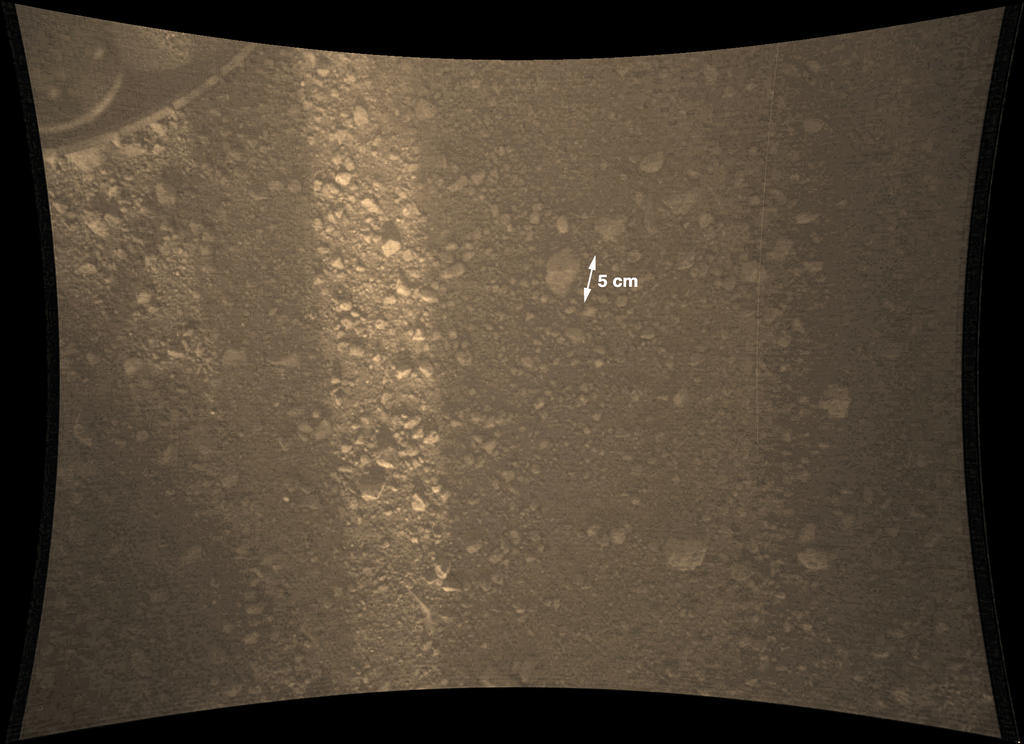
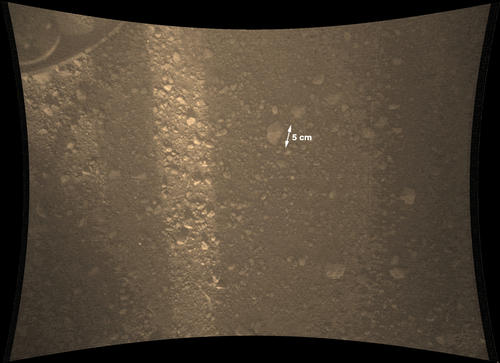
Pebble-Covered Martian Surface
</TD></TR><TR><TD>This full-resolution color image from NASA's Curiosity Rover shows the pebble-covered surface of Mars. It was taken by the Mars Descent Imager (MARDI) several minutes after Curiosity touched down on Mars.
The camera is about 30 inches (70 centimeters) from the surface as the rover sits on the ground. The image pixel scale is about 0.02 inches (0.5 millimeters), but the camera is slightly out of focus at this distance, so the actual ground scale is about 0.06 inches (1.5 millimeters). A sliver of sunlight passing through the structure of the rover illuminates the surface. The largest rock fragment in the image is about 2 inches (5 centimeters) long. Most are much smaller. A rover wheel is visible at the top left.
This is the 1,008th image that MARDI took. The original image from MARDI has been geometrically corrected to look flat. Curiosity landed inside of a crater known as Gale Crater.
Image Credit: NASA/JPL-Caltech/MSSS
</TD></TR></TBODY></TABLE>
http://mars.jpl.nasa.gov/msl/multimedia/images/?ImageID=4341
<TABLE border=0 cellSpacing=0 cellPadding=10 width=700 align=center><TBODY><TR><TD align=center>
</TD></TR><TR><TD>
08.08.2012
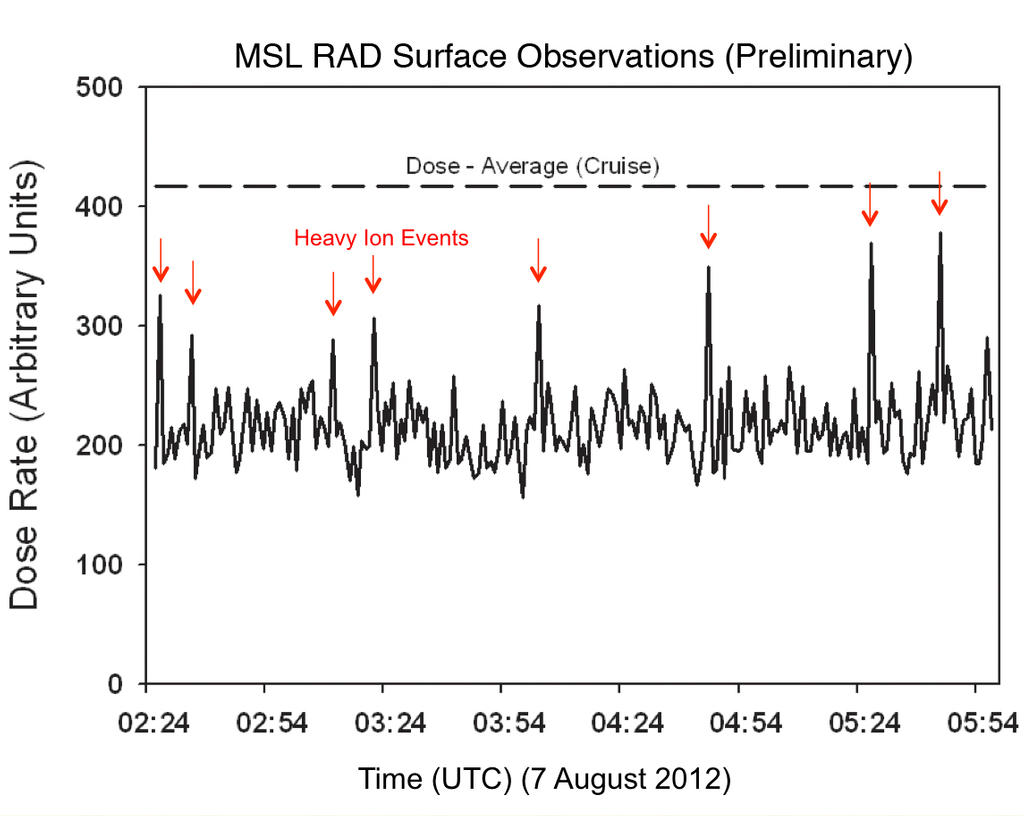
Curiosity's First Radiation Measurements on Mars
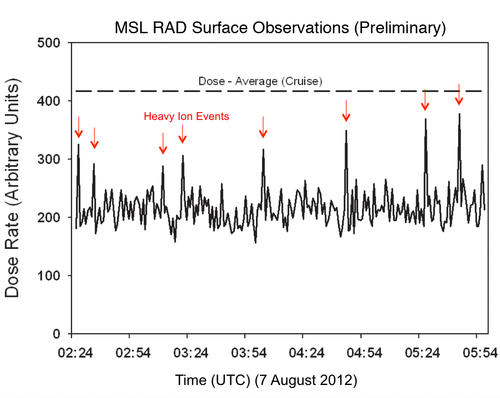
</TD></TR><TR><TD>Like a human working in a radiation environment, NASA's Curiosity rover carries its own version of a dosimeter to measure radiation from outer space and the sun. This graphic shows the flux of radiation detected by Curiosity's Radiation Assessment Detector (RAD) on Mars over three and a half hours on Aug. 6 PDT (Aug. 7 UTC). The data show that the radiation levels measured on Mars during this period of quiet solar activity are reduced from the average radiation detected in space during Curiosity's cruise to Mars. This is explained by the rover being on the planet versus out in space, where it would have more exposure to radiation from all directions. Red arrows point to spikes in the radiation dose rate from heavy ion particles, which would be the most dangerous to astronauts.
During the course of the mission, scientists will study the variation of the radiation levels as a function of solar activity to understand and model the effects of the Martian atmosphere on radiation dose rates. Scientists and engineers will use this information to improve our understanding of how the radiation environment affects habitability for possible Martian microbial life, and, in addition, to help design the best kind of shielding needed for human beings on the surface.
RAD measures 26 kinds of charged particles as well as neutrons and gamma rays. Understanding how the flux of these different particles change with time is an important objective for RAD
Image Credit: NASA/JPL-Caltech/SWRI
</TD></TR></TBODY></TABLE>
http://mars.jpl.nasa.gov/msl/multimedia/images/?ImageID=4338
More images...
http://mars.jpl.nasa.gov/msl/multimedia/images/
</TD></TR></TBODY></TABLE>