Re: mortality statistics
http://eurpub.oxfordjournals.org/content/early/2011/05/19/eurpub.ckr062.full.pdf
(2011)
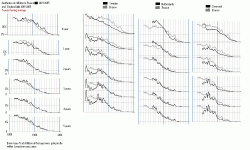
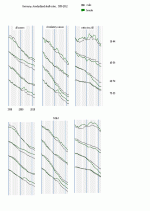
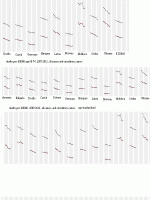
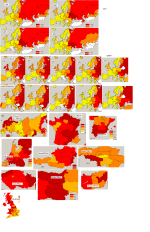
The rates are generally lowest in France in all groups, as previously observed.15
high rates, e.g. Indian and Pakistani born, and Eastern European born,4
low rates, e.g. the Chinese
the rates vary in some country of birth groups across countries,
indicating that either
(i) information systems differ, creating artefacts or
(ii) country-specific context may be important to disease outcome or
(iii) that differences existed between the same country of birth groups
in differing countries in social circumstances prior to migration.
Notably, while people born outside France, except the Chinese immigrants,
have higher circulatory disease mortality than the France born, their rates
were lower than in their counterparts in other countries.
do variations relate to socio-economic position, cardiovascular risk factors etc.
European data sets are not yet ready to answer such questions,
French (North–South/Mediterranean) Paradox
suggests that disease outcomes may be influenced by the local context, whether
this is health care, diagnostic methods and coding, availability of data in
surveillance systems, social and economic standing, stress, lifestyle,
migration history, social circumstances and health prior to
migration or other environmental factors. These variations are
extremely unlikely to be genetic.
This has led to the phrase ‘the French paradox’.29
the French paradox seemingly applies to people born outside France but
living there.
NI-HON-SAN Study of Japanese in Japan, Honolulu and San
Francisco.8It demonstrated convergence of cardiovascular risks
and risk factors among migrants, and showed the protection
against such diseases by maintenance of traditional behaviours
rather than rapid acculturation
8 Marmot MG, Syme SL, Kagan A, et al. Epidemiologic studies of coronary heart
disease and stroke in Japanese men living in Japan, Hawaii and California:
prevalence of coronary and hypertensive heart disease and associated risk factors.
Am J Epidemiol 1975;102:514–25.
15 Mu¨ller-Nordhorn J, Binting S, Roll S, Willich SN. An update on regional variation
in cardiovascular mortality within Europe. Eur Heart J 2008;29:1316–26.
[ no mentioning of Quebec ]
--------------------------------------------------------------------------
The French paradox concept was formulated by French epidemiologists3 in the 1980s
2. Artaud-Wild SM, Connor SL, Sexton G, et al. Differences in coronary mortality can be
explained by differences in cholesterol and saturated fat intakes in 40 countries but not
in France and Finland. A paradox. Circulation 1993;88:2771–9.
France and Finland have similar intakes of cholesterol and saturated fat, but consumption
of vegetables and vegetable oil containing monounsaturated and polyunsaturated fatty acids
is greater in France than in Finland. [PubMed]
------------------------------------------------------------------
http://en.wikipedia.org/wiki/French_paradox
http://www.ncbi.nlm.nih.gov/pmc/articles/PMC3898438/
cheese ?
http://www.ncbi.nlm.nih.gov/pubmed/22981595
-------------------------------------------------------------------
1940,que,all,32799,7365,568,447,692,842,926,850,898,1031,1187,1495,1849,2135,2512,2871,2788,2347,1994
1940,que,can, 3831, 16, 9, 5, 26, 20, 52, 71, 93, 179, 231, 330, 413, 501, 546, 510, 453, 236, 140
1940,que,dia, 538, 6, 1, 4, 7, 7, 8, 12, 6, 15, 16, 34, 62, 80, 93, 85, 56, 38, 8
1940,que,cer, 448, 0, 1, 2, 1, 4, 3, 1, 4, 6, 12, 24, 23, 37, 51, 77, 74, 72, 56
1940,que,cir, 7139, 19, 19, 23, 37, 48, 65, 82,117, 188, 298, 407, 553, 637, 833,1023,1048, 948, 794
1940,ont,all,38503,3567,326,317,490,540,587,667,895,1047,1398,2095,2657,3244,3924,4582,4871,3982,3299
1940,ont,can, 5127, 15, 6, 11, 24, 20, 26, 69,121, 206, 309, 475, 582, 612, 697, 721, 623, 402, 206
1940,ont,dia, 691, 0, 0, 4, 5, 5, 8, 4, 3, 8, 25, 39, 60, 93, 129, 111, 118, 60, 19
1940,ont,cer, 901, 0, 0, 1, 4, 4, 3, 6, 9, 15, 28, 44, 67, 90, 110, 141, 159, 118, 102
1940,ont,cir,14497, 8, 13, 12, 31, 39, 57, 81,139, 237, 404, 704, 992,1418,1759,2207,2521,2095,1775
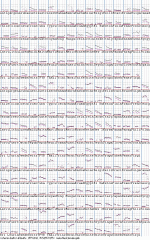
year,province,condition, deaths by age >=0,0-4,5-9,...,80-84,>84
1921,cdn,1840,----,1332,1495,1292,----,2001,1398,1086,1057,2013
1926,cdn,1808,----,1915,1860,1647,1186,2577,1631,1294,1508,2092
1930,cdn,2103,----,2248,2159,1773,1454,2849,2025,1699,1747,2355
1940,cdn,3140,----,2915,2903,2710,2313,3999,3174,2839,2813,3337
1950,cdn,3842,1695,4374,3861,3377,2870,4704,3929,3745,3641,4235
1960,cdn,4965,3854,5411,5156,4989,4404,5407,5022,4851,4503,5280
1970,cdn,4961,4754,5517,5103,5219,4723,5218,4944,5031,4479,4885
year,cdn,cdn_,nfld,pei_,ns__,nb__,que_,ont_,mani,sask,alta,bc__
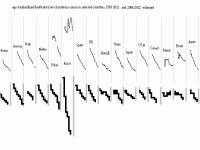
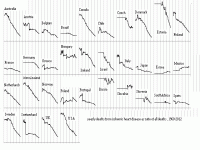
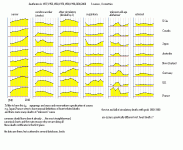
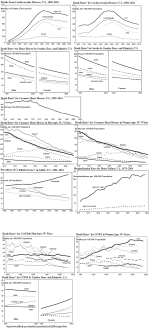
% of deaths from cardiovascular causes ,
cdn,nfd,pei,ns_,nb_,que,ont,man,sas,alb,bc_
=========================================================
more sources for CVD-deaths subsumed to the keyword Quebec here
association between poor living standards and ischemic heart disease
by a detailed geographical comparison of infant mortality in 1920-1939
and death in adults from ischemic; heart disease and other leading causes
in 1990-1994. Ischemic heart disease [r = 0.325] and malignant tumors
of digestive apparatus [r = 0.562] are strongly correlated with infant mortality.
A significant difference was observed in both infant and overall mortality rates
between the western and eastern counties. Our results suggest that the
geographical distribution of ischemic heart disease in Hungary reflects later
dietary influences.
or antibodies
or organic changes
-------------------------------------------------------------------------
[in Sweden] at age 50, we found a significant inverse association of education
with cholesterol level, LDL/HDL ratio and ApoB/ApoA1 ratio. Cholesterol was
also associated with occupational class, statistically significant after adjustment
for all covariates. At age 70, no significant associations were found between either
measurement of SEP and any of the biomarkers studied. Highest educated men
had decreased risk for CVD mortality during follow-up.
---------------------------------------------------------------------------
Long-term wine consumption is related to cardiovascular mortality and life
expectancy independently of moderate alcohol intake: the Zutphen Study.
---------------------------------------------------------------------------
35846 people born 1920-1959 with mortality follow-up 1961-2005.
630 died from CHD , inverse association of head circumference with deaths
from CHD (Ptrend = 0.010). The association was modified by maternal height
(Pinteraction = 0.01) and by adult body mass (Pinteraction = 0.05).
People in the lowest third of head circumference, who had a tall mother or a
high body mass index in adulthood, were at the highest risk of death from CHD.
Head circumference at birth was inversely associated with deaths from CHD,
and the combination of small head and tall mother, or small head and high
adult body mass, was associated with the highest risk. These findings suggest
that combined effects of genetic factors (growth potential and intrauterine growth)
and non-genetic factors acting throughout the life course (intrauterine growth
restriction and later weight gain) could mediate the effects of birth size on adult heart disease.
=----------------------------------------------------------------------------------
Dietary fiber intake in relation to coronary heart disease and all-cause mortality
over 40 y: the Zutphen Study.
---------------------------------------------------------------------------------
Long-term fish consumption and n-3 fatty acid intake in relation to (sudden)
coronary heart disease death: the Zutphen study.
----------------------------------------------------------------------------------------
15.[Sex mortality differences in Denmark 1840-2005. Women live longer than men,
but great changes during the last 50 years].
---------------------------------------------------------------------------------
Cohort patterns in mortality trends among the elderly in seven European countries, 1950-99.
METHODS: A standard age-period-cohort analysis was applied to all-cause and
cause-specific mortality data by 5-year age groups and sex, for Denmark, England
and Wales, Finland, France, The Netherlands, Norway, and Sweden, in the period 1950-99.
RESULTS: Cohort patterns were identified in all countries, for both the sexes and virtually
all causes of death. They strongly influenced the trends in all-cause mortality among
Danish, Dutch, and Norwegian men, and the trends in mortality from infectious diseases,
lung cancer (men only), prostate cancer, breast cancer, and chronic obstructive pulmonary
disease (COPD). All-cause mortality decline stagnated among Danish, Dutch, and
Norwegian male birth cohorts born between 1890 and 1915, among French men born
after 1920, and among women from all countries born after 1920. Where all-cause mortality
decline stagnated, cohort patterns in mortality from lung cancer, COPD, and to a lesser
extent ischaemic heart diseases, were unfavourable as well. For infectious diseases,
stomach cancer, and cerebrovascular diseases, mortality increased among cohorts
born before 1890, and decreased strongly thereafter.
CONCLUSIONS: Cohort effects related to factors such as living conditions in childhood
and smoking in adulthood were important in determining the recent trends in mortality
among the elderly in seven European countries.
-----------------------------------------------------------------------------------------
substantial genetic influence on individual frailty associated with mortality caused by CHD.
------------------------------------------------------------------------------------------
Height is not associated with long-term survival after acute myocardial infarction.
---------------------------------------------------------------------------------------------
Both a previous aptitude for endurance athletic events and continuity of vigorous physical
activity seem to be associated with protection against coronary heart disease, but an
aptitude for power speed events does not give protection against coronary heart disease.
------------------------------------------------------------------------------------------
[in Sweden] Birth weight showed a specific, inverse association with mortality from circulatory
diseases: the rate ratio was 0.67 (95% confidence interval 0.50 to 0.89) per 1000 g increase
in birth weigh
----------------------------------------------------------------------------------------
former aerobic sports athletes (endurance and mixed sports) in particular have high total
and active life expectancy and low risk for ischemic heart disease and diabetes in later years.
----------------------------------------------------------------------------------------------
Low weight at 1 year is associated with concentric enlargement of the left ventricle in adult life.
Left ventricular mass was not related to birth weight
higher mortality from cardiovascular disease in men of low weight at 1 year
---------------------------------------------------------------------------
[in England] Men who had been bottle fed also had a high standardised mortality ratio for
ischaemic heart disease (95; 68 to 130) and high mean serum concentrations of total
cholesterol (7.0 mmol/l), low density lipoprotein cholesterol (5.1 mmol/l), and apolipoprotein
B (1.14 g/l). In all feeding groups serum apolipoprotein B concentrations were lower in men
with higher birth weight and weight at 1 year.
--------------------------------------------------------------------------------------
ncreased risk of death from ischaemic heart disease in
men who had been breast fed and not weaned at one
year (standardised mortality ratio 97) compared with
those who were weaned at one year (SMR 79) and
those who had been breast and bottle fed (SMR 73).5
-------------------------------------------------------
y, was caused by a change in food processing that occurred after 1920,
when the new oil seed industry introduced into our food three greatly harmful lipid substances.
The unnatural trans-trans isomer of linoleic acid, which had never been in human food prior
to 1920 and which entered our food in margarines and refined oils, blocked the conversion
of natural cis-cis linoleic acid to prostaglandin E1, which tends to prevent MI, both by acting
as a vasodilator and by minimizing platelet aggregation. Harmful lactones were also introduced
into our food, increasing the risk of MI by decreasing the fibrinolytic activity of our blood.
The oil seed industry also introduced into our diet free radical lipid peroxides that



 IM A(M,49,23),N(M,4),N$(M,28)
 RINT N(F,I);:NEXT