• FluTrackers.com Inc. does not provide medical advice. Information on this web site is collected from various internet resources, and the FluTrackers board of directors makes no warranty to the safety, efficacy, correctness or completeness of the information posted on this site by any author or poster. The information collated here is for instructional and/or discussion purposes only and is NOT intended to diagnose or treat any disease, illness, or other medical condition. Every individual reader or poster should seek advice from their personal physician/healthcare practitioner before considering or using any interventions that are discussed on this website. By continuing to access this website you agree to consult your personal physican before using any interventions posted on this website, and you agree to hold harmless FluTrackers.com Inc., the board of directors, the members, and all authors and posters for any effects from use of any medication, supplement, vitamin or other substance, device, intervention, etc. mentioned in posts on this website, or other internet venues referenced in posts on this website.
  • We are not asking for any donations. Do not donate to any entity who says they are raising funds for us.

Monsoon floods kill more than 1,600 in Pakistan's, 20 million people affected - Red Alert

Re: Monsoon floods kill more than 1,600 in Pakistan's, 15 million people affected - Red Alert

Re: Monsoon floods kill more than 1,600 in Pakistan's, 15 million people affected - Red Alert

UN scales up aid delivery to flood-hit Pakistan despite huge logistical challenges

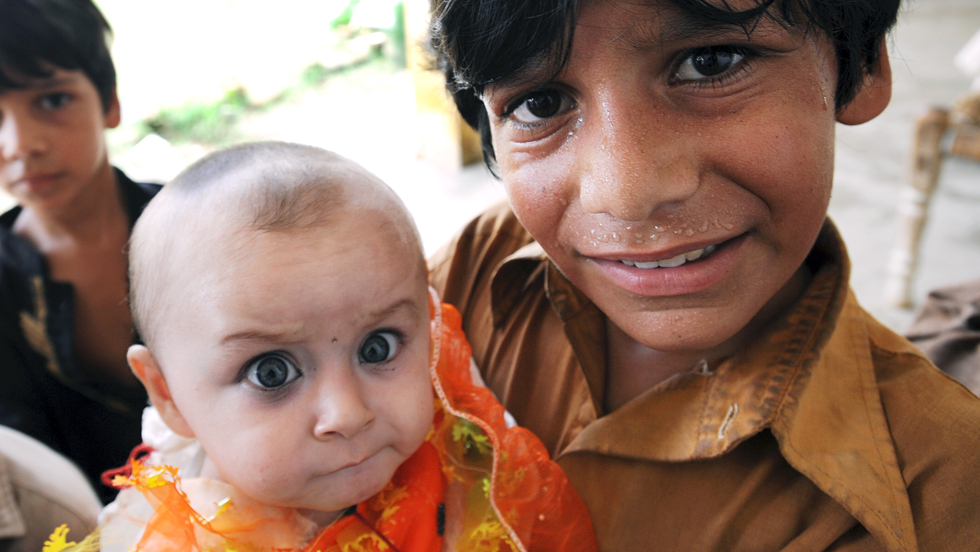
08-17-wfp-pkstan1.jpg
Flood victims collect one-month rations at distribution point in hard-hit Peshawar district

17 August 2010 ? Efforts by the United Nations agencies to scale up aid delivery to those affected by the massive floods in Pakistan continued today despite enormous logistical challenges posed by the devastated infrastructure that has left many areas accessible only by air after roads and bridges were destroyed by the deluge.

?We?re putting the final pieces in place on a distribution system which can reach the huge number of people in need in the shortest possible time,? said Wolfgang Herbinger, the country director of the UN World Food Programme (WFP) in Pakistan.

?It?s a huge challenge, particularly in Sindh [province], where the delivery infrastructure is most constrained.

?We have assessments completed in most of the country so we know where needs are, we have NGO partners to do the distributions, and ? at least for now ? a steady supply of food leaving our warehouses,? Mr. Herbinger added.

The agency expects food distributions to have reached 1 million people with a one-month food ration by today. At least 6 million people are estimated to be in need of assistance, with the Red Crescent Society, Government departments, local authorities, businesses and private individuals all working in tandem with WFP to fill the food gap.

Distributions in Punjab and Sindh provinces have been gathering pace since the weekend, while deliveries in Balochistan started yesterday, according to WFP. Food aid distribution in Khyber Pakhtunkhwa (KPK) province has been ongoing since 1 August. Hardest hit areas and communities are being prioritised where possible.

Trucks are being forced to take long detours to reach many distribution sites, causing delays and longer turnaround times before they can be loaded with further food supplies.

Helicopters are the only viable means to reach many areas which have been cut off, and WFP is in the process of moving three heavy-lift helicopters to Pakistan to join the 10 that have already been made available by the Pakistani Government.

In many areas of the Swat Valley, people have devised local solutions, picking up food from distribution sites and taking it home on their shoulders across areas where roads have been washed away. In the mountainous Shangla district, mules have been made available to help people get food home.

In an effort to ensure a continuous supply of food to those affected by the floods, WFP has set up new logistics hubs and warehouse facilities at Multan in Punjab and Sukkur in Sindh. The agency said it had enough food stocks currently for a first round of distributions, but will need significant additional donor support to continue assisting those affected in September.

WFP has so far received just over $30 million of the $150 million it needs for its operation in Pakistan in the next three months.

?Food, trucks, helicopters and manpower ? it all costs money. We are making a very urgent and direct appeal to the international community to redouble their support to our efforts to assist the people of Pakistan,? said Mr. Herbinger.

The UN High Commissioner for Refugees (UNHCR) said it will today airlift a further 32 tons of plastic tarpaulins, soap and mosquito nets to Quetta aboard two cargo planes belonging to Pakistan.

Some 64 tons of tents, plastic sheets and other relief supplies were flown in yesterday on four flights from a UNHCR warehouse in Peshawar. The supplies will be used to meet the needs of the soaring number of flood-affected people in Balochistan currently camping on roadsides or seeking shelter in schools, stadiums and other public facilities.

?UNHCR continues to face a logistical challenge in getting aid in fast enough to meet this still unfolding crisis,? Andrej Mahecic, a UNHCR spokesperson, told reporters in Geneva. ?In Balochistan, for example, people still need everything ? shelter, food, clean drinking water and health and hygiene systems. Our supplies are dwindling. We need more airlifts and massive amounts of funding to meet the still unfolding crisis,? he added.

Meanwhile, flood waters have receded in parts of KPK, revealing the magnitude of devastation, but also giving UNHCR better access to communities to provide relief and assess their immediate and longer term needs.

Teams of UNHCR staff in KPK have observed more people returning to their damaged homes, clearing debris and sorting through the mud to try to salvage furniture and other belongings.

UNHCR technical staff are also in the field assessing damage to houses and the best way to provide transitional shelter to help those who can return. Latest estimates put the number of destroyed or badly damaged homes in the province at some 893,000, meaning shelter is likely to remain one of the key priorities for months to come.

The UN Children?s Fund (UNICEF), for its part, warned that funding shortfalls could jeopardize its work in Pakistan, saying it lacked resources for its water and sanitation operation, even as millions of children remained at risk of waterborne diseases.

?We urgently need to scale up the distribution of water. If we are not able to do so because of lack of funding, waterborne diseases such as cholera, diarrhoea and dysentery will spread and begin killing affected populations, especially children, already weak and vulnerable to disease and malnutrition,? said Martin Mogwanja, UNICEF?s representative in Pakistan.

He said UNICEF was providing enough clean water to an estimated 1.3 million people every day, but millions more remained in need.

Polio and measles are the other threats to the health of children in Pakistan, according to UNICEF, which is working with WHO and the Government to carry out vaccinations against the two diseases in relief centres. UNICEF is also supplying oral rehydration salts, a home based treatment for diarrhoea, but funding constraints meant that available supplies are limited.

The UN Population Fund (UNFPA), meanwhile, reported that among the flood-affected population, nearly 52,500 women are expected to give birth in the next three months and about 53,000 newborns will need health care. More than 9,000 of those women will need surgical interventions to address pregnancy-related complications in the immediate future.

?Millions of Pakistanis are suffering from this disaster and they need international solidarity,? said UNFPA?s Executive Director Thoraya Ahmed Obaid. ?Women have special needs because they continue to give birth, regardless of the dangers surrounding them, and require timely medical care to ensure a safe delivery.?

UNFPA has deployed seven mobile service units that are fully staffed and equipped to provide emergency reproductive health care and psychosocial support to the affected communities. In addition, UNFPA is supporting 13 Government health facilities in 10 districts of the three affected provinces of KPK, Sindh and Punjab.

The Fund has also provided emergency reproductive health medicines, women?s hygiene kits, newborn kits and clean delivery kits that serve the needs of thousands of Pakistani women. It will also help distribute nearly 2,000 birthing kits. UNFPA estimates that it will have a shortfall of $8.8 million for its efforts to meet the basic reproductive health needs of the affected population in Pakistan during the next three months.

http://www.un.org/apps/news/story.asp?NewsID=35641&Cr=Pakistan&Cr1=
 
Re: Monsoon floods kill more than 1,600 in Pakistan's, 15 million people affected - Red Alert

Re: Monsoon floods kill more than 1,600 in Pakistan's, 15 million people affected - Red Alert

70 villages of Punjab submerged; Jheel Magsi on red alert
Submitted 10 mins ago

As many as 70 villages have been inundated as unrestrained floodwater battered Punjab once again. Gushing water entered into Shehar Sultan and Rohailanwali City. In Sindh, the floodwater showed no sign of mercy as flood warning has been issued to Jheel Magsi. Pakistan's worst floods in recorded history began more than two weeks ago in the mountainous northwest and have spread throughout the country. Some 20 million people and 62,000 square miles (160,000 square kilometers) of land — about one-fifth of the country — have been affected. The UN children's agency warned 3.5 million children were at high risk of deadly waterborne disease such as diarrhea and cholera. It said it did not have enough funds to distribute clean water to victims, or give them medical care. Helpless affectees reached Benazir Bhutto's tomb in Garhi Khuda Bakhsh when no one stepped in for their help. A breach has been occurred in safety embankment on Sindh River near Village Bangal Khan Bardi and inundated 10 villages.

http://www.nation.com.pk/pakistan-n...-of-Punjab-submerged-Jheel-Magsi-on-red-alert
 
Re: Monsoon floods kill more than 1,600 in Pakistan's, 15 million people affected - Red Alert

Re: Monsoon floods kill more than 1,600 in Pakistan's, 15 million people affected - Red Alert

Disease hovers over Pakistan's flood-stricken children

By Michael Georgy
CHARSADDA | Wed Aug 18, 2010 12:21pm EDT


CHARSADDA Pakistan (Reuters) - As Pakistan's floodwaters rushed into Bakhmina Said's mud-brick home, she grabbed medical records of her daughter's heart condition, put them in a metal trunk and headed to high ground.

Eighteen days later, one-year-old Naeema sleeps on a mat in sweltering heat at a fly-infested camp, with no fan, no chance of seeing a cardiologist anytime soon and at risk of catching other potentially fatal diseases in cramped, un-hygienic conditions.

"Who will treat her? The doctors said she has a hole in the wall of her heart," said Said, also worried because one of her six other children has fallen ill after the floods.

The United Nations has warned that up to 3.5 million children could be in danger of contracting deadly diseases carried through contaminated water and insects in a crisis that has disrupted the lives of at least a tenth of Pakistan's 170 million people.

It's a long list of growing risks -- endemic watery diarrhea, endemic cholera, endemic upper respiratory infections.

...

Read more:
http://www.reuters.com/article/idUSTRE67H3CS20100818
 
Re: Monsoon floods kill more than 1,600 in Pakistan's, 15 million people affected - Red Alert

Re: Monsoon floods kill more than 1,600 in Pakistan's, 15 million people affected - Red Alert

"WE ARE IN A HELPLESS SITUATION"

CNN_logo.gif
Homepage


Pakistan Flood: Photos


1.jpg
PETER BIRO/The International Rescue Committee

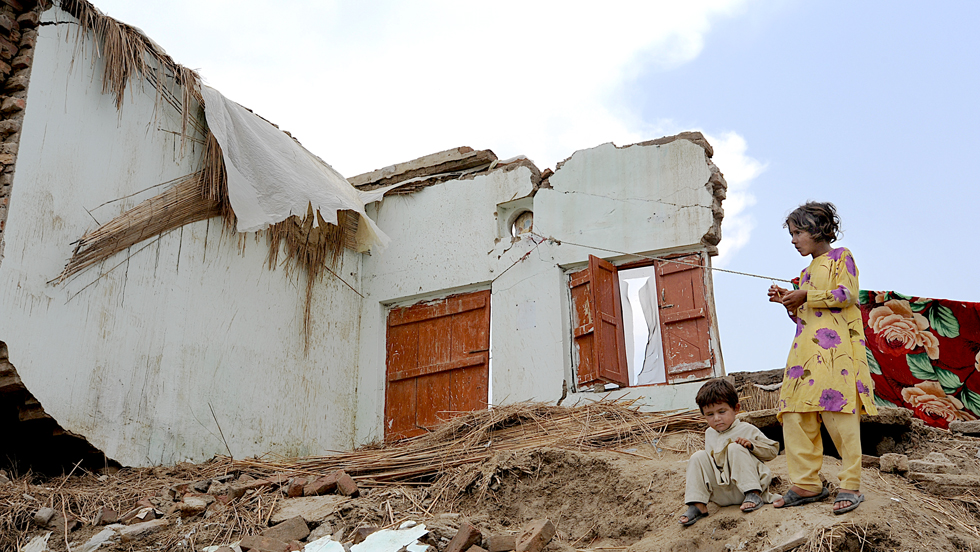
More than 1,400 people have been killed and a staggering 20 million people have been affected by devastating monsoon rains in Pakistan. Entire villages, roads, bridges and millions of hectares of crops have been washed away by the ongoing deluge.

2.jpg
PETER BIRO/The International Rescue Committee

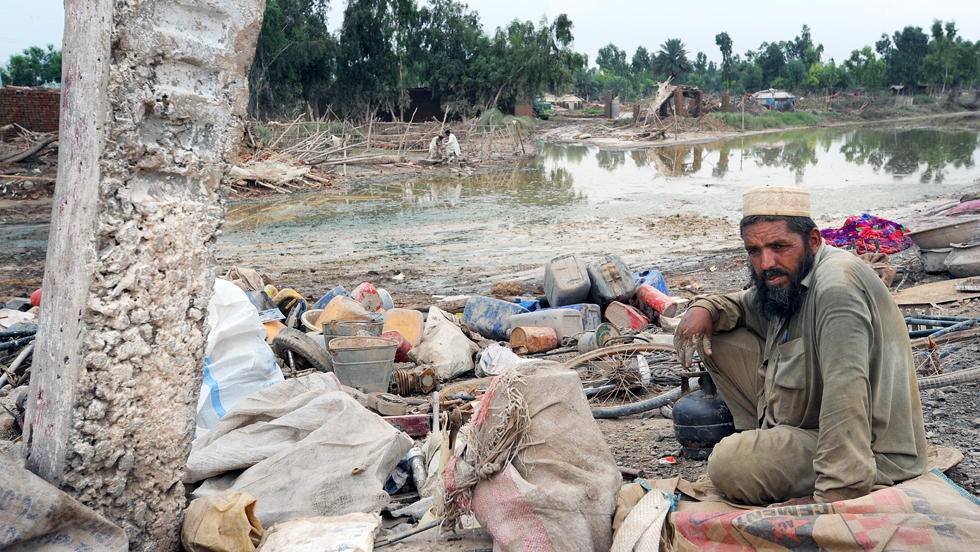
A refugee from Afghanistan sits amid the rubble that was formerly his home in the Azakhel camp near the city of Peshawar in Nowshera district, Khyber Pakthunkhwa province. The entire camp, which housed about 30,000 people, was crushed by water when the nearby Kabul River bursts its dams.

3.jpg
PETER BIRO/The International Rescue Committee

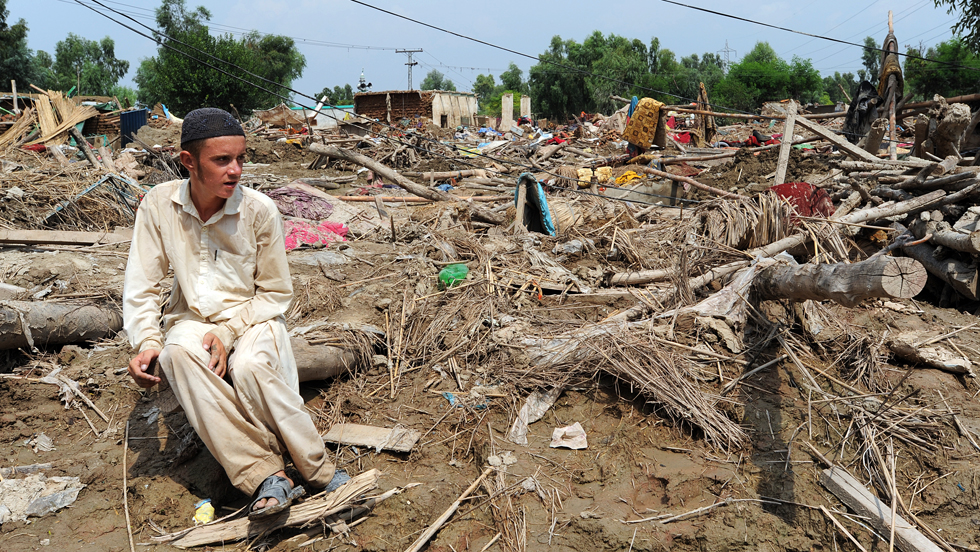
Almost all the mud houses at Azakhel camp have been turned into clay mounds and twisted debris.

6.jpg
PETER BIRO/The International Rescue Committee

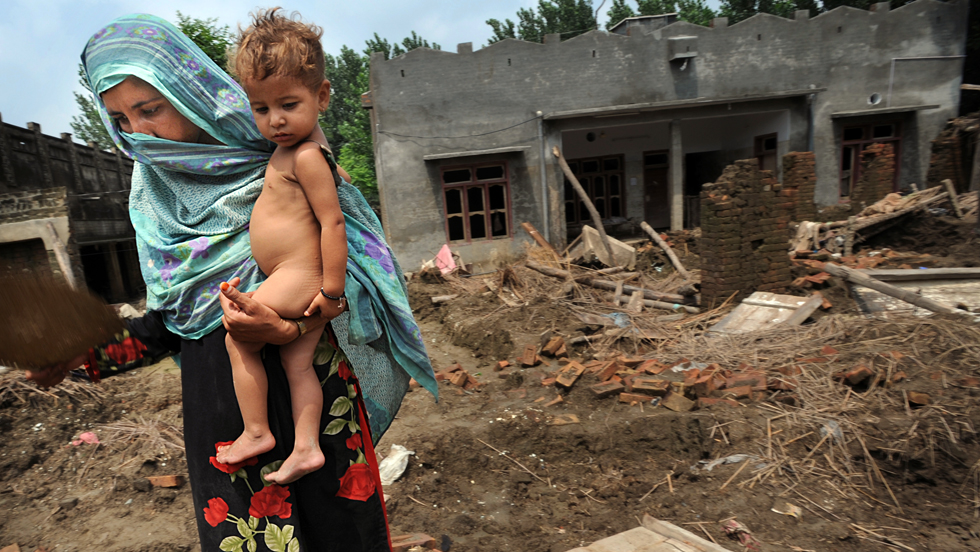
Zubadia Razia, 20, walks through the mud and rubble that was once her home in the devastated Charsadda district. She is looking for a suitcase she kept clothes in, but it is nowhere to be found. Large areas were damaged when three rivers in the district -- the Jindi, Kabul and Swat -- overflowed.

10.jpg
PETER BIRO/The International Rescue Committee

A boy and his young sister await the distribution of aid. The United Nations has warned that a shortage of aid money is threatening 6 million people, the majority of them children and infants, with potentially lethal diseases carried by contaminated water.

More photos:
http://edition.cnn.com/interactive/2010/08/world/gallery.large.pakistan.flood/aug.17.html
 
Re: Monsoon floods kill more than 1,600 in Pakistan's, 20 million people affected - Red Alert

General Assembly hears calls for global solidarity to help flood-hit Pakistan

08-19-ban.jpg
Secretary-General Visits Camp for Pakistanis Displaced by Flood on August 15 2010

19 August 2010 ? Speaker after speaker took the floor at a special meeting of the United Nations General Assembly today to call for global solidarity to help flood-hit Pakistan in the wake of the country?s worst disaster in living memory and for generous support for vital relief operations.

?Make no mistake: this is a global disaster, a global challenge. It is one of the greatest tests of global solidarity in our times,? Secretary-General Ban Ki-moon told the 192-member body, which adopted a resolution calling for international assistance in support of the Government?s efforts to address the crisis.

Mr. Ban, who visited the flood-stricken country on Sunday, said Pakistan is facing a ?slow-motion tsunami,? with needs expected to grow, even as 15 to 20 million people currently need shelter, food and emergency care.

?That is more than the entire population hit by the Indian Ocean tsunami, the Kashmir earthquake, Cyclone Nargis and the earthquake in Haiti, combined,? he stated, adding that at least 160,000 square kilometres of land is under water ? an area larger than more than half the countries of the world.

The Secretary-General thanked the international community for the generosity it has shown so far, especially in response to the $460 million requested by the UN and its partners through the Pakistan Initial Floods Emergency Response Plan that was launched last week, which is now 47 per cent funded.

Underscoring that the needs are great, and the disaster is far from over, Mr. Ban asked nations to respond urgently to the emergency response plan and help humanitarian agencies deliver the food, water, shelter and health care that millions in Pakistan so desperately need.

More than 45 speakers, including high-level officials from a number of countries, were scheduled to address the meeting, which is taking place on World Humanitarian Day, which is dedicated to the memory of all those aid workers who have lost their lives while bringing assistance to others, and to increase awareness of relief activities worldwide.

?Today?s meeting is demonstrative of the international community?s commitment to act, an opportunity to step forward and show to the people and the Government of Pakistan that we are ready and willing to assist them in every possible way,? said the President of the Assembly, Ali Treki.

He called on Member States to donate generously in the face of the ?unprecedented humanitarian disaster? unfolding in Pakistan. ?This is an extraordinary emergency situation. It requires an extraordinary response,? he stated.

The floods, which began late last month in the wake of particularly heavy monsoon rains and which have destroyed homes, farmland and major infrastructure in large parts of the country, have claimed more than 1,200 lives.

Earlier today the top UN relief official in Pakistan warned that if humanitarian assistance for clean water, food, shelter and health care is not provided soon enough, there could be a second wave of deaths caused by waterborne diseases.

?The death toll in this disaster has miraculously been far lower than in some other major recent natural disasters and we wish to keep it that way,? UN Humanitarian Coordinator Martin Mogwanja told reporters in New York, speaking from Pakistan.

The World Health Organization (WHO) also urged greater donor support for health projects in Pakistan, where more than 200 health facilities have been damaged or destroyed, adding that reports from the field already indicate a significant rise in the number of cases of acute watery diarrhoea, skin infections and malaria.

?It is crucial that all humanitarian health providers, local and national, coordinate their relief efforts closely to save lives, reduce suffering and deliver the most effective response,? said WHO?s Representative in Pakistan, Guido Sabatinelli.

Mr. Mogwanja noted that a food crisis is also possible given that thousands of hectares of crops which were due to be harvested in the next four weeks in most parts of the country have now been destroyed. It is therefore vital for food aid to reach those affected as soon as possible.
In the longer-term, he added, it will be necessary to assist in rebuilding livelihoods as well as public infrastructure such as roads, bridges, telecommunications, power lines and irrigation canals.

?The people of Pakistan are depending on the people of the world,? he stressed.

Among those addressing the Assembly today was the Foreign Minister of Pakistan, Makhdoom Shah Mehmood Qureshi, who thanked the international community for the generosity it has shown so far and urged greater efforts to assist the Government and people of the South Asian nation. During a meeting with the Secretary-General ahead of the Assembly session, Mr. Qureshi welcomed the leadership and commitment of the UN in the response to the disaster. He and Mr. Ban also discussed further steps and meetings over the coming months to bolster the relief and recovery efforts.

http://www.un.org/apps/news/story.asp?NewsID=35670&Cr=pakistan&Cr1=
 
Re: Monsoon floods kill more than 1,600 in Pakistan's, 20 million people affected - Red Alert

Flood waters threatens to submerge Thatta; forces mass exodus in Pakistan
Published: Saturday, Aug 28, 2010, 23:02 IST
Place: ISLAMABAD | Agency: PTI

Flood waters today breached more protective dykes and threatened to submerge the southern city of Thatta and nearby regions forcing a mass exodus, even as the UN warned that an estimated 72,000 children were at "high risk of death" due to malnutrition.

Pakistan's worst floods have affected 17 million of its population. Triggered a month ago by unusually heavy monsoon rains, the flood waters have made their way south after wreaking havoc in the northwest and central parts of the country.

A fresh wave of flooding in the flatlands of Sindh has displaced one million people since Wednesday.

The total number of people affected in the province is seven million. Tens of thousands of people have already fled Thatta, which was further threatened today after the swollen Indus river broke through more bunds and dykes.

Officials said it could take up to three days to repair the new breaches. The situation in flooded areas of Sindh province has been exacerbated by high tides in the Arabian Sea, which have forced the waters of the Indus to flow back inland.

Aid agencies are becoming increasingly worried about malnutrition among children in flooded areas.

"If nothing is done, an estimated 72,000 children, currently affected by severe acute malnutrition in the flood-affected areas, are at high risk of death," said Martin Mogwanja, the UN humanitarian coordinator in Pakistan.

"We are responding to the threat of malnutrition and must do so even more assertively," he said.

Even before the floods, acute malnutrition was high across the country. Twenty-seven per cent of children under five years were malnourished in Balochistan while the figures for Khyber-Pakhtunkhwa and Punjab were 13% and 17% respectively.

"We must act together to ensure that already malnourished children do not succumb to disease, and to prevent more from becoming malnourished and ill," said Mogwanja.

The UNICEF warned of the fallout of the "deadly synergy" of waterborne diseases like diarrhoea and malnutrition in flooded areas.

It said it was addressing this threat through vaccinations, provision of clean water, and the supply of water purification tablets and hygiene kits.

The floods have already killed over 1,700 people and affected 20 million. They have also inflicted billions of dollars of damage to homes, infrastructure and agriculture.

Flood victims in Sindh and other parts of the country have complained that not enough aid is being provided to them. In most flooded areas, the government has struggled to provide food, water and shelter to the displaced.

At several places, the survivors blocked roads to protest the shortage of relief materials.

The International Organisation for Migration, which is coordinating efforts by aid agencies to provide shelter to the displaced, said over 115,000 tents and 88,500 plastic sheets had been provided to 159,500 families.

However, it pointed out that over 642,000 families still required shelter support.

http://www.dnaindia.com/world/repor...thatta-forces-mass-exodus-in-pakistan_1430142
 
Re: Monsoon floods kill more than 1,600 in Pakistan's, 20 million people affected - Red Alert

Monday, August 30, 2010


Floods inundate Sujawal town

* Town centre under five feet of water

* Thatta-Sujawal road closed

* Nearby grid station flooded

* Soldiers, workers on ?war footing? to save Thatta city

KARACHI: Two hundred and fifty thousand residents fled Sujawal as floodwaters inundated the town while authorities struggled to build new levees with clay and stone to prevent flooding.

?Almost all of 250,000 residents fled the town before the water rushed in,? said Hadi Baksh, a disaster management official. Authorities rushed to build makeshift levees across the road connecting Sujawal and Thatta, parts of which were already flooded, Baksh said.

The floodwaters that hit Sujawal on Sunday surged into the town after breaking through a levee on the swollen Indus River two days earlier. Authorities in Sujawal were trying to limit the flood damage, but the water level had risen up to five feet in the centre of the town and 10 feet in the surrounding villages, said Anwarul Haq, the top official in Sujawal. Many of the people who fled Sujawal and Thatta headed to Makli necropolis. ?About half a million flood victims are camped out in Makli,? Baksh said. Most lack any form of shelter and are desperate for food and water.

Road closed: An AFP reporter said the road linking Thatta with Sujawal had been flooded and closed to all vehicular traffic, while a senior city official Hadi Bakhsh Kalhoro told AFP that an electricity grid station near Sujawal had been flooded. The military said its engineers had repaired an important embankment in the south and were trying to protect the highway linking Thatta with Karachi.

Battle for Thatta: Meanwhile, soldiers and workers struggled on ?war footing? on Sunday as they battled to save Thatta after most of the population of 300,000 fled the city in the face of advancing floodwaters. Soldiers worked frantically to repair breached levees on the Indus River. ?The water is still two kilometres away from Thatta, where the armed forces and the local administrative workers are working on war footing to save the city,? senior city official Hadi Bakhsh Kalhoro told AFP. Water levels were still rising in the district, but Kalhoro said, ?We are hopeful that we can at least save Thatta city in two days.? agencies

http://www.dailytimes.com.pk/default.asp?page=2010\08\30\story_30-8-2010_pg1_1
 
Re: Monsoon floods kill more than 1,600 in Pakistan's, 20 million people affected - Red Alert

Thursday, September 02, 2010

Flood submerges several more villages in Sindh

* Over 100 villages inundated in Khairpur Nathan Shah area of Dadu after breach in Main Nara Valley drain

* 13 villages flooded after breach in Larkana Canal

LAHORE: As the flood wave headed to the Arabian Sea, more villages were inundated in Dadu and Larkana districts of Sindh on Wednesday.

A breach in a saline nullah near Larkana inundated at least 13 villages, while two breaches in Main Nara Valley (MNV) drain near Khairpur Nathan Shah flooded more than a hundred villages.

A 20-feet breach developed in MNV drain in Khairpur Nathan Shah, which submerged over 100 villages, including Guza Konb, Bheb, Mehtu Babbar, while thousands of people were marooned. The flood threat now looms large on Dadu city. While in Larkana, 13 more villages were submerged, as efforts to plug the breaches developed in Larkana Canal failed. The flood wave is now heading to Badah tehsil.

At least three protective embankments had been washed away in Qambar Shahdadkot district near Gaji Khavar, causing the entire area to be submerged in water.

A bridge on saline nullah between Gaji Khavar and Dhamra had been washed away, inundating the road. The surging flood tide is now threatening Juhi.

Meanwhile in Thatta district, Sujawal town remains flooded in around four to five feet of water. The water is receding on the dykes of Bachalpur, Mud Mangli, Mekaro Dhoro and Lakhat near Nawabshah. On the other hand, gastroenteritis is rapidly spreading among the flood relief camps in interior Sindh. In the last 26 days, 65 flood-affected people, including women and children, lost their lives due to gastroenteritis. On Wednesday, at least two people died in Chohar district of Thatta, while two children died due to the deadly disease in Shikarpur.
Kotri: The Indus River is still flowing in ?very high flood? at Kotri Barrage, where water outflow was recorded at 788,000 cusecs on Wednesday. The ?very high flood situation? at Kotri Barrage is expected to continue during the next week. Water level in all the barrages in Khyber Pakhtunkhwa and Punjab had started receding. daily times monitor/agencies


http://www.dailytimes.com.pk/default.asp?page=2010/09/02/story_2-9-2010_pg7_1
 
Re: Monsoon floods kill more than 1,600 in Pakistan's, 20 million people affected - Red Alert

Sunday, September 05, 2010

Floodwaters continue to devastate Sindh towns

* 450 villages have been submerged in Dadu

* Sindh Irrigation Department says water levels have reached dangerous heights

Daily Times Monitor

LAHORE: Floodwaters, responsible for Pakistan?s worst natural disaster, continued to wreck havoc in Sindh while relief and rehabilitation work was being carried out in different parts of Punjab and Khyber Pakhtunkhwa, as the floodwaters had receded there, a private TV channel reported on Saturday.

The breach in the Suprio protective embankment, which was the last defence line of Mehar city in Dadu district, had widened to 45 feet, deluging at least five villages in the city. A total of 450 villages in Dadu had been submerged in the floodwaters. The water that broke out from the 30 feet breach in Suprio dyke had been moving towards Mehar, the largest city of Dadu, where people had started mass exodus to safer locations, the TV channel reported. Sindh Irrigation Department personnel could not make it to the breach site even after the lapse of several hours, contributing to the constantly widening of the breach. People living near the breach were busy with efforts to save the breach but a surging torrent caused difficulties for them. People fled from the Sita Road Town in Dadu, as a stream of water moved towards the town after submerging Khairpur Nathan Shah, while the areas were already 90 percent under floodwater with some people marooned in the flooded city waiting to be rescued, the TV channel reported.

In lower Sindh, floodwaters were advancing to Golarchi town in Badin after drowning Jati town. The flood victims of Jati and Chuhar Jamali towns had moved to Thatta, Makli and Hyderabad for safety. Jacobabad had been surrounded by floodwaters for the last 23 days. The land link of the city with other areas had not been restored until now. Thousands of flood victims in Naseerabad, Balochistan were living in camps and roadsides without any help. The people, due to lack of proper food and medicines, were suffering from gastroenteritis, malaria, skin and eye diseases.

Separately, water level reached dangerous heights in Hamal and Manchhar lakes with FP dyke under mounting water pressure. The water pouring from the MNV drain breach, roared towards the Indus Highway at Dur Muhamed Baro village. Hamal Lake situated in Qambar Shahdadkot district burgeoned to over 12 feet, causing a huge erosion at FP dyke, the TV channel reported.
According to the Sindh Irrigation Department, the water level had reached a dangerous height and the high officials had been primed about the issue. The officials said that the Hamal Lake had an eight-inch capacity, adding if the FP dyke breached, the water might move towards Warah, Wagan and Larkana. The Pakistan Army was carrying out relief operations in Punjab and Khyber Pakhtunkhwa, as the floodwaters had receded there.


http://www.dailytimes.com.pk/default.asp?page=2010\09\05\story_5-9-2010_pg7_12
 
Re: Monsoon floods kill more than 1,600 in Pakistan's, 20 million people affected - Red Alert

---snip---

The UN humanitarian affairs office reported new flooding around the town of Dadu near the Indus River in Sindh province, about 330km from the Arabian Sea.
Flood-related health problems continue to increase despite receding waters in many parts of the country. The World Health Organisation reported a spike in suspected malaria cases in Sindh and Baluchistan provinces, while diarrhoea and acute respiratory diseases such as pneumonia continue to plague the disaster zone. More than 4.5 million people have received medical help since the flooding began in late July.

Between 600,000 and 800,000 people have been displaced over the past four days and three towns are under water. About 150,000 people are waiting on a road for assistance, according to what the UN described as rough estimates from staff and local officials in the area.

At least 3.5 million people in Sindh and 6.5 million nationwide have been displaced. "The monsoon season has ended, fresh flooding has not," UN spokesman Maurizio Giuliano said.
---snip---
http://news.smh.com.au/breaking-new...ck-death-toll-rises-to-65-20100905-14vkp.html
 
Re: Monsoon floods kill more than 1,600 in Pakistan's, 20 million people affected - Red Alert

Women and children disproportionately affected by Pakistan floods

Of the nearly 20 million people affected by the floods in Pakistan, approximately 85% are women and children, and around 500,000 are pregnant women.

CARE staff have observed during assessment missions to flood-affected regions that many pregnant women are still living without proper shelter, supplies and food. Flood waters have damaged or destroyed more than 200 hospitals and clinics, and in some areas, female doctors and other staff are not available to provide health services to pregnant women. With limited or no access to health facilities, women are at a greater risk of complications and death related to pregnancy and childbirth.

It is also crucial that new mothers continue breastfeeding to provide the safest nutrition to their babies. There is an urgent need for clean drinking water and additional nutritious food for mothers. To help meet the specific needs of pregnant women, new mothers and children, CARE is distributing water purification tablets to provide clean water, particularly for pregnant women and children who are particularly susceptible to water-borne illness such as diarrhoea.

CARE's mobile health teams are providing primary health care and antenatal care to pregnant women in Khyber Pakhtunkhwa, South Punjab and Sind. Pregnant women are being vaccinated against tetanus, Traditional Birth Attendants have been trained in safe delivery practices, and Lady Health Visitors are assisting female doctors, who are providing all health care to women and girls in mobile health camps and static units.

http://www.reliefweb.int/rw/rwb.nsf/db900SID/KHII-89382G?OpenDocument
 
Re: Monsoon floods kill more than 1,600 in Pakistan's, 20 million people affected - Red Alert

Floods destroyed 7,277 Sindh villages
Published: September 07, 2010
PrintFacebookDiggStumbleUponText Size
KARACHI - The Provincial Disaster Management Authority (PDMA) on Monday said that a total number of 13,15,012 flood affected people are accommodated in 3,551 relief camps set up by the Government of Sindh.
The PDMA also stated that a total number of 7,277 villages are affected due to floodwater, leaving over 7 million people displaced.
It further said that 1,060,680 houses have been damaged, 2,62,264 Cattle died, while crop comprising 2,453,503 area also damaged due to floodwater. The report said that total 186 persons died and 909 persons got injured in flood devastation.

Meanwhile, the Programme Director, Provincial Support Unit Programme Peoples Primary Health Care Initiatives has said that PPHI was providing medical facilities to the flood affected people in 16 flood affected districts. The PPHI said that 10 basic health units that were operational for 24 hours had been fully submerged under water in 13 districts. However, PPHI also provides medical facilities in 305 medical camps, besides, 70 mobile camps moving to facilitate the flood affectees. All the medical camps of PPHI are being looked after by 803 medics and paramedics consisting of 227 male, 103 female, 262 health technicians, 67 LHVs and I19 vaccinators in Sindh. The report stated that 509,913 patients have been treated at these camps, out of which, 189 patients reported of dog bites cases, 51 of snake bite, while 5344 females and 10,339 children were vaccinated.
Besides, 50 deliveries were carried out by female doctors and some 1500 minor procedures of female patients were also performed at medical camps, report added.
The official report said that CDGK uprooted the PPHI medical camp set up at Razaqabad without any reason. In another report released by Sindh Health Department, said that total 10, 99, 375 patients have been treated from August 31 to September 5, 2010 in relief camps all over Sindh.
Health Department said that patients of different diseases are increasing in relief camps as a huge number of 1,86,407 people especially children reported patients of diarrhoea, 34,449 patients of Gastroenteritis, 1,73,592 of acute respiratory infection, 1,29, 265 patients of malaria, 1,96,580 patients of skin disease, 3855 of head stroke, 76413 patients of eye infections and 298,814 patients of other diseases have been treated in all flood affected districts, so far.
While, 2,95,610 patients have been vaccinated for different diseases and 66,352 people have been provided Hepatitis Vaccination. Besides this 426 deliveries were reported in relief camps and 355 cases of snake bites were also reported. In relief camps 355 anti snake vaccines were vaccinated.

http://www.nation.com.pk/pakistan-n...Sep-2010/Floods-destroyed-7277-Sindh-villages
 
Re: Monsoon floods kill more than 1,600 in Pakistan's, 20 million people affected - Red Alert

PAKISTAN: Flood Disaster-Rupees 249 billion losses to agriculture sector

The losses to agriculture sector of the country from deluge have increased to Rs 249 billion against the initial estimates of Rs 244 billion,

According to an initial estimate prepared by the Ministry of Food And Agriculture in coordination with the provincial governments, Azad Jammu and Kashmir government, and Pakistan Space and Upper Atmosphere Research Commission (SUPARCO), the rapid flood damages assessment indicates that 2 million hectares of the cultivated area of field crops is reported to have been destroyed throughout the assessed affected areas. Sources said that there would be an extensive loss in productivity of all kinds of Kharif crops, including rice, sugarcane, cotton, maize and pulses. The sources claimed that the cotton was the most affected crop, as it had to bear a loss of Rs 73 billion. About 0.5 million hectors cotton sowing areas were affected by the flood across the country.

Cotton crop had been sown on 3.2 million hectares, out of which 0.51 million hectares had been completely destroyed, which would lead to decline in production by almost 15 percent (about 2.5 million bales) to 11.5 million bales against the target production of 14 million bales in 2010. The report warned that the country would face serious shortage of cotton as lower production was expected in coming days. Bakkhar, Layyah and Mianwali districts have witnessed the worst damage. In Sindh, cotton crop was destroyed in Sukkur, Khairpur, Ghotki, Naushero Feroze and Benazirabad(Nawabshah) districts.

After cotton crop, the next most affected agriculture crop was the rice production, which is also main source of foreign exchange earning of the country. An amount of Rs 56.3 billion had been lost in damage to rice crop. Countrywide rice production was expected to decline by around 29 percent to 4.35 million tonnes against the original production target of 6.176 million tonnes. Sources claimed that the floodwaters would affect unfavorably Irri-6 paddy growing areas, whereas Basmati rice growing areas would not be affected by the same extent. Sugarcane production will remain about 47 million tonnes against the forecast target of 53.7 million tonnes.

Floods also damaged sugarcane crop areas spread over 0.6 million hectors against the total 1.069 million targeted areas of the commodity. Such damages to areas would equal to a loss of Rs 22 billion to the government in the filed of sugarcane production. This is the initial loss to the government and decrease in white sugar would aggravate the situation and the government would have to spend the precious foreign exchange over the import of while sugar.

Floods also destroyed other crops including maize; mung, mash, chillies and vegetable etc have cost the government more than Rs 100 billion.

Overall, total loss to agriculture sector is around Rs 249 billion at present, which might increase with the passage of time if the floodwater does not recede completely from the affected areas of the country. Sources claimed that the assessment teams made every effort to gather accurate data, the prevailing emergency situation did not always allow for completeness of information. The situation is still evolving and the data are preliminary ? representing only a snapshot for a particular period. Also, access to some areas is still not possible, thus a more detailed assessment will be required when access is restored. According to the World Bank initial estimates crops worth billion have been destroyed. This figure will increase in the near future, as local experts believe that the losses to essential cash crops such as rice, cotton, tobacco and sugarcane could exceed billion.

http://www.ahrchk.net/statements/mainfile.php/2010statements/2811/
 
Re: Monsoon floods kill more than 1,600 in Pakistan's, 20 million people affected - Red Alert

Pakistan: Trauma will remain long after floods have gone

<!--docTitle--><!--Attention ligne utilisée pour l'impression-->Source: Caritas
Date: 28 Sep 2010
By Kamran Chaudhry, Caritas Pakistan

Something of increasing concern to Caritas is the growing trauma among Pakistan's flood victims and its need to be addressed.

"Most of the internally displaced people are poor peasants. Many are severally depressed after seeing their mud houses collapsing, evacuating in a panic and living besides roads or in refugee camps for the past two months," says Riaz Nawab of Caritas Pakistan in Karachi. "The government must arrange adequate psychiatrists besides providing general medical assistance."

Wajid Ali, 26, suffered a nervous breakdown soon after his family was shifted to a government run college turned refugee camp in Karachi.
"Our eight year old son died of electrocution the day raging waters entered our village. A wire from an electricity pole broke and fell on him. He died in a few moments," said his young wife.

more....

http://www.reliefweb.int/rw/rwb.nsf/db900SID/MCOI-89QJDX?OpenDocument
 
Last edited by a moderator:
Re: Monsoon floods kill more than 1,600 in Pakistan's, 20 million people affected - Red Alert

PAKISTAN: Child-labour risks rise across flood zone


New threats to child protection

JACOBABAD, SINDH PROVINCE, 13 October 2010 (IRIN) - Flood victims across Pakistan have been returning home to villages where houses have been reduced to piles of mud and brick, farmland ravaged and streets reduced to swamps.

The family of Gulab Din, 60, returning to their house in a village near the town of Kashmore in Sindh Province after spending over a month in neighbouring Balochistan, is lucky.

?Two rooms in our house are still standing. At least we have some shelter,? he told IRIN as his extended family of nine gathered in the house. But while Gulab and his family are back home, their three buffaloes are not. This means the family, which sold milk to earn a living, now has no means of income.

?I have borrowed some money from a relative, but that Rs 30,000 [US$350] won?t take us very far at all, what with the house to repair, the vegetables to re-plant and some basic items like clothes and kitchen utensils to buy,? Gulab told IRIN. ?I need buffaloes to earn a living, but how am I to get them??

Gulab and his family?s needs are acute. To try and meet them, he is considering allowing his eldest son, Matloob Ahmed, 14, to take up work. ?It will only be for a short time, till we can get back on our feet. Then he can go back to school. I have heard some people have visited areas here to offer good jobs to boys.?

Assessments of damage are still being made, but the National Disaster Management Authority says over 1.9 million houses have been damaged or destroyed leaving over eight million people homeless.

?Problems of child protection, such as child labour, will arise after the relief phase, a little later on as people return home,? Smaranda Popa, chief of the UN Children?s Fund (UNICEF) child protection section, told IRIN. ?When they have nothing but say 10 children, exploitation is likely. Some may be sent to orphanages, some put to work and so on.?

Popa said UNICEF was currently engaged in assessments and analysis to work out a strategy with the government and gauge needs. ?Experiences from other disasters and logical analysis tell us this is always a problem, no matter where the calamity occurs,? she said.

Media reports have indicated children from flood-hit regions are being promised lucrative jobs, taken away from families, and then being used for sex work.

Threat to education

?The risk certainly exists of an increase in child labour, exploitation and there is a threat to education,? Zaheer Hassan at the Islamabad-based Society for the Protection of the Rights of the Child, told IRIN. He said data was being collected on these issues, as so far the focus had been on basic needs such as ?rescue and the provision of food?.

UNICEF says that of the 20 million people affected by floods, 10 million are children, 2.8 million of them aged under five.

An increase in child labour was noted after previous natural calamities such as the 2005 earthquake which hit parts of northern Pakistan and Pakistani-administered Kashmir.

There are fears this pattern could be repeated. ?Children need protection from all kind of risks,? said Hassan.

One issue is that of education. ?I will need my children to help restore the land. I don?t think we can afford to send them to school till that happens,? said Hassan Ali, 40, father of three from a village near the town of Ghotki in Sindh. He is not sure how long that will take.

A district administration official in Jacobabad, who asked not to be named, said: ?The way I see things people will really have no choice but to put every family member to work, including children.? He said though government compensation schemes were being rolled out, these were ?faulty and would help only some?.

Hassan Ali pointed out that for his, and other families, the priority was to get back to some measure of normalcy. ?Everything else, including schooling, is not the main issue right now,? he said.

Khurram Masood, media manager for Save the Children, UK, told IRIN from Islamabad: ?There is a risk of child labour in flood affected areas, especially as in many of these parts people are extremely poor in the first place. It is impossible for now to put a number on how great the risk is. Other risks to children come from the breakdown of the education system and from health dangers.?

kh/at/cb
http://www.irinnews.org/Report.aspx?ReportID=90752
 
Back
Top