• FluTrackers.com Inc. does not provide medical advice. Information on this web site is collected from various internet resources, and the FluTrackers board of directors makes no warranty to the safety, efficacy, correctness or completeness of the information posted on this site by any author or poster. The information collated here is for instructional and/or discussion purposes only and is NOT intended to diagnose or treat any disease, illness, or other medical condition. Every individual reader or poster should seek advice from their personal physician/healthcare practitioner before considering or using any interventions that are discussed on this website. By continuing to access this website you agree to consult your personal physican before using any interventions posted on this website, and you agree to hold harmless FluTrackers.com Inc., the board of directors, the members, and all authors and posters for any effects from use of any medication, supplement, vitamin or other substance, device, intervention, etc. mentioned in posts on this website, or other internet venues referenced in posts on this website.
  • We are not asking for any donations. Do not donate to any entity who says they are raising funds for us.

Middle East War - Not a political thread - Rpts of 100s dead 1st day - 10/7/23 - to Lebanon: 9/1724 - Iran too, 10/1/24 - Syria & Russia, 10/3/24 - to

Gaza Strip: Acute Food Insecurity Situation for 15 February - 15 March 2024 and Projection for 16 March - 15 July 2024

Famine is imminent as 1.1 million people, half of Gaza, experience catastrophic food insecurity​

RELEASE DATE
18.03.2024​
...
The latest evidence confirms that Famine is imminent in the northern governorates of the Gaza Strip and projected to occur anytime between mid-March and May 2024.

The IPC acute food insecurity analysis conducted in December 2023 warned of a risk that Famine may occur by the end of May 2024 if an immediate cessation of hostilities and sustained access for the provision of essential supplies and services to the population did not take place. Since then, the conditions necessary to prevent Famine have not been met.

According to the most likely scenario, both North Gaza and Gaza Governorates are classified in IPC Phase 5 (Famine) with reasonable evidence, with 70 percent (around 210,000 people) of the population in IPC Phase 5 (Catastrophe). Continued conflict and the near-complete lack of access to the northern governorates for humanitarian organizations and commercial trucks will likely compound heightened vulnerabilities and extremely limited food availability, access, and utilization, as well as access to healthcare, water, and sanitation.

The southern governorates of Deir al-Balah and Khan Younis, and the Governorate of Rafah, are classified in IPC Phase 4 (Emergency). However, in a worst-case scenario, these governorates face a risk of Famine through July 2024.

The entire population in the Gaza Strip (2.23 million) is facing high levels of acute food insecurity. This includes half of the population in IPC Phase 5 (Catastrophe), an increase of 530,000 people (92 percent) from the previous analysis.

During the projection period (mid-March to mid-July 2024), in the most likely scenario and under the assumption of an escalation of the conflict including a ground offensive in Rafah, half of the population of the Gaza Strip (1.11 million people) is expected to face catastrophic conditions (IPC Phase 5), the most severe level in the IPC Acute Food Insecurity scale.

Between the current and the projection period, around 400,000 more people are expected to slide into IPC Phase 5 (Catastrophe). The rest of the population faces Emergency (IPC Phase 4) (854,000 people, 38 percent of the population) or Crisis (IPC Phase 3) (265,000 people, 12 percent of the population).

The devastation brought about by the hostilities is indescribable. Widespread, intense, and relentless conflict has forced approximately 1.9 million people to flee, constituting 85 percent of the population in the Gaza Strip, with over 31,000 fatalities and 73,000 injuries reported.

The escalation of hostilities has caused widespread damage to assets and infrastructure indispensable to survival. About 50 percent of buildings - and more than 70 percent in the northern governorates - have been damaged or destroyed.

Extremely limited humanitarian access to and within the Gaza Strip continues to impede the safe and equitable delivery of life-saving multi-sector humanitarian assistance. This includes severe limitations to the supply of goods as well as basic services.

The IPC Famine Review Committee (FRC) was activated for a second time to review analysis conducted by a multi-agency, multi-sectoral analysis team to determine the current and projected food security situation in the Gaza Strip. The first analysis, conducted in December 2023, determined there was a risk of Famine within the projection period of December 2023 to May 2024, and that the risk would increase for each day that the intense conflict and restricted humanitarian access persisted or worsened. The role of the FRC is to assess the plausibility of IPC analyses for classifications in IPC Phase 5 (Catastrophe/Famine).

https://www.ipcinfo.org/ipc-country-analysis/details-map/en/c/1156872/?iso3=PSE

-----------------------------------

Famine in Gaza is imminent, with immediate and long-term health consequences


18 March 2024
Statement

Cairo/Geneva/Jerusalem

The latest analysis from the Integrated Food Security Phase Classification (IPC) partnership released today warns that the situation in Gaza is catastrophic, with northern Gaza facing imminent famine and the rest of the Strip at risk as well.

"The IPC announcement reflects the dire situation that the people of Gaza are facing," said WHO Director-General Dr Tedros Adhanom Ghebreyesus. "Before this crisis, there was enough food in Gaza to feed the population. Malnutrition was a rare occurrence. Now, people are dying, and many more are sick. Over a million people are expected to face catastrophic hunger unless significantly more food is allowed to enter Gaza."

Before the recent months’ hostilities, 0.8% of children under 5 years of age were acutely malnourished. Today’s report shows that as of February in the northern governorates, that figure is between 12.4 and 16.5%.

Without a significant and immediate increase in deliveries of food, water and other essential supplies, conditions will continue deteriorating. Virtually all households are already skipping meals every day and adults are reducing their meals so that children can eat.

The current situation will have long-term effects on the lives and health of thousands. Right now, children are dying from the combined effects of malnutrition and disease. Malnutrition makes people more vulnerable to getting severely ill, experiencing slow recovery, or dying when they are infected with a disease. The long-term effects of malnutrition, low consumption of nutrient-rich foods, repeated infections, and lack of hygiene and sanitation services slow children’s overall growth. This compromises the health and well-being of an entire future generation.

WHO and partners have been carrying out high-risk missions to deliver medicines, fuel and food for health workers and their patients, but our requests to deliver supplies are often blocked or refused. Damaged roads and continuous fighting, including in and close to hospitals, mean deliveries are few and slow.

The IPC report confirms what we, our UN partners and nongovernmental organizations (NGOs) have been witnessing and reporting for months. When our missions reach hospitals, we meet exhausted and hungry health workers who ask us for food and water. We see patients trying to recover from life-saving surgeries and losses of limbs, or sick with cancer or diabetes, mothers who have just given birth, or newborn babies, all suffering from hunger and the diseases that stalk it.

WHO, as a partner of the Nutrition Cluster, is currently supporting a nutrition stabilization center in Rafah to treat children with severe acute malnutrition with medical complications, who are at the highest risk of imminent death if not urgently treated. We are supporting the establishment of two additional centres: one in the north of Gaza at Kamal Adwan hospital and one at the International Medical Corps field hospital in Rafah. WHO is supporting the pediatric wards of Al-Aqsa and Al-Najjar hospitals through the provision of nutrition supplies and medicines as well as training of medical personnel, and the promotion of appropriate infant and young child feeding practices, including breastfeeding.

WHO has trained health workers on how to recognize and treat malnutrition with complications. WHO is supporting hospitals and the centers with medical supplies for the children being treated.

Further nutrition and stabilization centres need to be added in all key hospitals in Gaza. Communities themselves will need the support to scale up the management of malnutrition locally.

WHO and other UN partners again ask Israel to open more crossings and accelerate the entry and delivery of water, food, medical supplies and other humanitarian aid into and within Gaza. As the occupying force, it is their responsibility under international law to allow for the passage of supplies including food. Recent efforts to deliver by air and sea are welcome, but only the expansion of land-crossings will enable large-scale deliveries to prevent famine. The time to act is now.

###
...

https://www.who.int/news/item/18-03...h-immediate-and-long-term-health-consequences
 
WHO Director-General's opening remarks at the media briefing – 3 April 2024

3 April 2024

Good morning, good afternoon and good evening,

First to Gaza.

WHO is horrified by the killing of seven humanitarian workers from World Central Kitchen in Gaza on Monday.

The work they were doing was saving lives, providing food to thousands of starving people.

Their cars were clearly marked and should never have been attacked.

Delivering humanitarian aid in Gaza is already difficult and dangerous.

Hungry people will go unfed because World Central Kitchen has quite understandably paused its operations.

I honour our colleagues for their service, and for putting themselves in harm’s way to serve others.

WHO has been working with World Central Kitchen in Gaza to deliver food to health workers and patients in hospitals.

This horrific incident highlights the extreme danger under which WHO colleagues and our partners are working – and will continue to work.

But we can only do so with safe access. This means an effective and transparent mechanism for deconfliction must be put in place to ensure humanitarian convoys can move safely.

We need more entry points, including in northern Gaza, cleared roads, and predictable and expedited passage through checkpoints.

Delays and denials of humanitarian missions not only prevent us from reaching those in need, but also impact other operations and deliveries by diverting scarce resources.

In addition to the attack on the World Central Kitchen convoy, we are likewise appalled that Al-Shifa hospital has been put out of action, and that much of it has been badly damaged or destroyed.

Over the last few days, WHO’s team in Gaza has been seeking permission to access what is left of the hospital, to speak with staff and to see what can be saved.

But at the moment, the situation looks disastrous.

Al-Shifa was the largest hospital and main referral centre in the Gaza Strip, with 750 beds, 26 operating rooms, 32 intensive care rooms, a dialysis department and a central laboratory.

I repeat: hospitals must be respected and protected; they must not be used as battlefields.

Since the conflict began, WHO has verified 906 attacks on health care in Gaza, the West Bank, Israel and Lebanon, resulting in 736 deaths and 1014 injuries.

Only 10 of Gaza’s 36 hospitals are still able to function even partially. WHO will continue to support those hospitals to deliver services as best they can.

More than 33,000 people have now been killed in Gaza, and almost 80,000 injured.

We are seeing a very high burden of respiratory and skin infections and diarrheal illness.

This Sunday marks six months since the conflict began.

WHO welcomes last week’s UN Security Council resolution demanding a ceasefire, and we call for its immediate implementation.

Once again, we call for all hostages to be released, and for lasting peace.

===

https://www.who.int/news-room/speec...-remarks-at-the-media-briefing---3-april-2024
 
Press Releases

Statement by PM Netanyahu


Government
The 37th Government

Publish Date
14.04.2024

Prime Minister Benjamin Netanyahu, this evening :

"Citizens of Israel,

In recent years, and especially in recent weeks, Israel has been preparing for a direct attack by Iran.

Our defensive systems are deployed; we are ready for any scenario, both defensively and offensively. The State of Israel is strong. The IDF is strong. The public is strong.

We appreciate the US standing alongside Israel, as well as the support of Britain, France and many other countries.

We have determined a clear principle: Whoever harms us, we will harm them. We will defend ourselves against any threat and will do so level-headedly and with determination.

Citizens of Israel, I know that you also are also level-headed. I call on you to follow the directives of IDF Home Front Command.

Together we will stand and with G-d's help – together we will overcome all of our enemies

This page was last updated on 14.04.2024

https://www.gov.il/en/departments/news/spoke-iran140424

----------------------------------------------

Press Releases

Prime Minister's Office – Mossad Statement

Government
The 37th Government

Publish Date
14.04.2024

It has been over a week since the Cairo meeting – Hamas has rejected the outline that was tabled by the mediators.

The rejection of the proposal by the three mediators, which included the most significant flexibility on Israel's part, proves that Sinwar does not want a humanitarian deal and the return of the hostages, is continuing to exploit the tension with Iran, and is striving to unite the sectors and achieve a general escalation in the region.

Israel will continue to strive to realize the objectives of the war with Hamas with full force, and leave no stone unturned to return the 133 hostages from Gaza forthwith.

This page was last updated on 14.04.2024

https://www.gov.il/en/departments/news/spoke-office140424
 
U.S. Department of Defense

RELEASE
IMMEDIATE RELEASE

Statement by Secretary of Defense Lloyd J. Austin III on Iran's Strikes Against Israel

April 13, 2024 |

At the direction of President Biden, U.S. forces in the Middle East on April 13 intercepted dozens of missiles and UAVs en route to Israel, launched from Iran, Iraq, Syria and Yemen. Our forces remain postured to protect U.S. troops and partners in the region, provide further support for Israel's defense, and enhance regional stability.

We condemn these reckless and unprecedented attacks by Iran and its proxies, and we call on Iran to immediately halt any further attacks, including from its proxy forces, and to deescalate tensions. We do not seek conflict with Iran, but we will not hesitate to act to protect our forces and support the defense of Israel.

I am grateful for the professionalism and the skill of the brave U.S. troops who took part in today's actions and who continue to stand guard to prevent further conflict or escalation. I will continue to monitor the situation closely and to consult with our allies and partners.

https://www.defense.gov/News/Releases/Release/Article/3740656/statement-by-secretary-of-defense-lloyd-j-austin-iii-on-irans-strikes-against-i/​
 
News reports are saying that Israel has made some type of direct missile(s)? hit on in Iran.


Security Alert U.S. Embassy Jerusalem (April 19, 2024)


Home / News & Events / Security Alert U.S. Embassy Jerusalem (April 19, 2024) Location: Israel, the West Bank, and Gaza

Event: Security Alert

Out of an abundance of caution following reports that Israel conducted a retaliatory strike inside Iran, U.S. government employees and their family members are restricted from personal travel outside the greater Tel Aviv (including Herzliya, Netanya, and Even Yehuda), Jerusalem, and Be’er Sheva areas until further notice. U.S. government personnel are authorized to transit between these three areas for personal travel.

This is provided for your information as you make your own security plans.

The U.S. Embassy in Jerusalem reminds U.S. citizens of the continued need for caution and increased personal security awareness as security incidents often take place without warning. The security environment remains complex and can change quickly depending on the political situation and recent events.

In response to security incidents and without advance notice, the U.S. Embassy may further restrict or prohibit U.S. government employees and their family members from traveling to certain areas of Israel (including the Old City of Jerusalem) and the West Bank.

U.S. citizens are encouraged to consult the current Travel Advisory and Country Information for Israel, the West Bank, and Gaza, which advise U.S. citizens to be aware of the continuing risks of travel to Israel, the West Bank, and Gaza due to the security situation and heightened regional tensions and warns against travel to Gaza.

U.S. citizens can find additional information regarding steps to take in case of mortar and rocket fire in the Country Information for Israel, the West Bank, and Gaza:

Mortar and Rocket Fire: In the event of mortar or rocket fire, a “red alert” siren may be activated. Treat all such alerts as real; follow the instructions from local authorities and seek shelter immediately. Know the location of your closest shelter or protected space. U.S. government personnel and their family members may be restricted from traveling to areas affected by rocket activity, sirens, and/or the opening of bomb shelters. For additional information on appropriate action to take upon hearing a siren or explosion, see the Israel Defense Forces Home Front Command website (available on devices within Israel) or view the Preparedness Information PDF. U.S. citizens may also wish to download the free Israel Defense Forces Home Front Command application on Android or Apple devices to receive real-time security and safety alerts. Free commercial applications, such as Red Alert: Israel, are also available.

Actions to Take:


Assistance:

U.S. Embassy Jerusalem
14 David Flusser St.
Jerusalem
Telephone: +972-2-630-4000
E-mail: JerusalemACS@state.gov
Website: https://il.usembassy.gov/

U.S. Embassy Branch Office Tel Aviv
71 HaYarkon St.
Tel Aviv
Telephone: +972-3-519-7575
E-mail: TelAvivACS@state.gov
Website: https://il.usembassy.gov/

State Department – Consular Affairs
888-407-4747or 202-501-4444
Israel, West Bank, and Gaza Country Information
Israel, West Bank, and Gaza Travel Advisory 

https://il.usembassy.gov/security-alert-u-s-embassy-jerusalem-april-19-2024/
 
UN atomic watchdog confirms no damage to Iranian nuclear sites after alleged Israeli strike

​Today, 9:16 am

The watchdog adds that it is closely monitoring the situation.


Square profile picture
IAEA - International Atomic Energy Agency
@iaeaorg
IAEA can confirm that there is no damage to #Iran’s nuclear sites. DG
@rafaelmgrossi
continues to call for extreme restraint from everybody and reiterates that nuclear facilities should never be a target in military conflicts. IAEA is monitoring the situation very closely.

12:41 AM · Apr 19, 2024
·
https://www.timesofisrael.com/liveblog_entry/un-atomic-watchdog-confirms-no-damage-to-iranian-nuclear-sites-after-alleged-israeli-strike/#:~:text=The%20United%20Nations%20atomic%20watchdo g,drone%20attack%20early%20this%20morning.
 
Last edited by a moderator:
(Columbia University in the City of New York)

Columbia rabbi warns Jewish students to go home, don’t come back to campus because of ‘extreme antisemitism’

By Doree Lewak and Isabel Keane
Published April 21, 2024
Updated April 21, 2024, 12:47 p.m. ET

A prominent rabbi at Columbia University took the drastic step Sunday of warning Jewish students to go home and not return to campus because of “extreme antisemitism” at the Ivy League school.

The dire directive followed yet another night of virulent anti-Israel protests on campus — which included one protester holding up a sign suggesting that students waving Israeli flags should be the next target of Hamas terrorists.”

The events of the last few days, especially last night, have made it clear that Columbia University’s Public Safety and the NYPD cannot guarantee Jewish students’ safety in the face of extreme antisemitism and anarchy,” Rabbi Elie Buechler told students Sunday morning over WhatsApp.

“It deeply pains me to say that I would strongly recommend you return home as soon as possible and remain home until the reality in and around campus has dramatically improved.
...

https://nypost.com/2024/04/21/us-ne...ck-to-campus-because-of-extreme-antisemitism/

-------------------------------------

Columbia to hold classes virtually as Jewish leaders warn about safety amid tensions over pro-Palestinian protests

The university's president said school leaders would be coming together to discuss a way to bring an end to “this crisis.”

April 22, 2024, 12:54 AM CST / Updated April 22, 2024, 11:07 AM CST
By George Solis, Dennis Romero and Yasmeen Persaud

A growing number of leaders and organizations have called on Columbia University and its president to protect students amid reports of antisemitic and offensive statements and actions on and near its campus, which has been the site this week of a pro-Palestinian encampment and protest.
...

https://www.nbcnews.com/news/us-new...sh-leaders-warn-safety-palestinian-rcna148733

-------------------------------
Statement from Columbia University President Minouche Shafik


April 22, 2024
Columbia University in the City of New York

Dear Members of the Columbia Community,

I am deeply saddened by what is happening on our campus. Our bonds as a community have been severely tested in ways that will take a great deal of time and effort to reaffirm. Students across an array of communities have conveyed fears for their safety and we have announced additional actions we are taking to address security concerns. The decibel of our disagreements has only increased in recent days. These tensions have been exploited and amplified by individuals who are not affiliated with Columbia who have come to campus to pursue their own agendas. We need a reset.

There is a terrible conflict raging in the Middle East with devastating human consequences. I understand that many are experiencing deep moral distress and want Columbia to help alleviate this by taking action. We should be having serious conversations about how Columbia can contribute. There will be many views across our diverse community about how best to do this and that is as it should be. But we cannot have one group dictate terms and attempt to disrupt important milestones like graduation to advance their point of view. Let’s sit down and talk and argue and find ways to compromise on solutions.

To deescalate the rancor and give us all a chance to consider next steps, I am announcing that all classes will be held virtually on Monday. Faculty and staff who can work remotely should do so; essential personnel should report to work according to university policy. Our preference is that students who do not live on campus will not come to campus.

During the coming days, a working group of Deans, university administrators and faculty members will try to bring this crisis to a resolution. That includes continuing discussions with the student protestors and identifying actions we can take as a community to enable us to peacefully complete the term and return to respectful engagement with each other. I know that there is much debate about whether or not we should use the police on campus, and I am happy to engage in those discussions. But I do know that better adherence to our rules and effective enforcement mechanisms would obviate the need for relying on anyone else to keep our community safe. We should be able to do this ourselves.

Over the past days, there have been too many examples of intimidating and harassing behavior on our campus. Antisemitic language, like any other language that is used to hurt and frighten people, is unacceptable and appropriate action will be taken. We urge those affected to report these incidents through university channels. We also want to remind everyone of the support available for anyone adversely affected by current events.

We are a caring, mature, thoughtful and engaged community. Let’s remind ourselves of our common values of honoring learning, mutual respect, and kindness that have been the bedrock of Columbia. I hope everyone can take a deep breath, show compassion, and work together to rebuild the ties that bind us together.

Minouche

Minouche Shafik
President, Columbia University in the City of New York

https://president.columbia.edu/news...s of the Columbia,time and effort to reaffirm.
 
Translation Google

The Ministry of Communications shut down Al Jazeera's activities in Israel

Following a real violation of the state's security, and after the Israeli government approved the decision, a team of inspectors from the Ministry of Communications, accompanied by the Jerusalem District Police, closed the network's offices in Jerusalem and confiscated the communications equipment there. In addition, the network's broadcasts on the cable and satellite companies were stopped, and access to its websites was blocked. The instructions entered into force upon their signing and were carried out immediately


Type: Spoken messages

singularity: barges

Topic: Communication services
Iron swords

Date published: 06.05.2024

The Minister of Communications, Dr. Shlomo Karai: "We acted immediately against those who use the freedom of the press to harm Israel's security and IDF soldiers and incite terrorism in times of war. There will be no freedom of speech for the Hamas mouthpieces in Israel. Too much time has passed and we have faced too many legal bumps to get to this moment but it is good that it has come. "God will fight for you and you will be silent" - silence the enemy's whistles of incitement."
I thank Prime Minister Benjamin Netanyahu for his determination and support against all odds.

The director general of the Ministry of Communications, attorney Einval Meshash: "The activity of the ministry's inspectors to implement the instructions of the minister and the government was carried out in accordance with their authority and immediately to prevent further harm to the security of the state. I thank the Jerusalem District Police and the prosecutor's office for the accompaniment and assistance in the process."

After the approval of the government and the signing by the Minister of Communications Dr. Shlomo Karai of the orders ordering the termination of the Al Jazeera network in Israel which went into effect immediately, the team of office inspectors from the Supervision and Enforcement Administration of the Ministry of Communications together with the Jerusalem District Police closed the offices yesterday (Sunday) Al Jazeera network at the Ambassador Hotel in Jerusalem.

In addition to the closing of the channel's offices in Israel, equipment used to deliver the channel's content was seized, the channel's Arabic and English broadcasts on the cable and satellite companies were stopped, and access to its websites was blocked.

The closure of the network's activity in Israel comes after it was determined that the content broadcast on Al Jazeera, which broadcasts in Israel, actually harms the security of the country.

The instructions regarding the Al-Jazeera channel were given under the Law on Preventing Foreign Broadcasters from Harming the State's Security (Shoret-Iron Swords Order), 2024, which was submitted by the Prime Minister and the Minister of Communications and approved by the Knesset; the instructions were signed by the Minister of Communications after receiving the consent The prime minister and the approval of the government and with the unequivocal backing of all the security forces in Israel.


https://www.gov.il/he/pages/06052024


WHO Director-General's opening remarks at the media briefing – 8 May 2024

8 May 2024

Good morning, good afternoon and good evening,

First, to Gaza, where we are deeply concerned about Israel’s increased military activities in Rafah, where most of Gaza’s people have fled for safety.

An estimated 30 to 40 thousand people have left Rafah for Khan Younis and Deir al-Balah, but more than 1.4 million people remain at risk in Rafah, including 600 thousand children.

Already, one of Rafah’s three hospitals – the An-Najjar hospital – has had to shut down. Its patients have moved elsewhere, and hospital staff are removing supplies and some equipment to safeguard them.

The Rafah crossing from Egypt into Gaza remains closed, which is a major access points for supplies into Gaza.

Fuel that we expected to be allowed in today has not been allowed in, meaning we only have enough fuel to run health services in the south for three more days.

WHO has pre-positioned some supplies in warehouses and hospitals, but without more aid flowing into Gaza, we cannot sustain our lifesaving support to hospitals.

WHO has no intention of withdrawing from Rafah and will stay and deliver alongside our partners.

WHO is coordinating the work of 20 Emergency Medical Teams in Gaza, comprising 179 internationals from 30 countries, working alongside 800 local staff.

These teams are embedded in 10 existing hospitals, and have established five field hospitals.

They have provided almost 400 thousand consultations, performed more than 18 thousand surgeries, and added more than 500 additional hospital beds.

They are working at all levels of care, in the north and south, providing trauma stabilisation, delivering babies, supporting early warning for disease outbreaks, and so much more.

With support from WHO and hospital staff, Emergency Medical Teams have cleaned up Nasser Medical Complex in Khan Younis following an attack and siege earlier this year.

They have recruited health workers and the hospital is ready to start receiving dialysis patients today.

A ceasefire is needed urgently for the sake of humanity.

WHO calls for the removal of all obstacles to the delivery of urgent humanitarian assistance into and across Gaza, at the scale that is required.

===​

https://www.who.int/director-genera...ning-remarks-at-the-media-briefing-8-may-2024
 
WHO Director-General's opening remarks at the media briefing – 21 May 2024

21 May 2024
...
Now to Gaza, where the situation remains beyond catastrophic.

In north Gaza, the Al-Awda hospital remains under siege since Sunday.

Inside, 148 hospital employees, including administrators, health workers, cleaners, and volunteers, along with 22 patients and their companions, remain trapped.

This is the second time Al-Awda Hospital has been besieged since the beginning of the conflict.

During the war, the hospital has suffered significant losses, including the deaths of 14 employees and injuries to dozens more.

Intense hostilities near Kamal Adwan hospital have compromised its ability to provide care and made it harder for patients to reach.

As these are the only two functional hospitals remaining in northern Gaza, ensuring their ability to deliver health services is imperative.

In Rafah, heavy military attacks are continuing and casualties are increasing.

People have been given an impossible choice of staying in a place that is being attacked or moving to another place, which is also not safe.
Over 800 000 people have now fled but many hundreds of thousands remain.

Rafah’s hospitals were overwhelmed and the An-Najjar hospital has had to shutdown, meaning there are 220 fewer hospital beds for the injured and the sick.

Crossings from Egypt into Gaza have remained closed for two weeks, cutting off the primary pipeline for emergency health supplies into Gaza.

All over Gaza, the impact of the incursions and evacuation orders are being felt.

Six hospitals and nine primary health centres have been impacted. Over 70 shelters have now lost access to their medical points.

Daily consultations have fallen by close to 40%, and immunization by 50%.

Approximately 700 seriously ill patients, who would have otherwise been evacuated for medical care elsewhere, are stuck in a war zone.

At a time when the people of Gaza are facing starvation, we urge Israel to lift the blockade and to let aid through.

WHO has pre-positioned some supplies in warehouses and hospitals, but without more aid flowing into Gaza, we cannot sustain our lifesaving support to hospitals and the population.

WHO and partners have managed to deliver small amounts of fuel to hospitals in recent days, but this falls far short of the 50-to-60 thousand litres of fuel that are needed each day for health operations.

Without fuel, ambulances can’t reach patients, and life-saving services like dialysis can’t continue.

What is needed now more than ever is a ceasefire and to get aid flowing into Gaza.

...
https://www.who.int/news-room/speec...g-remarks-at-the-media-briefing---21-may-2024
 
WHO Director-General's opening remarks at the media briefing – 10 July 2024

11 July 2024

...
Finally, to Gaza.

Since the conflict began in October last year, more than 38,000 people have been killed, 88,000 injured, and about 10,000 are missing.

More evacuation orders issued by Israel are further threatening the health of people who have already suffered so much.

The Al Ahli and Patient Friendly hospitals in northern Gaza are the latest that are unable to function because of fighting nearby.

Patients from Al Ahli have been evacuated to the Indonesian Hospital, which is now operating at three times its capacity.

Over 10 000 patients still need medical evacuation for treatment that cannot be provided in Gaza.

Multiple evacuation corridors are needed urgently, to the West Bank, Egypt and Jordan.

And almost the entire population of Gaza now faces high levels of acute food insecurity.

Almost one in four are facing starvation, and another one in three face an emergency level of food shortages that can lead to a high rate of acute malnutrition.

At the same time, very few supplies are getting into Gaza.

Only five WHO trucks were allowed into Gaza last week.

More than 34 trucks are waiting at the Al Arish crossing, and 850 pallets of supplies are awaiting collection. A further 40 trucks are waiting at Ismailiya in Egypt.

WHO calls for the restrictions on supplies entering Gaza to be lifted immediately.

The people of Gaza who have nothing to do with this conflict must not be the ones who pay the price for it.
...

https://www.who.int/news-room/speec...-remarks-at-the-media-briefing---10-july-2024
 
Yesterday and today in Lebanon hand held comminication devices exploded reportedly owned Iran linked militia members. There are many, many sources about this. It is all over the news. Please google for yourself.

WSJ yt acct: https://www.youtube.com/watch?v=Edg3e9uFSAs

Approximately 3000 people were harmed and 12 were killed in yesterday's event. Reportedly 2 of the 12 killed were children. It appears to me that many of the men affected in videos are under 50 years of age.

I make this post because of the large number of casualties in a mass attack. Hospitals were reportedly overwhemled with hundreds of patients all presenting at the same time, and because this looks like an escalation of the geography beyond Israel and Palestine.

The Iran linked militia group has promised retaliation. So more violence seems likely.

Children and young adults are high impact deaths affecting whole families and multiple generations with grief. This phenomena is well known in pandemic studies.
 
Lebanon Travel Advisory

Travel Advisory
September 21, 2024

Lebanon - Level 4: Do Not Travel

OKUTC
Updated to urge U.S. citizens to depart Lebanon via commercial options while still available.

Due to the unpredictable nature of ongoing conflict between Hizballah and Israel and recent explosions throughout Lebanon, including Beirut, the U.S. Embassy urges U.S. citizens to depart Lebanon while commercial options still remain available. At this time, commercial flights are available, but at reduced capacity. If the security situation worsens, commercial options to depart may become unavailable. Please check flight options at Beirut–Rafic Hariri International Airport. The U.S. Embassy may not be able to assist U.S. citizens who choose to remain.

If you choose to remain in Lebanon, be prepared to shelter in place should the situation deteriorate further. The U.S. Embassy strongly encourages U.S. citizens in Southern Lebanon, near the borders with Syria, and/or in refugee settlements to depart those areas immediately.

Do Not Travel to Lebanon due to crime, terrorism, civil unrest, kidnapping, unexploded landmines, and the risk of armed conflict. Some areas, especially near the borders, have increased risk. Read the entire Travel Advisory.

Country Summary: U.S. citizens who remain in Lebanon should be aware of the risks and review their personal security plans.

U.S. citizens in Lebanon should be aware that consular officers from the U.S. Embassy are not always able to travel to assist them. The Department of State considers the threat to U.S. government personnel in Beirut serious enough to require them to live and work under strict security. The internal security policies of the U.S. Embassy may be adjusted at any time and without advance notice.

Since October 8, cross-border exchanges of fire have occurred between Hizballah and Israel; in some instances, including targets well north of the border region. On September 17-18, communications devices exploded in locations throughout Lebanon, including Beirut, killing dozens and injuring thousands. On September 20, a targeted strike hit the southern suburbs of Beirut.

The Lebanese government cannot guarantee the safety of U.S. citizens against sudden outbreaks of violence and armed conflict. Family, neighborhood, or sectarian disputes can escalate quickly and can lead to gunfire or other violence with no warning.

Terrorist groups continue plotting possible attacks in Lebanon. Terrorists may conduct attacks with little or no warning targeting tourist locations, transportation hubs, markets/shopping malls, and local government facilities.

Local security authorities have noted a rise in violent crimes, including political violence. Multiple unsolved killings in Lebanon may have been politically motivated.

Kidnapping, whether for ransom, political motives, or family disputes, has occurred in Lebanon. Suspects in kidnappings may have ties to terrorist or criminal organizations.

Unexploded landmines and explosive remnants of war are a hazard along the border with Syria. Heed land mine warning signs. Do not venture off the road into areas marked off with red and white plastic tape. Avoid roadside ditches, shoulders, and unmarked trails. Never touch anything resembling unexploded munitions.

U.S. citizens should avoid demonstrations and exercise caution if in the vicinity of any large gatherings or protests as these have the potential to turn violent quickly and with little notice. Protesters have blocked major roads, including thoroughfares between downtown Beirut and the area where the U.S. Embassy is located, and between Beirut and Beirut Rafic Hariri International Airport.

Read the country information page for additional information on travel to Lebanon.

If you decide to travel to Lebanon:
  • Visit our website for information on Travel to High-Risk Areas.
  • Appoint one family member to serve as the point of contact with kidnappers/hostage-takers, media, U.S. and host country government agencies, and members of Congress if you are kidnapped, or taken hostage.
  • Keep travel documents up to date and easily accessible.
  • Do not touch unknown metal objects and avoid traveling off well-used roads, tracks, and paths due to risk of unexploded ordnance.
  • Avoid demonstrations and crowds.
  • Stay alert in locations frequented by Westerners.
  • Monitor local media for breaking events and adjust your plans based on new information.
  • Enroll in the Smart Traveler Enrollment Program (STEP) to receive Alerts and make it easier to locate you in an emergency.
  • Follow the Department of State on Facebook and X/Twitter.
  • Review the Country Security Report for Lebanon.
  • Visit the CDC page for the latest Travel Health Information related to your travel.
  • U.S. citizens who travel abroad should always have a contingency plan for emergency situations. Review the Traveler’s Checklist.
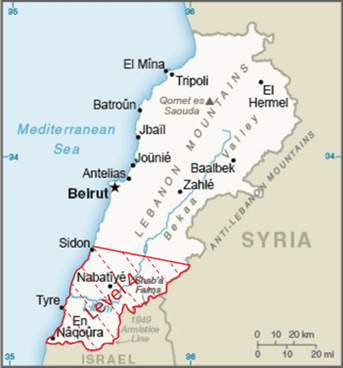
Southern Lebanon – Level 4: Do Not Travel, Depart If You Are (See map below)

The U.S. Embassy strongly urges U.S. citizens to avoid southern Lebanon and to depart if you are there; that is, all parts south of the city of Saida, to include inland areas, as illustrated in the map below. Cross-border rocket, missile, and artillery fire continues to impact southern Lebanon on a daily basis and has caused a significant number of fatalities and injuries.

Picture4.png


Border with Syria – Level 4: Do Not Travel, Depart If You Are There

The U.S. Embassy strongly urges U.S. citizens to avoid the Lebanon-Syria border and to depart if you are there. This area has seen clashes between Lebanese security forces and Syrian-based violent extremist groups. The U.S. Department of State also warns U.S. citizens of the risk of traveling on flights that fly over Syria, which include some flights to and from Beirut.

Refugee Settlements – Level 4: Do Not Travel, Depart If You Are There

The U.S. Embassy urges U.S. citizens to avoid travel to refugee settlements in Lebanon and depart if you are there. These settlements are prone to outbreaks of violence including shootings and explosions.

Visit our website for Travel to High-Risk Areas.
 
Syria & Russia -


Iran Military Adviser In Syria Dies Days After Israeli Strike: Media

By AFP - Agence France Presse
October 3, 2024​

https://www.barrons.com/news/iran-m...-strike-media-a2b1c9ce?refsec=topics_afp-news

---------------------------------------------------

35 views | Oct 03, 2024, 03:25:00 PM | TOI.in

Russian Airbase Under Attack: Israeli Missiles Blow Up Massive Weapons Depot In Syria

https://timesofindia.indiatimes.com...eapons-depot-in-syria/videoshow/113903881.cms


​---------------------------------

Here we go.....
 
WHO Director-General's opening remarks at the media briefing – 1 November 2024

1 November 2024
...
Now to Gaza.

This week, Israel’s parliament, the Knesset, passed two bills banning the United Nations Relief and Works Agency for Palestine Refugees in the Near East – or UNRWA – from operating in Gaza.

UNRWA is one of the largest providers of essential health services in Gaza, providing critical health and humanitarian support for over seven decades.

Every day, it provides thousands of medical consultations and vaccinates hundreds of children.

Many humanitarian partners rely on UNRWA’s logistical networks to get supplies into Gaza and onward to where they are needed.

The UNRWA staff that WHO works with are dedicated health and humanitarian professionals who work tirelessly for their communities under unimaginable circumstances.

Israel’s decision to restrict UNRWA’s operations contravenes Israel’s obligations and responsibilities and jeopardizes the lives and health of all who depend on these essential services.

This ban will not make Israel safer, it will only deepen the suffering of the people of Gaza and increase the risk of disease outbreaks.

Let me be clear: There is simply no alternative to UNRWA.

Tomorrow, the third phase of the polio vaccination campaign is set to begin in the northern part of the Gaza Strip, after it was postponed last week due to intense bombardment, mass evacuation orders, and lack of access or assurance of humanitarian pauses.

The humanitarian pause necessary to conduct the campaign has been assured, but the area of the pause has been substantially reduced, and is now limited to just Gaza City.

The final phase of the campaign had aimed to reach an estimated 119,000 children under 10 years old, but achieving that target is now unlikely, as conditions in northern Gaza get worse every day.

In the past two weeks, WHO has conducted 6 missions to northern Gaza to bring medical supplies and food for hospital staff and patients when permitted, and fuel to keep the generators working.

In recent days, following intense fighting, a siege and a raid, Kamal Adwan hospital has been reduced from a hospital helping hundreds of patients with dozens of health workers, to a shell of itself.

WHO helped to move the most critical patients to Nasser and Shifa hospitals, where they can receive a higher level of care. Now a few dozen patients remain at Kamal Adwan, with a handful of staff to care for them.

An attack and subsequent fire on one of the floors of the hospital has destroyed some of the supplies we delivered. We are trying to reach hospital staff for more information.
...

https://www.who.int/news-room/speec...marks-at-the-media-briefing---1-november-2024

-----------------------------------

Statement by Principals of the Inter-Agency Standing Committee – Stop the assault on Palestinians in Gaza and on those trying to help them

1 November 2024 Statement NEW YORK/GENEVA/ROME Reading time: 3 min (808 words)

We the leaders of 15 United Nations and humanitarian organizations urge, yet again, all parties fighting in Gaza to protect civilians, and call on the State of Israel to cease its assault on Gaza and on the humanitarians trying to help.

The situation unfolding in North Gaza is apocalyptic. The area has been under siege for almost a month, denied basic aid and life-saving supplies while bombardment and other attacks continue. Just in the past few days, hundreds of Palestinians have been killed, most of them women and children, and thousands have once again been forcibly displaced.

Hospitals have been almost entirely cut off from supplies and have come under attack, killing patients, destroying vital equipment, and disrupting life-saving services. Health workers and patients have been taken into custody. Fighting has also reportedly taken place inside hospitals.

Dozens of schools serving as shelters have been bombed or forcibly evacuated. Tents sheltering displaced families have been shelled, and people have been burned alive.

Rescue teams have been deliberately attacked and thwarted in their attempts to pull people buried under the rubble of their homes.

The needs of women and girls are overwhelming and growing every day. We have lost contact with those we support and those who provide lifesaving essential services for sexual and reproductive health and gender-based violence.

And we have received reports of civilians being targeted while trying to seek safety, and of men and boys being arrested and taken to unknown locations for detention.

Livestock are also dying, crop lands have been destroyed, trees burned to the ground, and agrifood systems infrastructure has been decimated.

The entire Palestinian population in North Gaza is at imminent risk of dying from disease, famine and violence.

Humanitarian aid cannot keep up with the scale of the needs due to the access constraints. Basic, life-saving goods are not available. Humanitarians are not safe to do their work and are blocked by Israeli forces and by insecurity from reaching people in need.

In a further blow to the humanitarian response, the polio vaccination campaign has been delayed due to the fighting, putting the lives of children in the region at risk.

And this week, the Israeli Parliament adopted legislation that would ban UNRWA and revoke its privileges and immunities. If implemented, such measures would be a catastrophe for the humanitarian response in Gaza, diametrically opposed to the United Nations Charter, with potential dire impacts on the human rights of the millions of Palestinians depending on UNRWA’s assistance, and in violation of Israel’s obligations under international law.

Let us be very clear: There is no alternative to UNRWA.

The blatant disregard for basic humanity and for the laws of war must stop.

International humanitarian law, including the rules of distinction, proportionality and precautions, must be respected. IHL obligations do not depend on reciprocity. No violation by one party ever releases the other from its legal obligations.

Attacks against civilians and what remains of civilian infrastructure in Gaza must stop.

Humanitarian relief must be facilitated, and we urge all parties to provide unimpeded access to affected people. Additionally, commercial goods must be allowed to enter Gaza.

The wounded and sick must receive the care they need. Medical personnel and hospitals must be spared. Hospitals should not turn into battlegrounds.

Unlawfully detained Palestinians must be released.

Israel must comply with the provisional orders and determinations of the International Court of Justice.

Hamas and other Palestinian armed groups must release the hostages immediately and unconditionally and must abide by international humanitarian law.

Member States must use their leverage to ensure respect for international law. This includes withholding arms transfers where there is a clear risk that such arms will be used in violation of international law.

The entire region is on the edge of a precipice. An immediate cessation of hostilities and a sustained, unconditional ceasefire are long overdue.

Signatories:

Ms. Joyce Msuya, Acting Emergency Relief Coordinator and Under-Secretary-General for Humanitarian Affairs (OCHA)
Ms. Nimo Hassan, MBE, Chair, International Council of Voluntary Agencies (ICVA)
Mr. Jamie Munn, Executive Director, International Council of Voluntary Agencies (ICVA)
Ms. Amy E. Pope, Director General, International Organization for Migration (IOM)
Mr. Volker Türk, United Nations High Commissioner for Human Rights (OHCHR)
Ms. Abby Maxman, President and Chief Executive Officer, Oxfam
Ms. Paula Gaviria Betancur, United Nations Special Rapporteur on the Human Rights of Internally Displaced Persons (SR on HR of IDPs)
Mr. Achim Steiner, Administrator, United Nations Development Programme (UNDP)
Ms. Anacláudia Rossbach, Executive Director, United Nations Human Settlement Programme (UN-Habitat)
Mr. Filippo Grandi, United Nations High Commissioner for Refugees (UNHCR)
Dr. Natalia Kanem, Executive Director, United Nations Population Fund (UNFPA)
Ms. Catherine Russell, Executive Director, UN Children's Fund (UNICEF)
Ms. Sima Bahous, Under-Secretary-General and Executive Director, UN Women
Ms. Cindy McCain, Executive Director, World Food Programme (WFP)
Dr. Tedros Adhanom Ghebreyesus, Director-General, World Health Organization (WHO)

https://www.who.int/news/item/01-11...ians-in-gaza-and-on-those-trying-to-help-them


Israel Foreign Ministry

@IsraelMFA


The Director General of the @IsraelMFA Jacob Blitshtein has notified @antonioguterres and the @UN that Israel is withdrawing from the agreement regulating
@UNRWA operations in Israel, Gaza, and the West Bank, citing the organization’s involvement in terrorism. Many other organizations continue to support humanitarian efforts in Gaza, and we will continue to work with them.

image.png


4:27 AM · Nov 4, 2024​​
 
Back
Top