
Install the app
How to install the app on iOS
Follow along with the video below to see how to install our site as a web app on your home screen.
Note: This feature may not be available in some browsers.
-
FluTrackers.com Inc. does not provide medical advice. Information on this web site is collected from various internet resources, and the FluTrackers board of directors makes no warranty to the safety, efficacy, correctness or completeness of the information posted on this site by any author or poster. The information collated here is for instructional and/or discussion purposes only and is NOT intended to diagnose or treat any disease, illness, or other medical condition. Every individual reader or poster should seek advice from their personal physician/healthcare practitioner before considering or using any interventions that are discussed on this website. By continuing to access this website you agree to consult your personal physican before using any interventions posted on this website, and you agree to hold harmless FluTrackers.com Inc., the board of directors, the members, and all authors and posters for any effects from use of any medication, supplement, vitamin or other substance, device, intervention, etc. mentioned in posts on this website, or other internet venues referenced in posts on this website.
-
We are not asking for any donations. Do not donate to any entity who says they are raising funds for us.
You are using an out of date browser. It may not display this or other websites correctly.
You should upgrade or use an alternative browser.
You should upgrade or use an alternative browser.
Mexico - Avian flu in wild & domestic birds 2025-2026
- Thread starter Lance
- Start date

Commonground
Senior Moderator
[translated, emphasis is mine]
TENDENCIASDOMINGO, 12 DE OCTUBRE DE 2025
Tamaulipas remains on alert for avian flu; risk to the population ruled out
Health authorities maintain active surveillance despite studies ruling out human risk... The Tamaulipas Health Secretariat (SST) reported that it maintains a preventive alert for avian flu, after the presence of the virus was confirmed in a migratory bird in Matamoros and in nearby poultry.
Although the tests conducted currently rule out a risk to the population, authorities maintain active surveillance throughout the state.
Authorities install sanitary cordon to prevent the spread of the virus
The head of the agency, Vicente Joel Hernández Navarro, explained that the detection arose after the discovery of a dead migratory bird that tested positive for avian flu, which prompted the immediate installation of a sanitary cordon.
"The first situation that arose was a migratory bird that died. It was tested and tested positive. Two weeks later, four poultry birds that were infected with the virus died," he said.
He added that in response to this situation, a group of specialized teams monitored a three-kilometer radius to prevent further cases.
"We have no human cases, that is, there is no health alert here in this regard, but there is very intensive work to prevent cases from occurring."
continued: https://oem.com.mx/elsoldetampico/t...u4e2TA6JnKLJWU_U2w_aem_JCjCqE8ZiJS_hTEBCIxa-A
Commonground
Senior Moderator
[Translated. Emphasis is mine. This article is dated September 23, 2025, but mentions Tamaulipas as does the above article]
September 23, 2025
Avian flu symptoms detected in person who handled infected bird at Bagdad Beach; area urged not to visit
Six people remain under medical observation, and teams are searching nearby communities for possible infections. Health authorities in Tamaulipas are investigating a possible human case of avian flu after a person showed symptoms after handling an infected bird in the Bagdad Beach area of Matamoros. The public was urged not to visit the site, as it is considered a risk point.
State epidemiologist Sergio Uriegas Camargo reported that an individual with mild symptoms is being monitored and has already had samples taken to rule out or confirm infection.
Suspected cases are being monitored in Tamaulipas through testing
"Avian influenza in humans is generally severe, so it's highly likely that it's another virus. However, anyone who shows symptoms and has had contact with sick or dead birds will be tested," he stated.
Yesterday, the Matamoros Health Authority confirmed the presence of avian influenza in a dead seagull found in the coastal area bordering Texas.
As a preventative measure, authorities began monitoring people who had contact with the sick bird, given the high transmission rate of avian influenza. In addition, medical personnel were deployed to surrounding communities to search for suspected cases.
“A survey is being conducted in communities near the beach where the discovery occurred to investigate possible infections. Samples will be taken from those who have had contact with sick or dead birds, and the rest will be under observation for two weeks to detect respiratory symptoms,” explained Uriegas.
The director of the Matamoros Health Authority, Gilma Alcocer Cortés, reported that the people who handled the bird remain under observation.
For its part, the Conibio Global association announced that six people underwent tests to determine the presence or absence of the virus.
https://oem.com.mx/elsoldetampico/l...laya-bagdad-piden-no-visitar-la-zona-25911341
Last edited:

sharon sanders
Editor-in-Chief & President
Commonground
Senior Moderator
In Post #1 it was listed under H5N1. And it also detected H5N2. From Post 1:
click on image
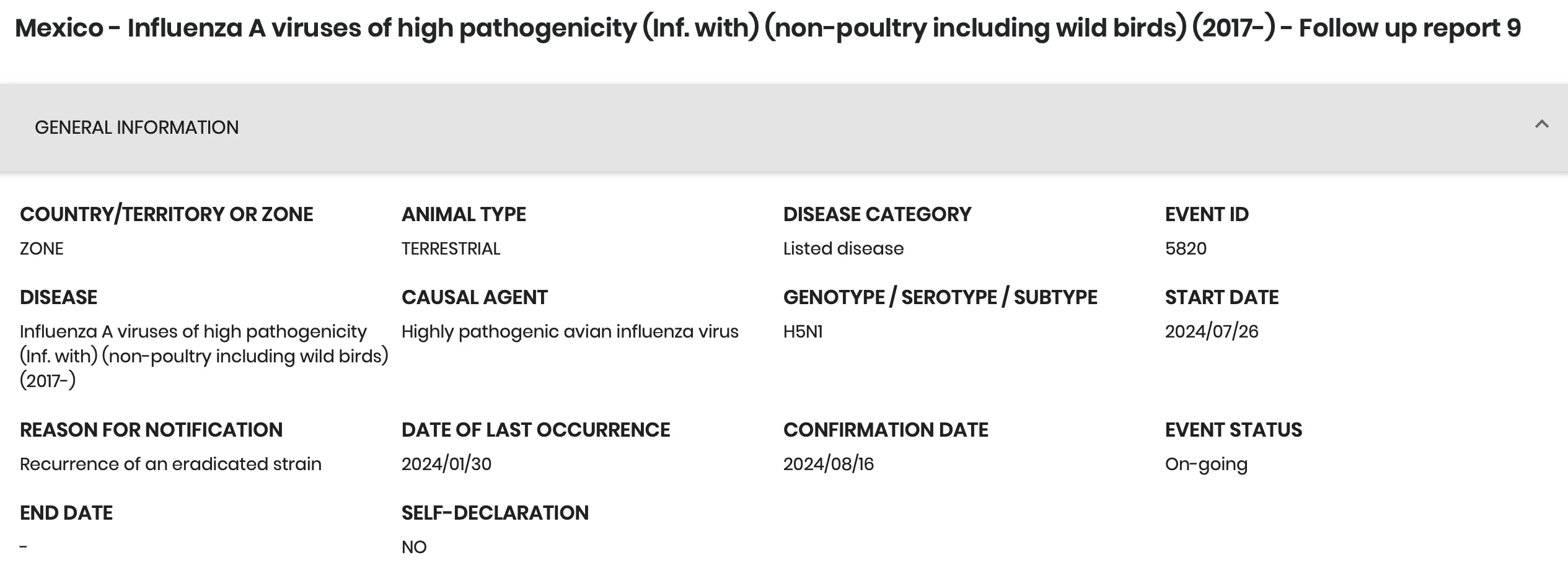
Avian flu confirmed in fighting birds in Mexico
October 2, 2025
Excerpt:
WOAH listed these two flock infections in the same report as other cases of H5N1 HPAI, but it also reported that sequencing also detected genes corresponding to serotype H5N2.
...https://www.wattagnet.com/poultry-m...ian-flu-confirmed-in-fighting-birds-in-mexico
click on image
Avian flu confirmed in fighting birds in Mexico
October 2, 2025
Excerpt:
WOAH listed these two flock infections in the same report as other cases of H5N1 HPAI, but it also reported that sequencing also detected genes corresponding to serotype H5N2.
...https://www.wattagnet.com/poultry-m...ian-flu-confirmed-in-fighting-birds-in-mexico
Commonground
Senior Moderator
translated
23 de septiembre de 2025 (note date)
H5 avian influenza outbreak confirmed in Playa Bagdad, Matamoros; death toll rises to 400
Excerpt:
The Conibio Global Foundation also reported that a volunteer supporting environmental monitoring efforts is under medical observation after developing fever, flu-like symptoms, and headache following direct contact with sick birds on the nesting island.
Although the case has not yet been confirmed, health authorities conducted laboratory tests similar to those used during the COVID-19 pandemic to rule out or confirm infection.
Epidemiologist Uriegas emphasized that early detection and interinstitutional coordination are key to containing risks:
“The investigation will remain active; if a suspected case appears in humans, a sample will be taken immediately to confirm or rule it out in a laboratory.” ...Meanwhile, health authorities are maintaining an operation to detect possible cases, conducting house-to-house visits in communities near Playa Bagdad and monitoring health units to identify suspected cases in humans.
... https://www.proceso.com.mx/nacional...-matamoros-suman-400-aves-muertas-359319.html
Commonground
Senior Moderator
translated
Health Secretary dismisses warning of bird flu cases in Matamoros
Following confirmation of cases of avian flu in the municipality of Matamoros, Tamaulipas Health Secretary Vicente Joel Hernández Navarro assured that the situation remains under control and that, for the moment, there is no health alert crisis in the state.
18 octubre, 2025
The official explained that the Ministry of Health, in coordination with animal health authorities, has implemented health fences in the areas where cases were detected, with the goal of preventing the spread of the virus among domestic birds.
"We are creating health fences and monitoring each of the families that have domestic chickens, because avian flu comes with migratory birds. This is helping us stay on top of the situation in all jurisdictions of the state," said Hernández Navarro.
The Health Secretary emphasized that, although the cases have been concentrated in Matamoros, surveillance has been strengthened in all health jurisdictions in Tamaulipas, especially those located along migratory bird routes.
He also announced that a meeting will be held with jurisdictional leaders to review prevention and response measures for possible outbreaks.
"It's not an alert, but the governor is asking us to pay special attention," he stated.
https://horacero.com.mx/tamaulipas/...-alerta-por-casos-de-gripe-aviar-en-matamoros

Shiloh
Editor, Senior Moderator
H5N1 Avian Influenza Detected at a Farm in Yucatán Housing Over 225,000 Birds
The Secretariat of Agriculture and Rural Development (Sader) has confirmed an outbreak of H5N1 avian influenza at a farm in Umán, Yucatán, housing 225,860 birds, and has ordered the implementation of sanitary measures to contain it.
Thursday, November 5, 2026, 14:53
Xóchitl Montero
An egg-producing farm with 225,860 hens has been placed under quarantine in the municipality of Umán, Yucatán, following the confirmation of the highly pathogenic H5N1 avian influenza virus. Consequently, health authorities have ordered the culling of the bird population to prevent the spread of the disease.
The Secretariat of Agriculture and Rural Development (Sader) reported the detection of the virus and the activation of international sanitary protocols, which include the surveillance of other farms located within a 10-kilometer radius of the affected facility.
The case was identified after the veterinarian in charge of the production unit reported the unusual death of 862 birds, a situation that prompted intervention by the National Service for Agri-Food Health, Safety, and Quality (Senasica).
Specialized personnel arrived at the facility to collect samples under strict biosecurity measures. Initial analyses, conducted at the Official Biosafety Level 2 Laboratory in Mérida, tested positive for a highly pathogenic avian influenza of the H5 subtype.
Subsequently, the samples were sent to a Biosafety Level 3 laboratory in Palo Alto, Mexico City, for further testing to determine the specific characteristics of the virus.
Over 225,000 birds ordered to be culled to contain the outbreak
Following the confirmation of the case, Senasica specialists established a 10-kilometer sanitary surveillance zone around the farm. The measures implemented include a definitive quarantine of the facilities, the complete depopulation of the production unit, the sanitary disposal of the birds, and the destruction of contaminated materials.
Cleaning and disinfection procedures were also ordered to reduce the risk of the virus remaining on the premises.
Once the sanitary fallow period—a time during which the facility remains empty—has concluded, authorities will introduce "sentinel" birds to check whether the virus is still present before authorizing the resumption of production.
In the meantime, health technicians are conducting sampling at broiler, egg-laying, and breeding farms located within the established perimeter.
The results will help determine if other facilities have been affected and whether emergency vaccination should be implemented in nearby units.
Investigation into whether migratory birds brought the virus to Yucatán
As part of the investigation to identify the source of the outbreak, health authorities are inspecting bodies of water near the farm.
These areas attract wild migratory birds from the northern part of the continent during the winter season; investigators are therefore seeking to determine whether any of these species might be linked to the introduction of the virus.
Sader (the Secretariat of Agriculture and Rural Development) reported that specialists in wildlife epidemiological surveillance will conduct field surveys and collect samples to identify potential cases of avian influenza among wild, free-roaming birds...
However, it has not yet been confirmed that migratory birds are the source of the infection.
Source: https://municipiospuebla.mx/nota/na...-en-granja-de-yucatan-con-mas-de-225-mil-aves
Last edited by a moderator: