
• FluTrackers.com Inc. does not provide medical advice. Information on this web site is collected from various internet resources, and the FluTrackers board of directors makes no warranty to the safety, efficacy, correctness or completeness of the information posted on this site by any author or poster. The information collated here is for instructional and/or discussion purposes only and is NOT intended to diagnose or treat any disease, illness, or other medical condition. Every individual reader or poster should seek advice from their personal physician/healthcare practitioner before considering or using any interventions that are discussed on this website. By continuing to access this website you agree to consult your personal physican before using any interventions posted on this website, and you agree to hold harmless FluTrackers.com Inc., the board of directors, the members, and all authors and posters for any effects from use of any medication, supplement, vitamin or other substance, device, intervention, etc. mentioned in posts on this website, or other internet venues referenced in posts on this website.
  • We are not asking for any donations. Do not donate to any entity who says they are raising funds for us.

mBio Study: New coronavirus has many potential hosts, could pass from animals to humans repeatedly

tetano

Editor, Senior Moderator
TORONTO - A new study reveals that the new SARS-like virus which has been causing infections in the Middle East behaves unusually in laboratory testing.

The unexpected behaviour of the virus may help to explain the pattern of spread of the cases so far, says senior author Christian Drosten, a leading coronavirus expert.

In essence, the new coronavirus is promiscuous, a term the virologists who authored the study use to describe the fact that it will grow in a variety of different types of animal cells, including cells from people, pigs and several species of bats.

That is not true for other known coronaviruses, which typically only grow in cells from the species they infect, says Drosten, who is the director of the institute of virology at the University of Bonn Medical Center, in Bonn, Germany.

Dutch virologist Ron Fouchier agrees that the finding is surprising.

"This is certainly unusual for a (corona)virus to have such a broad cellular host range," says Fouchier, a senior scientist with Erasmus Medical Centre in Rotterdam. Fouchier is also an author of the paper.

"There is something usual about this virus."

..


http://news.yahoo.com/study-finds-puzzling-behaviour-coronavirus-may-hint-pattern-050943504.html
 
Re: Study finds puzzling behaviour of new coronavirus, may hint at pattern of spread

Re: Study finds puzzling behaviour of new coronavirus, may hint at pattern of spread

hat tip Michael Coston


mBio: Coronavirus Has An Affinity For Multiple Hosts


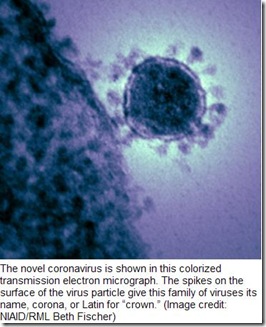
Coronavirus%25255B4%25255D.jpg

Photo Credit NIAID

# 6772

Most of the infectious diseases that afflict mankind today began in a different animal species, but jumped to humans and then adapted to our physiology.


  • The scourge of Tuberculosis, which now infects 1/3rd of humanity, likely jumped species when man began to corral and raise its traditional hosts; goats and cattle.
  • Measles appears to have evolved from canine distemper and/or the Rinderpest virus of cattle.
  • Influenza, as most of you know, is native to aquatic birds – but jumped species thousands of years ago and many strains have adapted to humans, pigs, and other species.

The list of zoonotic diseases (those shared between humans and animals) is long and continually expanding, and includes: SARS, Babesiosis, Borrelia (Lyme), Nipah, Hendra, Malaria, Hantavirus, Ebola, Bartonella, Leptospirosis, Q-Fever, bird flu and many, many others

Most viruses are fairly selective about the type of cells they will invade, what organ systems they will attack, and even what species they will infect.

Horse viruses generally attack equines, and not say, cats and dogs. Cat viruses tend to attack felines, and not birds. Bird viruses usually only infect avian species.

But some viruses are more promiscuous than others.
Rabies can infect nearly all warm-blooded animals, and we’ve seen the H5N1 `avian flu’ virus infect a wide range of mammals, including humans, dogs, cats, and pigs.
Later today, mBio®, the online open-access journal of the American Society for Microbiology, will publish a study that looks at the host range of the newly discovered coronavirus (hCoV-EMC) in the Middle East.


Although researchers are still looking for the receptor cell that allows entry of the virus into the host’s cells, they have found that the hCoV-EMC virus can infect a number of bat species, along with pigs, and of course, humans.
We’ll have to wait a few hours to see the study, but the ASM has a press release with some of the details, and we also have an excellent write up by Helen Branswellof the Canadian Press.

First, excerpts from the press Release
Public release date: 11-Dec-2012

New coronavirus has many potential hosts, could pass from animals to humans repeatedly

The SARS epidemic of 2002-2003 was short-lived, but a novel type of human coronavirus that is alarming public health authorities can infect cells from humans and bats alike, a fact that could make the animals a continuing source of infection, according to a study to be published in in mBio®, the online open-access journal of the American Society for Microbiology, on December 11. The new coronavirus, called hCoV-EMC, is blamed for five deaths and several other cases of severe disease originating in countries in the Middle East.

According to the new results, hCoV-EMC uses a different receptor in the human body than the SARS virus, and can infect cells from a wide range of bat species and pigs, indicating there may be little to keep the virus from passing from animals to humans over and over again.

First identified in a patient in Saudi Arabia in June, nine laboratory-confirmed cases of hCoV-EMC infection have now been identified, five of whom have died. Although the virus does not apparently pass from person-to-person very readily, the case fatality rate and the fact that the source of the virus has not been identified have caused concern among global public health authorities. Cases of hCoV-EMC infection are marked by severe pneumonia and often by kidney failure.

"This virus is closely related to the SARS virus, and looking at the clinical picture, it causes the same pattern of disease," says Christian Drosten of the University of Bonn Medical Centre in German, a lead author of the study.

Given the similarities, Drosten and his colleagues wanted to know whether hCoV-EMC and SARS might use the same receptor, a sort of molecular "dock" on human cells that the virus latches onto to gain entry to the cell. The SARS receptor, called ACE2, is found mostly on pneumocytes deep within the human lung, so an individual must breathe in many, many SARS viruses for a sufficient number of them to reach this susceptible area and cause an infection. Drosten says this simple fact helped ensure the SARS outbreak didn't spread like wildfire and was mostly limited to healthcare workers and residents of overcrowded housing in Hong Kong. Also, once a person was infected with SARS in the deep part of their lungs, he or she felt sick almost immediately and therefore was not active in the community and infecting others, another aspect of the receptor that helped curb the outbreak.

Does hCoV-EMC use the same receptor? If so, the means of controlling this new virus might become clearer.

"The answer is a clear no," says Drosten. "This virus does not use ACE2." This leaves open the possiblity that hCoV-EMC could use a receptor in the human lung that is easier to access and could make the virus more infectious than SARS, but it is still not known what receptor the virus does use.

To help identify how hCoV-EMC might have originated and moved between humans and animals, the second part of the study focused on the animal species the virus can infect. SARS is closely related to viruses from bats, but Drosten says the virus changed in the transition from bats to civet cats to humans and could no longer infect bats, so SARS was not present in the wild and did not pass repeatedly from bats to humans like a classical zoonotic disease. "So the [SARS] virus lost its old host and gained a new one," says Drosten.

Like SARS, hCoV-EMC is most closely related to coronaviruses from bats, but unlike SARS, this study found that hCoV-EMC can still infect cells from many different species of bats. "This was a big surprise," says Drosten. "It's completely unusual for any coronavirus to be able to do that – to go back to its original reservoir." The virus is also able to infect cells from pigs, indicating that it uses a receptor structure that all these animals have in common. If that receptor is present in mucosal surfaces, like the lining of the lung, it is possible the virus could pass from animals to humans and back again, making animals an ongoing source of the virus that would be difficult or impossible to eliminate.
(Continue . . . )

The study should be published online at http://mbio.asm.org/ later today.

Meanwhile, Helen Branswell has the following report.

Study finds puzzling behaviour of new coronavirus, may hint at pattern of spread

<cite>By Helen Branswell, The Canadian Press | Associated Press – <abbr>7 hrs ago</abbr></cite>
<cite><abbr></abbr></cite>
TORONTO - A new study reveals that the new SARS-like virus which has been causing infections in the Middle East behaves unusually in laboratory testing
(Continue . . . )
Posted by Michael Coston at <a class="timestamp-link" href="http://afludiary.blogspot.com/2012/12/mbio-coronavirus-has-affinity-for.html" rel="bookmark" title="permanent link"><abbr class="published" title="2012-12-11T07:58:00-05:00">7:58 AM</abbr>
 
Re: mBio Study: New coronavirus has many potential hosts, could pass from animals to humans repeatedly

[Source: mBio, full page: (LINK). Abstract, edited.]

Human Coronavirus EMC Does Not Require the SARS-Coronavirus Receptor and Maintains Broad Replicative Capability in Mammalian Cell Lines

Marcel A. M?ller<SUP>a</SUP>, V. Stalin Raj<SUP>b</SUP>, Doreen Muth<SUP>a</SUP>, Benjamin Meyer<SUP>a</SUP>, Stephan Kallies<SUP>a</SUP>, Saskia L. Smits<SUP>b</SUP>, Robert Wollny<SUP>a</SUP>, Theo M. Bestebroer<SUP>b</SUP>, Sabine Specht<SUP>c</SUP>, Tasnim Suliman<SUP>a</SUP>, Katrin Zimmermann<SUP>d</SUP>, Tabea Binger<SUP>a</SUP>, Isabella Eckerle<SUP>a</SUP>, Marco Tschapka<SUP>e</SUP>, Ali M. Zaki<SUP>f</SUP>, Albert D. M. E. Osterhaus<SUP>b</SUP>, Ron A. M. Fouchier<SUP>b</SUP>, Bart L. Haagmans<SUP>b</SUP>, and Christian Drosten<SUP>a</SUP>
<SUP></SUP>
Author Affiliations: Institute of Virology, University of Bonn Medical Center, Bonn, Germany<SUP>a</SUP>; Viroscience Lab, Erasmus MC, Rotterdam, The Netherlands<SUP>b</SUP>; Institute of Medical Microbiology, Immunology and Parasitology, University of Bonn Medical Center, Bonn, Germany<SUP>c</SUP>; Institute of Pharmacology and Toxicology, University of Bonn Medical Center, Bonn, Germany<SUP>d</SUP>; Institute of Experimental Ecology, University of Ulm, Ulm, Germany<SUP>e</SUP>; and Virology Laboratory, Dr. Soliman Fakeeh Hospital, Jeddah, Kingdom of Saudi Arabia<SUP>f</SUP>
<SUP></SUP>
Address correspondence to Bart L. Haagmans, b.haagmans@erasmusmc.nl, or Christian Drosten, drosten@virology-bonn.de.

Editor Michael Buchmeier, University of California, Irvine


ABSTRACT

A new human coronavirus (hCoV-EMC) has emerged very recently in the Middle East. The clinical presentation resembled that of the severe acute respiratory syndrome (SARS) as encountered during the epidemic in 2002/2003. In both cases, acute renal failure was observed in humans. HCoV-EMC is a member of the same virus genus as SARS-CoV but constitutes a sister species. Here we investigated whether it might utilize angiotensin-converting enzyme 2 (ACE2), the SARS-CoV receptor. Knowledge of the receptor is highly critical because the restriction of the SARS receptor to deep compartments of the human respiratory tract limited the spread of SARS. In baby hamster kidney (BHK) cells, lentiviral transduction of human ACE2 (hACE2) conferred permissiveness and replication for SARS-CoV but not for hCoV-EMC. Monkey and human kidney cells (LLC-MK2, Vero, and 769-P) and swine kidney cells were permissive for both viruses, but only SARS-CoV infection could be blocked by anti-hACE2 antibody and could be neutralized by preincubation of virus with soluble ACE2. Our data show that ACE2 is neither necessary nor sufficient for hCoV-EMC replication. Moreover, hCoV-EMC, but not SARS-CoV, replicated in cell lines from Rousettus, Rhinolophus, Pipistrellus, Myotis, and Carollia bats, representing four major chiropteran families from both suborders. As human CoV normally cannot replicate in bat cells from different families, this suggests that hCoV-EMC might use a receptor molecule that is conserved in bats, pigs, and humans, implicating a low barrier against cross-host transmission.


IMPORTANCE

A new human coronavirus (hCoV) emerged recently in the Middle East. The disease resembled SARS (severe acute respiratory syndrome), causing a fatal epidemic in 2002/2003. Coronaviruses have a reservoir in bats and because this novel virus is related to SARS-CoV, we investigated whether it might replicate in bat cells and use the same receptor (angiotensin-converting enzyme 2 [ACE2]). This knowledge is highly critical, because the SARS-CoV receptor influenced pathology, and its localization in the deep respiratory tract is thought to have restricted the transmissibility of SARS. Our data show that hCoV-EMC does not need the SARS-CoV receptor to infect human cells. Moreover, the virus is capable of infecting human, pig, and bat cells. This is remarkable, as human CoVs normally cannot replicate in bat cells as a consequence of host adaptation. Our results implicate that the new virus might use a receptor that is conserved between bats, pigs and humans suggesting a low barrier against cross-host transmission.


Footnotes

Citation M?ller MA, et al. 2012. Human coronavirus EMC does not require the SARS-coronavirus receptor and maintains broad replicative capability in mammalian cell lines. mBio 3(6):e00515-12. doi:10.1128/mBio.00515-12.

Received 9 November 2012

Accepted 12 November 2012

Published 11 December 2012

Copyright ? 2012 M?ller et al.

This is an open-access article distributed under the terms of the Creative Commons Attribution-Noncommercial-Share Alike 3.0 Unported License, which permits unrestricted noncommercial use, distribution, and reproduction in any medium, provided the original author and source are credited.
-
------
 

Attachments

Re: mBio Study: New coronavirus has many potential hosts, could pass from animals to humans repeatedly

http://news.yahoo.com/study-finds-puzzling-behaviour-coronavirus-may-hint-pattern-050943504.html
[snip]

"The usual concept for the coronaviruses is that as soon as you see this virus in human, it's actually irrelevant where it came from because the problem is there. We have it in humans," he says.

Given that paradigm ? which holds true for other known coronaviruses ? experts like Drosten were worried when sporadic cases of human infections with the new virus came to light this fall.

He feared the virus had left its animal reservoir and was spreading from person to person, with mild infections passing under the radar and only the severe cases coming to light.

But given that this virus seems to be able to infect multiple species ? at least in the lab ? that might suggest a pattern where the geographically and temporally distant cases are being infected from animal sources, not people, Drosten admits.

In some respects, that's a more reassuring idea. But in others, it's not. If the virus is able to infect a number of types of animals, it could continue to make periodic jumps to humans ? which could impede containment efforts.

If the EMC virus were to get into animals farmed in the Middle East, for instance, human exposures could be ongoing, Fouchier says.

"From looking at these data . . . you would think the zoonotic potential of a virus like this would be higher than something like the SARS coronavirus, which is more restricted," he says. A zoonosis is an animal disease that crosses the species barrier to infect people.

The risk will depend in part on how well the virus transmits, which at this point is still a mystery. But Drosten says veterinary surveillance should be going on to look for the virus in livestock and wild animals in the Middle East.

...
 
Re: mBio Study: New coronavirus has many potential hosts, could pass from animals to humans repeatedly

I think that until a field surveillance and serosurveys results will be available, drawing conclusion on the dispersion and putative animal reservoir for the new coronavirus is almost speculative and may prompt to unneeded shutter in a geographic troubled area.

Scientists are to be praises for their quick response and dissemination of findings about the new pathogen, but a certain degree of restraint should be kept when communicating the risk of this yet obscure disease agent and its behaviour.

Some commentators have paired the new coronavirus to the avian influenza virus H5N1, for disease severity and potential risk for publich human health.

I think this latter comparison should be reviewed with a lot of care. (IOH)
 
Back
Top