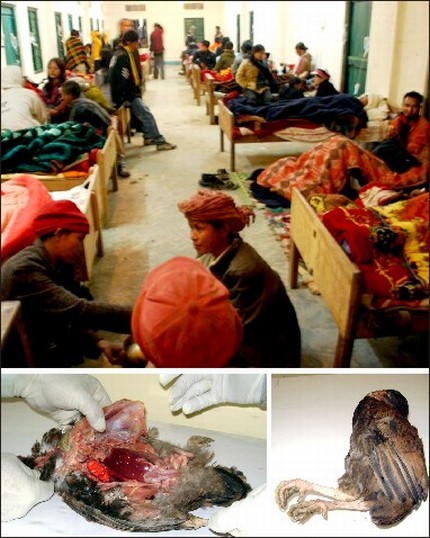
Re: Manipur - Government says "Mystery Disease" in poultry is Colibacillosis, 38 Humans Hospitalized
Coliform Infections, Colibacillosis Coliform infections refer to the many and various disease resulting from infection with
Escherichia coli bacteria. In recent years these infections have become recognized as a major cause of morbidity, mortality, and condemnations in chickens and turkeys. The incidence and severity of coliform infections have increased rapidly, and current trends indicate they are likely to become an even bigger problem.
The problems attributed to coliform infections are often complex. There is a marked variation in severity. Problems range from severe acute infections with sudden and high mortality to mild infections of a chronic nature with low morbidity and mortality. Infections may result in a respiratory disease from air sac infection, a septicemic disease from generalized infection, an enteritis from intestinal infection, or a combination of any or all of these.
Disease may result from coliform infection alone as in primary infection or in combination with other disease agents as complicating or secondary infection. Secondary infections commonly occur as a part of the classic air sac disease syndrome as a complication of
Mycoplasma gallisepticum infections.
All ages may be affected; however, it is more common in young growing birds, especially the acute septicemia in young turkeys and air sacculitis in young chickens. High early mortality may occur as the result of omphalitis or navel infections.
Cause: The disease is caused by
E. coli bacteria and from toxins they produce as they grow and multiply. There are many different strains or serological types within the group of
E. coli bacteria. Many are considered normal inhabitants of the intestinal tract of chickens and turkeys and consequently are common organisms in the birds’ environment.
The primary routes of invasion by the organism are the respiratory system and the gastrointestinal tract. Omphalitis and infections in young birds may result from entry of the organism through the unhealed navel or penetration of the egg shell prior to or during incubation.
Symptoms: The symptoms vary with the different types of infections. In the acute septicemic form, mortality may begin suddenly and progress rapidly. Morbidity may not be apparent and birds in apparently good condition may die. However, in most cases, morbid birds are evident as listless birds with ruffled feathers and indications of fever.
In the chronic infection, debilitation, and growth retardation are obvious. In the event of respiratory infection, additional symptoms of labored breathing, occasional coughing, and rales may be apparent. In the case of enteritis, diarrhea may be evident. Mortality may be high in recently hatched chicks and poults as a result of omphalitis due to coliform infections.
Diagnosis: Differential diagnosis by laboratory means is necessary since coliform infection in its various forms may resemble and be easily confused with many other diseases. Isolation and identification of the organism by culture procedures can be readily accomplished; however, mere isolation is not sufficient to make a diagnosis. One must take into consideration the organ from which the organisms were isolated, the pathogenicity of the particular isolate and the presence of other disease agents.
Prevention: Management and sanitation practices designed to minimize the exposure level of these types of organisms in the birds’ environment are necessary in any preventive program. In addition, these programs should include avoiding stress factors and other disease agents which may lower the resistance and predispose the birds to infection.
Important points in these management and sanitation practices include providing adequate ventilation, good litter and range conditions, properly cleaned and disinfected equipment and facilities, and feed and water supply free of contamination. In addition, these programs should include avoiding overcrowding and environmental stresses such as chilling and overheating, and avoiding vaccinating and handling at critical times. Proper egg handling, as well as a good hatchery management and sanitation program, are necessary to prevent early exposure.
Treatment: The response of coliform infections to various medications is erratic and often difficult to evaluate. Under practical conditions, treatment is disappointing and the results so variable that no one treatment can be recommended. Drug sensitivity varies with the strains, some of which may be partially or completely resistant to many, if not all, of the commonly used antibiotics. Laboratory tests to determine the sensitivity of the organism to the various drugs may prove useful in selecting the most beneficial drugs. When practical, moving the birds to a clean environment may be of more value than medication. For example, when outbreaks occur in growing turkeys in the brooder house, moving to range is often the best treatment.
http://chickaholic.wordpress.com/2008/12/16/bacterial-diseases-of-poultry/
Colibacillosis in humans
Colibacillosis is caused by
Escherichia coli infection.
E. coli is a bacteria which normally inhabits the intestinal tract of all animals. There are a number of different strains, many species-specific. Not all strains are pathogenic. In poultry,
E. coli infections may cause septicemia, chronic respiratory disease, synovitis (inflammation of the joints which can lead to lameness), pericarditis (inflammation of the sac around the heart), and salpingitis (inflammation of the oviduct).
Humans with colibacillosis usually manifest diarrhea which may be complicated by other syndromes depending on the
E. coli serotype. These complications may include fever, dysentery, shock, and purpura (multiple small purplish hemorrhages in the skin and mucous membranes).
The incubation period is 12 hours to 5 days, although 12-72 hours is most common. Transmission is via the fecal-oral route. Colibacillosis is often food- or water-borne.
In most cases, symptomatic treatment (fluids, antidiarrheals) is all that is required. In more severe infections, antibiotics such as tetracycline and chloramphenicol may be necessary.
In Florida, colibacillosis is not a reportable zoonotic disease.
http://edis.ifas.ufl.edu/PS019