
• FluTrackers.com Inc. does not provide medical advice. Information on this web site is collected from various internet resources, and the FluTrackers board of directors makes no warranty to the safety, efficacy, correctness or completeness of the information posted on this site by any author or poster. The information collated here is for instructional and/or discussion purposes only and is NOT intended to diagnose or treat any disease, illness, or other medical condition. Every individual reader or poster should seek advice from their personal physician/healthcare practitioner before considering or using any interventions that are discussed on this website. By continuing to access this website you agree to consult your personal physican before using any interventions posted on this website, and you agree to hold harmless FluTrackers.com Inc., the board of directors, the members, and all authors and posters for any effects from use of any medication, supplement, vitamin or other substance, device, intervention, etc. mentioned in posts on this website, or other internet venues referenced in posts on this website.
  • We are not asking for any donations. Do not donate to any entity who says they are raising funds for us.

Madeira reports dengue outbreak - 1,891 cases - autochthonous transmission confirmed

Gert van der Hoek

In Memoriam - Editor, Senior Moderator
From EPISOUTH

Madeira reports dengue outbreak - autochthonus transmission suspected


Location: Portugal Event: Dengue

On 3rd October 2012, the Portuguese health authorities
reported dengue cases in the autonomous region of Madeira,
Portugal (cf. map 1).

To date, 2 confirmed and at least 20 suspect cases of dengue
have been reported.
Further investigation and laboratory
results are on progress. The place of infection (autochthonous
versus imported) has yet to be specified.

Presence of Aedes aegypti vector in the Portuguese
archipelago is known since 2004-2005 (cf. Eurosurveillance
article, 2007). In this respect, an autochthonous transmission
cannot be excluded.


To date, no autochthonous dengue cases
have been reported in Madeira autonomous
region.

In regard to the number of cases, the
presence of the vector, and the possible
autochthonous transmission, the situation
needs to be carefully monitored.

Due to the presence of the Aedes aegypti
vector on the archipelago, the season and
the climate, an amplification of the epidemic
in the archipelago cannot be excluded.


Health authorities closely follow the situation
and international mandatory measures of
desinsectisation of aircrafts from Madeira are
applied.

The occurrence of dengue cases in Madeira
archipelago indicates that a possible
establishment of dengue in the
Mediterranean region cannot be excluded.

Sporadic cases of dengue were already
reported in the past years in several
EpiSouth countries, such as Croatia (cf.
eWEB n° 133), France (cf. e) and
Egypt.
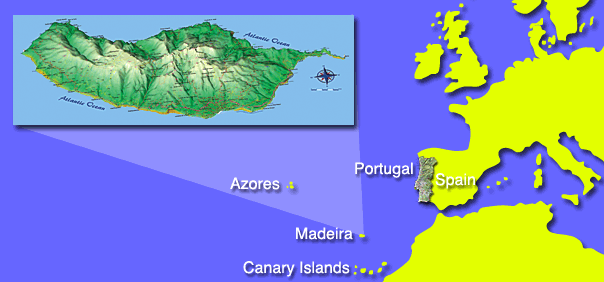


madeira-location.gif
 
Re: Madeira reports dengue outbreak - autochthonus transmission suspected

Re: Madeira reports dengue outbreak - autochthonus transmission suspected

Epidemiological update: Dengue in Madeira, October 2012

09 Oct 2012

ECDC
On 3 October, the Public Health Authority of Portugal (Dire??o-Geral da Sa?de) reported two cases of dengue infection in patients residing in the Autonomous Region of Madeira, Portugal. Both cases had no recent travel history abroad. The cases are suspected to be autochthonous however epidemiological investigations are still ongoing to confirm this possibility. Additional cases are under investigation by the local authorities and have been reported by the media.

A local response has been activated by the Health Services of the Autonomous Region of Madeira SESARAM, including epidemiological investigation, laboratory diagnosis, health care services response and dissemination of information regarding individual protection against mosquito bites. ECDC, in collaboration with the public health authorities in Portugal, is preparing a Rapid Risk Assessment.

This is the first known occurrence of locally transmitted dengue infection in Madeira, and consequently a new geographical area reporting autochthonous cases in the EU. There have been no reports of confirmed autochthonous dengue infections in the rest of Europe since the 2010 cases in France and Croatia.

For more information, read the ECDC fact sheet on dengue for professionals.

ECDC
 
Re: Madeira reports dengue outbreak - autochthonus transmission suspected

Re: Madeira reports dengue outbreak - autochthonus transmission suspected

machinetranslation

Dengue cases rise to 34 in Madeira

October 6, 2012

The President of the Health Service of the Autonomous Region of Madeira (SESARAM), Miguel Ferreira, 34 people there today unveiled infected with dengue in the Region.

"This afternoon, we had 34 positive cases in the Laboratory of Dr. Nelio Mendonca Hospital," he said.

Miguel Ferreira said that from now analyzes will be done in the Laboratory of Funchal, "initially were sent to the Institute Ricardo Jorge but the technique is already checked and we do them in the region."

"By late morning there were five people hospitalized for some of them but there was the prospect that they will be discharged today. But no serious cases, we have had only mild protests," he said.

Dengue is transmitted by the mosquito Aedes aegypti who settled in Madeira since 2005 but only now been detected official cases of the disease.

Sol Sapo
 
Re: Madeira reports dengue outbreak - autochthonus transmission suspected

Re: Madeira reports dengue outbreak - autochthonus transmission suspected

EPISOUTH

Location: Portugal Event: Dengue

On 10th October 2012, the Portuguese health authorities reported 18 confirmed dengue cases and 191 suspect cases in the autonomous region of Madeira, Portugal (cf. map 1).

Laboratory results confirmed that the outbreak was due to DEN-1 serotype.

The autochthonous qualification was confirmed for the two first reported confirmed cases (cf. eWEB n? 237).

Cases were mainly reported in municipalities of Funchal, Camara de Lobos and Santa Cruz (in Canico and Santa Cruz, cf. map 2).

It is the first time that autochthonous dengue cases have been reported in Madeira autonomous region.

Presence of Aedes aegypti vector in the Portuguese archipelago is known since 2004-2005 (cf. Eurosurveillance article, 2007).

Health authorities closely follow the situation and specific measures have been implemented, including recommendations for travellers.

The occurrence of an autochthonous cycle of transmission of dengue in Madeira archipelago indicates that a possible establishment of dengue circulation in the Mediterranean region cannot be excluded.

sporadic cases of dengue were already reported in the past years in several EpiSouth countries, such as Croatia , France and Egypt .
 
Re: Madeira reports dengue outbreak - autochthonus transmission confirmed

Re: Madeira reports dengue outbreak - autochthonus transmission confirmed

Rapid Risk Assessment on Dengue cases in Madeira

11 Oct 2012

ECDC

As of 10 October, 18 cases have been confirmed and 191 probable cases are under investigation. In total, 26 patients have been hospitalised but only 11 are currently. No cases have been reported on Porto Santo, the other inhabited island of the archipelago.

The cases of locally transmitted dengue infection in the Autonomous Region of Madeira, Portugal, were first reported on 3 October by the Portuguese Public Health Authority (Direção-Geral da Saúde).

This public health event is significant but not entirely unexpected given the established presence of the Aedes aegypti mosquito – the best mosquito vector for the disease – on Madeira. In light of this ECDC has produced a rapid risk assessment on the situation.

Protective measures
Portuguese public health authorities are implementing control measures to reduce the risk of sustained transmission locally, the export of infected vectors from the island, and to minimise the impact on the affected population.

The risk for travellers and for residents of the island will depend on the course of the outbreak in the coming weeks and the effectiveness of the control measures. People are advised to take individual protective measures to reduce mosquito bites.

Dengue is transmitted by a day-time mosquito so protection measures should be applied throughout the day. The present situation does not imply the need to change travel advice to Madeira.

Neighbouring geographical areas (e.g. Canary Islands) and other EU Member States need to assess the risk for the establishment of Aedes mosquito populations and introduction of dengue. Surveillance activities may need to be implemented or enhanced accordingly.

Dengue transmission
Vertical transmission of dengue virus from mosquitoes to their offspring is documented for Aedes aegypti. This phenomenon, even if limited, and that the mosquito can survive the mild Madeira winter, may contribute to renewed transmission in the spring next year, when the climate warms. Should dengue transmission become entrenched in Madeira, the risk for spread to continental Europe in the summer of 2013 would need to be assessed carefully, although there are no reports of established Aedes aegypti in continental Europe.

Dengue is a mosquito borne disease caused by viruses of the Flaviviridae family. The infection is not transmitted directly from human to human, except through blood transfusion, or organ and tissues transplantation. The majority of infections are either asymptomatic or result in a mild febrile illness. The more severe and potentially deadly forms develop in less than 5% of patients.


ECDC

thanks to Makoto
 
Re: Madeira reports dengue outbreak - autochthonus transmission confirmed

Re: Madeira reports dengue outbreak - autochthonus transmission confirmed

WHO

Dengue Fever in Madeira, Portugal

17 OCTOBER 2012 - An outbreak of dengue fever has been reported in Madeira, Portugal. As of 10 October 2012, a total of 18 confirmed cases and 191 probable cases have been reported.

The Public Health Authorities of Portugal are implementing control measures to reduce the risk of sustained transmission locally, to minimize the impact on the affected population and to prevent the export of infected vectors from the island.

Dengue fever is transmitted by the bite of an Aedes mosquito infected with any one of the four dengue viruses. Symptoms, which appear from 3-14 days after infection, range from mild fever to incapacitating high fever with severe headache, pain behind the eyes, muscle and joint pains and rash.

The public are advised to take individual protective measures during the day to reduce mosquito bites if travelling to areas with dengue fever outbreak.

WHO is supporting the Portuguese Ministry of Health to rapidly develop additional vector control guidance with a specific emphasis on vector control in port settings.

WHO encourages public health authorities in neighboring geographical areas and other Member States to assess the risk for the establishment of Aedes mosquito population and the introduction of dengue in their territories.

Travellers diagnosed with dengue on return from affected areas should be reported to the surveillance systems.

With respect to this event, WHO does not advise any travel or trade restriction to be applied to Madeira Island.

WHO
 
Re: Madeira reports dengue outbreak - autochthonus transmission confirmed

Re: Madeira reports dengue outbreak - autochthonus transmission confirmed

Hundreds sicken as dengue fever hits Portugal's Madeira


okt. 25, 2012


LONDON (Reuters) - Fifty-two people are confirmed to be suffering from dengue fever in the Portuguese archipelago of Madeira and another 404 probably have the mosquito-borne disease, health officials said on Thursday.

Two cases of dengue - also called "breakbone fever" because of the severe pain it can cause - have also been reported in France among people returning from Madeira, as well as one each in Britain and Sweden.

The European Centre for Disease Prevention and Control, which monitors disease in the European Union, said it was not recommending any restrictions on travel to Madeira, but was advising protection against mosquito bites.

While there have been no deaths since the first cases were reported in Madeira three weeks ago, some 40 people have required treatment in hospital. The archipelago lies north of the Canary Islands in the Atlantic Ocean.

More: Yahoo
 
Re: Madeira reports dengue outbreak - 400+ infected - autochthonus transmission confirmed

Re: Madeira reports dengue outbreak - 400+ infected - autochthonus transmission confirmed

Epidemiological update: Dengue fever outbreak, Madeira, Portugal, 52 cases confirmed and four cases in three other European countries

25 Oct 2012

ECDC

On 24 October 2012 the Portuguese Ministry of Public Health (Direcção-Geral da Saúde) confirmed 52 cases of dengue fever and 404 probable cases, compared to 37 confirmed and 262 probable cases in their previous update of 17 October.

Forty people required hospitalisation and five are still admitted to hospital. No deaths have been reported. The first cases were reported to the Portuguese public health authorities on 3 October 2012.

The United Kingdom, France and Sweden have reported four cases of dengue among travellers returning from Madeira and likely to have been infected during their stay on the island. Additional cases may be expected in the coming weeks.

The recent four cases of dengue among returning travellers from the island highlight the need for travellers to Madeira to protect themselves from mosquito bites by taking the necessary precautions.

The Autonomous Region of Madeira has also published recommendations on their website for individual protection measures. In light of cases among returning travellers, ECDC renews its advice to those who visited Madeira and experiencing febrile symptoms with severe headache, retro-orbital pain, myalgia, arthralgia and maculo-papular rash within 14 days of their trip to seek medical advice.

ECDC is supporting the public health authorities of the Madeira. A team of ECDC experts has been deployed since 22 October to assess the epidemiological and entomological situation and provide advice for prevention and control activities.

The conclusions of the rapid risk assessment published by ECDC on 10 October 2012 remain valid.
 
Re: Madeira reports dengue outbreak - 400+ infected - autochthonus transmission confirmed

Re: Madeira reports dengue outbreak - 400+ infected - autochthonus transmission confirmed

Source: http://www.chronicle.gi/headlines_details.php?id=26489

Madeira link - case of dengue fever reported in UK

A case of dengue fever has been reported in England, the Health Protection Agency said.

The HPA said the case was linked to the Portuguese island of Madeira, where there is currently an outbreak of the disease.

The sufferer was ?recovering well?, a spokesman said, but gave no further details to their identity or nationality.

Dengue fever is a viral infection spread by mosquitoes. Symptoms include a fever, headache and bone, muscle and joint pain. It can lead to more serious complications.

So far 52 confirmed and 404 probable cases have been identified by Portuguese Ministry of Public Health on the island west of Morocco, plus two cases in France and one in Sweden linked to the outbreak.

?The European Centre for Disease Prevention and Control (ECDC) does not recommend any restrictions on travel to Madeira, but travellers are advised to protect themselves from mosquito bites by taking necessary precautions,? an HPA spokesman said.

The person affected lives in Britain, the HPA said...
 
Re: Madeira reports dengue outbreak - 400+ infected - autochthonus transmission confirmed

Re: Madeira reports dengue outbreak - 400+ infected - autochthonus transmission confirmed

Crofsblogs

october 29, 2012

Madeira: Government should have heeded dengue warnings

Via Destak.pt: Dengue podia ter sido minimizado se Governo madeirense tivesse acolhido "m?ltiplos avisos" - Virologista. [Dengue could have been minimized if Madeira government had heeded "multiple warnings" -- virologist]

The report,with translation by Crawford Kilian:

O virologista do Instituto de Higiene e Medicina Tropical Jaime Nina afirmou hoje que o surto de dengue, na Madeira, podia ter sido minimizado, se o Governo regional tivesse ligado aos "m?ltiplos avisos", feitos desde 2005, por v?rias entidades.

Jaime Nina, virologist of the Institute of Hygiene and Tropical Medicine said today that the dengue outbreak in Madeira could have been minimized if the regional government had heeded "multiple warnings" since 2005 from various agencies.

aime Nina disse ? ag?ncia Lusa que o mosquito "Aedes aegypti" foi detetado na Madeira, em 2005. Desde essa altura, "h?, pelo menos, uma d?zia de relat?rios de entidades, quer locais, quer nacionais, nomeadamente do Instituto Nacional de Sa?de Dr. Ricardo Jorge [INSA] e do Instituto de Higiene e Medicina Tropical, a dizer que se deve combater o mosquito", um "vetor potent?ssimo de uma s?rie de doen?as humanas". J

Jaime Nina told the Lusa agency that the Aedes aegypti mosquito was detected in Madeira in 2005. Since then, "There have been at least a dozen reports from different organizations, whether local or national, like the Dr. Ricardo Jorge National Health Institute and the Institute of Hygiene and Tropical Medicine, saying the dengue mosquito had to be fought" as a "very powerful vector of a range of human diseases."

"N?o se pode dizer que o governo provincial n?o tivesse tido tempo. Pura e simplesmente n?o ligaram aos m?ltiplos avisos, deram prioridade a outras tarefas, e agora t?m um surto de dengue", disse o especialista, ? margem do encontro "Biosseguran?a: Doen?as Infecciosas, uma potencial amea?a biol?gica", que se realiza em Lisboa.

"It can't be said that the provincial government paid attention. Pure and simple, it didn't heed multiple warnings, giving priority to other tasks, and now they have a dengue outbreak," the specialist said, while attending a conference, "Biosecurity: Infectious Diseases, a Potential Biological Threat," held in Lisbon.

Crofsblogs
 
Re: Madeira reports dengue outbreak - 400+ infected - autochthonus transmission confirmed

Re: Madeira reports dengue outbreak - 400+ infected - autochthonus transmission confirmed

Source: http://portuguese-american-journal.com/travel-dengue-virus-outbreak-rises-to-62-cases-madeira/

Travel: Dengue virus outbreak rises to 62 cases ? Madeira

Posted on 31 October 2012

The Institute of the Administration of Health and Social Affairs (IASAUDE), based on Madeira island, has confirmed 62 dengue fever cases on the region, with 6 patients currently hospitalize in the Hospital of Funchal.

There were 52 cases of dengue in Madeira confirmed last week, with five patients in hospital, according to IASAUDE , compared with 37 confirmed cases a week earlier, with six patients in hospital.

In a statement last week, IASAUDE has said there were over 400 cases of probable infection with the virus in the archipelago and that a cumulative total of 40 patients have been taken to hospital with symptoms in recent weeks...
 
Re: Madeira reports dengue outbreak - 400+ infected - autochthonus transmission confirmed

Re: Madeira reports dengue outbreak - 400+ infected - autochthonus transmission confirmed

[Source: European Centre for Disease Prevention and Control (ECDC), full page: (LINK).]

Epidemiological update: outbreak of dengue in Madeira, Portugal

08 Nov 2012 / ECDC


The outbreak of dengue in Madeira has evolved rapidly since its onset on 3 October 2012.

As of 4 November, according to an update from the Portuguese Ministry of Health, 1 148 cases of dengue infection have been reported from the public health sector of which 517 were laboratory confirmed.

During the outbreak, 57 people have been hospitalised for observation and no deaths or cases of severe dengue have been reported. Three patients remained in hospital.

Almost all reported cases refer to the resident population.

However, a small number of visiting tourists have been diagnosed with dengue infection after developing symptoms back in their home countries.

The United Kingdom has reported six cases imported from Madeira, France and Germany two cases each and Sweden one case. None of these persons have had serious disease. In addition, eight cases were diagnosed after returning to mainland Portugal.

The updated figures indicate that the outbreak has not yet peaked and more cases among the island?s population as well as returning tourists should be expected.

The peak mosquito breeding period, including the dengue vector Aedes aegypti, will continue until the beginning of next year and coincides with a peak in the number of visitors to the islands over the Christmas holidays.

ECDC is providing technical assistance to the health authorities in Madeira in their efforts to control the outbreak.

The epidemiological case definition has been revised and an automated surveillance system has been set up with the support from ECDC.

The system, which is based on unique identifiers and reports from the public health services, allows for timely monitoring of cases by date of onset, age, sex, place of residence and area of daily activities. Private providers are encouraged to report via a web-based system.

The changes that were put in place meant that additional cases were identified retrospectively.

The entomological and epidemiological findings from the ECDC mission are currently being analysed and will form the basis for ECDC?s recommendations for dengue control in Madeira in the short and long term.

It is still too early to predict if this outbreak signals the start of endemic dengue on the island.
-
-------
 
Re: Madeira reports dengue outbreak - 700 infected - autochthonus transmission confirmed

Re: Madeira reports dengue outbreak - 700 infected - autochthonus transmission confirmed

machinetranslation

Nearly 700 confirmed cases of dengue fever in Portugal

15.11.2012

There are 669 confirmed cases of dengue fever in Portugal, a hemorrhagic fever that can lead to death. There are still 688 suspected cases awaiting laboratory confirmation.

The outbreak began in October in Madeira. Five people are still hospitalized with dengue fever. So far there has been no death from the virus but are recorded 89 hospitalizations.

SIC Noticias
 
Re: Madeira reports dengue outbreak - 700 infected - autochthonus transmission confirmed

Re: Madeira reports dengue outbreak - 700 infected - autochthonus transmission confirmed

Source: http://www.ecdc.europa.eu/en/press/...a&ID=788&RootFolder=/en/press/news/Lists/News


Update: risk assessment on dengue cases in Madeira
20 Nov 2012
Update: risk assessment on dengue cases in Madeira
ECDC

The Autonomous Region of Madeira constituted the first known occurrence of locally transmitted dengue infection on the island on 3 October 2012 when the Public Health Authority of Portugal reported two cases of dengue infection in residents. These infections in patients residing in Madeira mark the first sustained transmission of dengue in the European Union since the 1920s.

Local transmission of dengue infection has been now established for several weeks on Madeira and as of 11 November 2012, the Portuguese Ministry of Health reported 1 357 cases of dengue infection from the public health sector in Madeira. 669 of these cases were laboratory confirmed, 688 probable cases. Since the beginning of the outbreak, 89 patients were hospitalised and five currently remain in hospital. So far, 25 patients have been diagnosed with dengue after returning from the island: cases were reported from mainland Portugal (nine), the UK (six), Germany (seven), Sweden (one) and France (two).

In the meantime, Portuguese and regional health authorities have been implementing control measures to limit extension of the outbreak to reduce the risk of sustained transmission locally and that of exportation of infected vectors from the island. In addition, ECDC provided technical assistance to the health authorities in Madeira in their efforts to control the outbreak by deploying an expert mission from 22 October until 16 November. Following this visit, ECDC updated its initial rapid risk assessment on the situation. The updated assessment reconfirms that the current epidemiological situation does not imply any trade or travel restriction beyond the disinfestations implemented on the island at present.

However, residents as well as tourists are strongly advised to take individual protective measures ? like using repellents ? to avoid mosquito bites. Dengue is transmitted by a daytime mosquito (Aedes aegypti) and thus protective measures should be applied throughout the whole day.

The latest data indicate that the outbreak is still on-going and its exact development cannot be anticipated at this point of time. With tourists visiting Madeira, continued import of dengue cases from the island to other EU countries is to be expected until the mosquito population is decreased and transmission interrupted.

Anyone who develops a fever or flu-like symptoms (with severe headache, retro-orbital pain, myalgia, arthralgia and maculo-papular rash) within two weeks of returning from a trip to Madeira should seek medical advice...
 
Re: Madeira reports dengue outbreak - 1,672 cases - autochthonus transmission confirmed

Re: Madeira reports dengue outbreak - 1,672 cases - autochthonus transmission confirmed

Portugal?s Dengue Outbreak Worsens as Cases Accelerate
By Simeon Bennett - Nov 22, 2012

An outbreak of dengue on the Portuguese island of Madeira worsened as infections of the mosquito-borne disease accelerated.

Reported cases of the potentially lethal disease rose to 1,672 as of Nov. 18, Portugal?s health ministry said in a report on its website yesterday. That?s a 23 percent jump in one week, after cases rose 18 percent in the week ending Nov. 11, according to data on the website. The ministry first reported two cases on Oct. 3.

The epidemic is the first sustained outbreak of dengue in Europe since the 1920s, the European Centre for Disease Prevention and Control said in a Nov. 20 report. Transmission will probably increase as the number of visitors to the island swells during the Christmas holidays, the ECDC said.

Most cases so far are among island residents, though there have been 10 infections among visitors from mainland Portugal, seven from Germany, six from the U.K., two from France and one each from Sweden and Finland, the ministry said. One hundred people have been hospitalized and none have died.

Read more: Bloomberg
 
Re: Madeira reports dengue outbreak - 1,672 cases - autochthonus transmission confirmed

Re: Madeira reports dengue outbreak - 1,672 cases - autochthonus transmission confirmed

According to Episouth: 32 cases have been reported in travellers from Madeira.

machinetranslation


1891 dengue cases in Madeira, "966 of which laboratory confirmed"

AUTHOR: MICHAEL JOHN RIBEIRO

THURSDAY, NOVEMBER 29, 2012

The week that mediated the latest updates dengue outbreak in Madeira confirmed a decrease in the rate of new infections (219 new cases, 96 fewer than in the previous update), but the total number of cases of fever in 1891.

A weekly update tracking the outbreak of dengue in Madeira, conducted by Directorate General of Health (DGS), has shown that there are increasingly infected: almost 2000 cases were flagged, with about half to be confirmed in the laboratory.

"There have been 1891 cases of dengue fever, including 966 with laboratory confirmation," wrote the director-general, Francis George, the weekly reported. In the previous newsletter, the DGS report 929 cases reported between 1672 and confirmed in the laboratory.

This monitoring also shows a slowdown in the rate of new infections. In the update two weeks ago, the number of new cases of fever was 315, while in the evening bulletin new cases were reported 219.

PTJornal
 
Re: Madeira reports dengue outbreak - 1,891 cases - autochthonus transmission confirmed

Re: Madeira reports dengue outbreak - 1,891 cases - autochthonus transmission confirmed

Source: http://www.swissinfo.ch/eng/news/in...on_Madeira,_say_authorities.html?cid=34154478

Dec 10, 2012 - 17:56 Send this story Print this story
Outbreak of dengue fever diminishing on Madeira, say authorities

LISBON (Reuters) - An outbreak of dengue fever on Madeira island is waning after infecting 2,000 people in Europe's first sustained transmission since the 1920s, Portugal's health secretary Fernando Leal da Costa said on Monday.

Speaking to reporters during a visit to Madeira to assess the outbreak, Leal da Costa lauded the island's dengue detection and treatment system, saying dengue-carrying mosquitoes had apparently been brought inadvertently from a tropical country earlier this year...
 
Re: Madeira reports dengue outbreak - 1,891 cases - autochthonus transmission confirmed

Re: Madeira reports dengue outbreak - 1,891 cases - autochthonus transmission confirmed

[Source: European Centre for Disease Prevention and Control (ECDC), full page: (LINK). Edited.]


Epidemiological update: Outbreak of dengue in Madeira, Portugal

13 Dec 2012


As of 9 December 2012, the Portuguese Ministry of Health has reported 2,050 cases of dengue infection from the Autonomous Region of Madeira. During the current outbreak, 121 people have been hospitalised and no deaths or cases of severe dengue have been reported. Two patients remained in hospital as of 9 December 2012.

All reported cases refer to the resident population of the island.

However, a number of visiting tourists have been diagnosed with dengue infection after developing symptoms back in their home countries.

As of 12 December 2012, fifty-eight patients have been diagnosed with dengue after returning from Madeira.

The United Kingdom has reported twenty cases, Germany fourteen cases, France three, Finland four, Croatia, Denmark, Norway and Slovenia, Spain, Sweden and Switzerland have all reported one case each.

In addition, ten persons were diagnosed with dengue infection after returning to mainland Portugal.

The updated figures indicate that the outbreak has peaked and despite an important decrease of the number of notified cases reported, the outbreak is still on-going.

Therefore, more cases among the island?s population as well as among returning tourists should be expected.

(?)

The main breeding period of the dengue mosquito vector, Aedes aegypti, will continue until the beginning of next year and coincides with a peak in the number of visitors to the island over the Christmas holidays.

Therefore, residents and travellers visiting the island of Madeira are strongly advised to take individual protective measures (like using repellents) to avoid mosquito bites. Dengue is transmitted by a daytime mosquito and consequently protective measures must be applied throughout the day.

Travellers experiencing febrile symptoms with severe headache, retro-orbital pain, myalgia, arthralgia and maculo-papular rash within 21 days of visiting Madeira are advised to seek medical advice.

ECDC has provided technical assistance to the health authorities in Madeira in their efforts to control the outbreak by deploying a team of experts to the island (22 October to 16 November 2012).

On 20 November 2012, ECDC published an updated rapid risk assessment concerning the autochthonous dengue cases in Madeira which outlines the measures implemented in response to the outbreak.

ECDC continues to gather information on confirmed cases reported by EU/EEA Member States.

Blood donor deferral for 28 days from day of departure for travellers returning from the Autonomous region of Madeira is now recommended for all Member States, in accordance with section 2.3, Annex III of the Commission Directive 2004/33/EC of 22 March 2004.


Read more on the ECDC website:


Related links:
-
------
 
Re: Madeira reports dengue outbreak - 1,891 cases - autochthonus transmission confirmed

Re: Madeira reports dengue outbreak - 1,891 cases - autochthonus transmission confirmed

The 2012 Madeira Dengue Outbreak: Epidemiological Determinants and Future Epidemic Potential

PLoS Negl Trop Dis. Aug 2014; 8(8): e3083.

Author Summary

In 2012, Europe saw its first dengue epidemic taking place on the Atlantic island of Madeira. Due to strong tourism links, 81 cases were introduced into continental Europe in a short period of three months.

Although Aedes aegypti, the mosquito-vector responsible for this particular outbreak, is extinct in mainland Europe, climatic and globalization trends have eased the recent establishment of Aedes albopictus, dengue's secondary vector, in France, Germany, Italy and Spain.

Before this epidemic, dengue had only sporadically achieved short chains of transmission. The presence of fully susceptible populations, however, makes the possible introduction into Europe a major public health concern.

Here, using a mathematical approach, we analysed Madeira's dengue outbreak, focusing on the necessary conditions for introduction, spread and persistence.

We find that natural temperature cycles were the determining factor for the 2012's outbreak demise, and are generally expected to severely disrupt dengue transmission between November and April, suggesting weak potential for endemicity.

On the other hand, Madeira demonstrates a high potential for sporadic and potentially large epidemics in the remaining summer months, especially if the virus is introduced early during the warm season.

Link to full article: Plos Neglected Tropical Diseases
 
Back
Top Bottom