

sharon sanders
Editor-in-Chief & President
hat tip
@IndySpiritus
Number of human cases of Influenza A (H5N1) in Los Angeles County: 0
See CDC: H5N1 Bird Flu: Current Situation Summary for national surveillance data.
See CDPH: Bird Flu Situation for updates on the H5N1 situation in California.
As of November 1, 2024, H5 has been detected at low levels in wastewater in Los Angeles County.
The public health risk in LA County remains low, but Public Health is closely monitoring the situation. For information on H5N1 in animals, see LAC DPH Veterinary Public Health.
All healthcare providers should immediately contact public health if a patient has compatible symptoms and recent exposure to birds, livestock, or raw milk.
Call LAC DPH at:
About Avian Influenza A (H5N1)
Background
Avian influenza A or bird flu, refers to various strains of influenza A viruses that typically infect birds. While these viruses mainly affect wild birds, sometimes they also infect other animals, including wild and domestic animals (including seals, foxes, cats, and cows). H5N1 is one type of avian influenza that has been spreading among birds and mammals, leading to a nationwide outbreak.
Current Situation
Over the past few years, public health officials have been tracking an outbreak of avian influenza A (H5N1) in the U.S., which has affected various animals, including wild mammals, domestic pets, and, more recently, dairy cattle. The first human case in the U.S. occurred in 2022, and since March 2024, H5N1 has been detected in cattle, including in California. While human infections are rare and the overall risk to the public remains low, individuals who work closely with animals are at a greater risk. For more information, visit the CDC’s Bird Flu Current Summary Situation and the California Department of Public Health’s Bird Flu page.
Prevention
Human H5N1 infections are very rare and we're still learning about how this virus might cause infection in mammals. The following are general best practices to prevent the spread of H5N1:
Reporting
All healthcare providers should immediately contact Public Health if a patient has compatible symptoms and recent exposure to birds, livestock, or raw milk.
Call LAC DPH at:
Symptoms
Signs/symptoms of avian influenza A (H5N1) virus infection in humans may include:
In symptomatic patients, assess for recent history of recreational or occupational exposure to wild or domestic birds (such as backyard poultry), and dairy cattle. Since other mammals can become infected with H5N1, it is also advisable to ask patients about other animal exposures. Testing
Clinicians working with potential human H5N1 cases should adhere to Standard Precautions plus Contact and Airborne Precautions, including:
Information for Clinical Laboratories
LAC DPH is following CDC guidance to enhance influenza surveillance due to the ongoing global outbreak of influenza A (H5N1). Additional actions for clinical laboratories are as follows:
Resources & News
Resources
CDPH Confirms Two Cases of Bird Flu in California (October 3, 2024)
Avian Influenza Confirmed in Three California Dairy Herds (August 30, 2024)
CDC Confirms Three Human Cases of H5 Bird Flu Among Colorado Poultry Workers (July 25, 2024)
CDC Confirms Human Cases of H5 Bird Flu Among Colorado Poultry Workers (July 14, 2024)
CDC Reports Fourth Human Case of H5 Bird Flu Tied to Dairy Cow Outbreak (July 3, 2024)
CDC Confirms Second Human H5 Bird Flu Case in Michigan; Third Case Tied to Dairy Outbreak (May 30, 2024)
CDC Reports Second Human Case of H5 Bird Flu Tied to Dairy Cow Outbreak (May 22, 2024)
U.S. Case of Human Avian Influenza A(H5) Virus Reported (April 28, 2022)
Highly Pathogenic Avian Influenza A (H5N1) Virus Infection Reported in a Person in the U.S. (April 1, 2024) Printable Materials
Materials for Providers
 Avian Influenza: Information for Providers
English Materials for the Public
 Symptom Monitoring and Isolation Guidance for People Who Have Symptoms After Exposure to Avian Influenza A (H5N1)
English
 Symptom Monitoring and Isolation Guidance for People Exposed to Avian Influenza A (H5N1)
English
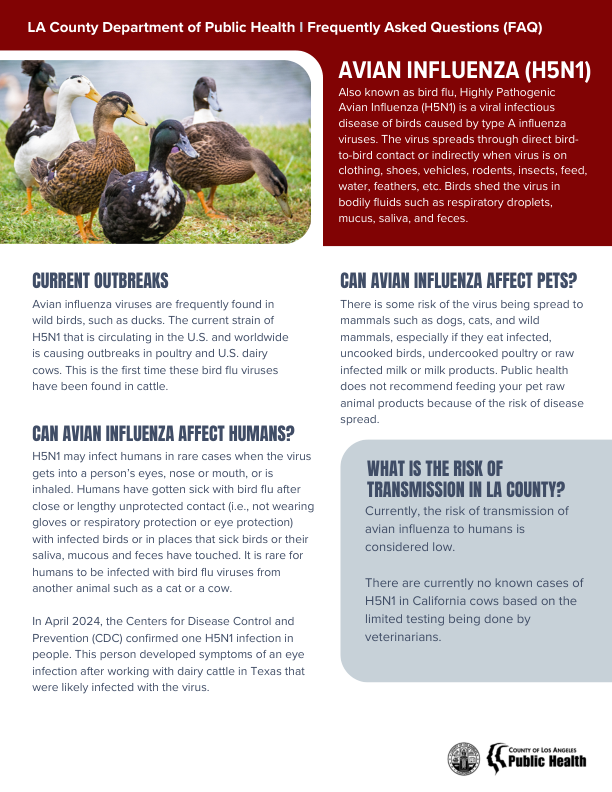 Avian Influenza: Information and Frequently asked Questions for the General Public
English | Español
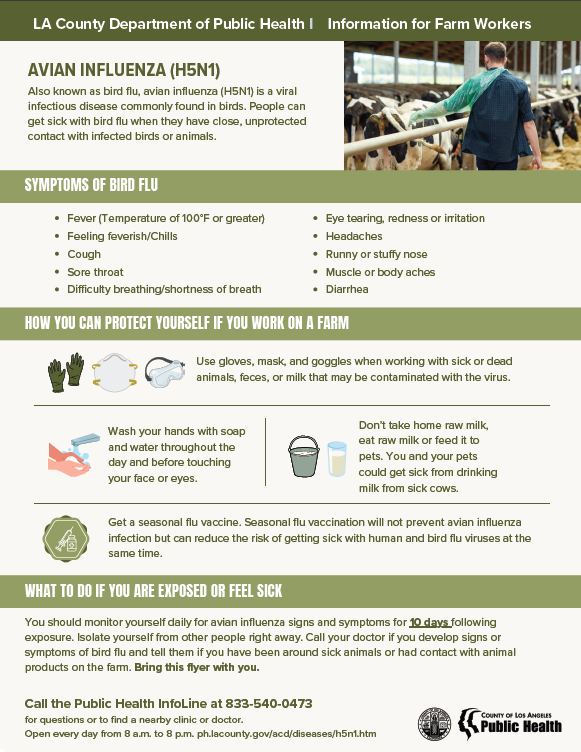 Avian Influenza: Information and Frequently asked Questions for Farm Workers
English | Español
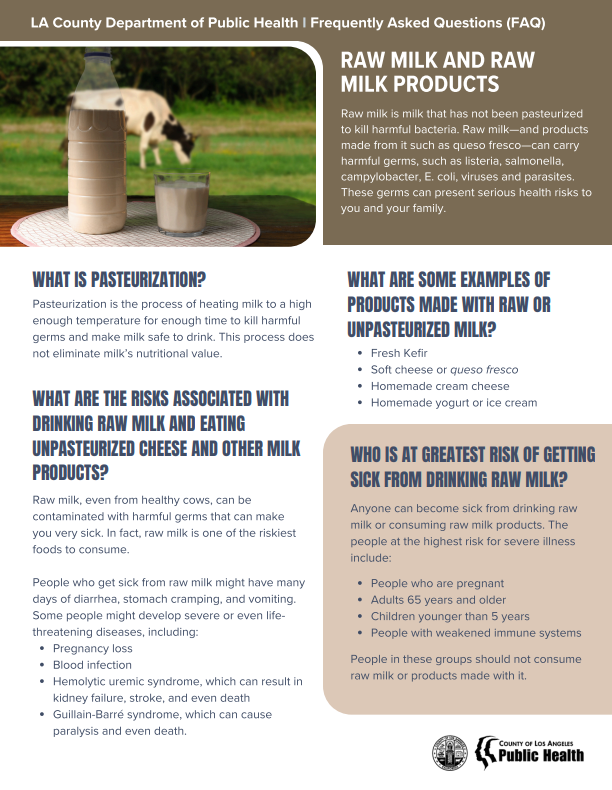 Avian Influenza: Information and Frequently asked Questions about Raw Milk Products
English | Español
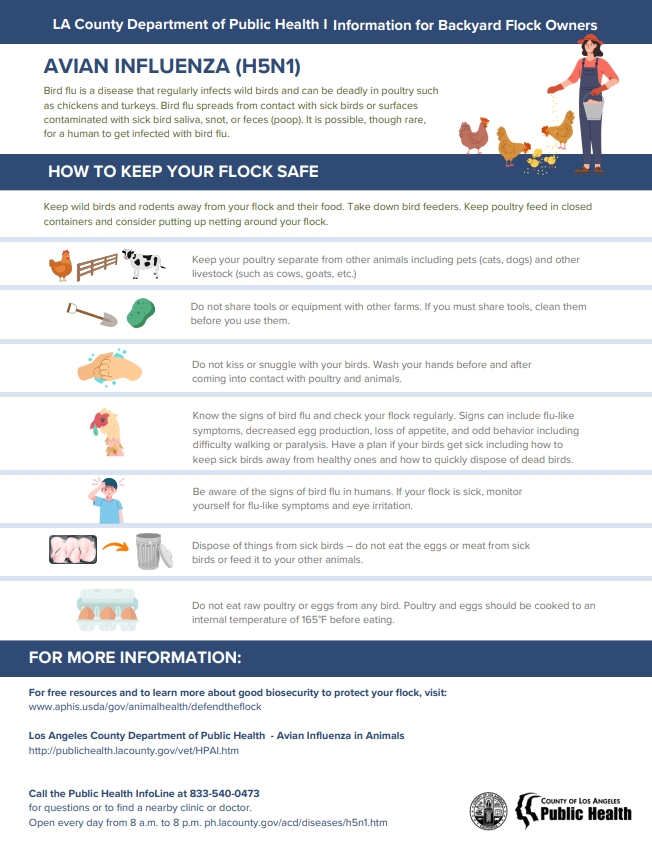 Avian Influenza: Information for Backyard Flock Owners
@IndySpiritus
Number of human cases of Influenza A (H5N1) in Los Angeles County: 0
See CDC: H5N1 Bird Flu: Current Situation Summary for national surveillance data.
See CDPH: Bird Flu Situation for updates on the H5N1 situation in California.
As of November 1, 2024, H5 has been detected at low levels in wastewater in Los Angeles County.
The public health risk in LA County remains low, but Public Health is closely monitoring the situation. For information on H5N1 in animals, see LAC DPH Veterinary Public Health.
All healthcare providers should immediately contact public health if a patient has compatible symptoms and recent exposure to birds, livestock, or raw milk.
Call LAC DPH at:
- (213) 240-7941 (7:30AM-5:00PM, Mon-Fri)
- (213) 974-1234 (After Hours, Emergency Operator)
About Avian Influenza A (H5N1)
Background
Avian influenza A or bird flu, refers to various strains of influenza A viruses that typically infect birds. While these viruses mainly affect wild birds, sometimes they also infect other animals, including wild and domestic animals (including seals, foxes, cats, and cows). H5N1 is one type of avian influenza that has been spreading among birds and mammals, leading to a nationwide outbreak.
Current Situation
Over the past few years, public health officials have been tracking an outbreak of avian influenza A (H5N1) in the U.S., which has affected various animals, including wild mammals, domestic pets, and, more recently, dairy cattle. The first human case in the U.S. occurred in 2022, and since March 2024, H5N1 has been detected in cattle, including in California. While human infections are rare and the overall risk to the public remains low, individuals who work closely with animals are at a greater risk. For more information, visit the CDC’s Bird Flu Current Summary Situation and the California Department of Public Health’s Bird Flu page.
Prevention
Human H5N1 infections are very rare and we're still learning about how this virus might cause infection in mammals. The following are general best practices to prevent the spread of H5N1:
- Do not consume raw milk, raw cheese and undercooked meat products.
- Avoid unprotected contact with sick or dead animals. The virus can spread to other birds, pets or mammals if they come in contact with infected feces or eat infected animals.
- Report sick or dead birds to your local animal control agency for potential collection and testing. Sick birds or animals may not have flu-like symptoms, but may appear generally sick, have difficulty moving, seizures, or be found dead.
- Anytime you are in contact with animals, wash your hands with soap and water before touching your face or eyes.
- If you work with or around sick animals, use appropriate personal protective equipment.
- Prevent wild birds from getting into areas that house pet birds or poultry. Also make sure wild birds cannot defecate down into areas holding pet birds or poultry.
- Take down bird feeders and shared bird baths to reduce the risk of the virus spreading from bird-to-bird.
- Keep pets away from sick and dead birds as there is some risk of the virus spreading to dogs, cats and other wild mammals if they eat raw or uncooked poultry.
- Do not feed raw milk or raw milk products to pets.
- Get a seasonal flu vaccine. Seasonal flu vaccination will not prevent infection with avian influenza viruses but can reduce the risk of getting sick with human and bird flu viruses at the same time.
Reporting
All healthcare providers should immediately contact Public Health if a patient has compatible symptoms and recent exposure to birds, livestock, or raw milk.
Call LAC DPH at:
- (213) 240-7941 (7:30AM-5:00PM, Mon-Fri)
- (213) 974-1234 (After Hours, Emergency Operator)
Symptoms
Signs/symptoms of avian influenza A (H5N1) virus infection in humans may include:
- Cough, sore throat, runny or stuffy nose, muscle or body aches, headaches, fatigue
- Fever* or feeling febrile
- Eye redness (or conjunctivitis)
- Shortness of breath or difficulty breathing
- Diarrhea, nausea, vomiting
In symptomatic patients, assess for recent history of recreational or occupational exposure to wild or domestic birds (such as backyard poultry), and dairy cattle. Since other mammals can become infected with H5N1, it is also advisable to ask patients about other animal exposures. Testing
- Testing of clinical specimens for avian influenza A virus can only be performed at a public health laboratory. Testing at a clinical or commercial laboratory cannot rule out avian influenza A virus infection.
- In patients with compatible symptoms and recent exposure to birds, livestock, or raw milk, consult with LAC DPH prior to obtaining H5N1/Influenza specimen to confirm if appropriate. LAC DPH will provide guidance on specimen collection and will coordinate testing with the public health laboratory. Call Public Health’s Acute Communicable Disease Control Program at 213-240-7941.
Clinicians working with potential human H5N1 cases should adhere to Standard Precautions plus Contact and Airborne Precautions, including:
- Hand hygiene
- Gloves
- Gowns
- Respiratory protection that is at least as protective as a fit-tested NIOSH-approved disposable N95 filtering facepiece respirator upon entry to the patient room or care area
- Eye protection
- Eye protection (i.e., goggles or a face shield) should be worn at all times when evaluating patients for H5N1 infection.
- Patient placement
- Confirmed or suspected cases should be placed in an airborne infection isolation room or a private room.
Information for Clinical Laboratories
LAC DPH is following CDC guidance to enhance influenza surveillance due to the ongoing global outbreak of influenza A (H5N1). Additional actions for clinical laboratories are as follows:
- If requested, submit remnant, previously tested influenza A/B positive molecular specimens to the Public Health Lab for additional testing.
- Immediately report to LAC DPH (call 213-240-7941) any clinical specimen for which subtyping is attempted and does not identify a seasonal subtype. These specimens should be urgently directed to the Public Health Lab for further testing.
Resources & News
Resources
- LAHANs
- LAC DPH Laboratory Notification: Enhanced Influenza Surveillance (June 13, 2024)
- CDC: H5N1 Bird Flu: Current Situation Summary
- CDPH: Wastewater Surveillance for Influenza A Viruses FAQs
- CDC's Interim Guidance for Infection Control Within Healthcare Settings When Caring for Confirmed Cases, Probable Cases, and Cases Under Investigation for Infection with Novel Influenza A Viruses Associated with Severe Disease
- Veterinary Public Health H5N1 Page
- USDA: Highly Pathogenic Avian Influenza (HPAI) Detections in Livestock
CDPH Confirms Two Cases of Bird Flu in California (October 3, 2024)
Avian Influenza Confirmed in Three California Dairy Herds (August 30, 2024)
CDC Confirms Three Human Cases of H5 Bird Flu Among Colorado Poultry Workers (July 25, 2024)
CDC Confirms Human Cases of H5 Bird Flu Among Colorado Poultry Workers (July 14, 2024)
CDC Reports Fourth Human Case of H5 Bird Flu Tied to Dairy Cow Outbreak (July 3, 2024)
CDC Confirms Second Human H5 Bird Flu Case in Michigan; Third Case Tied to Dairy Outbreak (May 30, 2024)
CDC Reports Second Human Case of H5 Bird Flu Tied to Dairy Cow Outbreak (May 22, 2024)
U.S. Case of Human Avian Influenza A(H5) Virus Reported (April 28, 2022)
Highly Pathogenic Avian Influenza A (H5N1) Virus Infection Reported in a Person in the U.S. (April 1, 2024) Printable Materials
Materials for Providers
English Materials for the Public
English
English
English | Español
English | Español
English | Español