

Gert van der Hoek
In Memoriam - Editor, Senior Moderator
Summary
Background
Spain is one of the European countries most affected by the COVID-19 pandemic. Serological surveys are a valuable tool to assess the extent of the epidemic, given the existence of asymptomatic cases and little access to diagnostic tests. This nationwide population-based study aims to estimate the seroprevalence of SARS-CoV-2 infection in Spain at national and regional level.
Methods
35 883 households were selected from municipal rolls using two-stage random sampling stratified by province and municipality size, with all residents invited to participate. From April 27 to May 11, 2020, 61 075 participants (75?1% of all contacted individuals within selected households) answered a questionnaire on history of symptoms compatible with COVID-19 and risk factors, received a point-of-care antibody test, and, if agreed, donated a blood sample for additional testing with a chemiluminescent microparticle immunoassay. Prevalences of IgG antibodies were adjusted using sampling weights and post-stratification to allow for differences in non-response rates based on age group, sex, and census-tract income. Using results for both tests, we calculated a seroprevalence range maximising either specificity (positive for both tests) or sensitivity (positive for either test).
Findings
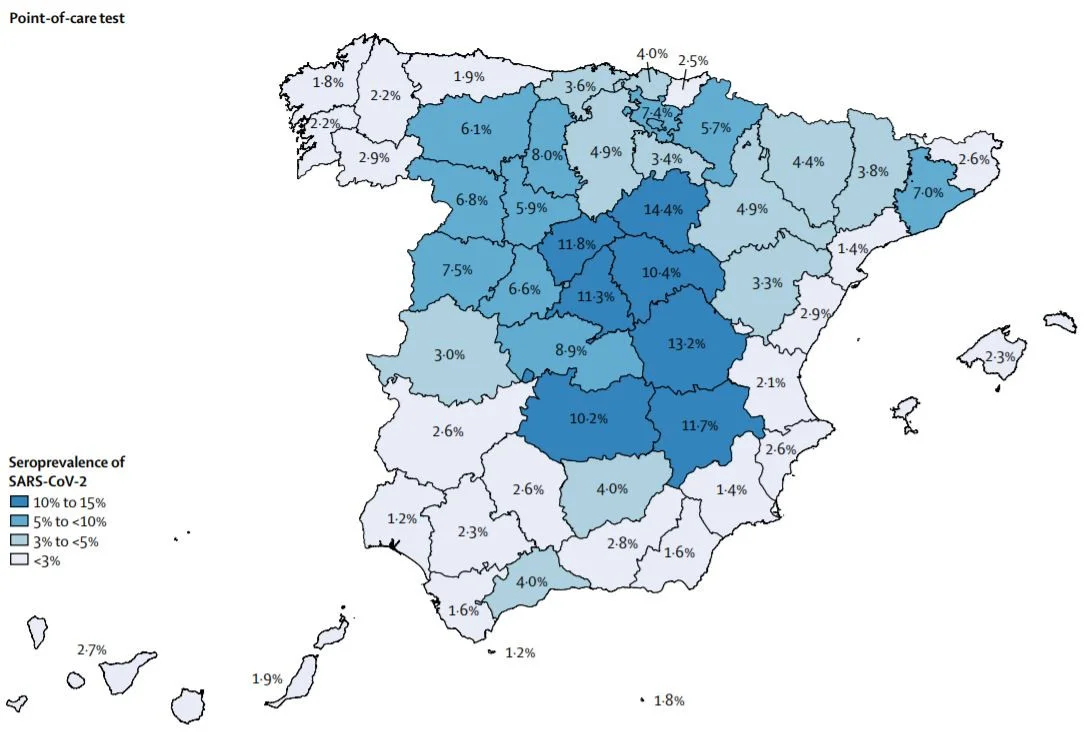
Seroprevalence was 5?0% (95% CI 4?7–5?4) by the point-of-care test and 4?6% (4?3–5?0) by immunoassay, with a specificity–sensitivity range of 3?7% (3?3–4?0; both tests positive) to 6?2% (5?8–6?6; either test positive), with no differences by sex and lower seroprevalence in children younger than 10 years (<3?1% by the point-of-care test). There was substantial geographical variability, with higher prevalence around Madrid (>10%) and lower in coastal areas (<3%).
Seroprevalence among 195 participants with positive PCR more than 14 days before the study visit ranged from 87?6% (81?1–92?1; both tests positive) to 91?8% (86?3–95?3; either test positive). In 7273 individuals with anosmia or at least three symptoms, seroprevalence ranged from 15?3% (13?8–16?8) to 19?3% (17?7–21?0).
Around a third of seropositive participants were asymptomatic, ranging from 21?9% (19?1–24?9) to 35?8% (33?1–38?5).
Only 19?5% (16?3–23?2) of symptomatic participants who were seropositive by both the point-of-care test and immunoassay reported a previous PCR test.
Interpretation
The majority of the Spanish population is seronegative to SARS-CoV-2 infection, even in hotspot areas. Most PCR-confirmed cases have detectable antibodies, but a substantial proportion of people with symptoms compatible with COVID-19 did not have a PCR test and at least a third of infections determined by serology were asymptomatic. These results emphasise the need for maintaining public health measures to avoid a new epidemic wave.
Background
Spain is one of the European countries most affected by the COVID-19 pandemic. Serological surveys are a valuable tool to assess the extent of the epidemic, given the existence of asymptomatic cases and little access to diagnostic tests. This nationwide population-based study aims to estimate the seroprevalence of SARS-CoV-2 infection in Spain at national and regional level.
Methods
35 883 households were selected from municipal rolls using two-stage random sampling stratified by province and municipality size, with all residents invited to participate. From April 27 to May 11, 2020, 61 075 participants (75?1% of all contacted individuals within selected households) answered a questionnaire on history of symptoms compatible with COVID-19 and risk factors, received a point-of-care antibody test, and, if agreed, donated a blood sample for additional testing with a chemiluminescent microparticle immunoassay. Prevalences of IgG antibodies were adjusted using sampling weights and post-stratification to allow for differences in non-response rates based on age group, sex, and census-tract income. Using results for both tests, we calculated a seroprevalence range maximising either specificity (positive for both tests) or sensitivity (positive for either test).
Findings
Seroprevalence was 5?0% (95% CI 4?7–5?4) by the point-of-care test and 4?6% (4?3–5?0) by immunoassay, with a specificity–sensitivity range of 3?7% (3?3–4?0; both tests positive) to 6?2% (5?8–6?6; either test positive), with no differences by sex and lower seroprevalence in children younger than 10 years (<3?1% by the point-of-care test). There was substantial geographical variability, with higher prevalence around Madrid (>10%) and lower in coastal areas (<3%).
Seroprevalence among 195 participants with positive PCR more than 14 days before the study visit ranged from 87?6% (81?1–92?1; both tests positive) to 91?8% (86?3–95?3; either test positive). In 7273 individuals with anosmia or at least three symptoms, seroprevalence ranged from 15?3% (13?8–16?8) to 19?3% (17?7–21?0).
Around a third of seropositive participants were asymptomatic, ranging from 21?9% (19?1–24?9) to 35?8% (33?1–38?5).
Only 19?5% (16?3–23?2) of symptomatic participants who were seropositive by both the point-of-care test and immunoassay reported a previous PCR test.
Interpretation
The majority of the Spanish population is seronegative to SARS-CoV-2 infection, even in hotspot areas. Most PCR-confirmed cases have detectable antibodies, but a substantial proportion of people with symptoms compatible with COVID-19 did not have a PCR test and at least a third of infections determined by serology were asymptomatic. These results emphasise the need for maintaining public health measures to avoid a new epidemic wave.