• FluTrackers.com Inc. does not provide medical advice. Information on this web site is collected from various internet resources, and the FluTrackers board of directors makes no warranty to the safety, efficacy, correctness or completeness of the information posted on this site by any author or poster. The information collated here is for instructional and/or discussion purposes only and is NOT intended to diagnose or treat any disease, illness, or other medical condition. Every individual reader or poster should seek advice from their personal physician/healthcare practitioner before considering or using any interventions that are discussed on this website. By continuing to access this website you agree to consult your personal physican before using any interventions posted on this website, and you agree to hold harmless FluTrackers.com Inc., the board of directors, the members, and all authors and posters for any effects from use of any medication, supplement, vitamin or other substance, device, intervention, etc. mentioned in posts on this website, or other internet venues referenced in posts on this website.
  • We are not asking for any donations. Do not donate to any entity who says they are raising funds for us.

Labor Markets and BF

sharon sanders

Editor-in-Chief & President
I am starting a new thread to discuss the potential effect of the pandemic on labor markets. Webster has been quoted saying that maybe 50% of the population could die. This would have a dramatic effect on the world's labor markets. First, is a basic article describing the labor market in the United States:

A rise in the unemployment rate generally signals a weakening labor market and a weakening economy. A rising unemployment rate typically signals a recession. A falling unemployment rate typically signals economic expansion.

The Bureau of Labor Statistics (BLS) reported that the unemployment rate rose from 4.7% to 4.8% during February 2006. The BLS also reported that the economy created 243,000 new jobs during this same period. More new jobs coupled with a higher unemployment rate--what's going on? Most economists view the rise in the unemployment rate as temporary. In fact, strong job growth might actually cause an increase in the unemployment rate. Understanding why requires us to look at how the BLS defines unemployment.

A person is unemployed if she is jobless AND actively sought work in the past 4 weeks. The labor force is the number of people employed plus the number of people unemployed. The unemployment rate is the number of people unemployed divided by the labor force. A person who is jobless but has NOT sought work in the past 4 weeks (because she gave up after failing to get a job), is jobless but NOT unemployed--they are not part of the labor force.

Suppose on February 1st, there are 100 people in the labor force and 5 people who are initially unemployed which implies a 5% unemployment rate. Mary, John, and William lost their jobs 4 months ago but stopped looking for work after 2 months of failed attempts. Mary, John, and William are jobless but not unemployed. The economy rebounds and 1 new job is created on February 15th. The job creation inspires Mary, John, and William to begin seeking work again on February 31st.

First, of the 5 people initially unemployed, only 4 will be unemployed because one new job was created. Second, 3 additional people who were not considered unemployed initially (Mary, John, and William) enter the labor force and are now unemployed. The new labor force equals 100 + 3 = 103 people and 4 + 3 = 7 people are unemployed which implies a 6.8% unemployment rate. Hence, the unemployment rate increases because people who were not part of the labor force enter the labor force, raising the number of unemployed people along with the size of the labor force.

1. If job creation continues in March, then would the unemployment rate increase or decrease? What if people continue entering the labor force at an unusually high rate?

2. Should jobless people who did not seek jobs in the past 4 weeks be considered unemployed?

3. Is the unemployment rate a good measure of the health of the economy?

 
Re: Labor Markets and BF

Labor Supply
The labor market is an inversion of the goods and services market: in the labor market, individual buyers from the goods and services market become the suppliers of labor, while the firms that sold goods in the goods and services market become the buyers. Firms need workers to produce and sell goods, and so after they have decided how many workers and how many hours of labor they want, they enter the labor market and "buy" labor. Workers enter the labor market with an idea of how much they want to work and how much they want to be paid, and they "supply" the labor. The combination of the two, labor supply and labor demand, determines how the labor market behaves. Let's take a look at labor supply. Workers, when deciding whether or not they want to work, and how much they want to work, are faced with a choice between two possibilities: leisure and consumption. (Economists assume that leisure can be treated as a normal good: more is better) There is a tradeoff, however, between leisure and consumption). If a person decides that they want leisure, then they will work less (or not at all), but this means that they won't be able to buy as many things. If they decide that they want to consume, then they will work more (or all of the time), but this means that they won't have as much free time to themselves. Their preferences for leisure (free time) and all other goods (consumption), combined with the current market wage, will determine what combination of leisure and all other goods they will choose, much in the same way that an individual's indifference curves and the market price of different goods will determine what combination of goods that individual will buy. Even though workers are the suppliers of labor, they make their working decisions in a manner similar to the way they make their buying decisions: based on preferences and price.
Workers will try and maximize their utility based on their preferences between having free time and having money, and on their budget constraint (how much of each good: leisure or all other goods, that they can afford).
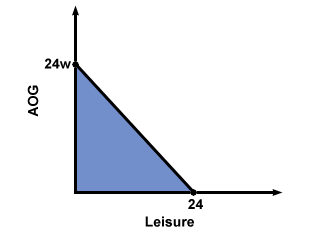
How do we represent a budget constraint for leisure and all other goods (AOG)? Typically, leisure is measured in one hour units, so that in one day, a worker can choose to take up to 24 hours of leisure. All other goods (AOG) are measured by their dollar value, so that a worker can choose to work 24 hours a day and buy up to 24 hours times the wage (24w) worth of all other goods. Graphically, a budget constraint would look like this:
lbudget.gif

Figure 1.1: Consumption/Leisure Budget Constraint


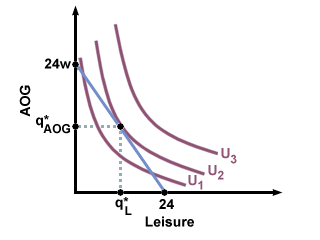
We can combine a worker's budget constraint with his indifference curves to see how the worker would optimize the labor-leisure choice:
lopt.gif


Figure 1.2: Optimizing the Consumption/Leisure Decision

Just as a buyer's budget constraint pivots with a change in the price of one good, a worker's budget constraint can pivot with a change in the wage. If the wage increases, the curve pivots outwards (U3). If the wage drops, then the curve pivots inwards (U1). Note that the maximum leisure point is fixed, since there are only 24 hours in a day.
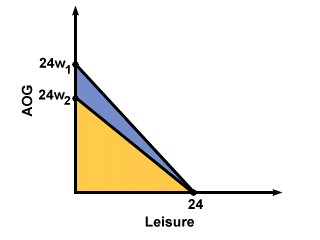
In the graph below, you can see the inwards pivot that occurs when the wage level drops: workers cannot afford as many other goods as they could prior to the drop in pay.
pivot.gif
Figure 1.3: Decreased Wages Cause a Pivot in the Budget Constraint


The substitution effect and the income effect, also influence worker's decisions between consumption and leisure.
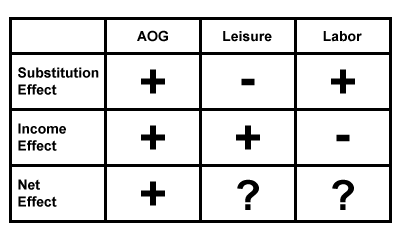
When the wage increases, the income effect makes workers feel wealthier and therefore makes them want more of both leisure and consumption. The substitution effect, however, makes leisure relatively expensive (since the worker would have to give up more wages to have free time; think of the wages lost as the price of leisure), so workers will want more consumption and less leisure. Because labor is inversely related to leisure, this means that an increase in wages will cause labor to both increase (substitution effect) and decrease (income effect). Therefore, when wages increase, the combined effect of the substitution and income effect is that workers will choose more consumption; the effect on the level of labor and leisure is uncertain. If we assume that the substitution effect is stronger, then workers will choose to work more and play less, which makes sense, since a higher wage would give workers more incentive to work.
lincsub.gif
Figure 1.4: Income and Substitution Effects on the Consumption/Leisure Decision


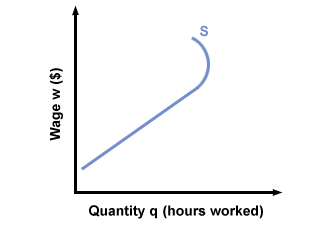
Is this always true, that the substitution effect outweighs the income effect? Some economists believe that it is initially true, at relatively low wage levels. However, as the wage gets progressively higher, they believe that the income effect begins to outweigh the substitution effect, and very high wage-earners will begin to choose leisure over consumption even if their wage increases. (Maybe that's why corporate bigwigs have the reputation of having too much free time gallivant around on tropical islands).
backbend.gif


Figure 1.5: Backward-bending Labor Supply Curve


An individual's labor supply curve marks out the number of hours they are willing to work at different wages, the same way that a seller's supply curve marks out how much they are willing to sell at different prices.
 
Last edited:
Re: Labor Markets and BF

Here's Jeff's take on it:
http://avianfluinvestor.blogspot.com/2006/03/planning-for-50-percent-mortality-rate.html

Planning for a 50 percent mortality rate


The most common scenario painted for a possible worldwide flu pandemic is 150 million deaths, with perhaps 2 million of those in the United States. But that's not the worst case scenario. Not by a long shot.

One scientist who's not afraid to speak the unspeakable is Robert G. Webster, the man credited with discovering the link between bird flu and human flu.

"Society just can't accept the idea that 50 percent of the population could die. And I think we have to face that possibility," Webster says. "I'm sorry if I'm making people a little frightened, but I feel it's my role."

Webster may be basing this blunt declaration on the fact that roughly half of those known to have caught the avian influenza from bird have died.

Imagine if 1 in every 2 people living on the planet today were to die in the space of 18 months? That would cut world population from the current 6 billion to 3 billion. That's more than enough people to run the planet. We did quite nicely with only 1 billion at the dawn of the industrial age in the 1800s. But a downsizing that big in such a short timespan has enormous ramifications.

First, we can throw out the possibility of hunting for the winners in the market basket of stocks. Sooner or later all the markets will tank. Stock market and bank "holidays" are a strong possibility. It won't be business as usual.

The psychological blow would be unprecedented. Everybody will lose loved ones - close family members. Society will be ripped apart. Tens of millions of children will be orphaned. Hundreds of millions of families will lose their wage earners. Economic activity will grind to a halt. Faced with a 50/50 chance of dying if you go to work, who wouldn't stay home? Fear and depression will have a huge impact on consumer behavior.

Housing markets worldwide will collapse as entire families die or are forced to abandon their homes. Demand for everything from food to oil to coal to steel to concrete will collapse.

Al Queda will be giving props to the flu for doing what they could only dream about: bringing western civilization to its knees. And this will make some environmentlists very happy. In one short, sharp blow, we'll radically reduce greenhouse gas emissions and the exploitation of natural resources. And solve the population problem too. There will be a lot more of everything to go around, which means you'll see deflation like you've never seen before.

We haven't seen a death rate like this since the black plague in the late 1300s, when an estimated 1/3 of Europe's population died. And it wasn't just Europe. The plague cut a swath through Palestine and Syria and entire rural provinces were totally depopulated. Syria lost a total of 400,000 people.

But that was nothing compared to what happened in China. The initial outbreak of plague in the Chinese province of Hubei in 1334 claimed up to ninety percent of the population, an estimated five million people. During 1353?54, outbreaks in eight distinct areas throughout the Mongol/Chinese empires may have caused the death of two-thirds of China's population, often yielding an estimate of twenty five million deaths.

The fallout from that was a sea change in the structure of feudal Europe. I'll cut and paste here from Wikipedia, which explains that "the sudden scarcity of cheap labour provided an incentive for landlords to compete for peasants with wages and freedoms, an innovation that, some argue, represents the roots of capitalism, and the resulting social upheaval caused the Renaissance and even Reformation. In many ways the Black Death improved the situation of surviving peasants. In Western Europe, because of the shortage of labour they were in more demand and had more power, and because of the reduced population, there was more fertile land available."

Before anybody gets too excited, the author goes on to point out that it took about 120 years for these benefits to be realized. But eventually the plague's great population reduction brought cheaper land prices, more food for the average peasant, and a relatively large increase in per capita income among the peasantry.

But there were growing pains. Human beings haven't changed that much since then, and given a similar mortality rate (say a 1 in 3 death rate) we can expect:

Renewed religious fervour and fanaticism

A turning away from religion

Persecution of anybody held to be responsible. Given the human penchant for ignoring the facts, this could be anybody. The 1918 flu was known as the Spanish Flu, even though it started in Kansas. Back in the 1300s, Jews were the whipping boys. If this flu starts out in China, all Asians could suffer in the blame game.

Looting, piracy and a thriving black market.

Fixation on death and morbidity which will be reflected in art and culture. Attention goths. You'll fit right in.


If it looks like we're headed down a road like this, your best investments might be a piece of fertile land, basic tools for building and farming, a few guns and plenty of ammo, a couple of Euell Gibbons wild food books, some rabbits and chickens and a few Amish friends who know how to get things done without cars or electricity. For the short term, bear market funds and PUT options will do well, so long as you cash in before everything collapses or "profiteering" becomes a crime. Gold has always held value as a means of exchange, so unless the rules are completely rewritten, that should still hold true.

Robert Webster, by the way, says he's got 3 months worth of food and water stocked away, enough for a 150 million death pandemic, but certainly not enough for a slaughter in the billions. Not even the Mormons have enough to ride that out.

So stay flexible and be prepared to adjust your investment strategy quickly as events unfold. And have a nice weekend. :)
 
Re: Labor Markets and BF

".....so long as you cash in before everything collapses or "profiteering" becomes a crime. Gold has always held value as a means of exchange, so unless the rules are completely rewritten, that should still hold true...."

So true.

"....So stay flexible and be prepared to adjust your investment strategy quickly as events unfold...."

The more liquid you are, the more flexible you can be.


The labor shortage will come in the fields that are the most labor intense:
nursing, health aids, agriculture workers, restaurants, hotels, all kinds of repair services, day care workers, handy man, drivers, some financial services, all kinds of salesmen, retail, mining, dock workers, police, fire, EMT, clerks, software design, fishing, airlines, butchers, etc...

I am sure I have left some out. The demand for these workers will exceed supply and drive these wages higher. If H5N1 follows the 1918 age range for highest fatality rate in the ages of 20 - 45, there will be a lower supply of health aids for the elderly.

Please add to my list of labor intensive jobs that will have low supply. I did not include constuction which is a labor intensive job because there will be excess capacity in real estate depressing the need for new constuction.
 
Last edited:
Back
Top