

Pathfinder
Editor, Senior Moderator
Translation Google
Call for vigilance in the face of the risk of a resurgence of measles
News
July 22, 2025

A case of indigenous measles in a 23-month-old infant was reported on July 17, 2025. This is the first time since 2019 that the island has been affected, while mainland France has been facing a resurgence in cases since the beginning of the year.
Upon receipt of the signal, health risk prevention and management measures were put in place by the ARS to prevent possible contamination:
Mandatory vaccination
Measles vaccination is mandatory for all children born since January 1, [SUP]2018.[/SUP] The first dose is administered at 12 months and the second between 16 and 18 months.
For people born before 1980, only one dose of vaccine is recommended. They can check their vaccination history with their doctor.
Measles vaccination protects against the disease in almost 100% of cases after 2 doses of vaccine.
For people born before 1980, only one dose of vaccine is recommended. They can check their vaccination history with their doctor.
Insufficient vaccination coverage in Reunion
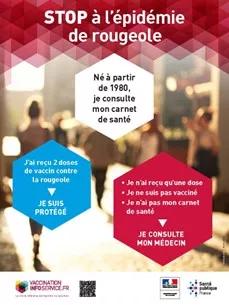
According to epidemiological data from Public Health France, in Réunion, the 2-dose vaccination coverage for infants against measles, mumps and rubella is 80%, and therefore lower than the 95% target required to interrupt transmission of the virus.
The ARS La Réunion reminds that vaccination is an essential preventive measure ensuring individual, but also collective, protection by helping to reduce the circulation of the virus.
It is therefore essential to check your vaccination status, as two doses are required to be effectively protected against measles. If in doubt or if fewer than two doses of vaccine have been administered, it is recommended to consult a healthcare professional to proceed, if necessary, with a catch-up in accordance with the vaccination schedule recommendations.
* This site, also available in a version dedicated to health professionals, allows everyone to access factual, practical and scientifically validated information on vaccination at different stages of life, on a disease, on vaccination in general or on a particular vaccination.
Measles, a serious and highly contagious disease
Fever, cough, fatigue, runny nose, conjunctivitis, followed by a rash, are the most common symptoms of measles which can lead to serious complications (laryngitis, ear infections, pneumonia, etc.) in children, as well as in adults, particularly in immunocompromised people and pregnant women (risk for the mother and the unborn child).
Because the virus is transmitted through the air, all non-immune people (children and adults) are at risk of contracting measles.
In an unvaccinated population, it is estimated that one contagious person can infect 15 to 20 people.
In case of symptoms
It is essential to consult your doctor and adopt barrier measures to limit the transmission of the virus:
Call for vigilance in the face of the risk of a resurgence of measles
News
July 22, 2025
A case of indigenous measles in a 23-month-old infant was reported on July 17, 2025. This is the first time since 2019 that the island has been affected, while mainland France has been facing a resurgence in cases since the beginning of the year.
Upon receipt of the signal, health risk prevention and management measures were put in place by the ARS to prevent possible contamination:
- Identification of contact persons and verification of their vaccination status
- Communication aimed at healthcare professionals (general practitioners via the URPS and the Council of the Order, pediatric emergency services and SAMU, infectious disease specialists, outpatient care services).
Mandatory vaccination
Measles vaccination is mandatory for all children born since January 1, [SUP]2018.[/SUP] The first dose is administered at 12 months and the second between 16 and 18 months.
For people born before 1980, only one dose of vaccine is recommended. They can check their vaccination history with their doctor.
Measles vaccination protects against the disease in almost 100% of cases after 2 doses of vaccine.
For people born before 1980, only one dose of vaccine is recommended. They can check their vaccination history with their doctor.
Insufficient vaccination coverage in Reunion
According to epidemiological data from Public Health France, in Réunion, the 2-dose vaccination coverage for infants against measles, mumps and rubella is 80%, and therefore lower than the 95% target required to interrupt transmission of the virus.
The ARS La Réunion reminds that vaccination is an essential preventive measure ensuring individual, but also collective, protection by helping to reduce the circulation of the virus.
It is therefore essential to check your vaccination status, as two doses are required to be effectively protected against measles. If in doubt or if fewer than two doses of vaccine have been administered, it is recommended to consult a healthcare professional to proceed, if necessary, with a catch-up in accordance with the vaccination schedule recommendations.
* This site, also available in a version dedicated to health professionals, allows everyone to access factual, practical and scientifically validated information on vaccination at different stages of life, on a disease, on vaccination in general or on a particular vaccination.
Measles, a serious and highly contagious disease
Fever, cough, fatigue, runny nose, conjunctivitis, followed by a rash, are the most common symptoms of measles which can lead to serious complications (laryngitis, ear infections, pneumonia, etc.) in children, as well as in adults, particularly in immunocompromised people and pregnant women (risk for the mother and the unborn child).
Because the virus is transmitted through the air, all non-immune people (children and adults) are at risk of contracting measles.
In an unvaccinated population, it is estimated that one contagious person can infect 15 to 20 people.
In case of symptoms
It is essential to consult your doctor and adopt barrier measures to limit the transmission of the virus:
- Contact your doctor to make an appointment, do not go spontaneously to the doctor's office or the emergency room .
- Reduce contact with other people.
- Activate barrier gestures: wash your hands regularly or use a hydro-alcoholic solution, cough or sneeze into your elbow or into a tissue, blow your nose into a disposable tissue and then throw it away.
- Regularly ventilate the rooms you are in.
- Maintain a distance of at least one meter from others.
- Additionally, wear a mask when you have symptoms.