• FluTrackers.com Inc. does not provide medical advice. Information on this web site is collected from various internet resources, and the FluTrackers board of directors makes no warranty to the safety, efficacy, correctness or completeness of the information posted on this site by any author or poster. The information collated here is for instructional and/or discussion purposes only and is NOT intended to diagnose or treat any disease, illness, or other medical condition. Every individual reader or poster should seek advice from their personal physician/healthcare practitioner before considering or using any interventions that are discussed on this website. By continuing to access this website you agree to consult your personal physican before using any interventions posted on this website, and you agree to hold harmless FluTrackers.com Inc., the board of directors, the members, and all authors and posters for any effects from use of any medication, supplement, vitamin or other substance, device, intervention, etc. mentioned in posts on this website, or other internet venues referenced in posts on this website.
  • We are not asking for any donations. Do not donate to any entity who says they are raising funds for us.

Kyasanur Forest Disease 2014-2020

Ronan Kelly

Retired 2020
From week 6 IDSP report http://idsp.nic.in/

Karnataka
Shimoga
vii Kyasanur Forest Disease
12 ( lab confirmed)
08/02/14 09/02/14
Under Surveillance
Outbreak reported from Villages/PHC?s Konandur, Kannagi,
Malur, Block Thirthalli, District Shimoga. District RRT
investigated the outbreak. House to house fever survey done.
Affected villages are surrounded by forest. 2 deaths of monkey
were reported. People go to forest to collect fire wood.
Agriculture is the main occupation of the community. Out of
35 serum samples collected and sent o NIV, Pune, 12 samples
were positive for Kyasanur Forest Disease (RT PCR). Gram
Panchayat was sensitized regarding prevention and control
measures. Health education given regarding personal
protection.
http://idsp.nic.in/idsp/IDSP/rcntobrk.pdf

21 cases of ?monkey fever? in Shimoga

STAFF CORRESPONDENT

In all, 21 cases of Kyasanur Forest Disease (KFD), also known as monkey fever, have been reported in the district this year.

It may be mentioned here that there was an outbreak of KFD in Tirthahalli taluk in last week of January.

District Health Officer Rajesh Suragihalli told presspersons that of the 74 blood samples sent to the Viral Diagnostic Laboratory, Shimoga, for medical investigation, 21 were found to be positive.

The Department of Health and Family Welfare has taken initiatives to tackle the problem.

...
http://www.thehindu.com/news/nation...of-monkey-fever-in-shimoga/article5719594.ece
 
Re: Kyasanur Forest Disease 2014

Re: Kyasanur Forest Disease 2014

Monkey fever scare: Khadar asks Malnad people to be careful
From Our Special Correspondent
Daijiworld Media Network - Bangalore

Bangalore, Mar 1:
...

[Karnataka?s Health Minister U T] Khadar, who spoke to reporters after holding a meeting with officials of the Health Department in Bangalore on Saturday, said 24 cases of money fever have been reported from Thirthahalli and others parts of Shimoga and Chikmagalur districts.

Out of 90 cases reported, blood tests have confirmed 24 cases of money fever.

The disease has not claimed any life so far, the minister said.
...
http://www.daijiworld.com/news/news_disp.asp?n_id=220679
 
Re: Kyasanur Forest Disease 2014

Re: Kyasanur Forest Disease 2014

Mangalore: Two Cases of 'Monkey Disease' Detected in District

Published Date: 16 Mar, 2014 (3:00 PM)
from special correspondent

Mangalore: Spotting of a dead monkey in the jurisdiction of the primary health centre in Venur on Saturday has increased the worries and caution about the spread of the Kyasanur Forest Disease, commonly known as 'Monkey Disease' or 'Mangana Kaayile' in local languages.
...
The first case to be detected in DK was of a woman from Beluvai near Moodbidri. Currently undergoing treatment in the intensive care unit of the Wenlock hospital, she is still not out of danger. Signs of infection are still left in a part of the brain, said hospital sources.

The second is of one Suresh from Tirthahalli of Shimoga district. First he was admitted to Meggan hospital in Shimoga. The doctors there asked him to be taken to the Wenlock hospital in the city.
...
http://www.mangalorean.com/news.php?newstype=broadcast&broadcastid=467250
 
Re: Kyasanur Forest Disease 2014

Re: Kyasanur Forest Disease 2014

Source: http://www.thehindu.com/news/cities/Mangalore/monkey-fever-returns-after-a-year/article5795317.ece

MANGALORE, March 17, 2014
Updated: March 17, 2014 11:54 IST
?Monkey fever? returns after a year
72 positive cases reported in Tirthahalli, one in Mangalore

?Monkey fever? (Kyasanur forest disease) is back after a gap of one year and has spread to new areas. ?More than 200 cases of fever have been reported from Tirthahalli taluk (in Shimoga), since January this year, of which 72 were positive,? said Rajesh Surigehalli, District Health Officer in-charge, Shimoga, and Deputy Director of Virus Diagnostic Lab, Shimoga.

Of them, 71 are from Tirthahalli and one from Hosanagara, he said. One case has been reported from Belvai in Mangalore taluk.

Last year, no cases of monkey fever were reported in the district; in 2012, there were 90 to 92 cases, mostly from areas around Konanduru in Shimoga.

Dr. Surigehalli pointed out two patterns in the reoccurrence of monkey fever in Shimoga. ?One, all new cases were reported in new areas; and two, they are reported 11 km away from the vaccinated area. The last case in the area was 12 years ago,? he said.

One reason could be the movement of cattle, carrying infected ticks...
 
Re: Kyasanur Forest Disease 2014

Re: Kyasanur Forest Disease 2014

Officials run second test to confirm monkey fever in patient

SPECIAL CORRESPONDENT

Health officials are in a state of ?watchful expectancy? for cases of monkey fever in the district and said there will be clarity on whether the patient from Belavai has monkey fever in a week.

While tests have shown that the patient has monkey fever, the officials on Monday said that a second test would be done to reconfirm the result.
...
Dr. Rajesh said that the last human positive case in Dakshina Kannada district was in 2006 when there were 54 cases of monkey fever and one death.
...
http://www.thehindu.com/todays-pape...rm-monkey-fever-in-patient/article5798737.ece
 
Re: Kyasanur Forest Disease 2014

Re: Kyasanur Forest Disease 2014

Source: http://www.newindianexpress.com/cit...es/2014/03/22/article2123589.ece#.Uy1z6V5pehc


Monkey Fever Outbreak has Health Official on Their Toes
By Mohammed Yacoob - BANGALORE
Published: 22nd March 2014 08:06 AM
Last Updated: 22nd March 2014 08:27 AM

Monkey fever, a viral disease characterised by headache and haemorrhage, is sweeping through parts of Shimoga, Chikmagalur and Dakshina Kannada districts.

Also called the Kyasanur Forest Disease (KFD), it spreads through the bite of a forest tick which carries the disease-causing virus from monkeys and other hosts to humans. The Health Department has already recorded 74 cases of monkey fever, and has stepped up efforts to identify the affected, and take preventive measures in Thirthahalli and Hosanagar taluks of Shimoga and other affected districts...
 
Re: Kyasanur Forest Disease 2014

Re: Kyasanur Forest Disease 2014

From Week 11 IDSP report;
Kerala
Wayanad
xv. Kyasanur Forest Disease
6 cases 0 fatalities 11/3/14 16/3/14
Under surveillance
Cases of fever and body ache reported from Village/PHC
Noolpuzha, SC Muthanga, Block Bathery, District
Wayanad.District RRT investigated the outbreak. Active search
for cases done. All affected cases are female workers with
history of working in forest area and tick bites. Out of 7 blood
samples tested 1 was positive for KFD. Health education given
regarding personal protection.


Karnataka Shimoga
ii. Kyasanur Forest Disease?
86 cases 0 fatalities 11/3/14
Under control
Outbreak reported from Villages Hadigallu, Bandikoppa, Banvikaisaru,
Tanigebylu, Kannangi,Ganimakki,Dobylur Bellur ,Jaddinagadde, PHC/CHC
Thirthalli , District Shimoga .District RRT investigated the outbreak. House to
house survey done. Affected villages are surrounded by forest. Monkey deaths
were reported .People go to forest for collection of wood and agriculture is the
main occupation of the community. 86 serum samples sent to NIV, Pune ; result
awaited. Gram Panchayat was sensitized regarding prevention and control
measures. Health education given regarding personal protection.

http://idsp.nic.in/idsp/IDSP/rcntobrk.pdf
http://idsp.nic.in/idsp/IDSP/11th_wk14.pdf
 
Last edited:
Re: Kyasanur Forest Disease 2014

Re: Kyasanur Forest Disease 2014

Suggestions on containing ?monkey fever? sent to govt.

K. JEEVAN CHINNAPPA

A technical note comprising suggestions on containing Kyasanur forest disease (KFD), a tick-borne viral disease, by adopting control measures was recently sent to the State Forest Department by the Ministry of Environment and Forests.
...
The note suggested that movements in the forest area where the disease had been previously reported should be restricted.

Tick repellents should be used and proper protective clothing should be worn by people venturing into the forest.

Therefore, mass treatment of domestic cattle was also suggested to prevent the disease from spreading. Vaccination of village residents and forest workers had been proven effective.
http://www.thehindu.com/todays-pape...-monkey-fever-sent-to-govt/article5865449.ece
 
Re: Kyasanur Forest Disease 2014

Re: Kyasanur Forest Disease 2014

KARNATAKA

SHIMOGA, April 26, 2014
Updated: April 26, 2014 12:56 IST
Monkey fever claims one life in Shimoga

STAFF CORRESPONDENT

Nagaraj, a forest guard, passed away after contracting Kyasanur Forest Disease (KFD), also known as ?monkey fever?, on April 20.

This is the first death this year caused by the illness.

...
he was admitted to the Jayachamarajendra Government Hospital in Tirthahalli in the first week of April. He was tested positive for KFD, treated for five days, and later discharged.

After a week, he again developed health problems which prompted his being admitted to a hospital in Manipal where he died.

...

The officer added that a total of 123 people had been tested positive for KFD this year.
...

http://www.thehindu.com/news/nation...claims-one-life-in-shimoga/article5948364.ece
 
Re: Kyasanur Forest Disease 2014

Re: Kyasanur Forest Disease 2014

From Week 22 IDSP report; http://idsp.nic.in/

Kerala Malappuram
Kyasanur Forest
Disease 4 cases 0 fatal
06/05/2014
Under surveillance
Cases reported from Block Chungathara, Village /PHC/ SC Karulai,
district Malappuram. All cases were reported from tribal area of a
reserve forest. The cases tested positive for KFD at NIV Pune by Ig M ELISA and RTPCR. All the cases were above 15 years of age.
House to house survey done to find new cases.
 
Re: Kyasanur Forest Disease 2014

Re: Kyasanur Forest Disease 2014

Waiting for English Language details - Ro

Kerala

Malayalam Print Report here;
Monkey flue in Nilambur Forest http://www.marunadanmalayali.com/news/keralam/monkey-flue-in-nilambur-forest-8434

and video reports here;
Monkey fever reported in Nilambur Forest area
http://www.malayalamtele.com/monkey-fever-reported-in-nilambur-forest-area-video_e576bc7c7.html

and here;
Monkey fever reported in Nilambur Forest area
Published on Nov 29, 2014
Monkey fever, a viral disease characterized by headache and hemorrhage, is been reported in Nilambur forest area among the tribal. it spreads through the bite of a forest tick which carries the disease-causing virus from monkeys and other hosts to humans. The health officials are awaiting the results of the sample collected from a monkey which was found death few days ago. The officials has failed to step up efforts to identify the affected, and take preventive measures in the forest areas.

http://youtu.be/zuaTjHNyF8I
 
Volume 21, Number 1?January 2015

Dispatch

Kyasanur Forest Disease Outbreak and Vaccination Strategy, Shimoga District, India, 2013?2014

S.K. Kiran, Achhelal Pasi, Satish Kumar, Gudadappa S. Kasabi, Prabhakara Gujjarappa, Aakash Shrivastava, Sanjay Mehendale, L.S. Chauhan, Kayla F. Laserson, and Manoj MurhekarComments to Author
[h=3]Abstract[/h] We investigated a Kyasanur Forest disease outbreak in Karnataka, India during December 2013?April 2014. Surveillance and retrospective study indicated low vaccine coverage, low vaccine effectiveness, and spread of disease to areas beyond those selected for vaccination and to age groups not targeted for vaccination. To control disease, vaccination strategies need to be reviewed.

In India, Kyasanur Forest disease (KFD), a tickborne viral hemorrhagic fever that occurs as seasonal outbreaks during January?June (1,2), has been endemic to 5 districts of Karnataka State. However, during 2012?2013, KFD infection was reported from other districts and states in India: Chamarajanagara District, Karnataka State; Nilgiri District, Tamil Nadu State; and Waynad District, Kerala State (3).
Vaccination with formalin-inactivated tissue-culture vaccine has been the primary strategy for controlling KFD. The strategy involves mass vaccination in areas reporting KFD activity (i.e., laboratory evidence of KFD virus [KFDV] in monkeys, humans, or ticks) and in villages within a 5-km radius of such areas (Directorate of Health and Family Welfare Services, Government of Karnataka, 2005 manual on Kyasanur Forest disease; unpub. data). Two vaccine doses are administered at least 1 month apart to persons 7?65 years of age. Vaccine-induced immunity is short-lived, so the first booster dose of vaccine is recommended within 6?9 months after primary vaccination; thereafter, annual booster doses are recommended for 5 years after the last confirmed case in the area (4).

14-1227-F1-tn.jpg
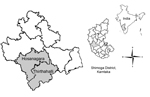
Figure 1. Map of Shimoga District, Karnataka State, India, showing the location of Thirthahalli and Hosanagara Taluks, which were affected by an outbreak of Kyasanur Forest disease virus during December 31, 2013?April 7,...


Beginning in January 2014, increased cases of unexplained fevers were reported from Thirthahalli Taluk, a subdistrict of Shimoga District (Figure 1). On February 6, 2014, the National Institute of Virology (Pune, India) confirmed the presence of KFDV in 5/12 serum samples from patients. We investigated the outbreak to describe the epidemiologic characteristics of KFD, estimate vaccine effectiveness (VE) and coverage, and propose recommendations for control.
[h=3]The Study[/h]
We established KFD surveillance in 3 large public health facilities in Thirthahalli Taluk: Thirthahalli Taluk Hospital, Kannangi Community Health Center, and Konandur Primary Health Center. Patients from neighboring Hosanagara Taluk also seek care at these facilities. A suspected case was defined as sudden onset of fever, headache, and myalgia in patients attending these facilities during the last week of December 2013 through the first week of April 2014. Medical officers at surveillance facilities collected information regarding each patient?s age, sex, place of residence, and clinical and vaccination history. Serum samples from all suspected case-patients were tested for KFDV at the National Institute of Virology by using reverse transcription PCR (RT-PCR) (5). RT-PCR?negative samples were tested by ELISA for KFDV IgM (5). Samples were also tested for dengue virus and Leptospira spp. We analyzed the data to describe the disease by time, location, and person. We used the population of affected villages and applied the age- and sex-distributions of Karnataka State?s population (2011 census) to the population of the affected villages to calculate attack rates.
To calculate vaccine coverage, we obtained 2013 KFD vaccination data from district health officials. To estimate VE, we conducted a retrospective cohort study in 4 villages within the Kannangi Community Health Center catchment area: Garaga-Kikkeri (466 residents in 106 households), where KFD vaccination was conducted in 2013, and the neighboring villages of Kannangi, Kombinakai, and Avalagere (total of 528 residents in 146 households), where vaccination was not conducted. We systematically sampled 60 households from the vaccinated village and 110 from the nonvaccinated villages and collected information from persons 8?66 years of age about the number of KFD vaccine doses received in 2013. Information about laboratory-confirmed cases in vaccinated and unvaccinated persons was obtained from surveillance data. We estimated the relative risk (RR) of acquiring KFD associated with vaccination and then calculated VE as follows: VE = 1 − RR.
During December 31, 2013?April 7, 2014, facility-based surveillance identified 246 suspected cases of KFD; 106 (43.1%) patients were positive for KFDV (78 by RT-PCR, 28 by IgM ELISA); 1 case-patient was also positive for dengue-specific IgM. The laboratory results of suspected case-patients screened up to March 2014 are available elsewhere (6).

14-1227-F2-tn.jpg
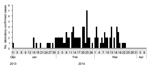
Figure 2. Distribution of 106 laboratory-confirmed Kyasanur Forest disease cases by date of symptom onset, Shimoga District, Karnataka State, India, December 2013?April 2014.


Of the 106 case-patients, 102 were from 41 villages in Thirthahalli Taluk (cumulative population 7,317), and 4 were from 3 villages (cumulative population 559) in Hosanagara Taluk (also in Shimoga District) (Figure 1). The overall attack rate was 13.5 cases/1,000 persons. In affected villages, cases were reported from all age groups; rates were highest among persons >15 years of age and among male residents (Table). Eighteen (16.9%) case-patients were in age groups not targeted for vaccination: 8 were <7 and 10 were >65 years of age. The cases began occurring during the last week of December 2013, peaked during February?March 2014, and then declined gradually (Figure 2).

Of the 106 case-patients, 95 (89.6%) reported that they had not been vaccinated and 11 (10.4%) reported being vaccinated (1 received 2 primary and 1 booster dose, 5 received 1 dose, and 5 received 2 doses). Ninety-one case-patients were from villages beyond a 5-km radius of an area with KFD activity in 2013 (i.e., outside an area targeted for vaccination in 2013).
During 2013 (before the outbreak), a total of 19,854 persons 7?65 years of age from Thirthahalli and Hosanagara Taluks had been targeted for KFD vaccination. The coverage of first, second, and booster doses was 23.4%, 15.4%, and 27.3%, respectively.
We included 176 KFD-vaccinated persons (26 received 1 dose, 150 received 2 doses) and 350 unvaccinated persons in the retrospective cohort study. The vaccinated and unvaccinated persons did not differ with respect to age, sex, or occupation (data not shown). Eight laboratory-confirmed KFD case-patients were reported from this cohort (7 were unvaccinated, 1 had received 2 doses of vaccine). The relative risk associated with 1 and 2 doses of vaccine was 0.96 (95% CI 0.06%?16.5%) and 0.33 (95% CI 0.04%?2.69%), respectively. The VE of 1 and 2 doses of vaccine was 4% (0%?96%) and 67% (0%?96%), respectively.

[h=3]Conclusions[/h]
The findings of our investigation highlighted 4 concerns regarding KFD vaccination strategy practiced in the region. First, vaccine coverage in villages selected for vaccination in 2013 was low. Earlier studies also have shown that nearly half of the eligible population in the targeted villages was not vaccinated (4). These findings indicate low acceptance of KFD vaccine, possibly because of vaccine-associated adverse effects and the need for multiple doses. Second, the observed VE was lower than that reported in a previous study (1 dose, 79%; 2 doses, 94%) (7). However, other recent reports also indicate lower VE (2,4,8). Third, the occurrence of cases in areas >5 km away from villages vaccinated in the previous year suggests that targeting vaccination to areas within a 5-km radius of reported KFD activity may not be effective in preventing KFDV transmission outside the vaccinated areas. KFDV is primarily transmitted by the bite of infected ticks, and it is spread by the movement of monkeys that carry infected ticks; thus, vaccinating around zones with reported KFD activity is unlikely to prevent spread of the virus. Fourth, ≈17% of the patients in our study with laboratory-confirmed KFDV infection were <7 or >65 years of age, and persons of these ages are not administered KFD vaccine, probably because lower attack rates were observed among these age groups in earlier outbreaks (7,9,10).
Our study had 2 limitations. First, the facility-based surveillance relied on passive detection of case-patients seeking care from the selected health facilities. The number of case-patients detected is influenced by the health-seeking behavior of the community and by the severity of illness. Second, although VE was found to be low, the cohort study had low power (22.3%); hence, the findings of low effectiveness must be interpreted with caution.
To control KFDV, systematic efforts are needed to improve the current vaccine and vaccine coverage. Current vaccination strategies should be reviewed and the reasons for low VE should be evaluated.

Dr. Kiran is a senior medical officer with the Department of Health and Family Welfare, in Shimoga District, India, and he conducted this outbreak investigation as a part of a Master of Public Health course at the National Institute of Epidemiology, Chennai, India. His research interests include emerging and reemerging infectious diseases and vaccine-preventable diseases.


[h=3]Acknowledgment[/h] We gratefully acknowledge the assistance provided by Rajesh Suragihalli, K.S. Prakash, K.O. Narasimhamurthy, and Shama Begum Fakruddin.

[h=3]References[/h]
  • Work TH, Roderiguez FM, Bhatt PN. Virological epidemiology of the 1958 epidemic of Kyasanur Forest disease. Am J Public Health Nations Health.1959;49:869?74. DOIPubMed
  • Pattnaik P. Kyasanur Forest disease: an epidemiological view in India. Rev Med Virol. 2006;16:151?65 . DOIPubMed
  • Mourya DT, Yadav PD, Sandhya VK, Reddy S. Spread of Kyasanur Forest disease, Bandipur Tiger Reserve, India, 2012?2013. Emerg Infect Dis.2013;19:1540?1. DOIPubMed
  • Kasabi GS, Murhekar MV, Sandhya VK, Raghunandan R, Kiran SK, Channabasappa GH, Coverage and effectiveness of Kyasanur Forest disease (KFD) vaccine in Karnataka, South India, 2005?10. PLoS Negl Trop Dis. 2013;7:e2025. DOIPubMed
  • Mourya DT, Yadav PD, Mehla R, Barde PV, Yergolkar PN, Kumar SR, Diagnosis of Kyasanur Forest disease by nested RT-PCR, real-time RT-PCR and IgM capture ELISA. J Virol Methods. 2012;186:49?54 . DOIPubMed
  • Yadav PD, Patil DY, Sandhya VK, Prakash KS, Surgihalli R, Mourya DT. Outbreak of Kyasanur Forest disease in Thirthahalli, Karnataka, India, 2014.Int J Infect Dis. 2014;26:132?4 . DOIPubMed
  • Dandawate CN, Desai GB, Achar TR, Banerjee K. Field evaluation of formalin inactivated Kyasanur Forest disease virus tissue culture vaccine in three districts of Karnataka state. Indian J Med Res. 1994;99:152?8 .PubMed
  • Kasabi GS, Murhekar MV, Yadav P, Raghunandan R, Kiran SK, Sandhya VK, Kyasanur Forest disease, India, 2011?2012. Emerg Infect Dis.2013;19:278?81 . DOIPubMed
  • Upadhyaya S, Dandawate CN, Banerjee K. Surveillance of formolized KFD virus vaccine administration in Sagar-Sorab talukas of Shimoga district.Indian J Med Res. 1979;69:714?9 .PubMed
  • Upadhyaya S, Murthy DP, Anderson CR. Kyasanur Forest disease in the human population of Shimoga district, Mysore State, 1959?1966. Indian J Med Res. 1975;63:1556?63 .PubMed
[h=3]Figures[/h]
[h=3]Table[/h]
Suggested citation for this article: Kiran SK, Pasi A, Kumar S, Kasabi GS, Gujjarappa P, Shrivastava A, et al. Kyasanur Forest disease outbreak and vaccination strategy, Shimoga District, India, 2013?2014. Emerg Infect Dis. 2015 Jan [date cited]. http://dx.doi.org/10.3201/eid2101.14-1227
DOI: 10.3201/eid2101.141227
Table of Contents ? Volume 21, Number 1?January 2015

http://wwwnc.cdc.gov/eid/article/21/1/14-1227_article
 
Jungle virus stirs

Author(s): M Suchitra
Jan 15, 2015 | From the print edition
A lesser-known viral disease, similar to Ebola and dengue and so far confined to just five forest districts of Karnataka, has recently been reported from Kerala and Tamil Nadu

Nagaratna andSuresh N S, a young farmer couple, live in Bandikkoppa village in Thirthahalli taluk of Karnataka?s Shivamogga district. Their small house is surrounded by forests of the Western Ghats. In January last year, both of them fell ill. They had thought it was flu but the fever did not subside even after five days. ?So we decided to visit the primary health centre (PHC),? says Nagaratna. At the PHC, they were referred to the taluk government hospital, which sent their blood samples to the National Institute of Virology (NIV) in Pune. Lab tests at NIV confirmed that the couple had Kyasanur forest disease (KFD), a viral haemorrhagic disease similar to Ebola and dengue.

imageThe couple was among the 137 people who suffered from the disease in Karnataka during January-May last year. Except eight, all were from Thirthahalli taluk. It also killed a forest guard in the area. This is the first time since 2003 that such a high number of KFD patients was reported from the state. In 2003, over 300 cases were reported.

KFD is not a new disease in the district. The first outbreak was reported in March 1957 after a series of unnatural deaths of monkeys and a mysterious fever engulfed the residents of Kyasanur, a forest village in Sorabataluk. Since then the state has seen frequent outbreaks, but the disease had been restricted to just five districts in the Western Ghats (see ?Bigger threat?).
...
continues at; http://www.downtoearth.org.in/content/jungle-virus-stirs
 
Karnataka
Shimoga xxii. KFD 05 cases 0 11/12/14
Under surveillance
Cases reported from Village Haradavalli,Demlapura,Tyanandur &
Guddekoppa,PHC Yogimalai & Guddekoppa TalukThirthahalli, District
Shimoga.District RRT investigated the outbreak.07 serum samples sent to NIV
Pune ,all tested positive for KFD(RT PCR) .All cases treated symptomatically.
Vaccination done in the affected area. Health education regarding personal
protection done.

http://idsp.nic.in/idsp/IDSP/DOB2014/52nd_wk14.pdf
 
KERALA

KALPETTA, February 13, 2015
Updated: February 13, 2015 08:00 IST
NCDC team begins tour of monkey fever-hit areas

E.M. MANOJ

An expert team of the National Centre for Disease Control (NCDC) began its tour of areas affected by money fever (Kyasanur Forest Disease or KFD) in Wayanad district on Thursday.

The team comprising N. Balakrishnan, Joint Director, NCDC, Bangalore, and Preethi Patta, Epidemic Investigation Officer, NCDC, Delhi, visited the KFD patients admitted to the taluk hospital at Sulthan Bathery, and interacted with tribal people in various tribal settlements adjacent to the forests in Pulpally grama panchayat.

The expert team held discussions with senior officials of the Health Department, and reviewed the steps taken to control the spread of the disease.
...
http://www.thehindu.com/news/nation...d&utm_medium=RSS&utm_campaign=RSS_Syndication
 
KERALA

KALPETTA, February 15, 2015
Updated: February 15, 2015 05:48 IST
Man dies of suspected monkey fever

STAFF REPORTER

Health Department yet to confirm cause of death, preventive steps intensified

Kullan Bomman, 40, of Ezhupathimoonnu Kattunayakka Tribal Hamlet at Cheeyambam, near Pulpally, in Wayanad district died of suspected monkey fever (Kyasanur Forest Disease or KFD) at the Government Medical College Hospital (MCH), Kozhikode, on Saturday.

The Health Department is yet to confirm the cause of death.

This is the third suspected monkey fever death case being reported from the district in a week.
...
http://www.thehindu.com/news/national/kerala/man-dies-of-suspected-monkey-fever/article6897238.ece
 
THIRUVANANTHAPURAM, February 17, 2015
Updated: February 17, 2015 08:48 IST
Monkey fever, a new challenge for Kerala

C. MAYA

The emergence of Kyasanur Forest Disease (KFD or monkey fever), a viral infection which had been confined for long to certain provinces in the interior forests of Karnataka, in Wayanad and Malappuram districts in Kerala this year, is a warning to the State&#146;s health system about yet another vector-borne disease which could become a public health challenge.

The focal point of KFD, since the 1950s, has been Shimoga and a few nearby provinces in Karnataka, where a few hundred cases were reported every year. This is the third consecutive year that KFD is rearing its head in Wayanad. Though in 2013 and 2014 only one confirmed case each were reported, this year KFD has manifested as an outbreak in two districts in Kerala, affecting nearly 50 persons and killing three.

&#147;The scenario has changed drastically since the 1960s. Human activities in forest areas have increased. Apart from forest staff and tribespeople, tourists too go trekking into forests. Because of deforestation, monkeys come to human settlements in search of food. Unless Kerala launches active tick surveillance studies and control measures, KFD can come further into the community,&#148; says G. Arunkumar, the Director of Manipal Centre for Virus Research (MCRV), which has been assisting Kerala in diagnostics.
...
http://www.thehindu.com/news/cities/...cle6904062.ece

Comment: You can follow both the MCVR (@MCVRMU) and Prof. Arunkumar (@arunviro) on Twitter. - Ro
 
Monkey Fever Claims 1 More Life

By Express News Service Published: 18th February 2015 06:01 AM Last Updated: 18th February 2015 06:01 AM


SULTHAN BATHERY:One more person from the district died of suspected Kyasanur Forest Disease (KFD), also known as monkey fever, on Tuesday.

The deceased Bomman, 42, of 73 Kattunayikka colony at Cheeyambam, near Pulpally, who had been undergoing treatment for diarrhoea at the Taluk Hospital here, was referred to the Kozhikode Medical College Hospital on Tuesday morning after he had recurrent convulsions.

His death was confirmed by the doctors at the medical college around 4 pm. Bomman, who had been working in a ginger field in Karnataka, returned home last week and sought medical help at the Community Health Centre in Pulpally for acute diarrhoeal disease. His serum samples had been sent to the virology laboratory in Manipal on Sunday and the results were awaited.

The death toll of KFD in the state would rise to four, if the test results confirm the presence of KFD virus. Three persons, one hailing from Madappali tribal colony in Amarakkuni, and two others from the 73 Kattunayikka colony, had fallen prey to the zoonotic disease in a span of 10 days. Meanwhile, the Health Department has intensified preventive measures in the KFD-hit areas in the district. The department has taken up controlled burning of habitat and repellent spraying to keep the ticks that transmit the disease at bay.

As many as 40 suspected KFD cases, apart from the 18 confirmed ones, were reported in the district in three weeks.
...
http://www.newindianexpress.com/sta...ims-1-More-Life/2015/02/18/article2673788.ece
 
Monkey fever hits Kerala, health worker fifth victim of disease

Author(s): M Suchitra
Date:Mar 8, 2015
Four more suspected cases have been reported in the district and about 20 persons are under observation

Officials of the health department in Kerala?s Wayanad have confirmed one more death due to Kyasanur Forest Disease (KFD) on March 4. Sulekha, 42, an Accredited Social Health Activist (ASHA) who died on February 27 has been declared a victim of KFD or monkey fever.

In the past one month, this is the fifth confirmed death due the disease in the district located within Western Ghats and bordering Karnataka. The other four persons who died of the disease were residents of two tribal colonies in the district.
...
http://www.downtoearth.org.in/content/monkey-fever-hits-kerala-health-worker-fifth-victim-disease
 
From Week 9 IDSP Report: http://idsp.nic.in/idsp/IDSP/outbreaks.htm

Wayanad KFD 140 cases 07 fatal 27/01/15 UnderSurveillance

Cases reported from different villages under PHCs Mullankolly,
Pulpally,Poothady, Noolpuzha & Chethalayam. Block Sulthan Bathery District
Wayanad. District RRT investigated the outbreak. All the cases are tribal people
residing close to or within the reserve forest area. There were reports of monkey
deaths from parts of the forest from early January 2014 onwards. 50 samples
tested positive on PCR test at MCVR Manipal. 07 cases died due to the condition.
Intersectoral coordination meeting with Forest officials Veterinary officials,
Police, community and Health official was conducted. Health education given to
public for taking precaution while entering the forest. Special IEC strategy
planned for the tourists who are likely to visit the area.
 
Back
Top