WEEKLY BULLETIN ON OUTBREAKS
AND OTHER EMERGENCIES
Week 22: 26 May to 1 June 2025
Data as reported by: 17:00; 1 June 2025
Kenya
Leishmaniasis
1 378 Cases
46 Deaths
3.3% CFR
EVENT DESCRIPTION
As of epidemiological Week 22, (ending 01 June 2025),
Kenya had reported a cumulative total of 1 378 visceral
leishmaniasis cases. Of these, 1 069 (79.5%) cases were
laboratory confirmed, and 46 were associated deaths,
resulting in a case fatality rate of 3.3%. In reporting week
22, 10 new cases were recorded in Mandera County
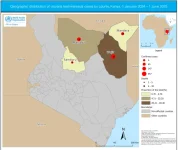
Cumulatively, cases were reported in the counties of
Wajir (957 cases, 38 deaths), Marsabit (347 cases, 5
deaths), Mandera (65 cases, 1 death), and Samburu
(9 cases, 2 deaths). Wajir county accounted for 69.4%
(n=957) of total cases and 82.6% (n= 38) of all reported
deaths.
The epidemic curve shows an upward trend beginning
from Week 49 of 2024, peaking in Weeks 7 to 10 of 2025,
and declining steadily through Week 21 of 2025.
This trend suggests that Kenya may be entering a
phase of reduced transmission, although localized
surges could persist, as seen in new cases reported in
Mandera County. Furthermore, the observed decline
in cases should be interpreted cautiously, as it may not
indicate an absolute decrease but rather a reflection of
reporting delays from some counties. Children under
5 years are the most affected age group, carrying the
highest mortality burden, followed by children aged 5 to
14 years. Of the total cases reported in 2025, 58.0% (n =
201) are male and 42.0% (n = 143) are female, indicating
a higher infection rate among males.
PUBLIC HEALTH ACTIONS
Kenya’s Ministry of Health, with support from WHO and
health partners, continues to coordinate response activities,
including:
Strengthened outreach and access to care by expanding
mobile clinics and undertaking active surveillance, case
investigations, and laboratory confirmation in affected
sub-counties and remote villages.
Enhance risk communication and community
engagement by utilising local languages, particularly
Somali and Borana. Trusted community messengers and
health volunteers were involved.
Support clinical responses by distributing crucial medical
supplies, offering treatment updates, and training local
healthcare workers in the management of visceral
leishmaniasis cases.
Enhance visibility and trust by sharing updates regarding
treatment, drug delivery, and success stories to
strengthen public confidence and promote early careseeking behaviour.
SITUATION INTERPRETATION
The overall weekly case count has declined; however,
Mandera County remains a concern due to emerging
new cases. The significant burden among children
under 15 years and the ongoing fatalities highlight the
necessity for sustained surveillance, timely case detection,
and access to diagnostics and treatment in remote areas.
Continued inter-county coordination and partner engagement
are vital to containing the outbreak. Targeted vector
control, active case finding, and the prompt deployment of
diagnostics and therapeutics are also crucial for maintaining
progress, preventing resurgence, and achieving full containment
of the outbreak.
https://www.afro.who.int/countries/...other-emergencies-week-22-26-may-01-june-2025