• FluTrackers.com Inc. does not provide medical advice. Information on this web site is collected from various internet resources, and the FluTrackers board of directors makes no warranty to the safety, efficacy, correctness or completeness of the information posted on this site by any author or poster. The information collated here is for instructional and/or discussion purposes only and is NOT intended to diagnose or treat any disease, illness, or other medical condition. Every individual reader or poster should seek advice from their personal physician/healthcare practitioner before considering or using any interventions that are discussed on this website. By continuing to access this website you agree to consult your personal physican before using any interventions posted on this website, and you agree to hold harmless FluTrackers.com Inc., the board of directors, the members, and all authors and posters for any effects from use of any medication, supplement, vitamin or other substance, device, intervention, etc. mentioned in posts on this website, or other internet venues referenced in posts on this website.
  • We are not asking for any donations. Do not donate to any entity who says they are raising funds for us.

Kenya: 2022 Yellow Fever

Shiloh

Editor, Senior Moderator
Source: https://www.thecitizen.co.tz/tanzan.../kenya-declares-yellow-fever-outbreak-3737986

Kenya declares yellow fever outbreak
Saturday March 05 2022
By Paul Owere
More by this Author

Nairobi. Kenya’s health ministry has declared an outbreak yellow fever in the country with 15 patients reported in Isiolo County resulting into three deaths so far.

In a statement issued by the Director General of Health Dr Patrick Amoth on March 3, the authorities say the first case was detected on January 12.

“To date 15 patients presenting with fever, jaundice, muscle pain and joint pain have been line-listed, the youngest being 11 whereas the oldest is 65. While the majority are young adults, males are most affected,” reads the circular...
 
Kenya on alert as it reports outbreak of yellow fever


The government has activated its health emergency response mechanisms following the death of three persons attributed to an outbreak of yellow fever in Isiolo County.

According to Acting Director General of Health Patrick Amoth, the first case was detected on January 12th this year while 15 patients presenting with fever, jaundice, muscle and joint pains have been line-listed.

“Out of the six samples analysed at KEMRI ,3 turned positive through serology (immunoglobulin M) and PCR. This is therefore to raise the alert in 47 counties, more so the high-risk counties of Wajir, Garissa, Marsabit, Meru, Samburu, Baringo, Elgeyo Marakwet, West Pokot and Turkana.” Said Amoth.

He says the ministry has put in place a national incident management structure to manage the outbreak and is developing a response plan to deploy a rapid response team to Isiolo and neighbouring counties to establish the magnitude and extent of the outbreak, determine at-risk population, conduct a risk assessment, initiate risk communication and community engagement activities and to implement integrated vector control measures.

According to Amoth, the national government and partners are mobilizing resources to support response activities even as he advised high-risk counties to mobilize resources to support response and prevention activities.

Following the outbreak, the ministry of health plans to conduct yellow fever vaccination in Isiolo and other high risks counties including Wajir, Garissa, Marsabit, Meru Samburu, Baringo, Elgeyo Marakwet, West Pokot, Turkana and possibly Tana river and Mandera.

Yellow fever is an acute viral haemorrhagic disease transmitted by infected mosquitoes of the Aedes species. Symptoms include fever, headache, jaundice, muscle pain, nausea, vomiting and fatigue.

Yellow Fever Virus is transmitted through the bite of an infected mosquito. Once contacted, it incubates in the body for three to six days followed by illness whose symptoms include fever, muscle pain with prominent backache, shivers, loss of appetite and nausea or vomiting. In severe cases, patients develop jaundice and bleeding.

Vaccination remains the single most important measure for preventing Yellow Fever.

On March 5, 2022 / News

https://www.health.go.ke/kenya-on-alert-as-it-reports-outbreak-of-yellow-fever/
 
Yellow fever death toll in Kenya rises to four

TUESDAY MARCH 08 2022

An outbreak of yellow fever, an acute and contagious viral disease, has claimed four lives in Kenya since it was first detected in January, the health ministry said Monday.

The cases were reported in the pastoralist and remote county of Isiolo, some 270 kilometres (160 miles) north of the capital Nairobi.

"We have an additional death to the three that we had reported earlier," Patrick Amoth, director general of Kenya's health ministry, told AFP.
...
https://www.theeastafrican.co.ke/te...ver-death-toll-in-kenya-rises-to-four-3740678
 
WEEKLY BULLETIN ON OUTBREAKS
AND OTHER EMERGENCIES

Week 11: 7 – 13 March 2022
Data as reported by: 17:00; 13 March 2022

...

Yellow fever Kenya

15 cases
4 Deaths
27.0% CFR


EVENT DESCRIPTION

Suspected yellow fever (YF) cases have been reported from eight
villages within three sub-counties in Kenya since 12 January 2022.
Consequently, on 4 March 2022, health authorities in Kenya declared
an outbreak of YF in Isiolo County, central Kenya, which is around
270 km north of the capital city of Nairobi.

As of 10 March 2022, there are a total of 15 suspect YF cases
(including four deaths) reported. Three sub-counties of Chari (33%),
Cherab (46%) and Garba Tulla (20%) have been affected in Isiolo
County.

The majority of the presumptive YF cases are from Merti village
(40%) in Cherab sub-county, followed by Biliqo Marara village
(13%), Chari sub-county and Grafarsa village (13%) in Garba Tulla
sub-county. The symptoms described are fever, jaundice, muscle,
and joint pain.

Of the 15 cases, 13 (87%) are males and two (13%) females. The
age range reported is between 11 and 65 years, with the most
affected age group being between 21-30 years (35%). There is no
information on the vaccination status of the reported cases, however
both the origin and the surrounding counties have no history of
vaccination campaign or routine immunization.

Six samples have been collected from Isiolo County with a
representative distribution of all areas reporting suspected YF
cases for confirmation. Two samples tested positive by reverse
transcriptase polymerase chain reaction (RT- PCR) at the national
laboratory (Kenya Medical Research Institute (KEMRI)). In addition,
three samples were presumptive YF IgM positive by the enzymelinked
immunosorbent assay (CDC MAC- ELISA) and another five samples
were equivocal. Further information is pending regarding
the differential diagnosis tests performed. On 8 March 2022, the
samples were shipped to the YF regional reference laboratory -
Uganda Virus Research Institute (UVRI) for confirmatory testing.

PUBLIC HEALTH ACTIONS

On 4 March 2022, the National authorities activated the alert
mode in all the 47 counties, especially in the following high-risk
counties: Wahir, Garissa, Marsabit, Mery, Samburu, Baringo,
Elgeyo Marakwet, West Pokot and Turkana.

The National Government and partners (UNICEF and CDC) are
mobilising resources to support response activities.

A National Incident Management Structure has been put in place
and is developing a response plan to deploy a rapid response team
to Isiolo and neighbouring counties to investigate the outbreak,
conduct a risk assessment, initiate risk communication and
community engagement activities, implement integrated vector
control measures and build capacity in clinical management.

The Ministry of Health is planning to conduct YF vaccination
campaign in outbreak affected areas, as informed by ongoing
investigations and laboratory results.

SITUATION INTERPRETATION

Kenya is endemic for YF and is classified as a high-risk country in
the “Eliminate Yellow Fever Epidemics” (EYE) Strategy. However,
YF hasn’t been documented previously in Isiolo County. Previous
outbreaks have been reported in 1992, 1993, 1994, and 2016 (where
two cases were imported from Angola. Kenya has not yet benefited
from large-scale preventive mass vaccination campaigns and has not
introduced YF vaccine into routine immunization (RI) nation-wide (YF
RI is limited to four counties in the north west of country, not directly
bordering Isiolo). Due to the minimal population immunity, there is
high risk of outbreak amplification.

PROPOSED ACTIONS

Vaccination is the primary means for prevention and control
of YF. As the country plans to introduce YF vaccination into
the routine immunization program, expedited planning and
implementation of these activities will help avert risk of future
outbreaks.

WHO recommends vaccination against YF for all international
travellers aged nine months and above going to Kenya. Yellow
fever vaccination is safe, highly effective and a single dose
provides life-long protection.

WHO also recommends avoiding mosquito bites including the
use of repellents. The highest risk for transmission of YF virus is
during the day and early evening. Communities should be made
aware of yellow fever symptoms and signs and instructed to
rapidly seek medical advice if presenting signs and symptoms
suggestive of YF infection.

View/Open

OEW11-0713032022.pdf (‎1.846Mb)‎

https://apps.who.int/iris/handle/10665/352474

 
Yellow Fever - Kenya


25 March 2022

Outbreak at a glance

During the period 12 January to 15 March 2022, a total of 53 suspected yellow fever cases, including six deaths, have been reported from Isiolo county, central Kenya. Two samples tested positive by RT-PCR and six were positive by ELISA, indicating probable yellow fever cases. The last reported yellow fever outbreak in Kenya was in 2011. WHO assesses the public health risk as high at the national and regional levels.

Outbreak overview

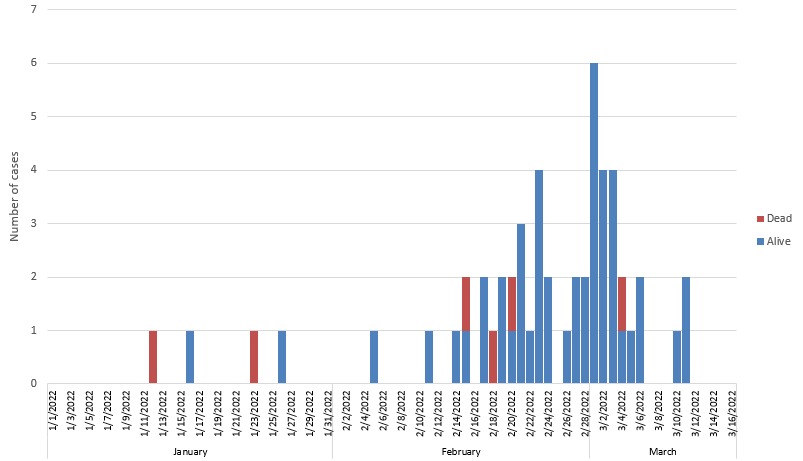
On 4 March 2022, the Ministry of Health (MoH) of Kenya declared an outbreak of yellow fever in the county of Isiolo in central Kenya (around 270 km north of the capital Nairobi). As of 15 March, a total of 53 suspected yellow fever cases have been reported from Isiolo county during the period 12 January to 15 March 2022, including six deaths (case fatality ratio: 11.3%) (Figure 1). The majority of the cases are males (47 cases; 88.7%), and the average age of cases is approximately 28 years (range: 3-78 years).

Figure 1. Epidemiological curve of yellow fever cases by date of symptoms onset and outcome, Isiolo county, Kenya, 1 January - 15 March 2022 (n=53).


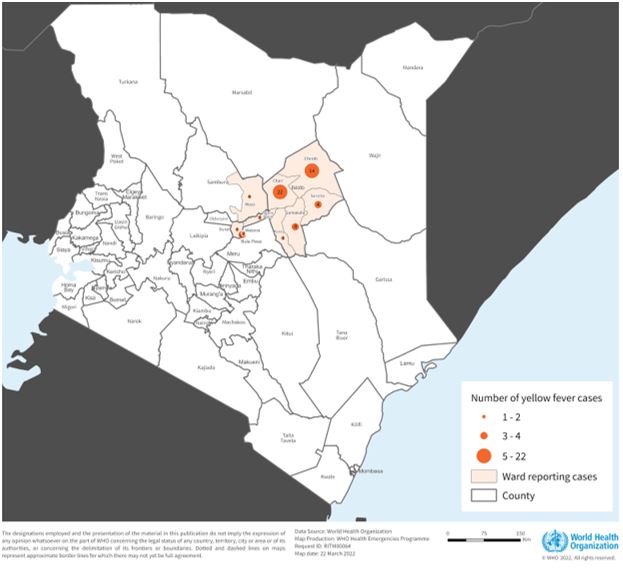
Suspected cases presented with symptoms of fever, jaundice, and muscle and joint pain. Overall, eleven wards within Isiolo county have been affected, with the highest number of cases reported in: Chari (21 cases; 39.6%), Cherab (14 cases; 26.4%) and Garba Tulla (5 cases; 9.4%) (Figure 2).

Figure 2. Number of yellow fever cases by ward, reported from 12 January to 15 March 2022 in Isiolo county, Kenya (n=53).


As of 15 March, samples were collected from 34 suspected cases (64%), and were tested for yellow fever at the national laboratory - Kenya Medical Research Institute - through reverse transcriptase-polymerase chain reaction (RT-PCR) and IgM antibodies by the enzyme-linked immunosorbent assay (ELISA). Two samples (6%) were found to be positive by RT-PCR, and six (18%) were positive for IgM antibodies by ELISA. On 8 March 2022, the samples were shipped to the yellow fever regional reference laboratory - Uganda Virus Research Institute (UVRI) - for confirmatory testing. At the point of writing this report, confirmation is still pending, and there is uncertainty around current laboratory results due to the presence of malaria positivities amongst the samples tested (n=5; 15%).

There is no information on the vaccination status of the reported cases, however, Isiolo and the surrounding counties have no history of yellow fever vaccination campaigns. Kenya has not conducted large-scale preventive mass vaccination campaigns, and yellow fever vaccination is included into the national routine immunization schedule (i.e. for children at 9 months) only in four counties in the northwest of the country (not directly bordering Isiolo) deemed to be at highest risk. According to WHO-UNICEF, at the national level, the overall estimated coverage through routine immunization is 7% of the target population. This is far below the recommended 80% population coverage to provide herd immunity against outbreaks.

Epidemiology of Yellow Fever

Yellow fever is an epidemic-prone mosquito-borne vaccine preventable disease caused by an arbovirus transmitted to humans by the bites of infected Aedes and Haemagogus mosquitoes.

Forty-seven countries in Africa (34) and Central and South America (13) are either endemic for, or have regions that are endemic for, yellow fever. Since September 2021, nine countries in the WHO African Region (Cameroon, Chad, Central African Republic, Côte d'Ivoire, the Democratic Republic of Congo, Ghana, Niger, Nigeria, and Republic of Congo) have reported human laboratory confirmed cases of yellow fever in areas that are at high risk for the disease and have a history of yellow fever transmission and outbreaks. These outbreaks are occurring in a large geographic area in the West and Central regions of Africa. These reports signal a resurgence and intensified transmission of the yellow fever virus. The outbreaks have included areas that have previously conducted large-scale mass vaccination campaigns but with persistent and growing gaps in immunity due to lack of sustained population immunity through routine immunization and/or secondary to population movements (newcomers without history of vaccination).

Public health response


The Government has implemented a national incident management structure to manage the outbreak and has developed a response plan, deploying a rapid response team to Isiolo and neighbouring counties to determine the extent of the outbreak, identify the at-risk population, conduct a risk assessment, initiate risk communication and community engagement activities and implement integrated vector control measures.

The Government and the WHO, together with partners (UNICEF, Food and Agriculture Organization, Amref Health Africa, Kenya Red Cross, Living Goods, Médecins Sans Frontières, US Centers for Disease Control and Prevention, World Vision, Action Aid) mobilized resources to support response activities, including a proposed request to the International Coordinating Group for vaccine provision for reactive yellow fever vaccination in Isiolo with possible extension to any other counties found to have cases or have imminent risk.

WHO risk assessment


Kenya is endemic for yellow fever and is classified as a high-risk country in the Eliminate Yellow Fever Epidemics (EYE) Strategy. Previous outbreaks have been reported in 1992, 1993, 1995 and 2011 in the western part of the country (Rift Valley zone). In 2016, two imported cases from Angola were also reported. Epidemic spread of yellow fever is a risk in Kenya as the estimated routine yellow fever vaccination coverage is very low among the target population (7%) and is limited in scope to four counties in the western part of the country (Baringo, Elgeyo Marakwet, West Pokot and Turkana).

Yellow fever has never been reported in Isiolo county, which is a pastoralist and remote area, around 270 km north of the capital Nairobi. The total population of Isiolo county was estimated at 268 002 in 2019 according to the Kenya National Bureau of Statistics. Although Isiolo is in the central region of Kenya and does not share international borders, it is marked by frequent population movements. Garba Tulla ward shares borders with South Wajir and Western Garissa counties that have been experiencing massive pastoralists movements, amplified by current drought conditions. There is also massive refugee migration from neighbouring Somalia into Garissa county, Kenya. A national park is also located in the area near Isiolo, and the presence of informal mining activities attracting large numbers of workers as well as the presence of non-human primates has been noted, underlying the potential risk of spread to other areas.

Considering the above-described scenario, the risk is assessed as high at the national and regional levels, and low at the global level.

WHO continues to monitor the epidemiological situation and review the risk assessment based on the latest available information.

WHO advice


Surveillance: WHO recommends close monitoring of the situation with active cross-border coordination and information sharing, due to the possibility of cases in neighbouring countries and the risk of onward spread. Enhanced surveillance with investigation and laboratory testing of suspect cases is recommended.

Vaccination: Vaccination is the primary means for prevention and control of yellow fever. Review of the risk analysis and scope of immunization activities to protect the population could help avert the risk of future outbreaks.

Vector control: In urban centres, targeted vector control measures are also helpful to interrupt transmission. As a general precaution, WHO recommends avoidance of mosquito bites including the use of repellents and insecticide treated mosquito nets. The highest risk for transmission of yellow fever virus is during the day and early evening.

Risk communication: WHO encourages its Member States to take all actions necessary to keep travellers well informed of risks and preventive measures including vaccination. Travellers should be made aware of yellow fever symptoms and signs and instructed to rapidly seek medical advice if presenting signs and symptoms suggestive of yellow fever infection. Viraemic returning travellers may pose a risk for the establishment of local cycles of yellow fever transmission in areas where a competent vector is present.

International travel and trade: WHO advises against the application of any travel or trade restrictions on Kenya. Yellow fever vaccination is required by national authorities for international travellers over one year of age entering Kenya, and it is recommended by WHO for travellers aged 9 months or over, except for those whose itineraries are limited to the following areas: the entire North Eastern Province, the States of Kilifi, Kwale, Lamu, Malindi and Tanariver in Coastal Province, and the cities of Nairobi and Mombasa.

In accordance with the IHR (2005) third edition, the international certificate of vaccination against yellow fever becomes valid 10 days after vaccination and the validity extends throughout the life of the person vaccinated. A single dose of WHO approved yellow fever vaccine is sufficient to confer sustained immunity and life-long protection against yellow fever disease. A booster dose of the vaccine is not needed and is not required of international travellers as a condition of entry.
Further information

https://www.who.int/emergencies/dise...ow-fever-kenya
 
Source: https://www.kenyanews.go.ke/efforts-to-prevent-yellow-fever-in-isiolo-intensifies/

Efforts to prevent yellow fever in Isiolo intensifies
KNA1 April 13, 2022 Counties, Editor's Pick, Isiolo, Universal Healthcare

Isiolo County residents have been urged to be wary of the threat posed by Yellow Fever disease and embrace precautionary measures to keep themselves away from mosquito bites.

The County Director of Public Health Guracha Kikuyu Sarite cited use of treated mosquito nets and clearing bushes within the neighborhood as some of the most effective ways to combat mosquitoes.

According to health experts, the disease is usually spread by a species of mosquito known as Aedes which usually thrives in wet and bushy areas such as along the river banks.

Sarite noted that the department of health has carried out 61 sample tests, with 53 of them categorised as highly suspicious and were subjected to advanced tests, whereby eight of them were confirmed as Yellow Fever Cases.

He said that seven people have so far died as a result of the disease in Isiolo County, adding that some suspected cases have also been reported in areas around Isiolo town, hence the need to promote primary health care campaigns in the area.

However, the chief officer said that the three suspected cases around Isiolo town could have emanated from people, who had travelled from the areas on the lower side of Ewaso Nyiro River, who are the most affected.

Sarite said the County Government in collaboration with other partners notably the National Government, the World Health Organisation (WHO) and local Non-Governmental Organisations will soon roll out a fumigation exercise in the affected areas to get rid of mosquitoes, using the insecticides that have been classified as suitable for the environment and do not affect people...
 
Source: https://www.the-star.co.ke/news/2022-05-01-yellow-fever-continues-to-spread-in-kenya--who/


Yellow Fever continues to spread in Kenya — WHO
Suspected cases have risen to more than 53 in Isiolo but mass vaccination has not been done
by JOHN MUCHANGI
01 May 2022 - 23:00

In Summary

• WHO says it now classifies Kenya as a high-risk country because of the current and past outbreaks in 1992, 1993, 1995 and 2011 in the western Rift Valley.

•The organisation also said Kenya was among 24 countries with confirmed outbreaks of a variant of polio in 2021.
Kenya has an abundance of the mosquito varieties that spread yellow fever.


The Yellow Fever disease could still be spreading in northern Kenya, according to a World Health Organization report.

The first case was reported on January 12 and by March 5, the Ministry of Health had recorded 15 suspected cases, three confirmed cases and three deaths.

However, by end of March, WHO says that suspected cases had risen to 53.

“The cases include six deaths, having been reported from Isiolo county and central Kenya,” the WHO says in a status report.

Despite the outbreak, there has been no mass vaccination yet...
 
Source: https://www.kbc.co.ke/mass-vaccination-against-yellow-fever-launched-in-isiolo/


Mass vaccination against Yellow Fever launched in Isiolo
By KBC Correspondent


The Government has launched a 10 –day mass vaccination campaign against yellow fever disease in Isiolo County as well as parts of the neighboring Garissa County.

This follows an outbreak of the disease in parts of Isiolo in March this year, with 71 reported cases and seven fatalities so far.

Speaking in Isiolo town Saturday while launching the campaign, Acting Director General for Health Dr. Patrick Amoth said that the mass vaccination drive will target all people aged 9 Months to 60 years, even as he called on residents in the targeted areas to take advantage of the free vaccination campaign and get immunized.

He said that all the three sub counties of Isiolo have reported yellow fever cases, with Merti and Garbatulla being most affected.

Dr Amoth assured members of public of safety of the yellow fever jab, asking them to dispel any rumors to the effect that the vaccine could harm them in any way....

.... posted by Muraya KamundeJuly 24, 2022
 
WEEKLY BULLETIN ON OUTBREAKS
AND OTHER EMERGENCIES

Week 31: 25 - 31 July 2022
Data as reported by: 17:00; 31 July 2022

...
All events currently being monitored by WHO AFRO
...
Kenya Yellow fever
Grade 2

Date notified to WCO 03-Mar-22
Start of reporting period 12-Jan-22
End of reporting period 23-Jul-22

Total cases 117
Cases Confirmed 3
Deaths 11
CFR 9.4%


From 12 Jan to 23 Jul 2022, there were a total of 117 suspected cases of yellow fever including 11 deaths (CFR 9.4%) reported from 10 counties in Kenya. An outbreak was reported officially in Isiolo and Garissa counties. Of the suspected cases, only three were confirmed by PCR at the Kenya Medical Research Institute and 12 were classified as probable cases.

https://apps.who.int/iris/bitstream/...2531072022.pdf
 
WEEKLY BULLETIN ON OUTBREAKS
AND OTHER EMERGENCIES

Week 35: 22 - 28 August 2022
Data as reported by: 17:00; 28 August 2022

...
All events currently being monitored by WHO AFRO
...

Kenya Yellow fever Grade 2

Date notified to WCO 3-Mar-22
Start of reporting period 12-Jan-22
End of reporting period 25-Aug-22

Total cases 123
Cases Confirmed 3
Deaths 11
CFR 8.9%


From 12 Jan to 25 Aug 2022, there were a total of 123 suspected cases of yellow fever including 11 deaths (CFR 8.9%) reported from 10 counties in Kenya. An outbreak was reported officially in Isiolo and Garissa counties. Of the suspected cases, only three were confirmed by PCR at the Kenya Medical Research Institute.

https://apps.who.int/iris/bitstream/...2228082022.pdf
 
WEEKLY BULLETIN ON OUTBREAKS
AND OTHER EMERGENCIES

Week 40: 26 September to 2 October 2022
Data as reported by: 17:00; 2 October 2022

...
All events currently being monitored by WHO AFRO
...
Kenya Yellow fever Grade 1

Date notified to WCO 3-Mar-22
Start of reporting period 12-Jan-22
End of reporting period 30-Sep-22

Total cases 139
Cases Confirmed 3
Deaths 11
CFR 7.9%


From 12 Jan to 30 Sep 2022, there were a total of 139 suspected cases of yellow fever including 11 deaths (CFR 7.9%) reported from 11 counties in Kenya. An outbreak was reported officially in Isiolo and Garissa counties. Of the suspected cases, only three were confirmed by PCR at the Kenya Medical Research Institute.

https://apps.who.int/iris/bitstream/handle/10665/363400/OEW40-260902102022.pdf
 
Source: https://reliefweb.int/report/kenya/...tuation-report-28th-oct-2022-epi-week-42-2022


Kenya: Disease Outbreak Situation Report as of 28th Oct 2022 - EPI Week 42 2022
Format Situation Report
Source Govt. Kenya
Posted 31 Oct 2022
Originally published 31 Oct 2022

....HIGHLIGHT 4: YELLOW FEVER OUTBREAK

The outbreak has been reported in Isiolo and Garissa Counties.
Other nine counties reported suspected cases,Samburu,Meru,Mombasa,Wajir,T urkana,Nairobi,Tana River , Nakuru and Laikipia.A total of one hundred and forty one (141 cases with three (3) confirmed positive ,nine (9) presumptive positive and eleven (11) deaths have been reported (CFR 7.8%). Yellow fever response campaign in Isiolo and Garissa Counties ended on 1st Aug 2022.Two new cases were reported from Isiolo (1) and Mombasa (1) Counties....
 
Back
Top