WEEKLY BULLETIN ON OUTBREAKS
AND OTHER EMERGENCIES
Week 11: 7 – 13 March 2022
Data as reported by: 17:00; 13 March 2022
...
Yellow fever Kenya
15 cases
4 Deaths
27.0% CFR
EVENT DESCRIPTION
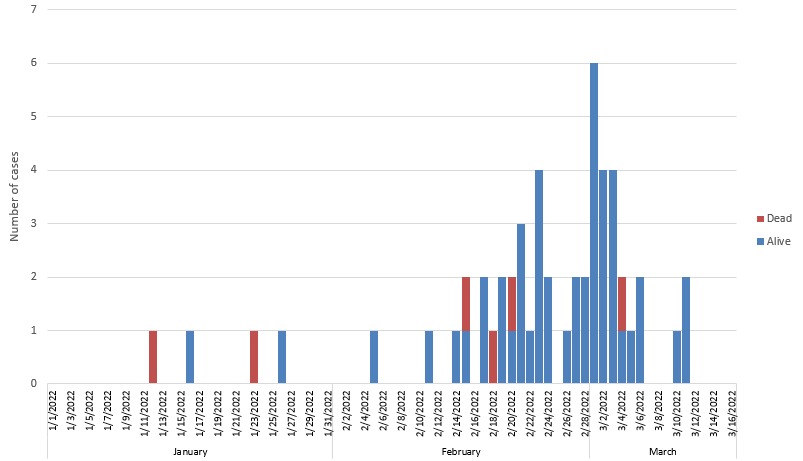
Suspected yellow fever (YF) cases have been reported from eight
villages within three sub-counties in Kenya since 12 January 2022.
Consequently, on 4 March 2022, health authorities in Kenya declared
an outbreak of YF in Isiolo County, central Kenya, which is around
270 km north of the capital city of Nairobi.
As of 10 March 2022, there are a total of 15 suspect YF cases
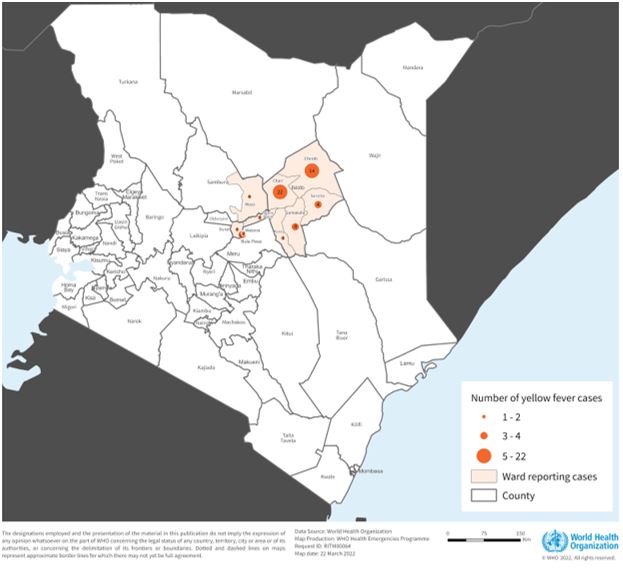
(including four deaths) reported. Three sub-counties of Chari (33%),
Cherab (46%) and Garba Tulla (20%) have been affected in Isiolo
County.
The majority of the presumptive YF cases are from Merti village
(40%) in Cherab sub-county, followed by Biliqo Marara village
(13%), Chari sub-county and Grafarsa village (13%) in Garba Tulla
sub-county. The symptoms described are fever, jaundice, muscle,
and joint pain.
Of the 15 cases, 13 (87%) are males and two (13%) females. The
age range reported is between 11 and 65 years, with the most
affected age group being between 21-30 years (35%). There is no
information on the vaccination status of the reported cases, however
both the origin and the surrounding counties have no history of
vaccination campaign or routine immunization.
Six samples have been collected from Isiolo County with a
representative distribution of all areas reporting suspected YF
cases for confirmation. Two samples tested positive by reverse
transcriptase polymerase chain reaction (RT- PCR) at the national
laboratory (Kenya Medical Research Institute (KEMRI)). In addition,
three samples were presumptive YF IgM positive by the enzymelinked
immunosorbent assay (CDC MAC- ELISA) and another five samples
were equivocal. Further information is pending regarding
the differential diagnosis tests performed. On 8 March 2022, the
samples were shipped to the YF regional reference laboratory -
Uganda Virus Research Institute (UVRI) for confirmatory testing.
PUBLIC HEALTH ACTIONS
On 4 March 2022, the National authorities activated the alert
mode in all the 47 counties, especially in the following high-risk
counties: Wahir, Garissa, Marsabit, Mery, Samburu, Baringo,
Elgeyo Marakwet, West Pokot and Turkana.
The National Government and partners (UNICEF and CDC) are
mobilising resources to support response activities.
A National Incident Management Structure has been put in place
and is developing a response plan to deploy a rapid response team
to Isiolo and neighbouring counties to investigate the outbreak,
conduct a risk assessment, initiate risk communication and
community engagement activities, implement integrated vector
control measures and build capacity in clinical management.
The Ministry of Health is planning to conduct YF vaccination
campaign in outbreak affected areas, as informed by ongoing
investigations and laboratory results.
SITUATION INTERPRETATION
Kenya is endemic for YF and is classified as a high-risk country in
the “Eliminate Yellow Fever Epidemics” (EYE) Strategy. However,
YF hasn’t been documented previously in Isiolo County. Previous
outbreaks have been reported in 1992, 1993, 1994, and 2016 (where
two cases were imported from Angola. Kenya has not yet benefited
from large-scale preventive mass vaccination campaigns and has not
introduced YF vaccine into routine immunization (RI) nation-wide (YF
RI is limited to four counties in the north west of country, not directly
bordering Isiolo). Due to the minimal population immunity, there is
high risk of outbreak amplification.
PROPOSED ACTIONS
Vaccination is the primary means for prevention and control
of YF. As the country plans to introduce YF vaccination into
the routine immunization program, expedited planning and
implementation of these activities will help avert risk of future
outbreaks.
WHO recommends vaccination against YF for all international
travellers aged nine months and above going to Kenya. Yellow
fever vaccination is safe, highly effective and a single dose
provides life-long protection.
WHO also recommends avoiding mosquito bites including the
use of repellents. The highest risk for transmission of YF virus is
during the day and early evening. Communities should be made
aware of yellow fever symptoms and signs and instructed to
rapidly seek medical advice if presenting signs and symptoms
suggestive of YF infection.
View/Open
OEW11-0713032022.pdf (1.846Mb)
https://apps.who.int/iris/handle/10665/352474