Re: Japan - Fukushima Daiichi Nuclear Power Plant - Unit 1 Meltdown & Radiation released, Unit 3 had hydrogen explosion, Unit 2 problem cooling & possible fuel rod failure, and release of radioactive material
Re: Japan - Fukushima Daiichi Nuclear Power Plant - Unit 1 Meltdown & Radiation released, Unit 3 had hydrogen explosion, Unit 2 problem cooling & possible fuel rod failure, and release of radioactive material
Press Release No. 8 of March 15, 2011 11:00 AM
15/03/2011 11:00
http://www.asn.fr/
ASN provides an update on the situation of nuclear Fukushima Daiichi, Fukushima Daini, and Tokai Onagawa - Degradation of the likely reactor containment Fukushima Daiichi 2.
I - Fukushima Daiichi Nuclear Power Plant
March 11, 2011 at 2:46 p.m. (local time), an earthquake struck central Fukushima Daiichi causing its automatic shutdown.
The earthquake also caused:
* The loss of both offsite power plant that has not been compensated by standby generators for reasons currently unknown;
* A tsunami that affected the pumping station necessary for the nuclear reactor cooling (heat sink).
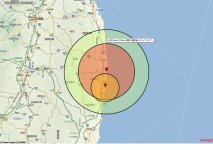
March 15, the evacuation of the zone of 20 km around the plant were almost completed and the Japanese authorities have asked the safekeeping of the population within a radius of 30km. The overview of this area is now prohibited.
Voluntary relief operations speaker lead to radioactive releases. Records of detection tags on the site show a high dose rate, with significant spikes in the vicinity of reactors 2 and 3, only about fifty workers remain on the site to ensure the necessary operations. The wind direction is now oriented towards the south-west towards the city of Tokyo, but should again move to the Pacific Ocean in the coming hours. Results from beacons located near the Tokyo metropolitan area are evaluated by IRSN; an increase in radioactivity is measured, but no significant health impact is noted at this time.
I.1 - Point of the situation on the No. 2 reactor
The reactor No. 2 now focuses the main concerns.
Partial melting of the heart is confirmed, the operator continues the operation of cooling the heart by injecting sea water whenever possible. The operator would have difficulty to perform these operations due to blockage of a relief valve of the tank.
Two successive explosions, at 06:10 am and 10 am (local time) probably led to a degradation of the containment led to significant increases in radioactive discharges detected.
To recall, the No. 2 reactor was automatically shut down during the earthquake. He had not been cooled for several hours.
I.2 - Summary of the situation on the reactor No. 4
A fire broke out on the reactor No. 4 at around 09:30 (local time) at the pool storage of spent fuel, the state spent fuel stored in this pool, potentially affected by fire is not determined.
The fire was extinguished around 12:00 (local time), the Japanese authorities, however,
indicate that radioactive discharges are likely to be directly emitted to the atmosphere.
The reactor was shut down for maintenance during the earthquake.
I.3 - Taking stock of reactors No. 1 and 3
Partial melting of hearts of these two reactors is confirmed. Cooling the reactor by injecting seawater continues much as possible. The containment is maintained integrity after the explosions occurred on these reactors.
Voluntary relief operations of the chamber are carried out regularly, and may lead to radioactive releases.
I.4 - Point of the situation on the reactors # 5 and 6
No reactors 5-6 were shut down for maintenance during the earthquake.
The situation does not change on these reactors.
II - Fukushima Daini Nuclear Power
The four reactors were automatically shut down following the earthquake; external power supplies are available.
The operator has confirmed to 12:00 (local time) that the four reactors were arrested in a normal manner and cooling is controlled.
The Japanese authorities have decided to evacuate the public in a radius of 10 km. Tags measurement of radioactivity around the site have found no increase in radioactivity compared to the usual level.
III - Nuclear Power Onagawa
The three reactors, operated by Tohoku Electric Power, would be controlled by the Japanese authorities, and their situation has not changed in recent hours.
The first level of the state of emergency in the Central Onagawa has been declared following levels of radioactivity recorded. The Japanese authorities have confirmed that the detection of radioactive releases was due to emissions from the plant in Fukushima Daiichi; radioactivity levels returned to normal.
IV Nuclear Tokai
The Tokai plant has two reactors, the first of these reactors is stationary final since 1998.
Reactor No. 2:
The reactor is stopped.
Following the tsunami, one of the engines of 2 pumps of the reactor has stopped but the backup system is normally taken over.
The operator Japan Atomic Power Company control the situation, which has no particular trend.