

Michael Coston
Editor, Senior Moderator
J. Virulence : Altered Virulence Of (HPAI) H5N8 Reassortant Viruses In Mammalian Models
#12,749
Although HPAI H5N8 has spread rapidly out of Asia to Europe, Africa, the Middle East (and briefly to) North America, its one saving grace is that - unlike close cousins H5N1 and H5N6 - it has yet to infect humans.
There have been some signs, however, that it might not take a whole lot for H5N8 to adapt better to mammalian hosts.
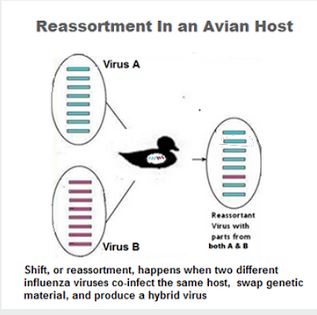
These earlier experiments focused on host adaptation, while today we've a new paper that looks at a single gene replacement via reassortment, one where H5N8 gains virulence after acquiring the PB2 gene from the (co-circulating in some regions) HPAI H5N1 virus.
We've only the abstract to go by, as the full paper is behind a paywall. Follow the link to read:
Last winter (seeFLI: Updated Risk Assessment On HPAI H5 ) German scientists warned that:
While none of this guarantees that H5N8 will someday evolve into a human health threat, the fact that it hasn't happened yet offers no assurance that it won't.
http://afludiary.blogspot.com/2017/0...e-of-hpai.html
#12,749
Although HPAI H5N8 has spread rapidly out of Asia to Europe, Africa, the Middle East (and briefly to) North America, its one saving grace is that - unlike close cousins H5N1 and H5N6 - it has yet to infect humans.
There have been some signs, however, that it might not take a whole lot for H5N8 to adapt better to mammalian hosts.
- In late July in Study: Virulence Of HPAI H5N8 Enhanced By 2 Amino Acid Substitutionswe looked a a classic serial passage experiment that that identified two specific amino acid changes (PB2 E627K and HA A149V) that enhance its virulence in mice (and possibly other mammals).
- While last January, in Sci Rpts: H5N8 - Rapid Acquisition of Virulence Markers After Serial Passage In Mice,researchers found that afteronly 5 passages the virus gained significant virulence markers, warning:
These results suggest that H5N8 viruses can rapidly acquire virulence markers in mammalian hosts; thus, rapid spread as well as repeated viral introduction into the hosts may significantly increase the risk of human infection and elevate pandemic potential.
We've only the abstract to go by, as the full paper is behind a paywall. Follow the link to read:
Altered virulence of Highly Pathogenic Avian Influenza (HPAI) H5N8 reassortant viruses in mammalian models
Su-Jin Park, Eun-Ha Kim, Hyeok-Il Kwon, Min-Suk Song, Se Mi Kim, Young-Il Kim, show all
Su-Jin Park, Eun-Ha Kim, Hyeok-Il Kwon, Min-Suk Song, Se Mi Kim, Young-Il Kim, show all
Page 00 | Received 08 Mar 2017, Accepted 08 Aug 2017, Accepted author version posted online: 05 Sep 2017
Download citation http://dx.doi.org/10.1080/21505594.2017.1366408
ABSTRACT
Recently identified highly pathogenic avian influenza (HPAI) H5N8 viruses (clade 2.3.4.4) are relatively low to moderately pathogenic in mammalian hosts compared to HPAI H5N1 viruses. In this study, we generated reassortant viruses comprised of A/MD/Korea/W452/2014(H5N8) with substitution of individual genes from A/EM/Korea/W149/2006(H5N1) to understand the contribution of each viral gene to virulence in mammals.
Substituting the PB2 gene segment or the NA gene segment of the H5N8 virus by that from the H5N1 virus resulted in significantly enhanced pathogenicity compared with the parental H5N8 virus in mice.
ABSTRACT
Recently identified highly pathogenic avian influenza (HPAI) H5N8 viruses (clade 2.3.4.4) are relatively low to moderately pathogenic in mammalian hosts compared to HPAI H5N1 viruses. In this study, we generated reassortant viruses comprised of A/MD/Korea/W452/2014(H5N8) with substitution of individual genes from A/EM/Korea/W149/2006(H5N1) to understand the contribution of each viral gene to virulence in mammals.
Substituting the PB2 gene segment or the NA gene segment of the H5N8 virus by that from the H5N1 virus resulted in significantly enhanced pathogenicity compared with the parental H5N8 virus in mice.
Of note, substitution of the PB2 gene segment of the H5N8 virus by that from the H5N1 virus resulted in a 1000-fold increase in virulence for mice compared to the parental virus (MLD50 decreased from 105.8 to 102.5 EID50).
Further, the W452W149PB2 virus also induced the highest virus titers in lungs at all time points and the highest levels of inflammatory cytokine responses among all viruses tested. This high virulence phenotype was also confirmed by high viral titers in the respiratory tracts of infected ferrets. Further, a mini-genome assay revealed that W452W149PB2 has significantly increased polymerase activity (p < 0.001).
Further, the W452W149PB2 virus also induced the highest virus titers in lungs at all time points and the highest levels of inflammatory cytokine responses among all viruses tested. This high virulence phenotype was also confirmed by high viral titers in the respiratory tracts of infected ferrets. Further, a mini-genome assay revealed that W452W149PB2 has significantly increased polymerase activity (p < 0.001).
Taken together, our study demonstrates that a single gene substitution from other avian influenza viruses can alter the pathogenicity of recent H5N8 viruses, and therefore emphasizes the need for intensive monitoring of reassortment events among co-circulating avian and mammalian viruses.
Clade 2.3.4.4 H5N8 viruses have proven themselves to be very promiscuous, reassorting easily with other LPAI viruses and producing novel genotypes, and occasionally new subtypes.Last winter (seeFLI: Updated Risk Assessment On HPAI H5 ) German scientists warned that:
`Generation of reassortants always must be expected when different high and low pathogenic influenza viruses are circulating in one population.'
This continual evolution is something we looked at again yesterday in What Strains May Come, and reminds us that the avian flu virus that arrives tomorrow could differ greatly from the one we saw yesterday.While none of this guarantees that H5N8 will someday evolve into a human health threat, the fact that it hasn't happened yet offers no assurance that it won't.
http://afludiary.blogspot.com/2017/0...e-of-hpai.html