
• FluTrackers.com Inc. does not provide medical advice. Information on this web site is collected from various internet resources, and the FluTrackers board of directors makes no warranty to the safety, efficacy, correctness or completeness of the information posted on this site by any author or poster. The information collated here is for instructional and/or discussion purposes only and is NOT intended to diagnose or treat any disease, illness, or other medical condition. Every individual reader or poster should seek advice from their personal physician/healthcare practitioner before considering or using any interventions that are discussed on this website. By continuing to access this website you agree to consult your personal physican before using any interventions posted on this website, and you agree to hold harmless FluTrackers.com Inc., the board of directors, the members, and all authors and posters for any effects from use of any medication, supplement, vitamin or other substance, device, intervention, etc. mentioned in posts on this website, or other internet venues referenced in posts on this website.
  • We are not asking for any donations. Do not donate to any entity who says they are raising funds for us.

Italy - Update on Etna's activity

Pathfinder

Editor, Senior Moderator
Etna (Sicile / Italie)

1236608063.jpg

Ash clouds have been coming out of the Bocca NE since Saturday (see screenshot of the webcam here below)...
http://volcans.blogs-de-voyage.fr/archive/2010/11/15/etna-sicile-italie.html

--------------------------------------------------------------------

Update on Etna's activity, 15 November 2010

Following several days of minor ash emissions from the Northeast Crater - the tallest of the four summit craters of Etna, hereafter "NEC" - on the morning of 14 November 2010 there was a significant increase in both the frequency and in the volume of ash emissions from the same crater. These emissions generated plumes a few hundred meters high, which were then carried by the wind as a long, narrow trail, first toward southwest (14 November), then toward northeast (during the night of 14-15 November), and finally toward east (15 November). The emissions occurred in an intermittent manner, alternating with periods of white gas and vapor emissions.

A visit to the summit craters was carried out by INGV-Catania staff on 15 November 2010, to make direct observations of the NEC activity and of the character of the ash deposits in the surrounding areas. Near the NEC cone, particularly to the south, in the northern portion of the Voragine, a few millimeters of brown ash were present on the ground. On the rim of the NEC itself, the deposit was up to 1 cm thick, especially on the eastern side. During the stay on the NEC rim, the ash emissions were rather modest, and accompanied by nearly continuous deep rumblings, sometimes becoming louder.

Since more than a year, on the crater floor there had been an open degassing vent, which until the previous visit to the NEC in October had a diameter of about 25 m. On 15 November, this vent was seen to be much larger, with a diameter of at least 75 m. Ash emissions from this vent occurred at times in a passive manner, but at times became more vigorous. The inner walls of the crater were covered by reddish brown ash deposits. No coarse-grained material was observed, neither in the deposits, nor in the emissions.

Photos:

http://www.ct.ingv.it/index.php?option=com_content&view=article&id=287
 
Re: Italy - Update on Etna's activity

<TABLE class=contentpaneopen><TBODY><TR><TD class=contentheading width="100%">Update on the eruptive activity of Etna, 3 January 2011 </TD><TD class=buttonheading width="100%" align=right></TD><TD class=buttonheading width="100%" align=right></TD><TD class=buttonheading width="100%" align=right></TD></TR></TBODY></TABLE><TABLE class=contentpaneopen><TBODY><TR><TD vAlign=top>


On the late afternoon of 2 January 2011, a strong glow appeared within the pit crater that is located on the lower eastern slope of the Southeast Crater cone, and during the following hours this evolved into vigorous, though modest Strombolian activity. This activity continued through the early morning, and decreased markedly after 06:00 local time (= GMT+2). The episode was accompanied by a significant increase in the volcanic tremor amplitude, which peaed around midnight and during the forenoon decreased to background levels. Between 23:00 on 2 January and 02:00 on the next day, the activity consisted of frequent Strombolian explosions (about 1-3 per minute), which launched coarse-grained incandescent material up to a few tens of meters above the rim of the pit. On a few occasions, incandescent bombs fell outside the pit's rim, mainly to the south and to the east. No outflow of lava occurred, and the event produced negligible quantities of volcanic ash.

<TABLE style="WIDTH: 100%" border=0 cellSpacing=5 cellPadding=5><TBODY style="TEXT-ALIGN: left"><TR style="TEXT-ALIGN: left"><TD style="TEXT-ALIGN: justify" vAlign=top>The episode of 2-3 January has been preceded by several days of repeated emissions of incandescent material, probably hot gas, from the same pit crater, and a dull glow was periodically visible during the night of 1-2 January.

It is furthermore possible that on the afternoon of 23 December 2010 a similar episode of Strombolian activity had occurred at the same pit, during a period of strongly increased volcanic tremor amplitude. However, bad weather precluded observations of the summit area; only in the video footage recorded by the Schiena dell'Asino monitoring camera a bright glow is intermittently visible between 16:00 and 16:05 of 23 December, located in correspondence with the pit crater.


</TD></TR></TBODY></TABLE>http://www.ct.ingv.it/index.php?option=com_content&view=article&id=299


</TD></TR></TBODY></TABLE>
 
Re: Italy - Update on Etna's activity

The eruption is also visible on the webcams (Post #3 for links)
 
Re: Italy - Update on Etna's activity

<TABLE class=contentpaneopen><TBODY><TR><TD vAlign=top>
Etna update, 12 January 2011

Starting on the late evening (about 21.00 GMT) of 11 January 2011, a slight increase in the volcanic tremor amplitude has been recorded by the INGV-CT seismic network, which reached a peak at 07:00 on 12 January.

During the early morning of this day, the source of the tremor was observed to shift from its previous location to the north of the Northeast Crater toward the Southeast Crater. These variations have been accompanied by the resumption of weak eruptive activity within the pit crater located on the eastern flank of the Southeast Crater cone, as observed already during the day of 11 January, and which gradually increased in intensity during the early morning of today. As of 08:45 GMT this morning, the activity continues to be rather weak, without any emission of volcanic ash, whereas dense emission of gas and vapor is observed at the other summit craters of Etna.

On the evening of 12 January, Strombolian activity continued from the active vent within the pit crater; during the afternoon and evening the volcanic tremor amplitude had continued to increase. Shortly after 21:00, lava that had accumulated within the pit crater started to overflow on its low eastern rim, feeding a lava flow that advanced toward the western wall of the Valle del Bove. It is possible that the ongoing activity is producing volcanic ash.

Further details on the ongoing activity will be provided here during the next few hours.

http://www.ct.ingv.it/index.php?view=article&id=308&option=com_content

------------------------------------------------------------------


<TABLE class=contentpaneopen><TBODY><TR><TD class=contentheading width="100%">Etna update, 13 January 2011 </TD><TD class=buttonheading width="100%" align=right></TD><TD class=buttonheading width="100%" align=right></TD><TD class=buttonheading width="100%" align=right></TD></TR></TBODY></TABLE><TABLE class=contentpaneopen><TBODY><TR><TD vAlign=top>
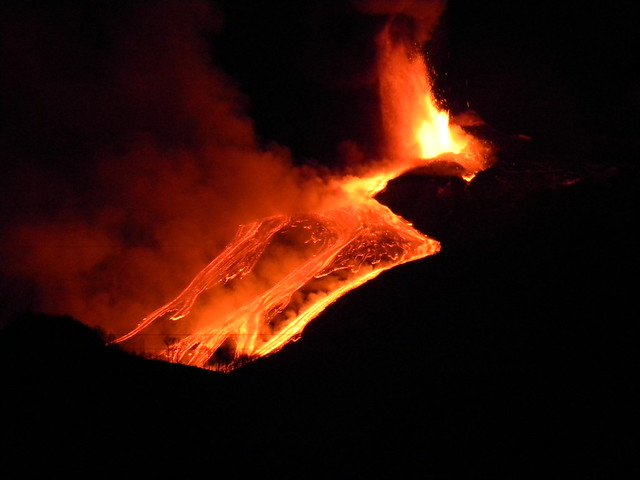
The eruptive episode that had started during the day of 11 January 2011 with very weak Strombolian activity within the pit crater on the east flank of the Southeast Crater cone, intensified during the following day, and culminated in the late evening of 12 January with sustained lava fountains, voluminous lava flows, and an eruptive column a few kilometers high. The paroxysm ceased around 00:50 of 13 January.

A more detailed report on this event will be posted on this page during the evening of today.

http://www.ct.ingv.it/index.php?view=article&id=309&option=com_content

http://www.ct.ingv.it/index.php?opt...naio-2011--etna-activity-updates-january-2011

------------------------------------------------------------------


</TD></TR></TBODY></TABLE>See also:

Erik Klemetti
Eruptions
Hot stuff from Earth's interior

Etna starts off 2011 by putting on a show

Erik Klemetti on January 13, 2011, 9:41 AM

5350138321_007f5cb524_z.jpg

Lava flow and fountain on Mt. Etna on January 12, 2011. Image by Dr. Boris Behncke - see the original here.

http://bigthink.com/blogs/eruptions/


</TD></TR></TBODY></TABLE>
 
Re: Italy - Update on Etna's activity

<IFRAME style="Z-INDEX: 100000; BORDER-BOTTOM: 0px; POSITION: absolute; BORDER-LEFT: 0px; WIDTH: 1px; HEIGHT: 1px; BORDER-TOP: 0px; TOP: 0px; BORDER-RIGHT: 0px; LEFT: 0px" id=_atssh19 height=1 src="//s7.addthis.com/static/r07/sh30.html#cb=0&ab=-&dh=www.flutrackers.com&dr=&du=http%3A%2F%2Fwww.flutrackers.com%2Fforum%2Fnewreply.php%3Fdo%3Dpostreply%26t%3D155129&dt=&inst=1&lng=en-us&pc=men&pub=xa-4a5e804627659a64&ssl=0&sid=4d349927094e8b85&srd=1&srf=0.02&srp=0.2&srx=0&ver=250&xck=0&rev=88088&xd=1" width=1 name=_atssh19 frameborder="0"></IFRAME>
<IFRAME style="Z-INDEX: 100000; BORDER-BOTTOM: 0px; POSITION: absolute; BORDER-LEFT: 0px; WIDTH: 1px; HEIGHT: 1px; BORDER-TOP: 0px; TOP: 0px; BORDER-RIGHT: 0px; LEFT: 0px" id=_atssh201 height=1 src="//s7.addthis.com/static/r07/sh30.html#cb=0&ab=-&dh=www.flutrackers.com&dr=&du=http%3A%2F%2Fwww.flutrackers.com%2Fforum%2Fnewreply.php%3Fdo%3Dpostreply%26t%3D155129&dt=&inst=1&lng=en-us&pc=men&pub=xa-4a5e804627659a64&ssl=0&sid=4d3498f9b648ea67&srd=1&srf=0.02&srp=0.2&srx=0&ver=250&xck=0&rev=88088&xd=1" frameBorder=0 width=1 name=_atssh201></IFRAME>
Activity at Mt. Etna


<!-- AddThis Button END --><SCRIPT type=text/javascript> var addthis_options = 'email, digg, delicious, myspace, google, facebook, live, twitter, stumbleupon, more'; var addthis_exclude = 'print'; var addthis_offset_top = 3; var addthis_offset_left = -9; var addthis_hover_delay = 400; var addthis_localize = { share_caption: "Share this image" }; // var addthis_config = { data_use_flash: false }; </SCRIPT><SCRIPT type=text/javascript src="http://s7.addthis.com/js/250/addthis_widget.js?pub=xa-4a5e804627659a64"></SCRIPT>
In mid-January 2011, Europe?s largest and most active volcano rumbled with new energy and lit up the Sicilian night with a fountain of lava. The Moderate Resolution Imaging Spectroradiometer (MODIS) on NASA?s Terra satellite captured this image of the east coast of Sicily and of Mount Etna as it was spewing ash or steam on January 11, before the lava eruption.

According to news reports from Italy, tremors were detected around Mount Etna on the evening of January 11; by the next evening, lava was shooting hundreds of feet into the air and flowing toward the western wall of the Valle del Bove. An ash plume from the eruption shuttered Fontanarossa Airport in nearby Catania (Sicily?s second-largest city) for much of January 12, with flights diverted or canceled. To date, there have been no reports of injuries.

The massive 3,350-meter-high volcano is one of the most consistently active volcanoes in the world, and accounts of its rumblings go back to 1500 B.C. Since at least October 2010, the volcano was showing signs of unrest that slowly built to the January 12 eruption.

An ongoing collection of ground-based photos and webcams of the eruption can be viewed online.

[...]
http://earthobservatory.nasa.gov/NaturalHazards/view.php?id=48612
 
Back
Top Bottom