• FluTrackers.com Inc. does not provide medical advice. Information on this web site is collected from various internet resources, and the FluTrackers board of directors makes no warranty to the safety, efficacy, correctness or completeness of the information posted on this site by any author or poster. The information collated here is for instructional and/or discussion purposes only and is NOT intended to diagnose or treat any disease, illness, or other medical condition. Every individual reader or poster should seek advice from their personal physician/healthcare practitioner before considering or using any interventions that are discussed on this website. By continuing to access this website you agree to consult your personal physican before using any interventions posted on this website, and you agree to hold harmless FluTrackers.com Inc., the board of directors, the members, and all authors and posters for any effects from use of any medication, supplement, vitamin or other substance, device, intervention, etc. mentioned in posts on this website, or other internet venues referenced in posts on this website.
  • We are not asking for any donations. Do not donate to any entity who says they are raising funds for us.

Irish recall all pork products - Dioxins in feed

JJackson

In Memoriam - Senior Moderator
From http://www.fsai.ie/ also
http://news.bbc.co.uk/2/hi/europe/7769391.stm
Recall of pork and bacon products

Laboratory results of animal feed and pork fat samples obtained yesterday (6 December) have confirmed the presence of dioxins. The food industry is therefore required to recall from the market all Irish pork products produced from pigs slaughtered in Ireland.
This includes all raw and cooked pork products e.g. pork, ham, sausages, bacon, gamon steaks
For further information, see:
Press Release
Questions and Answers
Information Note on Dioxins
 
Re: Irish recall all pork products - Dioxins in feed

From JJackson's BBC link:

All pork products made in the Irish Republic since September have been recalled over fears they are contaminated with a toxic substance.

The action was taken after dioxins were found in slaughtered pigs thought to have eaten contaminated feed.

Tests showed some pork products contained up to 200 times more dioxins than the recognised safety limit.

The UK's Food Standards Agency said it did not believe at this stage that UK consumers faced any "significant risk".

Food safety expert Professor Hugh Pennington told the BBC the health risk was "very, very low".

He said: "You have to have a lot of these compounds. You have to eat a lot of them, enormous amounts to have any visible effect."

But consumers and retailers in the Irish Republic have been warned to destroy all Irish pork and bacon products bought since 1 September as a precaution.

Bacon, ham, sausages, white pudding and pizzas with ham toppings are also included in the withdrawal of stocks.

A spokesman for discount supermarket Lidl said half of its stores had removed "own-brand" black pudding and pork belly products sourced from the Irish Republic from their shelves.

He added that half of Lidl's stores had stocked these products and refunds are being offered to people who had bought the products.

Waitrose said all of its fresh pork was British so it was unaffected.

Other supermarkets, including Tesco, contacted by BBC News said they were continuing to check their supplies but many believed they did not stock pork products imported from the Republic of Ireland.

Banned substance

Dioxins are formed during combustion processes, such as waste incineration, and during some industrial processes.

Suspicions over contamination were first raised on Monday as a result of the routine testing of pigs, which indicated the presence of polychlorinated biphenyls (PCBs) - banned in the Irish Republic since the 1970s - in animal feed.

Restrictions were placed on a number of pig farms and tests on pork samples confirmed the presence of dioxins on Saturday afternoon.

Chronic long-term exposure to dioxins can have serious health effects, including causing cancers, but Irish officials said the recall would ensure consumers only had minimum exposure to it.

The country's chief medical officer, Dr Tony Holohan, said anyone who had eaten pig meat did not need to seek medical help.

An Irish government spokeswoman said: "Investigations involving the Department of Agriculture, Fisheries and Food (DAFF) and the Food Safety Authority of Ireland are continuing to determine the extent of the contamination and to identify the processors and products involved."

The source of the contamination is believed to be a licensed mill which manufactures animal feed.

The Irish minister for agriculture, Brendan Smith, said the problem was confined to 47 farms.

He said: "This includes 38 beef farms. This is the total number of farms identified as having received possible contaminated animal feed. There is only one feed supplier involved."

The FSAI's chief executive Alan Reilly said: "The levels in the feed were very high. The levels in the pork itself were in the region of about 80-200 times above the safe limits."

'Absolute disaster'
Labour Party spokesman on agriculture and food, Sean Sherlock, said the government's priority had to be consumers, but action had to be taken to "save the Christmas pork and ham market".

He said: "The announcement amounts to a threat to the overall viability of our food industry as great as, if not greater than, the outbreaks of BSE and of foot and mouth."

Padraig Walshe, president of the Irish Farmers' Association, described the recall as "an absolute disaster" for the pig farming sector, but said fewer than 10% of products on the market had been processed since 1 September.

"It will be possible to have fresh product - and totally safe product - on the shelves within a couple of days," he said.

Mr Walshe said up to 70% of Irish pork was consumed within the country itself - "a larger proportion" of the rest goes to the UK.

About 7,000 people are employed in the Republic of Ireland's pig industry, which is worth more than 250m euros (?216m) a year.

The British Pig Executive said that between April-July this year, the UK imported 230,000 tonnes of pork and bacon, with up to 15,000 of those from the Republic of Ireland.

A spokeswoman for Defra said it was "keeping in close contact with the FSA as they evaluate any potential implications for Britain".
 
Re: Irish recall all pork products - Dioxins in feed

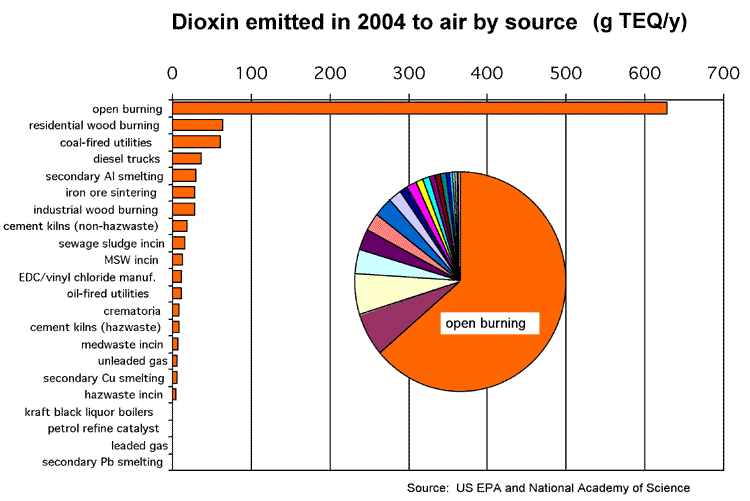
Open burning (including farm waste) can get both dioxins and PCBs into the food chain.

From: http://www.nofany.org/hottopics/dioxinsandburnbarrels.htm

Instead, dioxin?s main pathway into our bodies is food, most particularly milk, eggs, cheese and other dairy products and all meats. Plants actually absorb dioxins from the air in minute amounts and basically accumulate an amount that is related to the amount in the air. The more dioxins in the ambient air, the more dioxins are in plants exposed to those levels. When farm animals consume plants, they become highly concentrated in the animals. In other words, the ambient air levels of dioxin are largely responsible for dioxin levels in plants, which are responsible for dioxin levels in animals. The contaminant levels of dioxins in food can be correlated to ambient air levels in the plant feeds consumed by the animals we depend on for food......

.....Even informed people are unaware that dioxins occur in meats and dairy products in amounts above EPA?s recommended levels of exposure. Most people are also unaware that they and their neighbors may be inadvertently increasing their exposure by burning garbage and that they are literally part of the problem. Farmers with burn barrels may be unaware that they could be damaging the quality of the foods they produce. Gardeners and people lucky enough to have a few chickens are largely unaware that they may be increasing the contamination of their eggs that are otherwise so much better than those in the grocery store by burning their garbage.<?XML:NAMESPACE PREFIX = O /><O:P></O:P>

dioxin_inventory_graph.gif
 
Re: Irish recall all pork products - Dioxins in feed

Tainted Irish pork may have reached 25 countries: official


DUBLIN (AFP) ? Contaminated Irish pig meat may have been exported to up to 25 countries, Ireland's chief vet said Sunday, as shops at home and abroad cleared pork from their shelves amid fears of a cancer link.

"We believe it's in the order of 20 to 25 countries. It's certainly less than 30," Paddy Rogan said in comments quoted by the Irish media.

His remarks came after ministers Saturday ordered all pig meat products from the Republic of Ireland to be withdrawn as dioxins, which may cause cancer, were found in slaughtered pigs thought to have eaten contaminated feed.

The recall involved products processed since September 1 and has caused panic in the Emerald Isle, where many families would have been buying their traditional Christmas ham in the coming days.

Ireland is a major exporter of pork, with Britain by far the biggest market followed by Germany, France, Russia and Japan. Other major export destinations include Hong Kong, China and the Netherlands.

Officials and police are investigating the possible source of the contaminated feed, a plant run by Millstream Power Recycling Limited near Fenagh, County Carlow in southwest Ireland.

David Curtin, a firm spokesman, said what was under investigation was oil used in machinery used to dry the recycled bread products and dough which are ingredients in the feed.

He denied that any oil or other substance had been added to the feed during processing.

Irish Prime Minister Brian Cowen stepped in to try and calm the situation, saying it was important his government took "whatever measures are necessary" to build confidence in the industry for the future.

"The problem has been located. The continuing examination and inquiries will proceed and we must take action to reinforce confidence to the public, and obviously also allow the industry to move on from this point," Cowen said.

The crisis is another blow to recession-hit Ireland, where about 5,000 people work in a pig meat industry which exported 129,000 tonnes worth 368 million euros (468 million dollars) in 2007, according to official figures.

Irish people are being told not to eat domestically-reared pork meat, bacon, pork sausages, sausage meat, gammon steaks, offal from pigs, salami, ham, sausage rolls, black pudding and white pudding.

Supermarket shelves have been cleared of Irish pork products while stockists in Britain, like retailer Waitrose, have also pulled them as officials advise consumers not to eat Irish or Northern Irish pork.

Germany said it was taking all Irish pork products off the shelves as a precautionary measure, while contaminated Irish pork has been found in France and Belgium.

Swedish authorities have also advised consumers to avoid products containing Irish pork until further notice.

The European Commission
announced it was closely monitoring the situation, saying experts from countries that may have received tainted pork shipments would meet Tuesday.

Dioxins are toxic chemicals that can have serious health effects, including causing cancers, if there is long-term exposure to them at high levels.

Food Safety Authority of Ireland deputy chief executive Alan Reilly said dioxin levels found in meat samples were between 80 and 200 times above the legal limit but stressed the risk to the public was "very, very low".

"You would have to be eating products containing these chemicals for 40 years before you would show any signs of illness," he said.

Padraig Walshe, president of the Irish Farmers' Association, said the recall was an "absolute disaster" in the run-up to Christmas, adding the contamination could cost Irish farmers hundreds of millions of euros.

"It is going to be very difficult for the industry to get itself re-established and get customers to buy output again," Walshe told state broadcaster RTE. "It is a huge blow to the industry."

The contaminated feed was supplied to 10 Irish farms which supply roughly 10 percent of Ireland's pigs.

Nine farms in Northern Ireland have also used the contaminated feed.

http://www.google.com/hostednews/afp/article/ALeqM5ho1PqrlD9glBupKX-bdMKgb6WDTg

 
Re: Irish recall all pork products - Dioxins in feed

100,000 pigs to be culled in wake of dioxin scare

Monday, 8 December 2008


Around 100,000 pigs will have to be culled as a result of the major food safety scare that has led to Irish pork and bacon products being removed from sale worldwide.


The recall was put into effect on Saturday night after tests confirmed that pigs on a large number of farms had been eating feed contaminated with dioxin.

The feed was supplied by Millstream Recycling in Clohamon, Bunclody, Co Wexford, which says it is examining how its health and safety procedures could have been breached.

An estimated ?125m worth of food products will have to be destroyed in up to 25 different countries.

Beef is also being tested to determine if it is free from contamination, with the results expected in the next 24 hours.

http://www.belfasttelegraph.co.uk/b...d-in-wake-of-dioxin-scare-14098246.html?r=RSS
 
Re: Irish recall all pork products - Dioxins in feed

The feed was supplied by Millstream Recycling in Clohamon, Bunclody, Co Wexford,.....

From the company website:

For the past 15 years, Millstream Recycling has provided a reliable service in collecting any waste, damaged or out-of-date food and drinks for conversion to animal feeds, fuels, biogas and compost.

.
 
Re: Irish recall all pork products - Dioxins in feed

The Irish Independent reports that Gardai were last night investigating the circumstances which led to the massive pig meat scare at the weekend.


Senior officers from the National Bureau of Criminal Investigations met Department of Agriculture officials to try to establish the source of the scare.

They will try to identify where all elements of the feedstuff at the centre of the recall came from.

Last night, the cost of the pork scare was forecast to hit ?1bn as the recall of affected products went global and hundreds of thousands of consumers were forced to dump pig-meat products.

It emerged that contaminated product had gone to as many as 30 countries worldwide, leaving Ireland's reputation for quality agricultural produce in tatters.
And as supermarkets were forced to remove millions of euro of pork from their shelves, there were serious doubts about consumers' prospects of getting their money back.

Last night only three supermarket chains were offering full refunds, with just two saying they would recompense those who didn't have receipts for pork products, which have been linked to cancerous PCB dioxins.

Millstream Recycle, based in Bunclody, Co Wexford, emerged as the company at the centre of the food scare and was shut down as further tests took place.

The Food Safety Authority Ireland said that industrial oil had tainted ingredient at the company, which uses recycled bread and dough in production.

Officials are now probing links with an oil used in a machine at the food processor plant, which was closed down in the middle of last week when the contaminated feed was traced.

A spokesman for the firm said the oil being tested was put in a machine used to dry the animal feed and has never been added as an ingredient at any stage.
It is unclear who will bear the brunt of the cost of the recall after the Government indicated there would be no compensation package.
<TABLE id=table1 cellSpacing=1 cellPadding=0 width=300 align=right border=0><TBODY><TR><TD>
<!-- IFRAME Tag // Tag for network 257: Sales Online // Website: Finfacts.ie // Page: ROS // Placement: ROS-Bottom-300 x 250 (1079856) // created at: Nov 10, 2008 12:20:08 PM --><!-- End of IFRAME Tag -->​
</TD></TR></TBODY></TABLE>
The Irish Exporters Association said the total exports of pig meat and related added value products such as pizzas, pies and sandwiches containing pork was about ?750m.

There are fears that the longer-term effects will mean jobs and home market share being lost as major food companies turn to foreign suppliers in a bid to assuage consumer concerns.

But with all pork supplied since September 1 to be recalled or destroyed, including that sold in Ireland, the immediate cost will run into hundreds of millions -- putting the ultimate bill of this scare at a potential ?1bn.

The latest scare amounts to a major new hammer blow to the Irish economy at a time when it needs every euro of income.

Between 20 and 30 countries may have received contaminated shipments according to Irish officials -- including the UK, France, the Netherlands and Belgium.

Contaminated

And nine farms in the North have used the same contaminated animal feed, it emerged.

Taoiseach Brian Cowen last night insisted that pork products would be back on display as quickly as possible in a bid to boost consumer confidence.

The pork recall has sent shockwaves through the agricultural industry, and particularly the embattled pig production and processing sector.

Not since the foot and mouth outbreak of 2001 has such drastic action been taken by the authorities.

http://www.finfacts.ie/irishfinancenews/article_1015467.shtml
<!--finfactsad5_start-->
 
Re: Irish recall all pork products - Dioxins in feed

Why would they use PCB-containing oil in machinery to produce a product that will enter the food chain?

Aren't there alternatives?

.
 
Re: Irish recall all pork products - Dioxins in feed

Why would they use PCB-containing oil in machinery to produce a product that will enter the food chain?

Aren't there alternatives?

.
Hi Denise,

I think you auto-answer well in your previous post:
#6:
"Recycling has provided a reliable service in collecting any waste, damaged or out-of-date food and drinks for conversion to animal feeds, fuels, biogas and compost."

and

#7 (Dutchy):
"Apparently these kind of incidents- dioxine pollution - happen regularly."


It can be added to above words: "to human feeds" also, because those animals serve as human food.

That's the continuation of the shamefully practice of "waste in food" (who said? "Soylent green doesn't exist" - it does for the animal food) that started the "mad cow" disease, further spreaded with damaged/infected food to many healthy heards at the time.

If the dioxin damaged meat/milk/... business, and the health damaged world consumers filled an legal complaint to sue such irresponsable toxics spreader sources, than maybe those weak laws which permited the recycling of waste for food, would be changed and upgraded, because than would be bigger the legal fine than the profits ...

As we saw, there are plenty of toxics into our bodies, but we are mainly unaware of it, until the induced illness appear, and than the world research try to "walk on glasses" with many painfull experiments to find a cure for such strange illnesses.

Lawmakers - switch off the illness inducing source first.
 
Re: Irish recall all pork products - Dioxins in feed

Here is some background reading on the use of lubrication oil in the food processing industry. Apparently these kind of incidents- dioxine pollution - happen regularly.

http://www.fda.gov/ohrms/dockets/dailys/04/sep04/091704/04N-0230-emc00013-01.pdf

Here is a good timeline of the history of PCB-oil pollution of the food chain, with the non-response of Monsanto. Apparently the PCB-containing oil and other mechanical parts (like heatint coils) are rather common, as are contamination incidents.

.
 
Re: Irish recall all pork products - Dioxins in feed

Irish tests find dioxins in cattle as well as pork

By SHAWN POGATCHNIK ?

DUBLIN, Ireland (AP) ? Ireland announced Tuesday it has found illegal levels of dioxins ? the chemicals that are devastating its pork industry ? in cattle, but insisted its beef was safe to eat.

Agriculture Minister Brendan Smith said Ireland has decided not to recall any of its beef products at home or abroad because, unlike the contamination of pork products, the level and extent of dioxin found so far in cattle is much lower.

Smith said dioxin tests had come back positive for three farms out of 11 tested so far, while results were pending for 34 more farms that received dioxin-contaminated feed. He described the three farms that failed as "technically noncompliant, but not at a level that would pose any public health concern."

Smith said the government would prevent any cattle at those three farms from being slaughtered and put into the food chain until they could be individually tested for dioxin levels. Until then, he said, no meat from those farms would be permitted to enter the market.

Alan O'Reilly, deputy chief executive of the Food Safety Authority of Ireland, said dioxin levels detected in cattle from the three farms were two to three times over legal limits. He contrasted that with last week's finding of dioxin levels in pigs that were 80 to 200 times over those limits.

"There's a huge difference," O'Reilly said.

Ireland's chief medical officer, Dr. Tony Holohan, said the levels of dioxins detected in Irish beef and pork would not pose a health risk to anyone who ate either meat.

"To all intents and purposes this is not a public health issue. ... We do not expect to see symptoms as a result of this," Holohan said.

Nonetheless, the latest findings threatened to undermine Ireland's annual euro1.5 billion ($2 billion) industry in beef, Ireland's primary agricultural export ? more than three times the value of Ireland's gridlocked pork industry.

Ireland's major pigmeat processors have been refusing to start slaughtering an estimated 100,000 pigs at nine farms where illegally high levels of dioxins have been confirmed. The processors have already laid off 1,400 workers and say they won't budge until the government reimburses their costs.

http://www.google.com/hostednews/ap/article/ALeqM5iiddWI0O8AIRCkoi2RhraOkScflQD94V8H1O0
 
Back
Top