• FluTrackers.com Inc. does not provide medical advice. Information on this web site is collected from various internet resources, and the FluTrackers board of directors makes no warranty to the safety, efficacy, correctness or completeness of the information posted on this site by any author or poster. The information collated here is for instructional and/or discussion purposes only and is NOT intended to diagnose or treat any disease, illness, or other medical condition. Every individual reader or poster should seek advice from their personal physician/healthcare practitioner before considering or using any interventions that are discussed on this website. By continuing to access this website you agree to consult your personal physican before using any interventions posted on this website, and you agree to hold harmless FluTrackers.com Inc., the board of directors, the members, and all authors and posters for any effects from use of any medication, supplement, vitamin or other substance, device, intervention, etc. mentioned in posts on this website, or other internet venues referenced in posts on this website.
  • We are not asking for any donations. Do not donate to any entity who says they are raising funds for us.

Iowa House Cat Tests Postive For H1N1

Michael Coston

Editor, Senior Moderator
http://www.idph.state.ia.us/IdphNews/Reader.aspx?id=8FBE90B3-4667-4960-9AF5-1B9B477A3805


Protecting Pets from Illness


The Iowa Department of Public Health (IDPH) and the Iowa Department of Agriculture and Land Stewardship (IDALS) remind Iowans that in addition to protecting their families, friends and neighbors from the spread of the 2009 H1N1 influenza virus, it?s important to remember to protect family pets from the illness, as well. People who are sick with H1N1 can spread the virus not only to humans, but to some animals.


The Departments are sharing this message following the confirmation of a case of H1N1 in an Iowa cat.


The 13-year-old indoor cat in Iowa was brought to the Lloyd Veterinary Medical Center at Iowa State University?s College of Veterinary Medicine, where it tested positive for the H1N1 virus. The diagnosis is the culmination of collaborative efforts between IDPH, Iowa State University College of Veterinary Medicine, Center for Advanced Host Defenses, Immunobiotics and Translational Comparative Medicine, USDA, and IDALS Animal Industry Bureau.


?Two of the three members of the family that owns the pet had suffered from influenza-like illness before the cat became ill,? said IDPH Public Health Veterinarian, Dr. Ann Garvey. ?This is not completely unexpected, as other strains of influenza have been found in cats in the past.? Both the cat and its owners have recovered from their illnesses.


People can keep their pets healthy by washing hands, covering coughs and sneezes, and minimizing contact with their pets while ill with influenza-like symptoms. If your pet exhibits signs of a respiratory illness, contact your veterinarian.


?Indoor pets that live in close proximity to someone who has been sick are at risk and it is wise to monitor their health to ensure they aren?t showing signs of illness,? said Dr. David Schmitt, State Veterinarian for Iowa.


For more information about H1N1, visit www.idph.state.ia.us/h1n1/ or call the Iowa Influenza Hotline at 1-800-447-1985.
 
Re: Iowa House Cat Tests Postive For H1N1

first confirmed cat who ever got it from a human , AFAIK
(except laboratory, of course)
 
Re: Iowa House Cat Tests Postive For H1N1

This isn't good, when it can cross species, is it? Cats and birds, dang it... I'm guessing this is what you're referring to, hawkeye...
 
Re: Iowa House Cat Tests Postive For H1N1

This doesn't suprise me. Both of the vet's offices I have contact with were both commenting on the extremely large number of sick cats this spring and early summer. Of course, no one would have been looking for novel flu in cats at that time.

I was sick the first week in April and one of my never-goes-outdoors cats got sick about a week or so after. He was really, really sick but all his blood tests came back within normal ranges. The vet had no clue what was wrong with him. I was convinced that whatever I had, he got.

The diagnosis is the culmination of collaborative efforts between IDPH, Iowa State University College of Veterinary Medicine, Center for Advanced Host Defenses, Immunobiotics and Translational Comparative Medicine, USDA, and IDALS Animal Industry Bureau.
This was quite an effort. I guess I thought a routine blood workup would confirm influenza?
 
Re: Iowa House Cat Tests Postive For H1N1

Picture 1.png
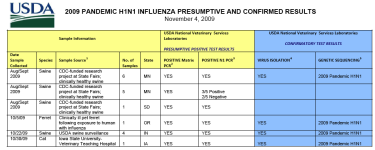
1 Suspect positive 2009 pandemic H1N1 samples can be received by USDA?s National Veterinary Services Laboratories (NVSL) from a variety of sources. Testing for the presence of 2009 pandemic H1N1 influenza in the U.S. swine herd is part of USDA?s National Swine Influenza Virus Surveillance Plan. Additionally, understanding the diversity of influenza viruses circulating in pigs is important for pandemic preparedness. Because of this need and given the increase in sporadic human infections with swine influenza viruses that was identified through CDC surveillance, CDC and USDA entered into an interagency agreement in August 2008. As part of that agreement, samples might be received from CDC‐sponsored studies seeking to understand which influenza viruses might be found in pigs at fair settings. Finally, private practitioners might collect and submit samples from swine or other species and submit those samples to state laboratories for initial screening, with suspect positive samples then submitted to NVSL.
2 A series of rapid screening tests are performed. The matrix test detects all influenza A viruses. The N1 test is specific for the N1 protein of the 2009 pandemic H1N1 virus. The initial rapid screening tests are highly sensitive and can detect active and inactive viruses in samples. Because these rapid screening tests are highly sensitive, it is not uncommon to have positive results for a specific subtype on the initial screen test and yet not be able to isolate a virus.
4 Virus isolation is the gold standard test used to diagnose influenza A infections. The virus is grown and isolated in cell culture or embryonated chicken eggs.
5 This test involves identifying the genetic sequence or key parts of the sequence (hemagglutinin (H), matrix (M), neuraminindase (N)) of the virus grown and comparing it to known influenza A genetic sequences. These known sequences are stored in databanks. If the genetic sequence matches that of a 2009 pandemic H1N1 virus, the sample is considered to be positive for2009 pandemic H1N1.

http://links.govdelivery.com/track?..._RESULTS_2009_PANDEMIC_H1N1_INFLUENZA_CHT.pdf
 
Re: Iowa House Cat Tests Postive For H1N1

We know that influenza can infect cats, birds, swine, humans, ferrets, etc.

BUT - how often has one strain infected so many individuals in so many species at one time???

I believe that we've seen one strain infect humans, swine, & ferrets, but not jump easily & in high numbers to other species.

The closest exception might be H5N1, but it never infected large numbers of the various species.

Since H1N1 is still making it's first thorough sweep of the globe, I think the final profile cannot be written until about September-October 2010. At that time it will have been present in large numbers in every continent.

.
 
Re: Iowa House Cat Tests Postive For H1N1

Yes. It is, and just as AlaskaDenise has stated, this is one strain and it keeps on infecting.

This isn't good, when it can cross species, is it? Cats and birds, dang it... I'm guessing this is what you're referring to, hawkeye...
 
Re: Iowa House Cat Tests Postive For H1N1

how many cats were tested for human flu worldwide in the last decades ?
how many times have they tried to infect cats with classical human flu
in labs ?

we had many different animals with seasonal flu - but no cats.
But cats are most common, so I assume that seasonal flu just
won't infect cats. Swinish ****** could be different ?!

cats should be cheaper and more easy to use in labs than ferrets
for vax-studies ?!?
But ferrets are more human-like
 
Re: Iowa House Cat Tests Postive For H1N1

Doesn't this throw conventional thinking on the genetic requirements for infectivity to the wind? Not only is it jumping species, but it is doing so without significant (or any) genetic change.

Up until now we assumed that H5N1's ability to jump species so easily was perhaps down to its polybasic cleavage site - i.e it carried many sets of keys with which to unlock entry into cells. Also isnt conventional wisdom that the genetic configuration led to the shape of the RBD, each of which is slightly different between species?

So what is it about this virus that allows it to bypass these (presumed) infective mechanisms?
 
Re: Iowa House Cat Tests Postive For H1N1

Doesn't this throw conventional thinking on the genetic requirements for infectivity to the wind? Not only is it jumping species, but it is doing so without significant (or any) genetic change.

Up until now we assumed that H5N1's ability to jump species so easily was perhaps down to its polybasic cleavage site - i.e it carried many sets of keys with which to unlock entry into cells. Also isnt conventional wisdom that the genetic configuration led to the shape of the RBD, each of which is slightly different between species?

So what is it about this virus that allows it to bypass these (presumed) infective mechanisms?

No kidding - few changes. When I looked at the sequence for the Chile turkey, it was amazing how little change there was.

This new virus may look mild to some, but when we consider the ease with which it is jumping species, scientists clearly have more to learn about the RBD, replication temperature genes, abilities to cause unexpected serious illness in people that ordinarily wouldn't be so sick, etc.

Me thinks we have a wolf in sheeps clothing......who does not need to hook up with a cute little H5 chick. ;)

(added) Looking again at the Chilean turkey compared to 13 humans - the turkey matched the concensus human HA 100%!

.
 
Last edited:
Re: Iowa House Cat Tests Postive For H1N1

how many cats were tested for human flu worldwide in the last decades ?
how many times have they tried to infect cats with classical human flu
in labs ?

we had many different animals with seasonal flu - but no cats.
But cats are most common, so I assume that seasonal flu just
won't infect cats. Swinish ****** could be different ?!

cats should be cheaper and more easy to use in labs than ferrets
for vax-studies ?!?
But ferrets are more human-like

Don't forget the H5N1 in cats, tigers, & leopards.

However, if we look on pet cat care sites, they state that cat "flu" is not influenza, but rather an URI from one of several pathogens. See: http://en.wikipedia.org/wiki/Cat_flu

So we can safely say that true influenza in cats may be extremely rare.

.
 
Re: Iowa House Cat Tests Postive For H1N1

.......... Also isnt conventional wisdom that the genetic configuration led to the shape of the RBD, each of which is slightly different between species?

So what is it about this virus that allows it to bypass these (presumed) infective mechanisms?

Very interesting point!

Mingus had drawn us some nice pictures of RBD "pocket shapes", where the avian receptor was skinny and a deep "V" shape, while the human was more like a wide "U" shape valley, with the virus needing to be somewhat like a fist for a good fit into the U-valley.

So yes -
what is it about this virus that allows it to bypass these (presumed) infective mechanisms?

Do we have a shape-shifter RBD, or a universal-key RBD, or is there more to the binding process than just the probe/receptor shapes, which is having an impact here?

Very good question!

Would any scientist care to stand up and propose an answer?

Super_flu, ARR_309, anyone else?

.
 
Re: Iowa House Cat Tests Postive For H1N1

Rest Easy. When It Comes to Swine Flu, Your Pet Is Safe

Recent reports of H1N1 in a cat or pigs are likely very rare, experts say

Posted November 4, 2009

WEDNESDAY, Nov. 4 (HealthDay News) -- When the news broke on Wednesday that a domestic cat had come down with H1N1 swine flu, probably transmitted to the feline by sick owners, many people no doubt wondered how vulnerable their own pets were to the illness.

So, does Fluffy or Fido need protecting from this strain of flu? The answer, experts say, is basically no.

While the H1N1 flu currently circulating can jump easily from person to person, it does not travel well from humans to animals or animals to humans, except in a few rare instances. :rolleyes:

"This really is not a practical issue at this point," said Dr. Chris Olsen, a professor of public health and associate dean for academic affairs at the University of Wisconsin School of Veterinary Medicine. "Is that to say it's not possible? No."

And even when inter-species transmissions do occur, the H1N1 virus seems more likely to move from humans to animals, rather than the other way around.

As reported Wednesday by the Associated Press, veterinarians at Iowa State University College of Veterinary Medicine announced the first laboratory-confirmed case of H1N1 infection in a cat. Veterinarian Dr. Brett Sponseller said two of three people who lived in the house with the 13-year-old feline had shown flu-like symptoms before the animal became ill. The cat was treated and has since recovered, the AP said.

Olsen said there have also been reports of the virus crossing from humans to livestock -- in particular pigs and turkeys and mostly in agricultural settings.

There have been instances "where the current pandemic virus has been isolated from pigs [the first identified at the Minnesota state fair in August], and [some] instances from turkeys. But, in all of those cases, it's quite clear that the person was the source of infection for the animals, not the other way around," Olsen said.

Several cases of pig-to-human and human-to-pig transmission of the seasonal flu have been documented but it's mostly in agricultural settings, added Dr. John Treanor, director of the infectious diseases division at the University of Rochester Medical Center in New York.

In fact, the U.S. Department of Agriculture said Wednesday that it had detected H1N1 in a commercial herd of pigs in Indiana, the AP reported. Again, both the pigs and the humans caring for them recovered from the flu, the news agency said.

According to Olsen, the livestock industry already has elaborate biosecurity precautions in place -- everything from asking about workers' health, to protective clothing, to having employees shower before entering or leaving a facility.

Although it's called the swine flu, the H1N1 virus is no longer really a pig virus. "This has been a human-adapted virus since we first recognized it in the early spring of this year," Olsen said, adding, "You absolutely cannot get it from what you eat."

And dog and cat owners don't need to take any extra precautions when it comes to the H1N1 flu, even though there have been instances of animals contracting, and sometimes even passing on, the regular seasonal flu.

Ferrets, for instance, are generally susceptible to the seasonal flu, and the AP reported Wednesday that H1N1 infection has been confirmed in two ferrets, one in Nebraska and the other in Oregon.

"Not only can they be infected with the flu but they are clearly able to transmit the flu back to people," Treanor said. "This is how flu viruses were first discovered. They [researchers] were looking at what the cause of flu would be, back in England in the 1930s, and noticed when they infected ferrets with material from the flu lab, workers got the flu from the ferrets. That led to the discovery of the influenza as the cause of flu."

Olsen added: "There are also reports of the human influenza virus going from people to dogs but this is, again, a rare occurrence."

Dogs can get something called the canine influenza virus, but that "has adapted itself to dogs and really is a dog pathogen at this point," Olsen said. It originally came from horses and mainly affects canines in an animal shelter.

Similarly, a recently developed dog flu vaccine has nothing to do with H1N1, said Dr. Bonnie Beaver, a professor in the department of small animal clinical sciences at the Texas A&M University College of Veterinary Medicine & Biomedical Sciences. "It's for a totally separate disease. It's not something people get."

"Our concern is transmission from human-to-human but we do need to protect pigs [and turkeys]," she said.

"Each animal tends to get its own kind of flu," Treanor said.

http://health.usnews.com/articles/h...y-when-it-comes-to-swine-flu-your-pet-is.html
 
Re: Iowa House Cat Tests Postive For H1N1

Dogs can get something called the canine influenza virus, but that "has adapted itself to dogs and really is a dog pathogen at this point," ....."It's for a totally separate disease. It's not something people get."

This is a bit misleading. It is still influenza, but certain strains have established themselves in some hosts - for the moment.

I'd say good general advice is to keep your distance as much as possible, when either the owner or the pet is ill.

.
 
Re: Iowa House Cat Tests Postive For H1N1

Welcome Ben.

Given that every possible combination of influenza has been found in small numbers of waterfowl, it's clearly able to contribute genes for adaptation to different hosts when the need arises.

H3N8 was present in horses for 40 years before a canine version showed up.

All we can do is minimize our contact with animals known to catch influenza.

.
 
Re: Iowa House Cat Tests Postive For H1N1

I'd say good general advice is to keep your distance as much as possible, when either the owner or the pet is ill.
I find that to be an almost impossible task. When I'm sick, my old cat must be on me every 10 minutes; and when he's sick, I'm checking him every 5.
 
Re: Iowa House Cat Tests Postive For H1N1

I find that to be an almost impossible task. When I'm sick, my old cat must be on me every 10 minutes; and when he's sick, I'm checking him every 5.

I know what you mean about cats. I've woken up from them sitting on my chest and breathing right onto my face.

However, we can keep the large dogs, pigs, ferrets, stone martens, tigers, giant anteaters, leopards, civets, camels, horses, seals, whales, and those little pikas at a respectible distance. :D

I'm not sure how to keep the blow flies from landing on what we touch. I just clean my hands well after doing outdoor work, even if they don't look dirty.

.
 
Back
Top