• FluTrackers.com Inc. does not provide medical advice. Information on this web site is collected from various internet resources, and the FluTrackers board of directors makes no warranty to the safety, efficacy, correctness or completeness of the information posted on this site by any author or poster. The information collated here is for instructional and/or discussion purposes only and is NOT intended to diagnose or treat any disease, illness, or other medical condition. Every individual reader or poster should seek advice from their personal physician/healthcare practitioner before considering or using any interventions that are discussed on this website. By continuing to access this website you agree to consult your personal physican before using any interventions posted on this website, and you agree to hold harmless FluTrackers.com Inc., the board of directors, the members, and all authors and posters for any effects from use of any medication, supplement, vitamin or other substance, device, intervention, etc. mentioned in posts on this website, or other internet venues referenced in posts on this website.
  • We are not asking for any donations. Do not donate to any entity who says they are raising funds for us.

Institute for Disease Control weekly reports winter 2012-2013

Ronan Kelly

Retired 2020
Last season's thread - http://www.flutrackers.com/forum/showthread.php?t=180970

Influenza Report, Week 40 (1/10 - 7/10), 2012
Report on the current flu situation

Influenza in Sweden
Influenza activity is still low in Sweden for 40 weeks reported V?stra G?taland a case of seasonal influenza A (H3N2) who were traveling abroad and only a few cases of patients with influenza-like illness reported by sentinel surveillance from across the country. By sentinel sampling has 5 samples received but none contained the virus.

During the summer, sporadic cases of influenza reported from laboratories in Stockholm, Scania, V?stra G?taland, and ?rebro. The cases reported during the summer weeks are probably people who become infected during travel abroad. During week 37, two cases of influenza B from Stockholm and V?stra G?taland and one case of influenza A (H1N1) pdm09 from Stockholm. During week 39 reported a case of seasonal influenza A (H3N2) from V?stra G?taland.
...
http://www.smittskyddsinstitutet.se...ngen-20122013/influensarapport-vecka-40-2012/
 
Re: Institute for Disease Control weekly reports winter 2012-2013

Influenza Report, Week 41 (8/10 - 14/10), 2012
Report on the current flu situation

Influenza in Sweden
For week 41 reported no cases of influenza from a laboratory in Sweden. A few cases of patients with influenza-like illness reported by sentinel surveillance. The sentinel sampling is 12 samples submitted but nothing has contained influenza virus.
(to date only 1 seasonal A virus has been identified - Ro)
...
http://www.smittskyddsinstitutet.se...ngen-20122013/influensarapport-vecka-41-2012/
 
Re: Institute for Disease Control weekly reports winter 2012-2013

Influenza in Sweden
Four cases of laboratory confirmed seasonal influenza A were reported during week 42 and after were also reported for week 41. They had been diagnosed in Kronberg, Jamtland (2 cases), Stockholm and V?stra G?taland. Two people were infected abroad, but the case in Kronoberg of the cases in J?mtland has not been infected abroad. During week 42, only a few patients with flu-like symptoms reported in the sentinel system. None of the 28 control samples that come to SMI have included flu.

All in all, suggests that flu season is under way in Sweden, both in the north and south, but not yet received wide circulation. Influenza Vaccination in the county has just started and right now, at the start of the season but before the flu become widespread, it is a very appropriate time to get vaccinated if you need protection against influenza. For more information, see the Board's recommendations on who should get vaccinated against the flu .

Besides influenza stray cases of respiratory syncytial virus (RSV) has been reported from different parts of the country (see RSV report for week 42 ). Although RSV season appears to have begun.

Table 1. Number of laboratory confirmed influenza cases, current week and cumulatively since week 40/2012, broken down by influenza A (H1N1) pdm09 and seasonal influenza A and B.

Influenza type / Current Week (41/2012) / Cumulatively
A (H1N1) pdm09 / 0 / 0
Seasonal Influenza A / 4 / 6
Seasonal influenza B / 0 / 0
Total / 4 / 6
...
http://www.smittskyddsinstitutet.se...ngen-20122013/influensarapport-vecka-42-2012/
 
Re: Institute for Disease Control weekly reports winter 2012-2013

Influenza in Sweden
Week 43 reported one laboratory-confirmed influenza cases in Sweden. The case was diagnosed in Stockholm and subtype influenza A (H1N1) pdm09.

The sentinel surveillance is still low activity with only isolated cases of influenza-like illness (ILI) reported. All ILS cases have been reported so far has been between 15-64 years old. Thirty-seven samples were collected within the sentinel surveillance, but all have been negative for influenza.

The number of calls to 1177 with questions about fever in children have previously been shown to be a good indicator of flu activity. The graph of the number of calls increased slightly in recent weeks, but has now leveled off. Although Web Search, which analyze searches made on V?rdguiden.se, show low activity.

RSV has also this week been diagnosed at various laboratories in Sweden, but we see no increase compared with last week (see the weekly RSV reports ).

Table 1. Number of laboratory confirmed influenza cases, current week and cumulatively since week 40/2012, broken down by influenza A (H1N1) pdm09 and seasonal influenza A and B.

Influenza type / Current Week / Cumulatively
A (H1N1) pdm09 / 1 / 1
Seasonal Influenza A / 0 / 6
Seasonal influenza B / 0 / 0
Total / 1 / 7

Table 2. The number of samples taken and the percentage of positive samples the current week.

Number of samples taken / Number of positive / Percentage of positive samples (%)
196 / 1 / 0.5%
...
http://www.smittskyddsinstitutet.se...ngen-20122013/influensarapport-vecka-43-2012/
 
Re: Institute for Disease Control weekly reports winter 2012-2013

Influenza Report, Week 44 (29/10 - 4/11), 2012

Editor: H?l?ne Englund , 08-457 23 54

Influenza in Sweden
During week 44, the number of reported flu cases compared to the previous week, but we have no indication that the spread took off in earnest. A total of five laboratory-confirmed influenza cases were reported, three seasonal influenza A and influenza B. The two cases reported from Stockholm, Jonkoping and Gothenburg. (Due to past problems with the transfer of data within the voluntary reporting, the number of laboratory confirmed cases from previous weeks in Table 2 corrected in this report., The total number of cases reported since monitoring start week 40 in 2012 are now 12 of them.)

Number of patients who applied with flu-like symptoms, and reported in the sentinel system, has also increased but are still only three countries that have reported cases. The sentinel samples received 41 samples of which one was positive for influenza A (H1N1) pdm09 ("swine flu") from Stockholm. Within our monitoring sampling in children and infection clinics received 12 samples. Although there was a sample positive for influenza A (H1N1) pdm09, from J?nk?ping. The number of web searches on flu and telephone inquiries for 1177 is at a normal level for the season.

Table 1. Number of laboratory confirmed influenza cases, current week and cumulatively since week 40/2012, broken down by influenza A (H1N1) pdm09 and seasonal influenza A and B, and the number of samples analyzed and the percentage of positive huh.

Influenza type / Current Week / Cumulatively
A (H1N1) pdm09 / 0 / 1
Seasonal Influenza A / 3 / 9
Seasonal influenza B / 2 / 2
Total cases / 5 / 12
Number of samples analyzed / 329 / 1288
Percentage of positive samples / 1.5% / 0.9%
...
http://www.smittskyddsinstitutet.se...ngen-20122013/influensarapport-vecka-44-2012/
 
Re: Institute for Disease Control weekly reports winter 2012-2013

Influenza Report, Week 45 (5/11 - 11/11), 2012
Report on the current flu situation

Editor: H?l?ne Englund , 08-457 23 54

Influenza in Sweden
Week 45 reported nine laboratory confirmed cases in Sweden, three each of influenza A, influenza B and influenza A (H1N1) pdm09 (see Table 1 and Figure 1 below).

The number of patients who visited sentinel called last week with flu-like illness (ILI) , as well as the number of samples that are submitted for analysis, declined slightly. This may be a "fall holiday" effect. None of the 34 analyzed sentinel specimens were positive for influenza. Nor any of the six samples taken at the child and infection clinics and analyzed at the SMI was positive.

The number of web searches on flu and telephone inquiries for 1177 remains at a normal level for the season.

Table 1. Number of laboratory confirmed influenza cases, current week and cumulatively since week 40/2012, broken down by influenza A (H1N1) pdm09 and seasonal influenza A and B, and the number of samples analyzed and the percentage positive.

Influenza type / Current Week / Cumulatively
A (H1N1) pdm09 / 3 / 6
Seasonal Influenza A / 3 / 13
Seasonal influenza B / 3 / 5
Total cases/ 9 / 24
Number of samples analyzed 307 / 1637
Percentage of positive samples / 2.9% / 1.5%
...
http://www.smittskyddsinstitutet.se...13/influensarapport-vecka-45-511---1111-2012/
 
Re: Institute for Disease Control weekly reports winter 2012-2013

Influenza Report, Week 46 (12/11 - 18/11), 2012
Report on the current flu situation

Editor: H?l?ne Englund

Influenza in Sweden
Week 46 reported 11 laboratory-confirmed influenza cases: six seasonal influenza A, four seasonal influenza B and influenza A (H1N1) pdm09.

Participating sentinel units reported 14 visits by patients with influenza-like illness (ILS). This is the same magnitude as week 44. None of the 39 samples taken on the ILS patients in sentinel surveillance were positive for influenza, suggesting that there still are other viruses that cause respiratory symptoms. (See last week's text of circulating respiratory viruses.) Nor anything out of the seven samples from the child and infection clinics analyzed at SMI were positive for influenza.

The number of calls to 1177 with questions concerning fever in children, the symptom that proved to be the best indicator of flu, was of the same magnitude as the corresponding period last year. (See also In-depth stats below.)

Table 1. Number of laboratory confirmed influenza cases, current week and cumulatively since week 40/2012, broken down by influenza A (H1N1) pdm09 and seasonal influenza A and B, and the number of samples analyzed and the percentage positive.

Influenza type / Current Week / Cumulatively
A (H1N1) pdm09 / 1 / 7
Seasonal Influenza A / 6 / 19
Seasonal influenza B / 4 / 9
Total cases / 11 / 35
Number of samples analyzed / 393 / 2055
Percentage of positive samples / 2.8% / 1.7%
...
http://www.smittskyddsinstitutet.se...ngen-20122013/influensarapport-vecka-46-2012/
 
Re: Institute for Disease Control weekly reports winter 2012-2013

Influenza Report, Week 47 (19/11 - 25/11), 2012
Report on the current flu situation

Editor: Hélène Englund
Influenza in Sweden
Week 47 reported nine laboratory confirmed cases of influenza from Stockholm, Södermanland, Kalmar, Skåne, Halland and Västra Götaland. Influenza occurs then, but activity is low and steady. Although the number of people with influenza-like illness (ILS) is still low. But this week was diagnosed a flu cases among sentinel samples or among samples from children and infection clinics . Although syndrome monitoring indicates a low influenza activity.

Table 1. Number of laboratory confirmed influenza cases, current week and cumulatively since week 40/2012, broken down by influenza A (H1N1) pdm09 and seasonal influenza A and B, and the number of samples analyzed and the percentage positive.

Influenza type / Current Week / Cumulatively
A (H1N1) pdm09 / 2 / 9
Seasonal Influenza A / 3 / 22
Seasonal influenza B / 4 / 13
Total cases / 9 / 44
Number of samples analyzed / 399 / 2477
Percentage of positive samples / 2.3% / 1.8%
...
http://www.smittskyddsinstitutet.se...ngen-20122013/influensarapport-vecka-47-2012/
 
Re: Institute for Disease Control weekly reports winter 2012-2013

Influenza Report, Week 48 (26/11 - 2/12), 2012
Report on the current flu situation

Editor: H?l?ne Englund

Influenza in Sweden
Week 48 reported 14 laboratory confirmed cases of influenza from different parts of the country (see Table 2 ). One of influenza A (H1N1) pdm09-cases were reported from an intensive care unit.

Only a few patients with influenza-like illness reported by sentinel surveillance, and none of the samples taken thus were positive for influenza. Nor any of the samples from the child and infection clinics were positive.

Inquiries to the 1177 (see chart ) regarding fever in children and syndromic surveillance Web Search shows a rising trend, but do not indicate any widespread flu activity. The past few weeks increase in phone calls to 1177 for cough in children may be linked to the increase in RSV and whooping cough which is now observed in the country.

Table 1. Number of laboratory confirmed influenza cases, current week and cumulatively since week 40/2012, broken down by influenza A (H1N1) pdm09 and seasonal influenza A and B, and the number of samples analyzed and the percentage positive.

Influenza type / Current Week / Cumulatively
A (H1N1) pdm09 / 2 / 11
Seasonal Influenza A / 7 / 29
Seasonal influenza B / 5 / 18
Total cases / 14 / 58
Number of samples analyzed / 357 / 2834
Percentage of positive samples / 3.9% / 2.0%
...
http://www.smittskyddsinstitutet.se...ngen-20122013/influensarapport-vecka-48-2012/
 
Re: Institute for Disease Control weekly reports winter 2012-2013

Influenza Report, Week 49 (3/12 - 9/12), 2012
Report on the current flu situation

Editor: H?l?ne Englund

Influenza in Sweden
During week 49, the number of laboratory-confirmed influenza cases for the second week in a row, from 16 cases, weeks 48 to 23 cases. This increase is normal for the season, and if nothing exceptional happens, the peak occurring in February.

Still lost both seasonal influenza A and B and influenza A (H1N1) pdm09. Thorough analyzes suggest that the circulating strains similar to vaccine strains (see the depth characterization of virus ).

Sentinel reporting shows no increase in influenza-like illness, but during week 49 influenza virus was detected in two samples taken in sentinel surveillance.

Web Search and Flu Koll speaks for normal flu activity for the season, and the number of calls to 1177 (see report ).

Table 1. Number of laboratory confirmed influenza cases reported to SMI, the current week and cumulatively since week 40/2012, broken down by influenza A (H1N1) pdm09 and seasonal influenza A and B, and the number of samples analyzed and the percentage positive.

Influenza type / Current Week / Cumulatively
A (H1N1) pdm09 / 5 / 15
Seasonal Influenza A / 11 / 42
Seasonal influenza B / 7 / 25
Total cases / 23 / 82
Number of samples analyzed / 389 / 3338
Percentage of positive samples / 5.9% / 2.5%
...
http://www.smittskyddsinstitutet.se...ngen-20122013/influensarapport-vecka-49-2012/
 
Re: Institute for Disease Control weekly reports winter 2012-2013

Influenza Report, Week 50 (10/12 - 16/12), 2012
Report on the current flu situation

Editor: H?l?ne Englund

Influenza in Sweden
For week 50 shows all monitoring systems for normal seasonal influenza activity and no significant increase in flu expected over the Christmas holidays. During week 50, the number of laboratory-confirmed influenza cases from the total 29 cases, 49 weeks for a total of 36 cases, week 50. Most cases were reported from metropolitan counties, but cases were also reported from Uppsala, S?dermanland, Blekinge, Halland, V?stmanland, V?rmland, Dalarna, and V?sterbotten ( see map ). Most were seasonal influenza A (24 cases), while 6 cases each of influenza B and influenza A (H1N1) pdm09 reported. Sentinel reporting shows no increase in influenza-like illness, but during week 50 influenza virus was detected in four samples taken in sentinel surveillance. The proportion of positive samples received thus rose for the second week in a row.

Calls to 1177 which is about fever among children as well as fever and cough among adults is increasing, but the increase is normal for the season. Infections always increases during december but the morbidity of respiratory infections during the holiday season does not seem to be in any way remarkable.

Influenza report makes Christmas break. Next flu report published on Thursday 10 January 2013. Influenza Monitoring continues and would something remarkable happen cast as news on the SMI website.

Table 1. Number of laboratory confirmed influenza cases, current week and cumulatively since week 40/2012, broken down by influenza A (H1N1) pdm09 and seasonal influenza A and B, and the number of samples analyzed and the percentage positive.

Influenza type / Current Week / Cumulatively
A (H1N1) pdm09 / 6 / 21
Seasonal Influenza A / 24 / 72
Seasonal influenza B / 6 / 31
Total cases / 36 / 124
Number of samples analyzed / 389 / 3852
Percentage of positive samples / 9.3% / 3.2%
...
http://www.smittskyddsinstitutet.se...ngen-20122013/influensarapport-vecka-50-2012/
 
Re: Institute for Disease Control weekly reports winter 2012-2013

Influenza Report, weeks 51-52 (17/12 - 30/12), 2012
Report on the current flu situation

Editor: H?l?ne Englund

Influenza in Sweden
This week's flu report is based on a small number of reporting laboratories and sentinel units than usual because of the Christmas and New Year holidays and represents the information available in the current situation.

The number of laboratory confirmed cases of influenza increased from 97 weeks 51-163 Week 52. Of these, 83 cases (51%), seasonal influenza A, 58 cases (36%) were influenza A (H1N1) pdm09 ("swine flu") and 22 cases (13%) influenza B (Table 1). Despite a lag in reporting, we have not seen the leveling off in the number of laboratory-confirmed cases that occur frequently during the Christmas season.

During the season (between weeks 40 and 52 in 2012) has a total of 389 laboratory-confirmed influenza cases reported to SMI. Over the whole season dominates seasonal influenza A, 53% of laboratory-confirmed cases were of this subtype.

Table 1. Number of laboratory confirmed influenza cases, current week and cumulatively since week 40/2012, broken down by influenza A (H1N1) pdm09 and seasonal influenza A and B.

Influenza type / Current Week / Cumulatively
A (H1N1) pdm09 / 58 / 113
Seasonal Influenza A / 83 / 205
Seasonal influenza B / 22 / 71
Total cases / 163 / 389

...
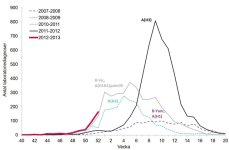
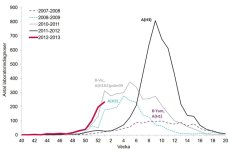
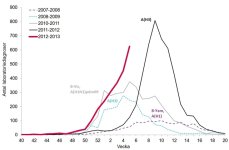
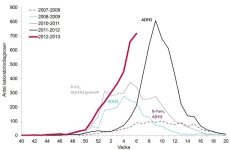
Figure 1. Number of cases of influenza laboratorieverierad per week and season.
SWE1.jpg

...
http://www.smittskyddsinstitutet.se...ngen-20122013/influensarapport-vecka-52-2012/
 
Re: Institute for Disease Control weekly reports winter 2012-2013

Influenza Report, Week 1 (31/12, 2012 - 6/1 2013) 2013
Report on the current flu situation

Editor: Hélène Englund

Influenza in Sweden
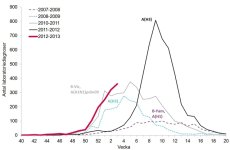
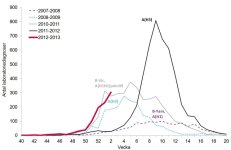
Influenza activity increased in the country in Week 1, but is still not remarkable for the season ( Figure 1 ). Total reported 233 cases of laboratory confirmed influenza during the week, of which 107 were A (H1N1) pdm09 ("Swine flu"), 95 seasonal influenza A and 31 seasonal influenza B ( Table 1 ). Influenza A (H1N1) pdm09 has mainly affected children aged 0 to 4 years and adults aged 15 to 64 years, while seasonal influenza A has been most common in people over 65.

The number of notifications for A (H1N1) pdm09 doubled compared with the previous week and the trend is very similar to the 2010-2011 season, which was the first year after the pandemic, and dominated by the subtype ( Figure 2 ). Influenza A (H1N1) pdm09 occur throughout the country, but the incidence was during week one maximum in Värmland, who reported 21 of the 107 cases ( Figure 3 ).

According to the clinical notifications available for the A (H1N1) pdm09 thus far this season, 67 patients hospitalized, of which 8 have needed intensive care. 84% of those hospitalized have been between 15 and 64 years. This compares with the 2010-2011 season when 119 patients had been hospitalized until Week 1 of which 17 were treated intensive ( flu report week 52-1 2010-2011 ). Overall, the season was reported 401 hospitalized patients, 63 of whom needed intensive care, and ten deaths ( Flu in Sweden 2010-2011 season ).

The sentinel reporting, based on patient visits in outpatient care, we have now exceeded the baseline for influenza-like illness (ILI). For week 1 reported 11.9 people per 100 000 inhabitants have sought medical advice because of ILS ( Detailed statistics ). The proportion of samples taken in the sentinel surveillance were positive for influenza have increased steadily since week 49 in 2012 ( Table 4 and depth statistics ).

The proportion of people who searched for Vårdguiden.se for flu and flu symptoms continued to increase during week 1 (see Web Search ). The number of questions about fever, cough and sore throat to 1177 medical counseling also increased compared to week 51 ( Contact Causes 1177 ).

...

Table 1 . Number of laboratory confirmed influenza cases, current week and cumulatively since week 40/2012, broken down by influenza A (H1N1) pdm09 and seasonal influenza A and B, and the number of samples analyzed and the percentage positive.
Influenza type / Current Week / Cumulatively
A (H1N1) pdm09 / 107 / 221
Seasonal Influenza A / 95 / 331
Seasonal influenza B / 31 / 109
Total cases / 233 / 661
Number of samples analyzed / 907 / 6232
Percentage of positive samples / 25.7% / 10.6%

Figure 1 . Number of cases of laboratorieverierad influenza (all subtypes) per week and season.
SWE1.jpg

...
 
Re: Institute for Disease Control weekly reports winter 2012-2013

Influenza Report, Week 2 (7/1 - 13/1), 2013
Report on the current flu situation

Editor: H?l?ne Englund

Contents
Influenza in Sweden
Influenza activity increased in the country, even during week 2 ( Figure 1 ). In total 304 cases of reported laboratory confirmed influenza, compared with 231 cases reported in week 1. Of these, 135 influenza A (H1N1) pdm09 ("swine flu"), 121 cases seasonal influenza A and 48 cases, influenza B ( Table 1 and Table 2 ), some A (H1N1) pdm09 cases have since been reported and diagnosed earlier in the season.

The increase in the number of laboratory-confirmed cases of seasonal influenza A seems to have stalled somewhat, while influenza B and A (H1N1) pdm09 continues to increase ( Figure 3 ). Development continues to resemble the 2010-2011 season, when we had a moderate and fairly early outbreak of A (H1N1) pdm09, but got a sharp peak of influenza B late in the season. Because all influenza seasons develop differently, it is difficult to predict what the near future will be developed, but it appears so far that the spread of A (H1N1) pdm09 has not accelerated as much in Sweden as it has previously done in Norway.

Influenza A (H1N1) pdm09 has primarily been demonstrated among children between 0 and 4 years of age and in adults between 15 and 30 years, while seasonal influenza A was most common in people over 65. Influenza B has so far affected all age groups fairly evenly. According to the clinical notifications for A (H1N1) pdm09 has all season 111 patients hospitalized, 12 of which have needed intensive care. The majority of intensive caring has been between 40 and 75 years. A man in late middle age with several underlying and serious risk factors for severe disease have died. His vaccination status is still unclear.

A (H1N1) pdm09 found throughout the country ( Table 3. Number of reported A (H1N1) pdm09 cases per county ). Incidence week 2 was still highest in V?rmland, but the outbreak appears to still be decaying there ( Figure 2 ). (After the reporting of influenza A (H1N1) pdm09 cases causing an apparently higher incidence of V?stra G?taland and S?dermanland for week 2 than would otherwise be the case.)

The sentinel reporting, we are above the baseline for the proportion of doctor visits for influenza-like illness (ILI) outpatient ( Figure 4 ). For week 2 reported 10.8 people per 100 000 inhabitants have sought medical advice because of ILS ( Table 4 ). within sentinel sampling, the number of submitted samples almost doubled from week 1, a total of 127 samples were received during the two weeks compared to 65 weeks samples first The percentage of positive samples for influenza have decreased from 40% to 23% ( Figure 5-6 , Table 5-6 ). This suggests that other than influenza viruses currently gives flu-like illness (see Other viral causes of respiratory infections in Sweden ) Web Searchlight graph of the number of people who searched for V?rdguiden.se for influenza-like illness plateaued at week 2 ( Web Search ). The number of people contacted in 1177 with questions about fever, cough and sore throat in adults and children fell for the second week in a row, but the number of searches is higher than normal for the season.

In summary, talking reports of care for increasing influenza activity, but the intensity is still normal for the season.

We would once again like to remind you that this year's seasonal vaccine contains three virus types circulating including A (H1N1) pdm09, and that there is the same vaccine that was given in the context of the pandemic. Seasonal vaccine has now been over three seasons to an estimated 1 billion people worldwide without any notable adverse reactions have been identified.

Information on seasonal vaccine and who belong to the risk group for severe disease and therefore recommended vaccinations available on the Board's website .
More detailed information on this year's vaccines are on SMI's website .

...

Table 1 . Number of laboratory confirmed influenza cases, current week and cumulatively since week 40/2012, broken down by influenza A (H1N1) pdm09 and seasonal influenza A and B, and the number of samples analyzed and the percentage positive.
Influenza type / Current Week / Cumulatively
A (H1N1) pdm09 / 135 / 342
Seasonal Influenza A / 121 / 464
Seasonal influenza B / 48 / 159
Total cases / 304 / 965
Number of samples analyzed / 1209 / 7314
Percentage of positive samples / 25.1% / 13.2%
...
Figure 1 . Number of cases of laboratorieverierad influenza (all subtypes) per week and season.
SWE1.jpg
...
 
Re: Institute for Disease Control weekly reports winter 2012-2013

Influenza Report, week 3 (14/1 -20 / 1), 2013
Report on the current flu situation

Editor: H?l?ne Englund

Influenza in Sweden
During week 3 were reported slightly more laboratory confirmed influenza cases than last week, 361 compared to 320 ( Table 1 and Table 2 ), but the increase seems to have leveled off. Even in other countries in Europe are the same trend (see Influenza in the world ). From outpatient reported slightly more patients with influenza-like illness (see Sentinel Surveillance ) and even syndromic surveillance Web Search is still upward. The sentinel sampling was 23% of the samples taken during week 3 positive for influenza virus. This proportion has fallen two weeks in a row from 37% in week 1.

We continue to influenza A (H1N1) pdm09 mainly affects children under four years of age and adults between 15 and 64 years, while other influenza A primarily affects the elderly over 65 years. Approximately thirty percent of the reported cases of influenza A (H1N1) pdm09 has been reported as hospitalized. Of these, 49% had one or more risk factors for severe disease, in which the most common were immunocompromised, chronic heart or lung disease. So far the season has been two deaths reported. Both of them suffered from severe underlying disease.

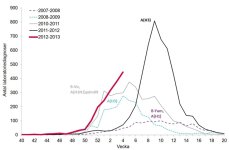
The overall picture suggests that the flu could be on track to reach its peak and that the season may be milder than it was last season when the 2011-2012 influenza A (H3) dominated.

Figure 1 . Number of cases of laboratorieverierad influenza (all subtypes) per week and season.
SWE.JPG

...
Table 1 . Number of laboratory confirmed influenza cases, current week and cumulatively since week 40/2012, broken down by influenza A (H1N1) pdm09 and seasonal influenza A and B, and the number of samples analyzed and the percentage positive.
Influenza type / Current Week / Cumulatively
A (H1N1) pdm09 / 180 / 521
Seasonal Influenza A / 145 / 647
Seasonal influenza B / 36 / 194
Total cases / 361 / 1,362
Number of samples analyzed / 1,222 / 8,602
Percentage of positive samples / 29.5% / 15.8%

...
 
Re: Institute for Disease Control weekly reports winter 2012-2013

Influenza Report, Week 4 (21/1 -27 / 1), 2013
Report on the current flu situation

Editor: H?l?ne Englund

Influenza in Sweden
The number of laboratory reported flu cases in the country increased from a total of 361 cases, weeks 3-445 case, week 4 ( Figure 1 , Table 1 ). The activity is now at a relatively high level, but the increase is not as sharp as when flu peaked in February 2012. Of the reported cases was 222 A (H1N1) pdm09 ("swine flu"), 159 cases seasonal influenza A and 64 cases influenza B. This means that the number of diagnoses increased for all types compared to week 3, but A (H1N1) pdm09 increased the most, 180 to 222 cases.

Influenza A (H1N1) pdm09 has been mainly reported in children between 0 and 4 years and adults between 15 and 39 years, while laboratory confirmed seasonal influenza A has been most common in people over 65. Influenza in the country, but the number of new cases per 100 000 inhabitants was still highest in V?rmland and Dalarna in week 4 ( map , table of H1N1 cases per county ).

Of a total of 803 cases of influenza A (H1N1) pdm09 notified by laboratories and sentinel samplers during the season with 189 hospitalized, 16 required intensive care and four treated for ECMO. Three children under five have required intensive care, but the majority has been between 40 and 64 ?r.Av those requiring intensive care was 70% belonged to the risk group for severe disease. So far, three people reported dead with A (H1N1) pdm09, two of which belonged to the risk group.

The sentinel reporting increased number of doctor visits for influenza-like illness from 11 to 14 per 100 000 population. The percentage of positive samples in the sentinel sampling increased from 30% to 40% compared with week 3, the proportion of A (H1N1) pdm09 has increased (59%), while the shares of seasonal influenza A (26%) and B (15%) are relatively constant.

The number of people who searched for V?rdguiden.se for influenza-like illness increased during week 4 ( Web Search ), as well as the number of adults and children who rang in 1177 with a fever and cough as a contact reason ( Contact Causes 1177 ).

In summary, all speak for reporting increasing influenza activity in Sweden. Like four seasons in five acts flu peak coming in February, but exactly when and how high it will be, we can not say for sure. Total lean year's flu curve slightly less steeply than last year, and so we can hope for a milder outbreaks than 2012th
...
Figure 1 . Number of cases of laboratorieverierad influenza (all subtypes) per week and season.
Swe.JPG
...

Table 1 . Number of laboratory confirmed influenza cases, current week and cumulatively since week 40/2012, broken down by influenza A (H1N1) pdm09 and seasonal influenza A and B, and the number of samples analyzed and the percentage positive.
Influenza type / Current Week / Cumulatively
A (H1N1) pdm09 / 222 / 743
Seasonal Influenza A / 159 / 802
Seasonal influenza B / 64 / 266
Total cases / 445 / 1,811
Number of samples analyzed / 1,433 / 10,163
Percentage of positive samples / 31.1% / 17.8%
...
 
Re: Institute for Disease Control weekly reports winter 2012-2013

Influenza Report, Week 5 (28/1 - 3/2), 2013
Report on the current flu situation

Editor: H?l?ne Englund

Contents
Influenza in Sweden
During week 5 reported 625 cases of laboratory confirmed influenza from its laboratories. There is an increase of 173 cases compared with week 4. Of these, 284 cases were influenza A (H1N1) pdm09, 232 seasonal influenza A and 109 influenza B cases ( Figure 1 , Table 1 and Table 2 ). All types increased compared with week 4, but the largest increase, 65% were influenza B ( Figure 3 ).

The reports of influenza-like illness from outpatient care continued to increase during week 5 (see sentinel ), as well as the number of calls to the 1177 health care advice and the number of searches on V?rdguiden on flu and flu symptoms increased ( Contact Causes 1177 , Web Search ). These systems thus shows what has been reported in health care and in the media - that many people are now sick.

During week 5 diagnosed Infectious Disease influenza virus in 39% of the samples taken in the outpatient setting under sentinel surveillance (see sentinel ). This represents a decrease from 44% positive samples week 4. From the positive samples was 45% influenza A (H1N1) pdm09, 34% influenza A (H3) and 21% influenza B, a distribution similar to that in the clinical laboratory reporting.

Generally diagnosed influenza A (H1N1) pdm09 still mainly in children under five years of age and in adults between 15 and 39 years. Seasonal influenza A (H3N2) mainly affects people over 65 years and can thus lead to more serious illness.

Among those who have been diagnosed with influenza A (H1N1) pdm09 season has been 335 reported hospitalized, 35 people have required intensive care. Most of the intensive nursed, 25 pieces, has been reported to have one or more risk factors for severe disease, such as chronic lung disease or weakened immune system. Six people have been reported as deceased. Of these belonged to five people at risk of which four had severe underlying diseases.

In summary indicates all the monitoring that we can expect a continued high level of influenza activity in the coming weeks. Because right now we have three types of influenza circulating at the same time, it is difficult to predict when the activity may diminish.

To protect yourself and others from infection is particularly important in the next few weeks, as well as to contact care if you become ill with influenza, and belongs to the group at risk of serious illness, or become seriously ill.

Read more

Nurse's website
National Board website (Which should be offered treatment with antivirals and what may be a sign of serious illness)
Figure 1 . Number of cases of laboratorieverierad influenza (all subtypes) per week and season.
Swe.JPG

Table 1 . Number of laboratory confirmed influenza cases, current week and cumulatively since week 40/2012, broken down by influenza A (H1N1) pdm09 and seasonal influenza A and B, and the number of samples analyzed and the percentage positive.
Influenza type / Current Week / Cumulatively
A (H1N1) pdm09 / 284 / 1,027
Seasonal Influenza A / 232 / 989
Seasonal influenza B / 109 / 380
Total cases / 625 / 2,396
Number of samples analyzed / 1,844 / 12,079
Percentage of positive samples / 33.9% / 19.8%
...
 
Re: Institute for Disease Control weekly reports winter 2012-2013

Influenza Report, Week 6 (4/2 - 10/2), 2013

Editor: H?l?ne Englund

Contents
Influenza in Sweden
During week 6, a total of 717 laboratory-confirmed cases of influenza, an increase of over 10%, compared with the previous week ( Table 1 ). This is a smaller increase than the previous week when the increase was approximately 45%. Influenza A (H1N1) pdm09 accounted for half of all cases, and accounted for almost the entire increase in the week, seasonal influenza A accounted for over a third and 17% were influenza B.

Number of influenza cases per laboratory .

Number of influenza A (H1N1) pdm09 cases per county .

Based on the reported cases, it is mainly children who were born after 2009 pandemic and adults who have been most affected by the A (H1N1) pdm09. The elderly are as usual the most needed health care for seasonal influenza A. Influenza B has mainly been observed in children and adolescents.

480 people have been hospitalized for the A (H1N1) pdm09 and of these 47, according to the reports we have received required intensive care and 6 have been treated with ECMO. Among the 32% of intensive caring is no indication of belonging to a risk group. A degree of underreporting may occur. A new death of a person who belonged to division has been reported. Total now has seven deaths reported. From Swedish Intensive Care Registry, SMI received reports of a total of 49 intensive nursed patients, of whom 28 had influenza A (H1N1) pdm09, three influenza A/H3 and four influenza B. Other patients had influenza A without specified subtype.

All three viruses are found throughout the country. Incidence The map indicates that eastern Sweden now suffered most during week 6, but since it takes different amounts of samples in different counties are assessing the spread severe (see map ). V?rmland has again reported the highest number of cases per capita, but there are also a lot of samples.

The relatively high influenza activity is also visible in the sentinel reports from outpatient there now 0.04% of the patient population have sought care for influenza-like illness (ILI). It may seem little, but is a relatively high figure. SMI has analyzed 168 samples taken in the sentinel surveillance Week 6. Also this week is about 40% of the samples were positive for influenza. Of the positive samples was 41% influenza A (H1N1) pdm09, 23% were influenza A/H3 and 26% influenza B / Yamagata-like.

Reports from 1177 and Web Search speaks both to influenza activity now leveled off, but is at a relatively high level.

Altogether, weekly reporting to the flu peak may have been reached, but that the high activity may persist for one or two weeks. In combination with the many RS cases , even the coming weeks be exhausting for care and general and especially for parents of young children.

Figure 1 . Number of cases of laboratorieverierad influenza (all subtypes) per week and season.
Swe.JPG

...
Table 1 . Number of laboratory confirmed influenza cases, current week and cumulatively since week 40/2012, broken down by influenza A (H1N1) pdm09 and seasonal influenza A and B, and the number of samples analyzed and the percentage positive.

Influenza type // Current week 6/2013 // Previous Week 5/2013 // Change // Cumulatively during the season

A (H1N1) pdm09 // 361 // 284 // 27% // 1388
Seasonal Influenza A // 236 // 256 // -8% // 1238
Seasonal influenza B // 120 // 119 // 1% // 514
Total cases // 717 // 659 // 9% // 3140
Number of samples analyzed // 2109 // 1888 // - // 14232
Percentage of positive samples // 34.0% // 34.9% // - // 22.1%
...
 
Re: Institute for Disease Control weekly reports winter 2012-2013

Influenza Report, Week 7 (11/2 - 17/2), 2013

Editor: H?l?ne Englund

Influenza in Sweden
During week 7, a total of 819 laboratory-confirmed cases of influenza, which is slightly less compared to last week, when 838 cases were reported ( Table 1 ). The decrease was primarily due to influenza A (H1N1) pdm09 and seasonal influenza A (H3), while influenza B, however increased substantially ( Figure - Influenza types ).

For the entire season, it is mainly children, born after 2009 pandemic, and adults aged 15-64 who have been affected most by the A (H1N1) pdm09, while influenza A (H3) mainly struck against people over 65. Influenza B has mainly been observed in children and adolescents aged 5 to 14 years. The reports from the last two weeks (weeks 6 and 7) shows a similar picture, with the difference that the influenza A (H3) detected more frequently in children and influenza B in the elderly.

Up until week 7, 637 people reported to have been hospitalized for the A (H1N1) pdm09 and of these, 66 required intensive care and six have been treated with ECMO. Among the 33% of the intensive nursed is no indication that patients belonging to a risk group. Among other intensive nursed was chronic lung disease, and immunocompromised most common underlying diseases. Total now has twelve deaths in close proximity to one influenza A (H1N1) infection pdm09 reported. From Swedish Intensive Care Registry , SMI received reports of 64 intensive nursed patients. This shows more than half of patients have an infection with influenza A (H1N1) pdm09, but also cases with influenza A/H3 and B treated in ICU. Moreover, one can note that the average age of those who cared for in the ICU is not more than 54 years.

The number of laboratory confirmed cases have been high in large parts of Sweden in the last week (see map ), but differences in sampling likely play a major role in the proportion of all cases diagnosed. For example, the number of diagnosed cases in week 7, in terms of population, the highest in V?rmland, Dalarna, Kalmar and West Bengal. In V?rmland, however, was only a quarter of the samples were positive, compared with half of the samples analyzed at the Sahlgrenska University Hospital in West Bengal, suggesting that in V?rmland was more generous with sampling and probably diagnosed a larger proportion of all cases. This means that the figures are not strictly comparable between different counties.

Sentinel physicians reported during week 7 a lower percentage of patient visits with influenza-like illness (ILI), compared with the peak week 6 ( Fig. 4 , Table 4 ). The proportion of positive samples collected in sentinel surveillance decreased from 43% week 6 37% week 7 ( Figure 5 ). A total of 151 samples analyzed SMI and of these 23 (15%) were positive for A (H1N1) pdm09, 14 (9%) for influenza A (H3) and 17 samples (11%) for influenza B ( Table 5 ). The majority of influenza B samples this season have been of the line type B-Yamagata, which is included in the seasonal vaccine, but the last two weeks have been also cases of B-Victoria diagnosed.

Also this week suggest the reports from Web Search and 1177 that influenza activity begins to slow down.

The decreasing number of cases of influenza A (both A/H1N1pdm09 and A/H3) together with indications from other surveillance systems indicate that the peak for these viruses, which mainly causes disease in children and the elderly, can be reached. Growth of influenza B can lead to the influenza season as a whole can have a longer sequence than would otherwise be expected in case of influenza A begins to decrease. A similar development has among other things been seen in Denmark (see Influenza in the world ).
...
Influenza type // Current week 7/2013 // Previous Week 6/2013 // Change // Cumulatively during the season

A (H1N1) pdm09 // 325 // 362 // -10% // 1,714
Seasonal Influenza A // 288 // 315 // -9% // 1,619
Seasonal influenza B // 206 // 161 // 28% // 763
Total cases // 819 // 838 // -2% // 4,096
Number of samples analyzed // 2,360 // 2,212 // - // 16,737
Percentage of positive samples // 34.7% // 37.9% // - // 24.5%
...
http://www.smittskyddsinstitutet.se...ongen-20122013/influensarapport-vecka-7-2013/
 
Re: Institute for Disease Control weekly reports winter 2012-2013

Influenza Report, Week 8 (18/2 - 24/2), 2013
Report on the current flu situation
Editor: H?l?ne Englund

Influenza in Sweden
In week 8, the number of laboratory confirmed cases of influenza A (H1N1) pdm09 and seasonal influenza A (H3) to decrease, while influenza B increased ( Table 1 , Figure 3 ). In total 734 cases of influenza were reported at week 8 compared with 855 cases week 7. The decrease seen in all parts of the country (see map ). Although the three flu variants were detected in the same proportions at the national level, where the different classes in different regions. For example, in Stockholm and Uppsala detected more cases of influenza B than A ( Table 2 ). Age distribution of cases was earlier in the season (see Influenza Report Week 7 ).

Up until week 8, 746 people hospitalized for the A (H1N1) pdm09 and of these, 75 required intensive care. No new cases nursed in ECMO has been reported. 65% of intensive caring and ECMO patients and 51% of other hospitalized belonged to a risk group for severe disease. No new deaths related to influenza A (H1N1) pdm09 infection have been reported. Through the Swedish Intensive Care Registry has 29 intensive nursed patients who fell ill weeks 5 or later reported: of these, one third had influenza B, half the influenza A (H1N1) pdm09 and the remaining other influenza A infections.

Sentinel physicians reported in week 8, a slightly higher percentage of patient visits with influenza-like illness (ILI) , compared with the previous week, but the increase is probably due to a low number of reporters ( Fig. 4 , Table 4 ). For the third week in a row, we see a decrease in the proportion of positive samples collected in sentinel surveillance. From the positive samples was 65% influenza A and 35% influenza B ( Figure 5 , Table 5 ). Subtype A (H1N1) pdm09 constituted 58% of the influenza A-positive samples. Among samples positive for influenza B belonged to 88% B / Yamagatalinjen, part of the seasonal flu vaccine.

The reports of syndromic surveillance systems Web Search , Sickness Report and Flu income , and the number of calls to 1177 (see Contact Causes 1177 ) speaks as well as other reporting declining influenza activity during week 8.

It is above all the flus that usually causes serious illness, A (H1N1) pdm09 and seasonal influenza A, which decreases. Influenza B can remain relatively high level of a few weeks. Although it can cause severe pneumonia in young adults, but it is much rarer than the A (H1N1) pdm09. Often affected older toddlers and school children from relatively mild influenza B infection that requires medical care.
...
Influenza type // Current week 8/2013 // Previous Week 7/2013 // Change // Cumulatively during the season

A (H1N1) pdm09 // 229 // 327 // -30% // 1,945
Seasonal Influenza A // 257 // 308 // -17% // 1,887
Seasonal influenza B // 248 // 220 // 13% // 1,023
Total cases // 734 // 855 // -14% // 4,855
Number of samples analyzed // 2,151 // 2,360 // - // 18,888
Percentage of positive samples // 34.1% // 34.1% // - // 25.7%
...
http://www.smittskyddsinstitutet.se...ongen-20122013/influensarapport-vecka-8-2013/
 
Back
Top Bottom