• FluTrackers.com Inc. does not provide medical advice. Information on this web site is collected from various internet resources, and the FluTrackers board of directors makes no warranty to the safety, efficacy, correctness or completeness of the information posted on this site by any author or poster. The information collated here is for instructional and/or discussion purposes only and is NOT intended to diagnose or treat any disease, illness, or other medical condition. Every individual reader or poster should seek advice from their personal physician/healthcare practitioner before considering or using any interventions that are discussed on this website. By continuing to access this website you agree to consult your personal physican before using any interventions posted on this website, and you agree to hold harmless FluTrackers.com Inc., the board of directors, the members, and all authors and posters for any effects from use of any medication, supplement, vitamin or other substance, device, intervention, etc. mentioned in posts on this website, or other internet venues referenced in posts on this website.
  • We are not asking for any donations. Do not donate to any entity who says they are raising funds for us.

Indonesia Reporting Human Cases of H5N1 Controversy

Re: Indonesia says it will no longer formally announce bird flu deaths

Re: Indonesia says it will no longer formally announce bird flu deaths

I agree with Ironorehopper and gsgs,
that's an media-only move, probably.

Some of the many other inter-estabs prof./spec. links probably got official reports from there which are quoted classified, not for the media.
 
Re: Indonesia says it will no longer formally announce bird flu deaths

Re: Indonesia says it will no longer formally announce bird flu deaths

June 6, 2008
Indon health minister silent on bird flu toll

JAKARTA - INDONESIAN Health Minister Siti Fadilah Supari refused on Friday to say how many Indonesians had died of bird flu.
She also insisted it was no longer necessary to announce the toll on a case-by-case basis.

'Publicly announcing the toll every time a victim dies brings no benefit at all to efforts to contain the virus,' she said, without confirming a media report that a 15-year-old girl had become Indonesia's 109th bird flu victim.

The minister said she had decided to end the practice of publicly updating the national toll with every new death, and the names of victims would no longer be released to protect the families.

'We will announce the toll periodically, every three months or so,' she said.

Earlier this year Ms Supari closed a 24-hour information centre which provided confirmation of new human cases of avian influenza and stopped the ministry's practice of emailing bird flu alerts to journalists.

The last toll published by the World Health Organisation (WHO) says there have been 108 deaths from bird flu in Indonesia since 2005, out of 133 cases.

That is almost half of the world toll of 241.

WHO officials in Jakarta and Geneva refused to discuss the minister's comments, saying only that there had been no communication on the matter from the Indonesian health ministry.
-snip-
http://www.straitstimes.com/Latest+News/Asia/STIStory_245019.html
ln-asia-jakarta.jpg

c.gif

Earlier this year Ms Supari closed a 24-hour information centre which provided confirmation of new human cases of avian influenza and stopped the ministry's practice of emailing bird flu alerts to journalists. -- PHOTO: AP
 
Re: Indonesia says it will no longer formally announce bird flu deaths

Re: Indonesia says it will no longer formally announce bird flu deaths

I saw the WHO officials text line.

Still:
"Some of the many other inter-estabs prof./spec./corp.s links probably got unofficial reports from there which are quoted classified, not for the media."

Where goes the Baxter agreement folks ...
 
Re: Indonesia says it will no longer formally announce bird flu deaths

Re: Indonesia says it will no longer formally announce bird flu deaths

Indonesia's bird flu reporting policy draws (f)ire

Fri 6 Jun 2008,

By Olivia Rondonuwu

JAKARTA, June 6 (Reuters) - Indonesia's decision to report bird flu cases in humans only every six months, rather than immediately, is irresponsible and could lead to delays in containing outbreaks of the disease, a scientist said on Friday.

Health Minister Siti Fadillah Supari, who has clashed with the international community and United States over her handling of health issues, on Thursday said her ministry had changed its policy and would only report cases every six months.

She did not say whether that reporting policy also included the World Health Organisation (WHO). But a health ministry official said on Friday that the ministry had not decided yet whether it would report to the WHO every one, two, or three months.

"It's a drawback," said Gusti Ngurah Mahardika, a bird flu researcher at Bali's Udayana University.


"It's an obligation (to report) not only every day, but every minute if there's a new development. If they only report to WHO every six months, it will be too late to recognise if there's a new development towards a pandemic."

WHO officials in Geneva said they are still seeking confirmation of the new policy.

With 108 confirmed human fatalities from bird flu, Indonesia has the highest toll of any nation. Since the virus resurfaced in Asia in late 2003, it has killed 241 people in a dozen countries, according to the WHO.

Supari has attracted criticism from the international community for her stance on sharing bird flu samples.

Officials in Indonesia have said they want to ensure equal access to any vaccines that are made against bird flu, but U.S. Health Secretary Michael Leavitt said in April after visiting Jakarta that Indonesia also wanted payments.

The United States and Indonesia are also locked in a dispute over the future of a U.S. naval lab in Jakarta, mainly over virus transfers and the number of U.S. staff allowed to have diplomatic status.

International health experts say it is vital to have access to samples of the constantly mutating H5N1 virus, which they fear could change into a form easily transmissible among humans and sweep the world in months, killing millions of people.

"We are obliged to report to WHO, we are also obliged to report it to the public," said Nyoman Kandun, director-general of communicable diseases at the health ministry, adding that the new policy was meant as a better way to "package" the information.

Indonesia so far has maintained its decision not to share bird flu samples, saying it wants guarantees from richer nations and drugmakers that poor countries would get access to affordable vaccines developed from their samples. (Reporting by Olivia Rondonuwu; Editing by Sara Webb and David Fogarty)

http://africa.reuters.com/commodities/news/usnJAK308549.html
 
Re: Indonesia says it will no longer formally announce bird flu deaths

Re: Indonesia says it will no longer formally announce bird flu deaths

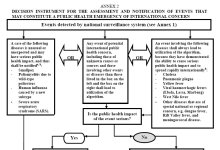
[FONT=TimesNewRoman,Italic]View attachment 2489[/FONT]
[FONT=TimesNewRoman,Italic]http://www.who.int/gb/ebwha/pdf_file.../A58_55-en.pdf[/FONT]

[FONT=TimesNewRoman,Italic]Obviously I have not quite got the chart readable but it can be found as Annex 2 at the link to the IHR(2005)[/FONT]

[FONT=TimesNewRoman,Italic]I also wrote something more general on the IHR and WHO 2 years ago which can be found here http://www.flutrackers.com/forum/showthread.php?t=66555[/FONT]
Active link

http://www.who.int/gb/ebwha/pdf_files/WHA58/A58_55-en.pdf

4. At the local community level and/or primary public health response level
The capacities:
(a) to detect events involving disease or death above expected levels for the particular time
and place in all areas within the territory of the State Party; and
(b) to report all available essential information immediately to the appropriate level of healthcare
response. At the community level, reporting shall be to local community health-care
institutions or the appropriate health personnel. At the primary public health response level,
reporting shall be to the intermediate or national response level, depending on organizational
structures. For the purposes of this Annex, essential information includes the following: clinical
descriptions, laboratory results, sources and type of risk, numbers of human cases and deaths,
conditions affecting the spread of the disease and the health measures employed; and
(c) to implement preliminary control measures immediately.
5. At the intermediate public health response levels
The capacities:
(a) to confirm the status of reported events and to support or implement additional control
measures; and
(b) to assess reported events immediately and, if found urgent, to report all essential
information to the national level. For the purposes of this Annex, the criteria for urgent events​
[FONT=TimesNewRoman,BoldItalic]
Annex 1 A58/55
43​
[/FONT]
include serious public health impact and/or unusual or unexpected nature with high potential for
spread.
6. At the national level​
[FONT=TimesNewRoman,Italic]
Assessment and notification​
[/FONT]. The capacities:
(a) to assess all reports of urgent events within 48 hours; and
(b) to notify WHO immediately through the National IHR Focal Point when the assessment
indicates the event is notifiable pursuant to paragraph 1 of Article 6 and Annex 2 and to inform

WHO as required pursuant to Article 7 and paragraph 2 of Article 9.
 
Re: Indonesia says it will no longer formally announce bird flu deaths

Re: Indonesia says it will no longer formally announce bird flu deaths

Indonesia to announce bird flu deaths biannually

Posted By BY HELEN BRANSWELL, THE CANADIAN PRESS


Indonesia's health minister said Thursday her country would no longer report H5N1 avian flu deaths as they happen, but will share a revised death toll every six months -- a threatened policy change experts said would put the country in violation of a key international health treaty.

The International Health Regulations, a treaty to which Indonesia is a signatory, requires prompt reporting of cases of diseases that have been designated as global health threats. SARS, polio, smallpox and human cases of avian influenza infection are specified under the treaty.

Indonesian Health Minister Siti Fadilah Supari -- whose country has lost the most people to H5N1 -- signalled the change Thursday.

http://www.orilliapacket.com/ArticleDisplay.aspx?e=1061998
 
Re: Indonesia says it will no longer formally announce bird flu deaths

Re: Indonesia says it will no longer formally announce bird flu deaths

[FONT=TimesNewRoman,Bold]ANNEX 2[/FONT][FONT=TimesNewRoman,Bold]
[FONT=TimesNewRoman,Bold]DECISION INSTRUMENT FOR THE ASSESSMENT AND NOTIFICATION OF EVENTS THAT[/FONT]
[FONT=TimesNewRoman,Bold]MAY CONSTITUTE A PUBLIC HEALTH EMERGENCY OF INTERNATIONAL CONCERN[/FONT]
[FONT=TimesNewRoman,Bold]OR OR[/FONT]

[FONT=TimesNewRoman,Bold]Events detected by national surveillance system (see Annex 1)[/FONT]

A case of the following
diseases is unusual or
unexpected and may
have serious public
health impact, and thus​

shall be notified
[/FONT]
[FONT=TimesNewRoman,Bold]a, b[/FONT][FONT=TimesNewRoman,Bold]:[/FONT]
-


[FONT=TimesNewRoman,Bold]Smallpox[/FONT]
-


[FONT=TimesNewRoman,Bold]Poliomyelitis due to[/FONT]
[FONT=TimesNewRoman,Bold]wild-type[/FONT]
[FONT=TimesNewRoman,Bold]poliovirus[/FONT]
-


[FONT=TimesNewRoman,Bold]Human influenza[/FONT]
[FONT=TimesNewRoman,Bold]caused by a new[/FONT]
[FONT=TimesNewRoman,Bold]subtype[/FONT]
-


[FONT=TimesNewRoman,Bold]Severe acute[/FONT]
[FONT=TimesNewRoman,Bold]respiratory[/FONT]
[FONT=TimesNewRoman,Bold]syndrome (SARS)[/FONT]

[FONT=TimesNewRoman,Bold][FONT=TimesNewRoman,Bold]EVENT SHALL BE NOTIFIED TO WHO UNDER THE INTERNATIONAL HEALTH[/FONT]

[FONT=TimesNewRoman,Bold]REGULATIONS[/FONT]
[/FONT]

 
Re: Indonesia says it will no longer formally announce bird flu deaths

Re: Indonesia says it will no longer formally announce bird flu deaths

The Reader (not verified) — Fri, 06/06/2008 - 8:0

http://www.thejakartapost.com/news/2008/05/23/for-birds.html
For the Birds

The Jakarta Post , Jakarta | Fri, 05/23/2008 7:38 PM | Cover Story
As citizens of the country hardest hit by avian influenza, Indonesians are inundated with messages about the disease. Increasingly it appears that bird flu is joining the list of other serious and persistent ailments, such as dengue fever, TB and HIV/AIDS that have to be controlled from the ground up. Emmy Fitri reports.
JPRBW080425023d.img_assist_custom.jpg
Homemaker Yuli Rosmalia is confident she knows the ins and outs of bird flu – “who doesn’t these days?” -- from the relentless public information blitz on TV and in print media.
As she talks, the 30-something occasionally uses the English term of avian influenza, a knowledge gained from reading up on the disease. <o:p></o:p>
“For sure, it has nothing to do with eating chicken. People get sick when they have contact with dead chickens. That’s why I never want to keep chickens in my backyard,” she says.
It was a typical afternoon in her low-income residential neighborhood in <st1:place>East Jakarta</st1:place>, located near a military complex. Yuli sat with four other mothers, feeding their children. The restless youngsters scampered off in their bare feet across a vacant lot, crossing paths with a hen and her chicks that pecked up fallen crumbs of food from the children. <o:p></o:p>
“We know whose chickens they are,” says Ibu Sapto, another one of the mothers.<o:p></o:p>
“They’re owned by a retired Army soldier. He has chickens that are not caged so they range freely during the day, and doves that are kept in a cage in front of his house.” <o:p></o:p>
“She (Rosmalia) already complained to sub-district officials about the birds. I don’t think the officials dared to say a word to him, that’s why they are still there,” she adds, to the laughter of the others. <o:p></o:p>
Although the sub-district head was not available for comment, an official said he knew about a resident who owned free-ranging chickens nearby -- a crime according to a <st1:city><st1:place>Jakarta</st1:place></st1:city> administration bylaw on poultry containment issued last year under then governor Sutiyoso. <o:p></o:p>
ut we have repeatedly asked the owner to cage the chickens and keep the cage clean. Maybe he thought they’re just chickens so why make a fuss. Typical,” the official says.<o:p></o:p>
Second only to neighboring Banten, <st1:city><st1:place>Jakarta</st1:place></st1:city> accounts for almost half of the total human fatalities from bird flu in the national tally, which, as of April 20, stood at 107. The capital is home to densely populated slums and low-income kampongs marked by poor sanitation. Compounding the problem is that many residents keep small backyard farms to help make ends meet. <o:p></o:p>
Yuli’s apparent knowledge of bird flu transmission while allowing her children to play in a potential danger zone is a contradiction. However, she and her friends are probably typical of most Indonesians when it comes to the disease. Knowledge does not instantly change lifestyles and risky behavior.
As Richard Fielding, associate professor of medical psychology at the <st1:place><st1:placetype>University</st1:placetype> of <st1:placename>Hong Kong</st1:placename></st1:place>, said last year, varying perceptions among people about backyard farming and the sale of live chickens explain why it is difficult to draw up a single set of rules about what is healthy. <o:p></o:p>
His colleague, translational public health expert Gabriel M. Leung, also points out that densely populated Asia, where animals and people live in close proximity and some of the world’s most virulent epidemics began, will continue to be a hotbed of disease. For bird flu, much of the problem stems from traditional methods of rearing poultry. <o:p></o:p>
Regulating the poultry industry – from factory-style farming to backyard operations – is imperative but no guarantee for resolving issues arising from the complex nature of the industry. Chicken and other poultry products remain the number one affordable animal-based protein source for most of the population here. <o:p></o:p>
JPRBW080425019d.img_assist_custom.jpg
Bird flu, caused by the H5N1 virus, is endemic in a tropical, agricultural country like <st1:country-region><st1:place>Indonesia</st1:place></st1:country-region>, where poor sanitation is the norm, especially in rural areas. Almost all of the 33 provinces in the country have reported outbreaks of avian influenza, and short of the drastic and unfeasible step of culling entire poultry populations, the virus will remain endemic in domesticated birds. <o:p></o:p>
Chief executive of National Commission for Avian Influenza and Pandemic Preparedness, Bayu Krisnamurthi, contends it is not possible to stamp out the disease from the country completely. <o:p></o:p>
“There is no history in other countries of complete success in eradicating this disease. This continues with diseases we face today, like TB or dengue. Diseases that we have to deal with in our daily lives.” <o:p></o:p>
Facing myriad problems in many sectors, <st1:country-region><st1:place>Indonesia</st1:place></st1:country-region>, according to Bayu, has shown great effort in dealing with avian influenza.<o:p></o:p>
“Preparedness is the key because the virus has been with us all along and is going to hover around us. It’s literally in our hands to stop it from catching us,” he says, referring to the commission’s slogan about the importance of hand washing to prevent the spread of infection. <o:p></o:p>
“And we all are now, not only <st1:country-region><st1:place>Indonesia</st1:place></st1:country-region> but the world, in the learning process while preparing for the worst from this virus. What we need to do is to prevent bird flu from becoming a pandemic.” <o:p></o:p>
The fact that most people who have died of bird flu came from low to middle-income families fuels the assumption bird flu “picked” its victims, based on poor lifestyle, an unhealthy environment and lack of access to information. The doubters point out that the first person to die of H5N1 in the country, a Tangerang resident in 2005, was from an affluent background.<o:p></o:p>
“That remains a big question,” says Tjandra Yoga Aditama, the former director of <st1:place><st1:placename>Persahabatan</st1:placename> <st1:placetype>Hospital</st1:placetype></st1:place> and now the Health Ministry’s director for infectious diseases. “It’s hard to trace back the contact history of a patient and identify the source of infection because we live in this vast, mobile community, like <st1:city><st1:place>Jakarta</st1:place></st1:city>, Tangerang and <st1:city><st1:place>Bogor</st1:place></st1:city>. They’re interlinked.”<o:p></o:p>
The problem is that this first death is just one of many question marks hanging over the disease.<o:p></o:p>
“There is still more to learn about this disease. Clinicians, doctors and hospitals are learning too because it’s something new,” Tjandra says.<o:p></o:p>
In the much-feared worst-case scenario, avian influenza would spiral into a full-fledged pandemic. Scientists have always said that no country can ever be truly primed to respond to a pandemic, especially in this age of international air travel where diseases can spread between continents in days.<o:p></o:p>
So, many people keep their fingers crossed, hoping that the ugly historical examples of the 1918 Spanish flu pandemic, 1968 Hong Kong pandemic and 2000 SARS outbreak will not be repeated on a greater scale.<o:p></o:p>
Preventing that from happening starts in the home, with simple, basic hygienic practices. Yuli and her friends already know that – now they just have to start putting it into practice.<o:p></o:p>
 
Last edited by a moderator:
Re: Indonesia says it will no longer formally announce bird flu deaths

Re: Indonesia says it will no longer formally announce bird flu deaths

AVIAN INFLUENZA, HUMAN (51): INDONESIA, NEW POLICY
**************************************************
A ProMED-mail post
<http://www.promedmail.org>
ProMED-mail is a program of the
International Society for Infectious Diseases
<http://www.isid.org>

Date: Thu 5 Jun 2008
Source: CIDRAP News [abbreviated and edited]
<http://www.cidrap.umn.edu/cidrap/content/influenza/avianflu/news/jun0508indonesia-br.html>


Indonesia quits offering prompt notice of H5N1 cases
----------------------------------------------------
Indonesia's health minister said today [5 Jun 2008] the government
has stopped the practice of promptly notifying global health
officials each time it confirms a human H5N1 avian influenza case or
death, a move some say will likely hamper efforts to monitor the
world's pandemic risk level.

Health Minister Siti Fadilah Supari today confirmed that a
15-year-old girl from Jakarta tested positive for H5N1 avian
influenza on 13 May 2008 and died the next day, according to a report
from the Associated Press (AP). Indonesia's National Committee for
Avian Influenza Control and Pandemic Influenza had previously listed
the case as confirmed on its Web site, but the information is
apparently no longer listed [see comment below].

The WHO, which typically confirms cases when it receives
notifications from health ministries or test results from its
collaborating laboratories, has not yet confirmed Indonesia's most
recent case and has not commented on Supari's decision to stop
sending out H5N1 case notifications. The WHO last confirmed, on 30
Apr 2008, an Indonesian H5N1 case, in a 3-year-old boy who died on 23
Apr 2008.

Supari told the AP that the health ministry would not send out H5N1
case confirmations until after they have been reported in the media.
However, Reuters reported today that the ministry will announce the
death toll from the H5N1 virus only every 6 months.

"How does it help us to announce these deaths?" Supari told the AP.
"We want to focus now on positive steps and achievements made by the
government in fighting bird flu." She told Reuters that announcements
of H5N1 deaths are sometimes misunderstood. "It's OK not to announce
it. Sometimes they only give hurtful comments instead of helping,"
she said without further explanation. Indonesia has been hit hardest
of any country by the H5N1 virus. According to the WHO's most recent
count, the country has had 133 cases and 108 deaths.

The country's refusal to share timely reports of human H5N1 cases is
the latest in a series of controversies that began when Indonesia
stopped sharing its H5N1 isolates in early 2007 to protest what it
views as a lack of access to affordable H5N1 therapies and vaccines.
The WHO has held several meetings to resolve the virus sharing
issues, but so far no agreements have been reached.

Sharon Sanders, editor-in-chief of FluTrackers, a well-known Web
message board that focuses on avian flu developments, told CIDRAP
News that Indonesia's decision to delay H5N1 notifications will
obscure what is happening there, which negatively affects the world's
ability to prepare for a pandemic. She said Indonesia's news blackout
would likely have the opposite effect from what the government
apparently intends. "Now, there will be intense speculation and
generation of rumors surrounding suspicious deaths that have similar
symptoms to H5N1 infections," Sanders said. "False rumors of an H5N1
outbreak have the potential to be even more economically devastating
than a government-confirmed outbreak." Sanders said media reports
coming out of Indonesia are generally reliable, but have some
drawbacks. "In many instances, reported suspicious human cases have
little or no follow up, so we are left with gaps in our total
picture," she said.

[Byline: Lisa Schnirring]

--
Communicated by:
ProMED-mail
<promed@promedmail.org>
& ProMED Rapporteur Mary Marshall

[The WHO table of the cumulative number of confirmed human cases of
avian influenza A/(H5N1), last updated on 28 May 2008, records 133
cases and 108 deaths in Indonesia [see:
<http://www.who.int/csr/disease/avian_influenza/country/cases_table_2008_05_28/en/index.html>].
The death of the 15-year-old girl described in the 2nd paragraph of
the above report would raise the case total to 134 and the number of
deaths to 109, if confirmed independently.

It is not clear, however, whether this case is one of the 2 suspected
cases described in ProMED-mail on 14 May 2008 (see: Avian influenza,
human (47): Indonesia, susp 20080514.1623). In this posting it was
reported that: "A 16-year-old girl died 4 days after being admitted
to the Persahabatan Hospital in the Indonesian capital on 8 May 2008
with laboratory test later confirming she had the avian flu virus.
10 days before her death, her 15-year-old brother died after a brief
treatment at another hospital with symptoms similar to bird flu." The
cause of death of the 15-year-old could not be confirmed because no
blood sample had been taken. It is possible therefore that the death
toll may now be at least 110. - Mod.CP]

[see also:
Avian influenza, human (50): Bangladesh, WHO 20080529.1740
Avian influenza, human (49): Bangladesh, WHO 20080525.1718
Avian influenza, human (48): Bangladesh 20080523.1704
Avian influenza, human (47): Indonesia, susp 20080514.1623
Avian influenza, human (46): Japan, Egypt WHO 20080418.1389
Avian influenza, human (45): Egypt, Japan 20080416.1370
Avian influenza, human (44): Egypt 20080411.1332
Avian influenza, human (43): China, Egypt WHO 20080408.1292
Avian influenza, human (42): Egypt, Indonesia 20080406.1257
Avian influenza, human (41): Indonesia, Pakistan, WHO 20080404.1235
Avian influenza, human (40): Indonesia 20080331.1193
Avian influenza, human (39): Indonesia, Viet Nam (WHO) 20080319.1060
Avian influenza, human (38): Viet Nam 20080317.1041
Avian influenza, human (37): Egypt, WHO 20080313.1010]
....................cp/ejp/jw
*##########################################################*
************************************************************
ProMED-mail makes every effort to verify the reports that
are posted, but the accuracy and completeness of the
information, and of any statements or opinions based
thereon, are not guaranteed. The reader assumes all risks in
using information posted or archived by ProMED-mail. ISID
and its associated service providers shall not be held
responsible for errors or omissions or held liable for any
damages incurred as a result of use or reliance upon posted
or archived material.
************************************************************
Become a ProMED-mail Premium Subscriber at
<http://www.isid.org/ProMEDMail_Premium.shtml>

 
Re: Indonesia says it will no longer formally announce bird flu deaths

Re: Indonesia says it will no longer formally announce bird flu deaths

AVIAN INFLUENZA, HUMAN (51): INDONESIA, NEW POLICY


[The WHO table of the cumulative number of confirmed human cases of
avian influenza A/(H5N1), last updated on 28 May 2008, records 133
cases and 108 deaths in Indonesia [see:
<http://www.who.int/csr/disease/avian_influenza/country/cases_table_2008_05_28/en/index.html>].
The death of the 15-year-old girl described in the 2nd paragraph of
the above report would raise the case total to 134 and the number of
deaths to 109, if confirmed independently.

It is not clear, however, whether this case is one of the 2 suspected
cases described in ProMED-mail on 14 May 2008 (see: Avian influenza,
human (47): Indonesia, susp 20080514.1623). In this posting it was
reported that: "A 16-year-old girl died 4 days after being admitted
to the Persahabatan Hospital in the Indonesian capital on 8 May 2008
with laboratory test later confirming she had the avian flu virus.
10 days before her death, her 15-year-old brother died after a brief
treatment at another hospital with symptoms similar to bird flu." The
cause of death of the 15-year-old could not be confirmed because no
blood sample had been taken. It is possible therefore that the death
toll may now be at least 110. - Mod.CP]
The above Promed commentary is curious. Usually Promed readily excludes unconfirmed cases, even when they are obvious bird flu cases because they belong to an H5N1 positive cluster. The commentary fails to note that the death of the brother was attributed to typhus,

http://www.recombinomics.com/News/05140803/H5N1_Jakarta_Cluster_Another.html

just as the cluster preceding the one above was attributed to dengue fever.

http://www.recombinomics.com/News/03310803/H5N1_Cluster_Denial.html

The same Promed commentator accepted the dengue diagnosis and noted that the obvious H5N1 cluster was therefore not a cluster.
The news blackout may have served as an epiphany for H5N1 commentators at Promed (especially CP).
 
Last edited:
Re: Indonesia says it will no longer formally announce bird flu deaths

Re: Indonesia says it will no longer formally announce bird flu deaths

The International Health Regulations 2005 revision (IHR (2005)) is the legal document signed by Nation States which forms the authority for the WHO. It is an improvement on the IHR(1968) in that it requires more from the member states by way of reporting but is still too weak for my liking in that the Countries that negotiated it were unwilling to accept any independent verification of their compliance to its requirements or sanction should they fail to comply.

I posted earlier in the thread Article 6 and Annex 2 from the IHR(2005) but did not explain their significance an omission Dr. Niman partially rectified but I would like to try and make clearer. The point being - I would argue - that Indonesia’s new position is in clear violation of its obligations under IHR(2005) and for the reasons outlined above and expanded on in the old commentary linked to in the earlier post.

Articles 1 to 5 are mainly concerned in requiring each country to set up internal monitoring systems, commensurate with their level of wealth and development, which should funnel information to a central collection point. This Focal Point is then required to be register as the countries interface with WHO and to supply certain information. Which brings us to Article 6 which covers Notification.

1. Each State Party shall assess events occurring within its territory by using the decision
instrument in Annex 2. Each State Party shall notify WHO, by the most efficient means of communication available, by way of the National IHR Focal Point, and within 24 hours of assessment of public health information, of all events which may constitute a public health emergency of international concern within its territory in accordance with the decision instrument, as well as any health measure implemented in response to those events. If the notification received by WHO involves the competency of the International Atomic Energy Agency (IAEA), WHO shall immediately notify the IAEA.
2. Following a notification, a State Party shall continue to communicate to WHO timely, accurate and sufficiently detailed public health information available to it on the notified event, where possible including case definitions, laboratory results, source and type of the risk, number of cases and deaths, conditions affecting the spread of the disease and the health measures employed; and report, when necessary, the difficulties faced and support needed in responding to the potential public health emergency of international concern
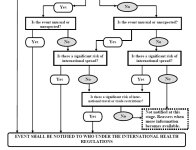
As is usually the case with these UN documents the interesting bit is in an Annex which we are immediately referred to. Annex 2 is a decision tree
IHR1.jpg


Novel influenza virus is specifically listed in the first box which has a direct line to the Notify box at the bottom so it is difficult to see how it could be argued that a human H5N1 infection – fatal or otherwise – is not a mandatory notification.


capture.jpg
So having passed the Annex B test we return to Article 6 text which then obliges notification to the WHO via the Focal Point within 24hrs. It further requires notification of “any health measure implemented in response to those events” and “timely, accurate and sufficiently detailed public health information available to it on the notified event, where possible including case definitions, laboratory results, source and type of the risk, number of cases and deaths, conditions affecting the spread of the disease and the health measures employed”

While I am not a lawyer (second only to philosophers – and possibly politicians - in their ability to prove black is white) a plain text reading would seem to show Indonesia in clear breach should they continue on this path. The problem is - unlike common law – international laws (with the exception of commercial laws) seldom include any meaningful sanctions for non-compliance by Nation State signatories.

We have only our own governments to blame.
 
Last edited:
Re: Indonesia says it will no longer formally announce bird flu deaths

Re: Indonesia says it will no longer formally announce bird flu deaths

Indonesia's bird flu policy draws criticism

June 07 2008 at 10:32AM
By Olivia Rondonuwu

Jakarta - Indonesia's decision to report bird flu cases in humans only every six months, rather than immediately, is irresponsible and could lead to delays in containing outbreaks of the disease, a scientist said on Friday.

Health Minister Siti Fadillah Supari, who has clashed with the international community and United States over her handling of health issues, on Thursday said her ministry had changed its policy and would only report cases every six months.

She did not say whether that reporting policy also included the World Health Organisation (WHO). But a health ministry official said on Friday that the ministry had not decided yet whether it would report to the WHO every one, two, or three months.

"It's a drawback," said Gusti Ngurah Mahardika, a bird flu researcher at Bali's Udayana University.

"It's an obligation (to report) not only every day, but every minute if there's a new development. If they only report to WHO every six months, it will be too late to recognise if there's a new development towards a pandemic."


WHO officials in Geneva said they are still seeking confirmation of the new policy.

With 108 confirmed human fatalities from bird flu, Indonesia has the highest toll of any nation. Since the virus resurfaced in Asia in late 2003, it has killed 241 people in a dozen countries, according to the WHO.

Supari has attracted criticism from the international community for her stance on sharing bird flu samples.

Officials in Indonesia have said they want to ensure equal access to any vaccines that are made against bird flu, but U.S. Health Secretary Michael Leavitt said in April after visiting Jakarta that Indonesia also wanted payments.

The United States and Indonesia are also locked in a dispute over the future of a U.S. naval lab in Jakarta, mainly over virus transfers and the number of U.S. staff allowed to have diplomatic status.

International health experts say it is vital to have access to samples of the constantly mutating H5N1 virus, which they fear could change into a form easily transmissible among humans and sweep the world in months, killing millions of people.

"We are obliged to report to WHO, we are also obliged to report it to the public," said Nyoman Kandun, director-general of communicable diseases at the health ministry, adding that the new policy was meant as a better way to "package" the information.

Indonesia so far has maintained its decision not to share bird flu samples, saying it wants guarantees from richer nations and drugmakers that poor countries would get access to affordable vaccines developed from their samples.

http://www.iol.co.za/index.php?click_id=31&art_id=nw20080606141111409C130913&set_id=
 
Re: Indonesia says it will no longer formally announce bird flu deaths

Re: Indonesia says it will no longer formally announce bird flu deaths

How is it that Supari has an interview with the AP, and I can't find any articles within Indonesia on it, or anything on it from about 4 links in China? Also, CNN.com did not pick it up.

"How does it help us to announce these deaths?" Supari asked in an interview with The Associated Press.

http://news.guelphmercury.com/Wire/article/337046

Edited: CBS News & Reuters picked it up. I'm still looking to see who else did.
 
Last edited:
Re: Indonesia says it will no longer formally announce bird flu deaths

Re: Indonesia says it will no longer formally announce bird flu deaths

Thank you to everyone on FluTrackers for your moderate response to this volatile issue.

Of course we are concerned about the comments that indicate Indonesia may not report the H5N1 status inside that country in a timely manner.

It is not good for Indonesia. It is not good for world public health. Indonesia has opened the box for rumours and suspicions to flourish regarding the "bird flu" situation there.

What we can do in a positive way is to continue to work with our various contacts there on the ground, search the media for reports, and support the Indonesian people.

Would any of us want to trade places in this case?

How would we want to be treated by the world?

There are many repressed peoples in this world. Many do not have enough food and water for each day. They live in states where basic freedoms are denied. They live in "hot zones" where conflict is constant.

What is the world's response? Ignore it and it will go away. It is not my problem.

Well, these problems are coming to all of us in the form of disease.

There are no borders for disease. We can run but we can not hide.

If we continue to turn our eyes and our spirits from our brothers in need, we will pay the price.

I urge compassion and support for all humanity. All peoples. All cultures.

If we can help the people of Indonesia, lets do it. If they need anti-virals, we need to send as much as we can. We can not be detoured by a government or government leader that we do not agree with.

All for one, one for all.


Re: Indonesia says it will no longer formally announce bird flu deaths

Re: Indonesia says it will no longer formally announce bird flu deaths

Commentary

Delay and Denial Control of Indonesia H5N1 Clusters
Recombinomics Commentary 04:13
June 7, 2008

The death of the 15-year-old girl described in the 2nd paragraph of the above report would raise the case total to 134 and the number of deaths to 109, if confirmed independently.

It is not clear, however, whether this case is one of the 2 suspected cases described in ProMED-mail on 14 May 2008 (see: Avian influenza, human (47): Indonesia, susp 20080514.1623). In this posting it was reported that: "A 16-year-old girl died 4 days after being admitted to the Persahabatan Hospital in the Indonesian capital on 8 May 2008
with laboratory test later confirming she had the avian flu virus. 10 days before her death, her 15-year-old brother died after a brief treatment at another hospital with symptoms similar to bird flu." The cause of death of the 15-year-old could not be confirmed because no blood sample had been taken. It is possible therefore that the death toll may now be at least 110. - Mod.CP

The above discussion from today’s ProMED commentary on the new Indonesian policy on delaying announcements of H5N1 fatalities is curious. Usually ProMED excludes any suspect H5N1 which are not lab confirmed, even when the unconfirmed case is in a fatal H5N1 confirmed familial cluster. The announcement by Indonesia may have served as an epiphany for ProMED commentator.

The preceding Indonesia cluster was quite similar. The fatality of the index case was mis-diagnosed as dengue fever and the death was quickly followed by an H5N1 confirmed death in a sibling. That cluster was picked up by wire services and when director general of communicable diseases, Nyoman Kandun, was specifically asked about the cluster, the incorrect dengue fever diagnosis was used to deny the cluster, and this denial was accepted and supported by the same commentator cited above.

The latest comments are a step in the right direction, but the commentary above fails to note that the brother was diagnosed with typhus. Thus, the delay in reporting the case above has already created confusion regarding the diagnosis of the fatal infection in the index case. The commentary also fails to note that the time gap between the index case and the confirmed cases in each cluster supports human to human transmission.

The time gap was also present in the cluster confirmed on the same day as the earlier cluster. That cluster was not picked up by the wire services, but a relative of the confirmed case had died of respiratory disease just prior to the death of the H5N1 confirmed case.

Thus, there are three recent clusters. In each cluster the index cases dies and the cause of death is mis-diagnosed (respiratory disease, dengue fever, and typhus), while the relative then dies of lab confirmed H5N1,

It seems likely that this series of denied clusters may have contributed to the decision to delay H5N1 reporting and reduce transparency. The delay in reporting is in violation of the International Health Regulations, which added H5N1 to the reportable disease list, which requires immediate notification of human H5N1 cases. These regulations were revised in 2005 to increase transparency and give WHO the authority to investigate suspect cases, even without direct participation of host country agencies.

The rapidly deteriorating situation in Indonesia indicates it is time for the WHO to exercise its newly acquired options.


.
 
Re: Indonesia says it will no longer formally announce bird flu deaths

Re: Indonesia says it will no longer formally announce bird flu deaths

[Article from Boxun]

To improve the country's image in Indonesia will not release bird flu death
(Boxun - June 6, 2008 reprint)

Source: Lianhe Zaobao
Indonesia last month, a 15-year-old girl became the first 109 people died of bird flu, the Ministry of Health decided not to announce the news. This is for Indonesia to improve the image of the avian flu and a heavy blow to most of the measures taken by.

Health Minister Siti said: "We announced this news on what benefits? we have to fully take active measures, while stressing that the Government's achievements in bird flu prevention and control. "

She also confirmed that the South Jakarta that the girl last month on the 13th was identified infection with the H5N1 virus, died the next day.

Will be dissatisfied with the WHO

Indonesian decision may anger the United Nations World Health Organization. WHO waiting for Indonesia officially announced the news to amend the Indonesian human bird flu deaths in the figures. WHO Web site as of yesterday the Indonesian bird flu death toll is 108, accounting for 241 deaths of the world for nearly half.

Siti had the problem of avian influenza with the WHO and conflict.

Last year in January, heard a U.S. official in the collections of some laboratory bird flu virus samples after the news, she refused to share with the WHO medical profession was seen as treasures of the bird flu virus samples.

She was concerned that pharmaceutical companies use the Indonesian virus samples vaccine research and development, leading to the developing countries can not afford to buy expensive price of the vaccine. She called for the establishment of the global bird flu vaccine, developed at the top limit or States Liyijunzhan plan.

At present, all Indonesian bird flu virus samples are stored in a laboratory in the Ministry of Health, from the vicinity of Aijie Man Institute scientists detected deoxyribonucleic acid (DNA) of the gene sequencing.

Siti said: "We have the ability to detect."


Before this, the Ministry of Health notified by e-mail bird flu death cases, confirmed that the news of the Information Center also operate almost 24 hours. A few months ago, the Ministry of Health gradually abolish the practice of mixing in the deaths of news, web publishers.

She said that the first half of this year, only 18 people infected with the virus, while the previous year and the first half of the first half of last year, respectively 35 and 27.

Of the 33 provinces in Indonesia, there are 31 provinces bird flu. UN Food and Agriculture Organization in March issued a statement criticizing the Indonesian poultry in bird flu prevention and control work has failed. (Boxun.com)
http://64.233.179.104/translate_c?h...n.com/news/gb/intl/2008/06/200806061634.shtml
 
Re: Indonesia says it will no longer formally announce bird flu deaths

Re: Indonesia says it will no longer formally announce bird flu deaths

Before this, the Ministry of Health notified by e-mail bird flu death cases, confirmed that the news of the Information Center also operate almost 24 hours. A few months ago, the Ministry of Health gradually abolish the practice of mixing in the deaths of news, web publishers.

She said that the first half of this year, only 18 people infected with the virus, while the previous year and the first half of the first half of last year, respectively 35 and 27.

It should be pointed out that only 16 of these individuals have actually been reported by WHO.

http://www.who.int/csr/disease/avian_influenza/country/cases_table_2008_05_28/en/index.html

The last confirmed case from Indonesia was reported on April 30, 2008.

http://www.who.int/csr/don/2008_04_30/en/index.html

The news articles suggest that deaths from H5N1 will not be reported in a timely fashion. It will be interesting to see if Indonesia reports any survivors from H5N1 infections in a timely fashion.
 
Re: Indonesia says it will no longer formally announce bird flu deaths

Re: Indonesia says it will no longer formally announce bird flu deaths

[Also, this is what I have come up with as far as "source of infection" for the confirmed cases in 2008 up until April 29th]:

I count 14 confirmed cases of H5N1 in humans in 2008, in Indonesia.
"Source of Infection is under investigation" = 8 times
"Poultry died in the neighborhood" = 3 times
"visited a wet market recently" = 1 time
"victim lived in close proximity to a wet market/slaughter house" = 2 times

Quote:
Avian influenza ? situation in Indonesia ? update 41
2 April 2008
The Ministry of Health of Indonesia has announced three new cases of human H5N1 avian influenza infection. The cases are not linked epidemiologically. The first is a 15-year-old male student from Subang District, West Java Province who developed symptoms on 19 March, was hospitalized on 22 March and died on 26 March .

The second case is an 11-year-old female student from Bekasi City, West Java Province who developed symptoms on 19 March, was hospitalized on 23 March and died on 28 March.

The third case is a 21-month-old female from Bukit Tinggi, West Sumatra Province who developed symptoms on 17 March, and was hospitalized on 22 March. She is presently recovering in hospital.

The source of infection for all three cases is still under investigation.


Quote:
Avian influenza ? situation in Indonesia ? update 40
21 February 2008
The second case is a 3-year-old boy from South Jakarta District, Jakarta Province who developed symptoms on 3 February, was hospitalized on 10 February and died on15 February. The investigation team found that chickens & a pet bird had died in the neighborhood in the two weeks prior to the case?s onset of symptoms.


Quote:
Avian influenza ? situation in Indonesia ? update 39
12 February 2008
The Ministry of Health of Indonesia has announced a new case of human infection of H5N1 avian influenza. A 15-year-old female from West Jakarta, Jakarta Province developed symptoms on 2 February, was hospitalized on 8 February and is currently in hospital in a critical condition. The case is the daughter of a previously confirmed case, the 38-year-old female from West Jakarta, Jakarta Province who developed symptoms on 23 January.

Investigations into the source of her infection are ongoing. However, she was exposed to her sick mother on 27-28 January and spent time in a neighbourbood where chickens and other birds were found.


Quote:
Avian influenza ? situation in Indonesia ? update 38
5 February 2008

The Ministry of Health of Indonesia has announced two new cases of human H5N1 avian influenza infection. The first is a 29-year-old female from Tangerang City, Banten Province who developed symptoms on 22 January, was hospitalized on 28 January and died on 2 February. Investigations into the source of her infection are ongoing .

The second case is a 38-year-old female from West Jakarta, Jakarta Province who developed symptoms on 23 January 2008, was hospitalized on 26 January and is currently in hospital in a critical condition. Investigations into the source of her infection are ongoing.


Quote:
Avian influenza ? situation in Indonesia ? update 35
29 January 2008

The Ministry of Health in Indonesia has confirmed an additional four cases of human infection with the H5N1 avian influenza virus. Two of these cases were fatal. There is no evidence of an epidemiological link between the cases.

The first case, a 31-year-old female from East Jakarta, Jakarta Province, developed symptoms on 18 January, was hospitalized on 22 January and is currently in hospital. The investigation indicated that she visited a wet market where live poultry are sold three days prior to symptom onset.

The second case, a 9-year-old male from Depok Municipality, West Java, developed symptoms on 16 January, was hospitalized on 23 January and died on 27 January. Investigations into the source of his infection indicate that the case lived next door to a wet market where live poultry are sold.

The third case, a 32-year-old male from Tangerang Municipality, Banten Province, developed symptoms on 17 January, was hospitalized on 24 January and is currently in hospital. Investigations into the source of his infection are ongoing.

The fourth case, a 23-year-old female from East Jakarta, Jakarta Province, developed symptoms on 19 January, was hospitalized on 24 January and died on 27 January. Investigations into the source of her infection are ongoing.


Quote:
Avian influenza ? situation in Indonesia ? update 33
23 January 2008

The Ministry of Health of Indonesia has announced a new case of human infection of H5N1 avian influenza. A 30-year-old male from Tangerang District, Banten Province developed symptoms on 13 January 2008, was hospitalized on 19 January and is currently in hospital. Investigations into the source of his infection are ongoing.

Of the 120 cases confirmed to date in Indonesia, 97 have been fatal.


Quote:
Avian influenza ? situation in Indonesia ? update 32
21 January 2008

The Ministry of Health of Indonesia has announced a new case of human infection of H5N1 avian influenza. An 8-year-old male from Tangerang District, Banten Province developed symptoms on 7 January 2008, was hospitalized on 16 January and died in an AI referral hospital on 18 January. Investigations into the source of his infection are ongoing, however initial reports indicate the case lived in close proximity to a chicken slaughter house.


Quote:
Avian influenza ? situation in Indonesia ? update 29
11 January 2008

The Ministry of Health of Indonesia has announced a new case of human infection of H5N1 avian influenza. A 16-year-old female from West Java Province developed symptoms on 30 December 2007, was hospitalized on 4 January 2008 and is currently in hospital. Investigations found a history of deaths in chickens in the case?s neighborhood in the two weeks preceding her onset of symptoms.


http://www.who.int/csr/don/archive/country/idn/en/
 
Back
Top