• FluTrackers.com Inc. does not provide medical advice. Information on this web site is collected from various internet resources, and the FluTrackers board of directors makes no warranty to the safety, efficacy, correctness or completeness of the information posted on this site by any author or poster. The information collated here is for instructional and/or discussion purposes only and is NOT intended to diagnose or treat any disease, illness, or other medical condition. Every individual reader or poster should seek advice from their personal physician/healthcare practitioner before considering or using any interventions that are discussed on this website. By continuing to access this website you agree to consult your personal physican before using any interventions posted on this website, and you agree to hold harmless FluTrackers.com Inc., the board of directors, the members, and all authors and posters for any effects from use of any medication, supplement, vitamin or other substance, device, intervention, etc. mentioned in posts on this website, or other internet venues referenced in posts on this website.
  • We are not asking for any donations. Do not donate to any entity who says they are raising funds for us.

Indonesia H5N1 Ginting family cluster in Bandung - 05/24 - 05/27, 2006

Status
Not open for further replies.

HenryN

Retired
The LIFE of the PATIENT SUSPECT BIRD FLU NOT TERTOLONG
23/05/2006 18:32 - Social the Culture/Metro the Day Ini
Tim medical RS Handsome Sadikin brought the Ai Tati body to the morgue.
(Metro the TV)
Metrotvnews.com, Bandung: the Patient suspect bird flu, the citizen of the Village liked the Well-being, Cinunuk, Cileunyi, the Bandung Regency that was treated in the Handsome Sadikin Hospital, Ai Tati, on Tuesday afternoon (23/5), died.
Casualties began to be treated in RSHS since Monday (22/5) at midnight with his older brother, Ade Firman, after beforehand was treated in the regional Public Hospital of the Berung Tip, the Bandung City.
The handling doctor of RSHS bird flu, Polite said, was based on results x-rayed to casualties's lungs was seen by the existence of the swelling.
The swelling like that was suffered by casualties, according to Polite, generally often was experienced by the sufferers of the bird flu illness.
Casualties's body, Ai Tati, at this time still was buried in RSHS. In The Meantime, casualties's older brother, Ade Firman, his condition was increasingly critical.
The team of the doctor was forced to have to install the ventilator implement took the form of respiratory aids.
(/AMR)

http://www.metrotvnews.com/berita.asp?id=17230
 
Re: Indonesia BF - 5/22-5/23

Re: Indonesia BF - 5/22-5/23

The patient Bird Flu died in Bandung the writer: SugengBandung -- MIOL: A patient suspect bird flu died in RS Handsome Sadikin (RSHS) Bandung, on Tuesday (23/5).Casualties, Ai Tita, 10, the citizen liked the Well-being, Cileunyi, the Bandung Regency, it was suspected was casualties family cluster bird flu, because during simultaneously, his full sibling, Ade Firman, 18, also in the critical condition.The two casualties were beforehand treated in RS the Berung Tip for one day, before being reconciled to RSHS, on Monday night (22/5).However, after being treated less than 19 hours, Tita did not remain, and died 02.50 WIB.Like was said the team's member of the handling of bird flu RSHS Polite, had been based on the medical note, since coming the two casualties in the critical condition, with the breathless complaint difficult and has experienced shock.To confirm whether both of them were infected by bird flu, sample blood was at once sent to the Departemenresearch and development hallThe Jakarta health.The mother of casualties, Cacih, 50, said, before his two children suffered the hot complaint high, several tails of the chicken were belonging to his neighbour found died suddenly.Before being brought to the hospital, his two children have experienced the hot sign high for three days.The "clinical sign both of them were similar to bird flu, so as we at once treated him in special isolation space RSHS bird flu in Flamboyant space."If being proven the clinical test showed they were infected by bird flu, both of them to cluster third that was handled the hospital after the family from Sumedang and Indramayu, firm Polite.In the meantime, the condition for Ade Firman, also still was critical.The sign that was experienced by him was the same as his brother who has died that.(SG/OL-02).</PRE>
http://www.mediaindo.co.id/berita.asp?id=100699</PRE>
 
Re: Indonesia BF - 5/22-5/23

Re: Indonesia BF - 5/22-5/23

Liputan6.com, Bandung: the Older Brother was siblings, Ai Teti and Ade Firman that was expected terjangkit bird flu died in the Handsome Sadikin Hospital, Bandung, West Java, on Tuesday early afternoon (23/5).Teti died after being treated 19 hours in Space of the Poinciana Tree Isolation RSHS. the Hose five hours after the Teti death, Ade that also was treated in same space appeared the Power.The team's medical RSHS member, the doctor Jatnika Setiabudhi said his side tried as hard as possible to help the life of casualties.One of them by installing respiratory aids.Jatnika added, his side did not yet accept results of the laboratory of confirming both of them were attacked by the bird flu virus."Friends from [the Service] Livestock Breeding was tracing," said he.Was based on the RSHS note, the two casualties that was the citizen of the Sukahayu Village, Cileunyi this was suspect 40th bird flu and 41 that was handled by the side RS Handsome Sadikin [read: the Bird Flu Patient in RSHS improved].Teti and Ade became the patient suspect 10th bird flu and 11 that died.(JUM/Patria and Guidance Divine Guidance)</PRE>
http://www.liputan6.com/view/7,123356,1,0,1148440931.html</PRE>
 
Re: Indonesia BF - 5/22-5/23

Re: Indonesia BF - 5/22-5/23

Two older brothers were siblings, IN (10) and AC (18), the patient suspected the citizen's bird flu Kec.Cileunyi Kab.Bandung, died in RS Handsome Sadikin (RSHS), on Tuesday (23/5).IN died struck 14.50 WIB in Handsome Sadikin Space of the Isolation of the Hospital Poinciana Tree (RSHS) Bandung.Whereas AC died four jams at intervals of.Two nurses issued the bed to bring the patient's body suspected bird flu, IN (10), from Poinciana Tree Space to the Morgue Installation of RSHS Bandung, on Tuesday (23/5).The patient was named AT with his older brother, (18), was the patient who was reconciled from the Ujungberung Hospital because breathless and feverish high.They entered RSHS, on Monday night (22/5).M. the SAPTA TUMULT/Managing Director HOMEWORK (the Managing Director) RSHS Dr. Cissy B. Kartasasmita, overnight said, AC died approximately struck 19.00 WIB. That temporary information that was received by me from Poinciana Tree Space, the place of the patient was treated, he said.Beforehand, on Tuesday late afternoon (23/5), Cissy, announced the AT. death in a heavy-hearted manner, we must announce the obituary.The patient AT died, whereas his older brother still in the condition very serious, said Cissy B. Kartasasmita.The patient AT and AC began to be treated in Poinciana Tree Space on Monday (22/5) struck 21.00 WIB with the hot and breathless sign.Both of them were the reconciliation patient from RSUD Ujungberung, the Bandung City.According to the Chairman Tim the Control of Bird Flu of RSHS Bandung, Dr Hadi Jusuf, results of the laboratory inspection showed the level of Leucocytes of the two low patients and trombosit him was rather low.Now results of the photograph Thorax showed the Inflammation of the lungs has crept as far as two rods paruparu him.Since Monday night, the patient was at once given the tablet oseltamivir (Tamiflu) 150 mg.Also was given kartikosteroid to inflamasi that great and help of high oxygen, he said.</PRE>
http://www.pikiran-rakyat.com/cetak/2006/052006/24/0206.htm </PRE>
</PRE>
 
Re: Indonesia BF - 5/22-5/23

Re: Indonesia BF - 5/22-5/23

Suspect H5N1 Bird Flu Cluster in Bandung Indonesia

Recombinomics Commentary

May 23, 2006

Patient suspect bird flu, the citizen of the Village liked the Well-being, Cinunuk, Cileunyi, the Bandung Regency that was treated in the Handsome Sadikin Hospital, Ai Tati, on Tuesday afternoon (23/5), died.
Casualties began to be treated in RSHS since Monday (22/5) at midnight with his older brother, Ade Firman, after beforehand was treated in the regional Public Hospital of the Berung Tip, the Bandung City.

The handling doctor of RSHS bird flu, Polite said, was based on results x-rayed to casualties's lungs was seen by the existence of the swelling.
The swelling like that was suffered by casualties, according to Polite, generally often was experienced by the sufferers of the bird flu illness.
Casualties's body, Ai Tati, at this time still was buried in RSHS. In The Meantime, casualties's older brother, Ade Firman, his condition was increasingly critical.

The team of the doctor was forced to have to install the ventilator implement took the form of respiratory aids.

The above translation describes a suspect H5N1 bird flu familial cluster in Bandung, Indonesia.. Additional media reports indicate a third sibling is being treated at home.

This cluster in Bandung raises concerns that the number of familial cluster is increasing. The cluster in Northern Sumatra has an extended transmission chain and 7 of the 8 family members have died.

Additional outbreaks in J
akarta and Surabaya raise concerns that the number of cluster in Indonesia will continue to grow,
 
Re: Indonesia BF - 5/22-5/23

Re: Indonesia BF - 5/22-5/23

[FONT=Helvetica, Arial]Two siblings believed to have bird flu[/FONT]
[FONT=Arial, Helvetica] [/FONT]
[FONT=Arial, Helvetica]Abdul Khalik and Yuli Tri Suwarni, The Jakarta Post, Jakarta, Bandung[/FONT]
[FONT=Arial, Helvetica]One of two new suspected bird flu patients from the same family in Bandung, West Java, died Tuesday, leading to speculation that a new cluster has surfaced.[/FONT]
[FONT=Arial, Helvetica]The two, a 10-year-old girl and an 18-year-old man, were admitted to Hasan Sadikin Hospital in Bandung on Monday evening, but the girl's condition worsened and she died at 2:50 p.m on Tuesday. [/FONT]
[FONT=Arial, Helvetica]The siblings, residents of Cileunyi in Bandung regency, exhibited symptoms associated with bird flu and had known contact with dead chickens. [/FONT]
[FONT=Arial, Helvetica]"They had high fevers and lower respiratory infections, which made it hard for them to breathe," said Djatnika, the deputy head of the hospital's bird flu team. [/FONT]
[FONT=Arial, Helvetica]Blood samples taken from the two, he said, have been sent to a Health Ministry laboratory. Local tests, however, are not considered definitive and need confirmation from a World Health Organization (WHO)'s internationally accredited laboratory. [/FONT]
[FONT=Arial, Helvetica]A previous bird flu cluster in West Java was identified earlier this year in Indramayu, where several members of the same family died. As well as a new one in Medan found last week, health authorities have pinpointed five bird flu clusters around the country. [/FONT]
[FONT=Arial, Helvetica]But new cases of bird flu have continued to emerge. On Monday, a man from a North Sumatra village, who belonged to a bird flu cluster believed to total eight infections from one family, died. Local tests also confirmed two more bird flu infections in the country. [/FONT]
[FONT=Arial, Helvetica]While the government put the total cases of bird flu here at 43, with 33 fatalities, WHO put the figure at 41 cases, with 32 fatalities. [/FONT]
[FONT=Arial, Helvetica]The ASEAN Foundation, one arm of the Association of Southeast Asian Nations, has said it is time to turn to technology for help. [/FONT]
[FONT=Arial, Helvetica]The foundation proposes using information and communications technology (ICT), particularly short message service (SMS), to prevent further outbreaks of the disease. [/FONT]
[FONT=Arial, Helvetica]The idea is based on the successful application of ICT in Thailand and Vietnam to stop new bird flu cases in both humans and animals at village level. The foundation is now applying ICT for the same purpose in Laos and Cambodia. [/FONT]
[FONT=Arial, Helvetica]The foundation's executive director, Apichai Sunchindah, said Thailand and Vietnam had been successful in dealing with bird flu through the use of information technology. [/FONT]
[FONT=Arial, Helvetica]In Thailand, he said, one million volunteers -- equipped with cellular phones or computers -- were deployed at village level. They filed their reports via e-mail or text message to a central terminal for the government to follow up. [/FONT]
[FONT=Arial, Helvetica]"With this system, people are involved and the government can map out the spread of bird flu to take sufficient measures," Sunchindah said on the sidelines of an international symposium on ICT for social development in Jakarta on Tuesday. [/FONT]
[FONT=Arial, Helvetica]While Indonesia is struggling to contain bird flu, there have been no reports of new cases in Thailand or Vietnam this year, winning them praise from international communities. [/FONT]
[FONT=Arial, Helvetica]Professor Felix Librero from the University of the Philippines, who has conducted intensive research on the use of text messages to pass on information to fight bird flu, and managing director of Malaysia's Southbound Sdn. bhd. Chin Saik Yoon, both agreed the method would work in Indonesia. [/FONT]
[FONT=Arial, Helvetica]There are about 60 million cell phone users in the country.[/FONT]

http://www.thejakartapost.com/detailheadlines.asp?fileid=20060524.A03&irec=4
 
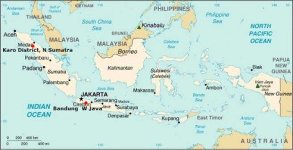
Map

Map

Karo District, North Sumatra - the district where the large cluster is from.

Bandung, West Java - the new cluster is from a town/village near to Bandung -- they are hospitalized in Bandung.

BTW -- I just read this on Wikipedia about the people of the Karo region (where the Big Cluster family is from) -- the Karo Batak people: A favorite food among locals is babi panggang, a kind of roast pork.

http://en.wikipedia.org/wiki/Kabanjahe

(Note - these are not precise village locations - just indications of the districts/provinces involved.)

Indonesia.JPG
 
Second sibling [Ade] in Bandung cluster dies

Second sibling [Ade] in Bandung cluster dies

toggletext-ed from Indonesian:

The older brother was siblings the Assumption of Bird Flu died
May 24, 2006

Photo caption: Teti died after could be treated for 19 hours in Space of the Poinciana Tree Isolation RS Handsome Sadikin, Bandung. At intervals of five hours, the brother, Ade that was treated in same space blew out the last breath.

Liputan6.com, Bandung: The Older Brother was siblings, Ai Teti and Ade Firman that was expected terjangkit bird flu died in the Handsome Sadikin Hospital, Bandung, West Java, on Tuesday early afternoon (23/5).

Teti died after being treated 19 hours in Space of the Poinciana Tree Isolation RSHS. The Hose five hours after the Teti death, Ade that also was treated in same space appeared the Power.

The team's medical RSHS member, the doctor Jatnika Setiabudhi said his side tried as hard as possible to help the life of casualties. One of them by installing respiratory aids. Jatnika added, his side did not yet accept results of the laboratory of confirming both of them were attacked by the bird flu virus. "Friends from [the Service] Livestock Breeding was tracing," said he.

Was based on the RSHS note, the two casualties that was the citizen of the Sukahayu Village, Cileunyi this was suspect 40th bird flu and 41 that was handled by the side RS Handsome Sadikin. Teti and Ade became the patient suspect 10th bird flu and 11 that died.

(JUM/Patria and Guidance Divine Guidance)

http://www.liputan6.com/view/7,123356,1,0,1148436258.html
 
Bird Flu Case May Be First Double Jump

Bird Flu Case May Be First Double Jump

May 24, 2006
Bird Flu Case May Be First Double Jump
By DONALD G. McNEIL Jr.

Reacting to the death on Monday of an Indonesian man, the World Health Organization said yesterday that the case appeared to be the first example of the avian flu jumping from human to human to human.

But the health agency quickly cautioned that this did not necessarily mean that the virus had mutated into a strain that could start a pandemic by jumping rapidly between people as ordinary flu does.

It is a "definite possibility" that the virus jumped more than once inside a family cluster, said Maria Cheng, a spokeswoman for the W.H.O. in Geneva. Although a second jump sounds alarming, "It doesn't look like the trend has changed," she said. "Each case was in very close contact with the previous one."

In the past there have been at least three cases of suspected human-to-human transmission of the A(H5N1) strain of bird flu; all were between family members who spent hours in close contact and would have breathed in large amounts of virus-contaminated droplets. The virus is known to attach itself to receptors deep in the lungs, not in the nose and throat as seasonal flu does.

The man who died was 32 and became sick on May 15. He is believed to have caught the flu while caring for his 10-year-old son, who died of the disease on May 13.

The boy attended a family pork roast in the village of Kubu Sembilang in northern Sumatra on April 29. The hostess, a 37-year-old woman, had become sick on April 27 and was coughing heavily, and several family members slept in her small room, the health agency said. She died May 4 and was buried without any tissue samples being taken; she is presumed to have spread the flu only because of her symptoms.

Six more family members who were at the barbecue fell sick in the first week of May. Five of them, including the 10-year-old, died in the second week of May; only one, the hostess's 25-year-old brother, recovered.

Thirty-three other people in Kubu Sembilang who had contact with the family have been quarantined or have been treated with Tamiflu, an antiviral drug, Ms. Cheng said.

The W.H.O. assumes that the incubation time for bird flu in humans is 7 to 10 days, longer than that of regular flu, she said.

Henry L. Niman, who runs recombinomics.com, a Web site tracking the genetics of flu cases, argues that the incubation period is closer to the two to four days of regular flu, so the boy may have been infected by another family member, meaning that the virus might have made three consecutive human-to-human jumps. But Ms. Cheng said the health agency's "working hypothesis" was still that it had jumped only twice.

An Indonesian health official, according to local news reports, said the boy's father had run away after falling ill and had been treated with Tamiflu. He was later found in the village again but refused treatment.

Ms. Cheng said the village had "not been as cooperative as we'd like."

Recalling outbreaks of Ebola in which African villagers had been terrified at the sight of foreign doctors arriving in hoods and white overalls, she said she thought that the W.H.O. team had worn civilian clothes, and put on masks only when talking to sick patients.

http://www.nytimes.com/2006/05/24/world/asia/24birdflu.html
 
Bird Flu Probe in Indonesia Intensifies on Human Link (Update3)

Bird Flu Probe in Indonesia Intensifies on Human Link (Update3)

Thirty-three other people in Kubu Sembilang who had contact with the family have been quarantined or have been treated with Tamiflu, an antiviral drug, Ms. Cheng said.
Bird Flu Probe in Indonesia Intensifies on Human Link (Update3)

May 24 (Bloomberg) -- World Health Organization officials intensified their investigation of the spread of bird flu among seven Indonesian family members and may consider raising the alert level for a possible lethal pandemic.

Any evidence of the H5N1 avian influenza strain being passed from human-to-human in a chain of three or more people may prompt the WHO to convene a panel of experts and consider raising the pandemic alert level, Maria Cheng, a spokeswoman for the WHO, said yesterday in Geneva.

"There will be a lot of pressure from some circles'' to raise the level of alert, Michael Osterholm, director of the University of Minnesota's Center for Infectious Disease Research and Policy, said by telephone from New York. The concern is that "other cases are being unrecognized.''

Cases involving sustained human transmission would suggest the virus has undergone genetic changes making it more contagious, according to the WHO. So far, studies of the Sumatran outbreak and genetic analyses of the virus don't indicate it has undergone major changes, Cheng said.

At least 124 of 218 people known to have been infected with the H5N1 virus have died, the WHO said yesterday. Almost all of the H5N1 cases confirmed by the WHO since late 2003 can be traced to direct contact with sick or dead birds.

A 10-year-old girl probably died yesterday of avian flu in Indonesia's West Java province, the Jakarta Post reported, citing Djatnika, a hospital official in Bandung, the provincial capital. The case is unrelated to the family cluster on Sumatra.

A pandemic such as the one that killed 50 million people in 1918 may take more than 142 million lives and cause the world's economy to shrink by one-eighth, according to a report in February by the Lowy Institute and Australian National University.

Rupiah Slides

Indonesia's currency fell to a one-week low after the WHO statement. The rupiah declined 1 percent to 9,334 per dollar at 11:16 a.m. in Jakarta. Against the euro, the dollar strengthened to $1.2788 at 12:29 p.m. in Tokyo from $1.2815 in New York late yesterday.

An international team of experts joined local authorities last week on Sumatra to try to pinpoint how the people became infected with H5N1 in the past month.

The Indonesian Health Ministry and the WHO have intensified their investigation and response activities, the United Nations agency said. "Priority is now being given to the search for additional cases of influenza-like illness in other family members, close contacts, and the general community,'' it said. More than 30 people are being monitored for symptoms.

Fever Surveillance

A temporary command post will coordinate fever surveillance in Kubu Sembelang, the village in North Sumatra's Karo District, where most of the family members lived, said Sari Setiogi, a WHO spokeswoman in Jakarta. Infectious disease training will be conducted at the local hospital, she said.

The investigation has so far found no evidence of a spread within the general community and no evidence that efficient human-to-human transmission has occurred, the WHO said.

"It appears that this virus has not gone outside this family cluster,'' said Peter Cordingley, a spokesman with the WHO in the Philippines capital, Manila. So far the virus "has shown no signs of mutation.''

A 32-year-old man from Kubu Sembelang died of avian flu earlier this week, marking the seventh case in the family and the sixth person to die. His 10-year-old son died of H5N1 nine days earlier on May 13.

Thai Family

Health officials found strong evidence of direct human-to-human spread of H5N1 in Thailand in 2004, when it probably spread from an 11-year-old girl to her aunt and mother, killing the mother and daughter. People who had more casual contact with the girl didn't become infected.

Epidemiologist Osterholm said some health officials may call for the alert to be raised to level 4. The WHO's pandemic alert is at the third of six levels, indicating that a new flu virus subtype is causing disease in humans, though not yet spreading efficiently and sustainably among people.

"It that happens we're looking at a very bad situation,'' the WHO's Cordingley said. "We have no idea how many people might die. We don't know how contagious it might be.''

To contact the reporters on this story:
Jason Gale in Singapore at j.gale@bloomberg.net;
John Lauerman in Boston at jlauerman@bloomberg.net.

http://www.bloomberg.com/apps/news?pid=10000087&sid=aZekCCvuJE5s&refer=top_world_news
 
Two siblings believed to have bird flu

Two siblings believed to have bird flu

Two siblings believed to have bird flu

Abdul Khalik and Yuli Tri Suwarni, The Jakarta Post, Jakarta, Bandung

One of two new suspected bird flu patients from the same family in Bandung, West Java, died Tuesday, leading to speculation that a new cluster has surfaced.

The two, a 10-year-old girl and an 18-year-old man, were admitted to Hasan Sadikin Hospital in Bandung on Monday evening, but the girl's condition worsened and she died at 2:50 p.m on Tuesday.

The siblings, residents of Cileunyi in Bandung regency, exhibited symptoms associated with bird flu and had known contact with dead chickens.

"They had high fevers and lower respiratory infections, which made it hard for them to breathe," said Djatnika, the deputy head of the hospital's bird flu team.

Blood samples taken from the two, he said, have been sent to a Health Ministry laboratory. Local tests, however, are not considered definitive and need confirmation from a World Health Organization (WHO)'s internationally accredited laboratory.

A previous bird flu cluster in West Java was identified earlier this year in Indramayu, where several members of the same family died. As well as a new one in Medan found last week, health authorities have pinpointed five bird flu clusters around the country.

But new cases of bird flu have continued to emerge. On Monday, a man from a North Sumatra village, who belonged to a bird flu cluster believed to total eight infections from one family, died. Local tests also confirmed two more bird flu infections in the country.

While the government put the total cases of bird flu here at 43, with 33 fatalities, WHO put the figure at 41 cases, with 32 fatalities.

The ASEAN Foundation, one arm of the Association of Southeast Asian Nations, has said it is time to turn to technology for help.

The foundation proposes using information and communications technology (ICT), particularly short message service (SMS), to prevent further outbreaks of the disease.

The idea is based on the successful application of ICT in Thailand and Vietnam to stop new bird flu cases in both humans and animals at village level. The foundation is now applying ICT for the same purpose in Laos and Cambodia.

The foundation's executive director, Apichai Sunchindah, said Thailand and Vietnam had been successful in dealing with bird flu through the use of information technology.

In Thailand, he said, one million volunteers -- equipped with cellular phones or computers -- were deployed at village level. They filed their reports via e-mail or text message to a central terminal for the government to follow up.

"With this system, people are involved and the government can map out the spread of bird flu to take sufficient measures," Sunchindah said on the sidelines of an international symposium on ICT for social development in Jakarta on Tuesday.

While Indonesia is struggling to contain bird flu, there have been no reports of new cases in Thailand or Vietnam this year, winning them praise from international communities.

Professor Felix Librero from the University of the Philippines, who has conducted intensive research on the use of text messages to pass on information to fight bird flu, and managing director of Malaysia's Southbound Sdn. bhd. Chin Saik Yoon, both agreed the method would work in Indonesia.

There are about 60 million cell phone users in the country.
http://www.thejakartapost.com/detailheadlines.asp?fileid=20060524.A03&irec=4
 
Re: Indonesia 5/24

Re: Indonesia 5/24

<form name="trans" action="kataku_trial.php" method="post"> <table cellspacing="0" cellpadding="4" width="100%" border="0"> <tbody> <tr> <td bgcolor="#ffe4bd"> <table cellspacing="0" cellpadding="0" width="400" border="0"> <tbody> <tr><td valign="top" bgcolor="#ffffee">

Liputan6.com, Bandung: the Body Ade Firman Cahyana, 18 years, and Ai Eti, 10 years, the older brother was siblings that was expected terjangkit the bird flu virus was buried in the Cisitu Village, the Cimekar Village, the Cileunyi Subdistrict, the Bandung Regency, West Java, on Wednesday morning (24/5).
This case increased long the list of casualties who died had the family's relations or cluster in West Java after beforehand two families from Sumedang and Indramayu [read: the Older Brother was siblings the Assumption of Bird Flu died].
Officially West Javanese Livestock Breeding as far as this is concerned has taken the sample of poultry blood as well as destroyed dozens of poultries in casualties's residence.
This was carried out after the death of two older brothers was siblings this made some citizens of the Sukahayu Village, Cileunyi, the residence of the family of frightened casualties.
From results of the sample test of poultry blood, three chickens were stated positive terjangkit the bird flu virus.

http://www.liputan6.com/view/7,123389,1,0,1148475454.html

(ORS/Patria and Guidance Divine Guidance)
</pre>​
</td></tr> <tr> <td colspan="2">
spacer.gif
</td></tr></tbody></table></td></tr></tbody></table></form> <table cellspacing="0" cellpadding="0" width="85%" border="0"> <tbody> <tr> <td valign="top" align="middle">
spacer.gif
</td> <td>
spacer.gif

</td></tr></tbody> </table>
 
Second Suspect H5N1 Bird Flu Cluster Member Dies in Bandung

Second Suspect H5N1 Bird Flu Cluster Member Dies in Bandung

http://www.recombinomics.com/News/05240601/H5N1_Bandung_Fatalities_2.html
Second Suspect H5N1 Bird Flu Cluster Member Dies in Bandung

Recombinomics Commentary

May 24, 2006

Teti died after being treated 19 hours in Space of the Poinciana Tree Isolation RSHS. The Hose five hours after the Teti death, Ade that also was treated in same space appeared the Power.

The above translation indicates the second sibling in Bandung in West Java has died. Death was 5 hours after index case, indicating both died on the day that they arrived. Other media reports indicate a third sibling is being treated at home.

Indonesia has a high case fatality rate, due in part to late admission of patients. Usually patients are kept at home or treated in primary facilities and only those admitted to infectious disease hospitals are tested. Thus, surveillance remains poor and clusters remain high. Family members are not trained in universal precautions and frequently become infected by the index case or additional family members.

The clusters of cases in north Sumatra, Bandung, Jakarta, and Surabuya are cause for concern. The case fatality rate is high and the cluster in Sumatra has been transmitted through several generations of human-to-human transmission (H2H2H2H2).
 
Re: Indonesia 5/24

Re: Indonesia 5/24

<TABLE cellSpacing=0 cellPadding=0 width=487 border=0><TBODY><TR><TD width=487 colSpan=2><CENTER>
</CENTER><!--BEGIN MAIN BANNER AND HEADLINE GIF-->
health.gif

<!--BEGIN DATE STAMP-->Wednesday, May. 24, 2006
<!--END DATE STAMP-->
A New Bird Flu Cluster
Seven family members in rural Indonesia fall ill, and medical investigators are racing to figure out why
By BRYAN WALSH/HONG KONG
Public fears of bird flue seem to have abated in recent weeks, but scientists know the world is always one viral mutation away from a deadly pandemic. That fact has been driven home again by a worrying cluster of human bird flu cases in rural Indonesia that could represent the first time the H5N1 virus has managed to pass from human to human to human. The cluster likely began with a 37-year-old woman who hosted a family pork roast on April 29 in the Indonesian village of Kubu Sembilang in north Sumatra. The woman had become sick on April 27, and as she worsened, several family members slept in the same small room as she did. By the first week of May six more members of the family had fallen ill with avian flu. The first woman died on May 4 and was buried before any tissue samples could be taken, but doctors were able to confirm H5N1 in the remaining family members, all but one of whom have died. An eighth family member, a 32-year- old man, became sick on May 15 and died May 22; he may have caught the virus while caring for his infected 10-year-old son, who died of the disease on May 13.
The WHO has dispatched a team of investigators to the area, including experts from the organization's headquarters in Geneva, but they have been unable to find any evidence of contaminated poultry in the village that may have triggered the human infections. "If we can't find an external source that explains all seven confirmed cases, then we have to go with the theory that this is human to human," says Peter Cordingley, the spokesperson for the WHO's Western Pacific regional headquarters. Human to human transmission within a family is believed to have occurred at least twice before, in Thailand and Vietnam, although never involving this many people. But if the 10-year-old boy was infected by a family member, and then went on to infect his father, it would represent the first known time the virus had passed from human to human to human. "It's certainly possible," says Gregory Hartl, a WHO spokesperson in Geneva.
That's a worrying threshold to cross, but the good news is that the virus doesn't seem to have spread outside the family. The 32-year- old man ran away from doctors after falling ill, and passed though four neighboring villages before he was apprehended, coming into contact with 33 people. All of them are currently under observation and being given the antiviral drug Tamiflu as a prophylactic, but none have shown signs of infection. Scientists have genetically sequenced two viruses isolated from the cluster and found no evidence of the kinds of significant mutations that would likely be necessary before the virus could pass easily from person to person. "The virus looks pretty much the same as other cases," says Dr. Guan Yi, an avian-flu expert at the University of Hong Kong who has seen the genetic sequences. If those contacts remain healthy for the next week and a half, then the outbreak at Kubu Sembilang will likely be judged contained. But the cluster itself could remain a mystery. Villagers have been extremely uncooperative with investigators, complicating efforts to get samples from animals and forcing the WHO to set up its command hub 5 miles from the village. "We don't have a lot of access to the village right now," says Hartl. "But they've lost seven people. There's a lot of shock and grief they have to work through first." It's a reminder of the power bird flu still has to surprise?and to kill.
</TD></TR></TBODY></TABLE>
http://www.time.com/time/health/printout/0,8816,1197527,00.html
 
Re: Indonesia 5/24

Re: Indonesia 5/24

http://www.medicalnewstoday.com/healthnews.php?newsid=43974
Is H5N1 Evolving In Indonesia Or Not?

We hear that seven members of the same family in Kubu Sembelang, Indonesia, became infected with the H5N1 bird flu virus strain, all within a few days of each other. The World Health Organization (WHO) says it is possible that people infected people. However, the level of alert remains unchanged. Nobody can find an animal source for these human infections.

These seemingly ambiguous reports do nothing to alleviate anxiety levels for millions of readers around the world. Readers are immediately gripped with the thoughts: ?What is really going on? Has the virus mutated? What do we do? Why don't they tell us more? Are we being told everything?' Conspiracy theories abound. However, looking closely, the reports are not ambiguous or contradictory.

Let's recap on exactly what has happened in Indonesia so far:

It all started when a woman infected with H5N1 shared a very small room with family members. The woman was very sick, coughing and sneezing a lot. Her nephew, 10, who was also in this small room, got infected. Then the nephew's father got ill after spending a couple of days caring for his very sick son. Eventually seven family members got ill.

There have been cases of humans infecting other humans before. The WHO said, many months ago, that a human can catch bird flu from another human if there is prolonged and close physical contact - as would be the case when someone is caring for an infected person.

If all the seven members of this family were in close contact with each other, and subsequently infected each other - this is nothing new.

The H5N1 virus, in its current form, can only make a human sick if it manages to reach deep down in the lungs. It does not infect the upper-respiratory tract of a human, it infects the lower-respiratory tract. For a human to become infected and ill he/she must be exposed to a large, continuous cluster of H5N1. When an infected person coughs, tiny quantities of H5N1 are expelled, because it is so deep down in the lung. This makes it even more difficult for one human to infect another. The only way one human can infect another is by constantly coughing, really close to that other human, in close quarters, for a long time.

With family members all sharing a small room, it is easily possible that a sizeable cluster built up - enough to start infecting other family members. H5N1 already does that without having to mutate - transmit from human-to-human if conditions are right. What it cannot do is transmit from one human who sneezes in the supermarket to another who is walking by.

So, the infection of these family members is easily possible without H5N1 needing to mutate. In fact, if it had mutated we would have expected to see more infected people, perhaps neighbours and other people down the road - this has not happened. The only ones to become infected were the ones who shared this tiny room with an infected person who was coughing a lot.

What may raise some eyebrows is that even so, for all seven to become infected is surprising. Experts have said, even if a human is caring for another H5N1 infected person, and has close, prolonged physical contact, transmission is possible, but difficult.

What conclusions can we draw from the information so far?

-- We know all the family members, if they did infect each other, did so in a small room - a situation which could lead to human-to-human infection without the virus having to mutate.

-- Perhaps there is an animal source for all the seven. That source has not been found yet.

-- It would be premature to say H5N1 has mutated - more people would have become infected in that area.

-- It is possible H5N1 has mutated ever so slightly and that is why seven people were infected. But this is only speculation.

According to WHO, there is no evidence of ?efficient' human-to-human transmission. Authorities in the area have to be thorough - turn every stone to find a possible animal source, keep checking all humans for further infection.

Written by: Christian Nordqvist
Editor: Medical News Today
 
Re: Indonesia 5/24

Re: Indonesia 5/24

The H5N1 virus, in its current form, can only make a human sick if it manages to reach deep down in the lungs. It does not infect the upper-respiratory tract of a human, it infects the lower-respiratory tract. For a human to become infected and ill he/she must be exposed to a large, continuous cluster of H5N1. When an infected person coughs, tiny quantities of H5N1 are expelled, because it is so deep down in the lung. This makes it even more difficult for one human to infect another. The only way one human can infect another is by constantly coughing, really close to that other human, in close quarters, for a long time.

With family members all sharing a small room, it is easily possible that a sizeable cluster built up - enough to start infecting other family members. H5N1 already does that without having to mutate - transmit from human-to-human if conditions are right. What it cannot do is transmit from one human who sneezes in the supermarket to another who is walking by.

So, the infection of these family members is easily possible without H5N1 needing to mutate. In fact, if it had mutated we would have expected to see more infected people, perhaps neighbours and other people down the road - this has not happened. The only ones to become infected were the ones who shared this tiny room with an infected person who was coughing a lot.


I find it interesting how they are acting like this is old news. They make it sound as if we should all know this, like this shouldn't be alarming to us.

I am sorry but statements like these really anger me because they convey a false sense of reality. They do not emphasize the fact that this is a MAJOR change, if not in the virus, then in what we are being told about the virus.

How many articles mention that the virus is a 'disease of the birds'?

Thousands.

How many articles mention that you can only catch the virus if you are handling infected poultry?

Thousands.

How many articles mention that you can only catch the virus if you have close contact with infected poultry?

Thousands.

How many articles mention that you can catch the virus if you have close contact with an infected human being?

Zero. Until yesterday.
 
Status
Not open for further replies.
Back
Top