• FluTrackers.com Inc. does not provide medical advice. Information on this web site is collected from various internet resources, and the FluTrackers board of directors makes no warranty to the safety, efficacy, correctness or completeness of the information posted on this site by any author or poster. The information collated here is for instructional and/or discussion purposes only and is NOT intended to diagnose or treat any disease, illness, or other medical condition. Every individual reader or poster should seek advice from their personal physician/healthcare practitioner before considering or using any interventions that are discussed on this website. By continuing to access this website you agree to consult your personal physican before using any interventions posted on this website, and you agree to hold harmless FluTrackers.com Inc., the board of directors, the members, and all authors and posters for any effects from use of any medication, supplement, vitamin or other substance, device, intervention, etc. mentioned in posts on this website, or other internet venues referenced in posts on this website.
  • We are not asking for any donations. Do not donate to any entity who says they are raising funds for us.

Indonesia H2H Cover-up?

Re: Indonesia H2H Cover-up?

Correct me if I am wrong but wasn't it Indonesia that wanted to have patent rights to any vaccine that was created from a strain that was found within their country?

Is it possible that the reason that none of the sequencences from Indonesia have been released is due to the fact that they are holding out until so they can get patent rights on a vaccine from such a strain?
 
Re: Indonesia H2H Cover-up?

siam said:
Well we keep coming back to cats. Though as I understand it they are mainly feral. Did this family have a pet cat?
siam, a pet cat would not be neccessary. All cats, given the chance, will lick a bowl out, leaving saliva behind. Patting a cat after it has cleaned it's self allows the person to be in contact with cat saliva. There may also be cat feces about.
 
Last edited:
Re: Indonesia H2H Cover-up?

Bird Flu Deaths in Indonesia Worry Health Officials </NYT_HEADLINE><SCRIPT language=javascript> <!-- function submitCCCForm(){ PopUp = window.open('', '_Icon','location=no,toolbar=no,status=no,width=650,height=550,scrollbars=yes,resizable=yes'); this.document.cccform.submit(); } // --> </SCRIPT>
01


<NYT_BYLINE type=" " version="1.0">
By DONALD G. McNEIL Jr.
</NYT_BYLINE>
Published: May 17, 2006
<NYT_TEXT>
A cluster of avian flu deaths in an Indonesian extended family has raised the possibility that the virus had passed between people there, the World Health Organization said yesterday.
There have been several avian flu clusters in Indonesia, but this is the largest known, and the different beginning dates of symptoms in the family are worrying, officials said.
The flu is spreading rapidly in Indonesian backyard flocks, and before this week, the country had 25 known human deaths, the second-highest number in the world after Vietnam.
"We haven't seen any evidence of spread beyond this cluster," said Maria Cheng, a W.H.O. spokeswoman. "The investigation is still at an early stage."
Reports of limited transmission of the virus from human to human raise concerns but not alarms among health officials ? there have been previous suspected cases, each involving a family member who spent hours nursing a sick relative. Unlike seasonal flu viruses, which attach in the nose or throat, making them easy to spread, the A(H5N1) virus is known to attach to receptors found deep in human lungs.
Reports from the village of Kubu Sembilang on the island of Sumatra, repeated on wire services and infectious disease Web sites, were somewhat confusing. Five family members have been confirmed by a W.H.O.-certified laboratory in Hong Kong as having the A(H5N1) virus. Either 7 or 8 members of the family were said to have shown symptoms, and six were reported to have died.
According to experts familiar with the case who were cited on recombinomics.com, a Web site tracking genetic changes in infectious diseases, the first to die was a 37-year-old woman who fell ill on April 27, two days before a large family barbecue, and died May 4. The other family members ? two sons, a brother, sister, neice and nephew ? developed symptoms after the barbecue and five more died between May 9 and May 14.
No tissue from the 37-year-old woman was tested, so it is possible that she died of something else and that other members of the family were also infected by something else. Local reports said both pork and chicken were served at the barbecue. Because pigs can catch avian and human flus, it is also possible the woman was infected by a pig or chicken before the barbecue, and other family members were infected later. In Indonesian villages, pigs are often cooked in the ground and diseases from undercooked pork are common.
Tests on poultry and pigs in the village have not found the virus. Ms. Cheng of the W.H.O. said no large poultry outbreak had been reported in the area, but many such outbreaks that caused human cases have been missed before in several countries. Indonesia has started a chicken-vaccination program but it has not yet been effective.
H5N1 avian flu is known to have infected 208 other people, of whom 115 have died, according to the official W.H.O. Web site, which was last updated on May 12.
Two other A(H5N1) deaths in Indonesia have been reported in the last week ? a 38-year-old caterer in Surabaya who worked with pigs and a 12-year-old boy.
Vietnam, where the current outbreak began in 2003, had 93 cases by the end of 2005, but started an aggressive poultry-vaccination drive last summer and has not had a case in humans or poultry this year.
Indonesia, by contrast, has been criticized by global veterinary health officials for failing to contain its poultry outbreak. Lack of money for vaccines and a lack of cooperation between federal and local health authorities has been blamed.

http://www.nytimes.com/2006/05/17/health/17cnd-flu.html?_r=2&oref=slogin&oref=slogin
</NYT_TEXT>
 
Re: Indonesia H2H Cover-up?

I'd really like for ALL the sequences to be available so they can be compared. I believe the WHO is acting at Pandemic Phase 4 in spite of the fact that they haven't declared it yet.
~~~~~~~~~~~~~~~

On another topic, I have wanted to reply to Alaska Denise's and Laidback Al's posts on Ro (R sub zero) or basic reproductive number. Alaska Denise asked some time back if anyone thought the Ro in Indonesia was greater than 1... and it got me thinking about Ro and Ro measured at what level???

For a while last year there was some discussion that it might be >1: Reasoning was that it might be higher than thought because maybe some human cases were not having symptoms/dying, but simply developing antibodies. (If true, that would have been just ducky, in that the case fatality rates would have been less too and we could sleep better at night. CFRs over 60% are a mind blower! Evidently for Webster too. :rolleyes:) Well, no such luck! An Indonesian study of many people in several areas where there had been family clusters showed others had not been infected.

The modeling stuff is fascinating... I like it because you can think about what factors might determine or influence the "tipping point" for pandemic. It also helps me think about what is being considered and what might be left out of a working model...

A bit more about Ro:
As mentioned earlier... it's is used in epidemiological modeling to represent the basic reproductive number, that is, "the average number of new (secondary) cases of infection for each (primary) infective case introduced into a susceptible population with random contact".

Ro is determined by a combination of the following:
  1. characteristics of the H5N1,
  2. nature of human interactions and
  3. number of contacts in the community
1 is the contribution of the virus, 2 & 3 are characteristics of interpersonal relationships and networks.

If Ro is less than 1, the virus is not propagating in a sufficient number of new human hosts to go pandemic. The virus dies out. If it's greater than, 1 it is propagating sufficiently.

Theoretically when Ro=1, we've reached a pandemic threshold. But if we're talking about a cluster in a family, maybe not... Ro depends on the network it's measured in. (Transmissibility, according to the paper Laidback Al referenced does not: http://www.flutrackers.com/forum/showthread.php?p=12878#post12878 )

Families clearly have unique close interpersonal relationships. Family members live in very close living spaces in Asia, also sharing close contact with their animals (fowl and mammals). Except in this last Indonesian cluster, not with fowl, perhaps with pigs or cats or some other vector...?

Random thoughts and a graphic...

Here's a thread AD began back on 4/18 and a link to the pdf article: http://www.flutrackers.com/forum/showthread.php?t=4465

AlaskaDenise said:
http://octavia.zoology.washington.edu/disease/eid.pdf

the article starts on the lower right corner of the first page.

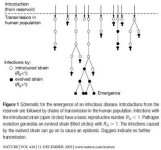
It says that if the "R0" (average number of secondary infections arising from one infected individual) ,exceeds one, it is an epidemic waiting to happen.

There is an interesting chart on the second page, showing how infections caused by the evolved strain can go on to become an epidemic.

Is there enough information available to the public to determine if the "limited human transmission" cases have shown evolution?

This graphic she refers to made me think of what Henry has said so many times, that as the virus spreads into new geographical areas and new species, the chances of it going pandemic increase... simply because of the ever-growing number of times virus encounters new host... that may be coinfected...

Ro-sec-infections.jpg
 
Re: Indonesia H2H Cover-up?

niman said:
My guess is the novel cleavage site is swine.

Does any one have a map showing the Muslim and Christian areas in Indonesia?
Can the map be over laid with the bf outbreaks?
 
Swine to Human H5N1Transmission in Indonesia?

Swine to Human H5N1Transmission in Indonesia?

Swine to Human H5N1Transmission in Indonesia?

Recombinomics Commentary

May 17, 2006

Among the confirmed deaths on Wednesday was a 38-year-old catering businesswoman from Surabaya who had dealt with live pigs and pork meat before she died last week.

The above comments on a confirmed death in Surabaya are cause for concern. Last year H5N1 infected swine were identified in Surabaya. Reports indicated that all eight genes had been sequenced in Japan, and the sequence included a polybasic cleavage site. Although the sequence was generated over a year ago, it has not been made public via deposition at the public database at GenBank or Los Alamos. Instead it is almost certainly being withheld in the WHO private database.

Only one human H5N1 sequence has been deposited from Indonesia. That sequences has a novel HA cleavage site of RESRRKKR, which is not found in any sequence at GenBank. However, a recent report suggested that the novel sequence was in human isolates from Indonesia as well as a cat isolate from Indonesia.

Novel sequences are common in swine H5N1, in part because there are a limited number of such sequences. All public swine H5N1 sequences have come from China, and most have novel HA cleavage site. The common H5N1 sequence is RERRRKKR. Two of the swine sequences, A/swine/Guangdong/1/2003(H5N1) and A/swine/Shandong/2/03(H5N1), but even in these cases the nucleotide sequence that encodes the cleavage site is relatively rare. It is unique for the Guangdong sequence and shared with a few wild bird isolates in the Shandong sequence.

Several of the swine isolates, A/swine/Fujian/F1/2001(H5N1), A/swine/Fujian/1/2003(H5N1), A/swine/Guangdong/2/2003(H5N1), A/swine/Guangdong/4/2003(H5N1, A/swine/Guangdong/5/2003(H5N1) have the REIRRKKR sequence which is shared with a small number of waterfowl including Guangxi ducks, and A/swine/Anhui/2004(H5N1), which has REGRRKKR which is also found in a small number of waterfowl.

These small number of isolates in these swine H5N1 sequences raise the possibility that the novel sequence in the human isolates in Indonesia also come from swine. In any event, the human and swine sequences from Indonesia should be released, and the source of the novel HA cleavage site should be determined.
 
Re: Indonesia H2H Cover-up?

siam said:
Well we keep coming back to cats. Though as I understand it they are mainly feral. Did this family have a pet cat?

And what do cats eat? We KNOW mice can get H5N1. And from many months ago - what about the rats?

.
 
Re: Indonesia H2H Cover-up?

Mellie:

It's that 5th case on the RO chart that I think about. That "chain" it's forming is what has me worried. When they can start linking these families, or some intermediary mammal, and form the long chain - then we have a strong mutation opportunity.

I wonder what the Indonesian HIV rate is? What are the odds of this strain infecting one of them? At some point we'll see a test of Webster's theory for HIV BF outcomes.

.
 
Re: Indonesia H2H Cover-up?

if the family members that Henry reported today are just now breaking with symptoms and are H5N1 positive-then we may have generation 3. Its the first time that has happened, IIRC. Anyone else remember a three generation cluster?

IF these family members are postiive, and end up really sick or theres fatalities, and we cant rule in an animal to human source-then I'm going to get a little twitchy.

It still wont be totally efficient- since theres no other infections in other contacts-but I dont like it if its adding generations. It may mean getting better at what it does-adapting quickly.

then I recall that other article todday, that said specimens from IIRC 50+ contacts had been taken, and 7 were negative- the rest sent for "more tests". that makes me uncomfortable too. Hope we get more info on those tests. If a significant number of them come back with antibodies- then we will know that the virus has adapted more.

If there are positives and a third genration- anyone want to take a guess at the possibility of pandemic in the ensuing 12 months? I'm uncertain, but it seems like it would be considerably more likley than before these changes. Is that a fair gueses?
 
Re: Indonesia H2H Cover-up?

More discussion on the basic reproductive number (R0)

This was a reponse I posted in another thread (on 5/16/2006)

http://www.flutrackers.com/forum/showthread.php?p=12878#post12878

In an article from last year, some researchers distinguish between transmissibility and basic reproductive number for airborne pathogens.

http://www.cdc.gov/ncidod/EID/vol11no08/04-0449.htm

Basic Reproductive Number (R0) refers to the the ratio of a single infected individuals infecting others in close contact situations. When this number is equal to one (1) each infected individual is only infecting one other person. When it is less than one, it means that over time fewer and fewer people are being infected. And when this number is greater than one (1) it means that each infected individual is infecting more and more people.

But according to the article, one also has to consider transmissibility


Quote:
<TABLE cellSpacing=0 cellPadding=6 width="100%" border=0><TBODY><TR><TD class=alt2 style="BORDER-RIGHT: 1px inset; BORDER-TOP: 1px inset; BORDER-LEFT: 1px inset; BORDER-BOTTOM: 1px inset">In any given network exists a critical transmissibility value, Tc, which indicates whether a large-scale epidemic is probable. Any disease with average transmissibility <Tc cannot cause sustained transmission within a population and will thus be limited to small outbreaks. Such diseases die out because of the probabilistic nature of transmission before the disease has a chance to spread to the population at large. </TD></TR></TBODY></TABLE>

We just don't know what the transmissibility value is for this group of infected people. Were they, as Niman asserts, all infected from an index case or were they infected due to some common source.

Given that it has been more than two weeks, I think we can assume that the transmissibility rate is not very high for this cluster. The R0 number will be dependent on how these people actually got infected and whether or not any more individuals have been infected, but we don't know about yet.


link: http://www.cdc.gov/ncidod/EID/vol11no08/04-0449.htm<!-- / message -->
 
Re: Indonesia H2H Cover-up?

Going along the same thought-line as LMonty, if this is 3rd generation and their symptoms are less and they live...then that would mean the kill rate of the virus is dropping...but does that also indicate that the virus "is" or "is-approaching" efficient H-H?

-hawkeye


LMonty said:
if the family members that Henry reported today are just now breaking with symptoms and are H5N1 positive-then we may have generation 3. Its the first time that has happened, IIRC. Anyone else remember a three generation cluster?

IF these family members are postiive, and end up really sick or theres fatalities, and we cant rule in an animal to human source-then I'm going to get a little twitchy.

It still wont be totally efficient- since theres no other infections in other contacts-but I dont like it if its adding generations. It may mean getting better at what it does-adapting quickly.

then I recall that other article todday, that said specimens from IIRC 50+ contacts had been taken, and 7 were negative- the rest sent for "more tests". that makes me uncomfortable too. Hope we get more info on those tests. If a significant number of them come back with antibodies- then we will know that the virus has adapted more.

If there are positives and a third genration- anyone want to take a guess at the possibility of pandemic in the ensuing 12 months? I'm uncertain, but it seems like it would be considerably more likley than before these changes. Is that a fair gueses?
 
Re: Indonesia H2H Cover-up?

Hello everybody.

I find a old news story from the CIDRAP site that expose a Big outbreak management mistake that happend last Summer.
It's not impossible there is a link with a possible field swine H5N1 strain presence in Indonesia.


http://www.cidrap.umn.edu/cidrap/content/influenza/avianflu/news/july2505avian.html

Indonesia culls pigs, tests two men for avian flu
Jul 25, 2005 (CIDRAP News) –

In a response to Indonesia's first three fatal human cases of avian influenza, officials killed some infected pigs and poultry yesterday, but not as many as they had planned to, according to news services.

Plans had called for culling about 200 pigs in a village near the Jakarta suburb of Tangerang, the home of a man and two daughters who died of avian flu this month. But officials instead killed only 18 pigs, along with "dozens" of chickens and ducks, according to a Reuters report yesterday.

The agriculture minister, Anton Apriyantono, told a radio station that the original plan would have hurt the local economy, the story said. But his spokesman, Hari Priyono, said the plan was to kill only the pigs that tested positive for avian flu.

Personale note: Considering the high yeild of false negative data, this was the worst thing to do in this situation.

He said only 18 pigs tested "truly positive" for the virus, and those 18 were slaughtered, according to the story. "In days to come, whenever we find a positive one here, we will slaughter it straight away," he was quoted as saying.

Indonesian officials reported to the World Organization for Animal Health (OIE) in May that the H5N1 avian flu virus had been detected in some pigs at two sites in Tangerang.

Indonesia's first human victims of avian flu were a 38-year-old man and his two daughters, aged 1 and 8, who died between Jul 9 and 14. Authorities have said they have no clear evidence that the three had had any contact with sick poultry or infected pigs.

Reports from Jakarta today said two men hospitalized in the city are being tested for avian flu even though indications are that they have some other illness.

A Reuters story said initial signs are that the two men, one of whom is a photographer who recently photographed chicken farms, have typhoid fever. The men were suffering from "high fever and flu symptoms," the story said.

But Health Minister Siti Fadilah Supari said the men were "suffering from an ordinary flu," according to a report in the Jakarta Post.

A World Health Organization (WHO) spokeswoman in Indonesia, Sari Setiogi, said samples from the two men would be sent to Hong Kong for testing, with results expected in 7 to 10 days, according to the Reuters report.

Reuters quoted Evi Zelvino of Jakarta's public health agency as saying the patients' "temporary diagnosis" was typhoid.

Zelvino also said authorities planned to investigate the case of a Malaysian who died earlier this month. Doctors have said the person died of typhoid, the story said.

Meanwhile, Chinese authorities say they have ruled out avian flu in the investigation of a mysterious disease that has killed 17 farm workers and afflicted 41 more in southwestern China's Sichuan province, according to reports. The workers all fell ill after handling sick or dead pigs or sheep, reports said.

China Daily quoted Zeng Huajin, a senior provincial health official, as saying that the illness was probably caused by Streptococcus suis, a bacteria usually found in pigs.

"I can assure you that the disease is absolutely not SARS [severe acute respiratory syndrome], anthrax or bird flu," Zeng said.

The Chinese news agency Xinhua said yesterday that the patients all had high fever, fatigue, nausea, vomiting, and bruises under the skin. Other reports mentioned hemorrhaging.

Of the surviving patients, two had recovered, 27 were in stable condition, and 12 were in critical condition, Xinhua reported.

Bob Dietz, a WHO spokesman in Manila, told Reuters the disease didn't sound like avian flu because it didn't seem to involve "a large pneumonia content or a large respiratory problem."

Center for Infectious Disease Research & Policy
Academic Health Center -- University of Minnesota
Copyright © 2006 Regents of the University of Minnesota


Personal note: One year after, we could titled this story "How to let a endemic swine H5N1 emerge".

:mad:
 
Re: Indonesia H2H Cover-up?

My 2 cents:

Indonesia is a giant melting pot and excellent lab for H5N1 to make keys.

All roads lead to human.

Limited H2H = almost check made.
 
Re: Indonesia H2H Cover-up?

I posted this on the Breaking news Indonesia thread earlier... It's a summary of why this thread is entitled as it is... I think, however, that apparent coverup is a case of a "sin of omission" rather than a "sin of commission". I don't think Indonesia has the wear-with-all to deal with this --> so they haven't. Systemic systems problems are very difficult to fix. Poverty doesn't help...

Here's lots of stuff from H5N1 in Indonesian pigs last year (I left out one that makes the formatting go all cockeyed; use the link instead).

~~~~~~~~~~~~~~~~~~~~~~~~~~~~~~~~~~~~~~~~~~~

... ProMed Mail, Snowy Owl links and info from last year and reports/ comments from many others including Niman ~~ from last year (4/05 through 5/05). H5N1 in pigs, the mixing vessel, his may be why Osterholm said the pandemic was likely to come out of Indonesia...

~~~~~~~~~~~~~~~~~~~~~~~~~~~~~~~~~~~~~~~~~~~
ProMed in April, 05:

http://www.promedmail.org/pls/askus/..._ID:1000,28662

<table summary=""> <tbody><tr><td nowrap="nowrap" align="right">Archive Number</td> <td nowrap="nowrap" colspan="1" rowspan="1" align="left">20050412.1058</td></tr><tr><td nowrap="nowrap" align="right">Published Date</td> <td nowrap="nowrap" colspan="1" rowspan="1" align="left">12-APR-2005</td></tr><tr><td nowrap="nowrap" align="right">Subject</td> <td nowrap="nowrap" colspan="1" rowspan="1" align="left">PRO/AH/EDR> </td></tr> </tbody> </table>
AVIAN INFLUENZA - EASTERN ASIA (44):
INDONESIA, PIGS: REQUEST FOR INFORMATION

**************************************************
A ProMED-mail post
<http://www.promedmail.org>
ProMED-mail is a program of the
International Society for Infectious Diseases
<http://www.isid.org>

[1]
Date: Tue, 12 Apr 2005
From: Irene Lai <iwlai@attglobal.net>
Source: Kompas, 9 Apr 2005 [translated from Indonesian, edited]

Indonesia: Avian Influenza Virus Identified in Pigs
---------------------------------------------------
Ca Nidom, a molecular biology researcher from [the Centre for]
Tropical Disease Control, Airlangga University, Surabaya, East Java,
has reportedly identified avian influenza virus in throat swabs and
sera of pigs by RT-PCR. [District location not mentioned].

Inactivated RNA isolates have been sent to the Tokyo University,
where 8 fragments (HA, NA, PA, PB1, PB2, M, NP, NS) were sequenced.
Results showed that the virus was [structurally?] similar to the
avian influenza virus from poultry, and is characterised by high
pathogenicity (based on the study regarding the cleavage site).

--
Dr. Irene Lai
International SOS
<iwlai@attglobal.net>

******
[2]
Date: Tue, 12 Apr 2005
From: Irene Lai <iwlai@attglobal.net>
Source: Kompas, 5 Apr 2005 [5 first paragraphs translated from
Indonesian, edited]
<http://www.kompas.com/kompas%2Dcetak...mi/1676599.htm>


Indonesia: Agriculture Department to Investigate Avian Influenza Virus in Pigs
--------------------------------------------------
The Department of Agriculture will study the discovery of avian
influenza virus from infected pigs. The agriculture department will
carry out sampling from several pig farms. More research is needed,
especially regarding the background and route through which the
infection of pigs with avian flu virus took place.

The Minister of Agriculture, Anton Apriyantono, said to the
journalist on Mon, 11 Apr 2005 in Jakarta, that his staff has already
ordered the General Director of Farming Production to investigate
that finding. "We need confirmation because the news is not clear
yet. First, it is not clear where the pigs are originally from, what
is their current location and which type of pigs have been involved".
The General Director of Farming Production will assist the veterinary
investigators in studying samples from pigs. "We are already working
on it", said Anton

As broadcast on Saturday, the molecular biology researcher in
Airlangga University, CA Nidom, discovered the avian influenza virus
in pigs. The finding was based on identification of [DNA/RNA?] and
might be interpreted as indicative for the presence of new avian
influenza cases in Indonesia. "We are responding to that report by
taking samples from pigs in Indonesia. Is it correct that pigs have
been infected? For me this is still the question", he said.

--
Dr. Irene Lai
International SOS
<iwlai@attglobal.net>

[ProMED-mail is grateful to Dr Lai for sending us the above
translated reports. - Mod.AS]

[These reports are somewhat contradictory. On the one hand it is
suggested that the complete genome of an avian influenza virus
isolated from a pig in Indonesia has been sequenced from RT-PCR
fragments, whereas on the other hand the presence of avian influenza
virus infection in pigs in Indonesia has still to be confirmed by
isolation of infectious virus. The serotype of the virus does not
appear to have been established, so it cannot be assumed at this
stage that the virus is the H5N1 East Asian epidemic strain.

However, although the situation is somewhat confused, these reports
cannot be dismissed lightly, because the presence of H5N1 virus in
pigs might increase the risk of adaptation of the epidemic avian
influenza virus to growth and transmission in mammals -- although it
should be emphasized that the role of pigs as mixing vessels in the
generation of pandemic influenza viruses is no more than a
hypothesis. Further information is awaited with some apprehension. -
Mod.CP]

~~~~~~~~~~~~~~~~~~~~~~~~~~~~~~~~~~~~~~~~~~~
Niman's Recombinomics Commentary FROM LAST YEAR:

H5N1 in Indonesian Pigs Confirmed
Recombinomics Commentary
May 25, 2005

The government responded to the media attention by carrying out its
own survey, and found H5N1 in three out of eight pigs it tested in Banten,
Naipospos told Nature. Like those tested by Nidom, the pigs showed no
outward signs of disease.

Despite this worrying result, communication has faltered between
Indonesia and the international organizations charged with monitoring
animal health, such as the United Nations' Food an Agriculture Organization
(FAO) and the World Organisation for Animal Health (OIE).
When interviewed by Nature last week, the OIE's regional representative
for the Asia-Pacific region still referred to the presence of H5N1 in pigs
as "a rumour".

The above story of H5N1 in pigs in Indonesia has parallels to the human and birdflu found in pigs in South Korea. WHO's initial response was that the human WSN/33 sequences were a lab error. Eventually they did send a high ranking member who saw the data generated while he was in the lab. Although he commented "something is going on here", WHO has yet to issue a statement.

Previously, the WHO had written a press release indicating that they were
going to halt verification efforts, but that release may have never circulated.

In South Korea the pigs are infected with two human (H1N1 and H1N2) and one avian (H9N2)flu virus.

The viruses are evolving, the pigs are dying, yet WHO just hears a noisy car.

~~~~~~~~~~~~~~~~~~~~~~~~~~~~~~~~~~~~~~~~~~~
CIDRAP piece (Osterholm's organization) FROM LAST YEAR

http://www.cidrap.umn.edu/cidrap/con...2705avflu.html

Indonesian pigs have avian flu virus; bird cases double in China


May 27, 2005 (CIDRAP News) ? Avian influenza could be infecting up to half of the pig population in some areas of Indonesia, but without causing symptoms, Nature magazine reported in this week's edition.

Meanwhile, Chinese officials said a flu outbreak among wild birds is twice as large as previously reported, but they denied reports of human cases.

In Indonesia, Chairul Nidom, a virologist at Airlangga University's tropical disease center in Surabaya, Java, was conducting independent research earlier this year. He tested the blood of 10 apparently healthy pigs housed near poultry farms in western Java where avian flu had broken out, Nature reported. Five of the pig samples contained the H5N1 virus.

The Indonesian government has since found similar results in the same region, Nature reported. Additional tests of 150 pigs outside the area were negative. However, the story said, lack of funding for surveillance and testing is a concern to Nidom, who said he has samples from 90 more pigs from Banten, but he can't afford to test them or to broaden his investigation.

"I think pigs pose a much greater threat of spreading the disease to humans than poultry," Nidom told Nature. Pigs are often described as a mixing vessel in which human and avian flu viruses can swap genetic information, which could lead to a hybrid virus with the ability to spread easily among people.

The Indonesian government sent a report to the World Organization for Animal Health (OIE) on May 23 that describes three surveys involving "purposive and pooled sampling" of pigs, with a total 187 samples.

The first survey, Nidom's Feb 23 study on one farm, yielded 5 positives out of 10 samples tested for H5N1. The second, on Apr 14 in another village, involved 10 nasal swabs from 31 pigs and produced positives in 6 of the 10.

The third survey included six pigs from the same village as Nidom's small survey and yielded 1 positive swab. The report says that no pig has shown visible signs of avian flu. It lists the source of the pig infections as "contamination with chicken manure" from adjacent backyard chicken farms.

Additional tests included 250 blood serum and swab samples from pigs in seven provinces, the report says. All the results were negative.

The Nature report said the H5N1 virus was found in pigs in China in 2001 and 2003, but two surveys last year, involving 8,457 pig samples, found no evidence of the virus.

In China, more than 1,000 migratory birds have died of H5N1 avian flu in Qinghai province, according to a report today by Xinhua, the Chinese news agency.

The size of the outbreak, initially reported as not being H5N1, grew this week from 178 birds to 519, and now to more than 1,000. Emergency measures are being taken in Qinghai, including increasing infectious disease control and surveillance for animals and humans, Xinhua reports. The agency said earlier that authorities planned to vaccinate 3 million poultry in the region.

The Chinese government has repeatedly said that no people have been infected with avian flu, despite unconfirmed claims on Internet sites that as many as 120 people have died of the illness.

The World Health Organization (WHO) is seeking details on the provincial outbreak, according to a Canadian Press (CP) report quoting Maria Cheng, WHO spokeswoman in Beijing.

"We've seen those reports about possible human H5N1 cases, and have requested more information from the Ministry of Health," Cheng said. The WHO is urging China to share virus samples from the dead birds as well as information on human exposure to dead birds.

"It would be premature to consider this event over," Cheng said.

In a separate report in Xinhua yesterday, Chinese researchers claimed to have developed two H5N1 vaccines that are "100%" effective for birds, animals, and people, CP reported. Officials at the WHO office in Beijing, however, described that research as involving only birds and said no animal or human clinical trials have been conducted.
~~~~~~~~~~~~~~~~~~~~~~~~~~~~~~~~~~~~~~~~~~~

Indonesian report to OIE
http://www.oie.int/eng/info/hebdo/aIS_69.htm#Sec2

Click the link!

~~~~~~~~~~~~~~~~~~~~~~~~~~~~~~~~~~~~~~~~~~~

Nature report on H5N1 virus in pigs in Indonesia (Java)

http://www.nature.com/nature/journal...l/435390a.html

Nature 435, 390-391 (26 May 2005) | <abbr title="Digital Object Identifier">doi</abbr>: 10.1038/435390a
Bird flu spreads among Java's pigs

David Cyranoski, Tokyo

Abstract

Indonesian government scrambles to track disease.

Concerns over the presence of a dangerous strain of avian flu virus in Indonesia's pigs are growing, as government tests confirm the existence of infection. In some areas, the H5N1 virus could be infecting up to half of the pig population, without causing any signs of disease.

The initial discovery was made earlier this year by an independent researcher working outside national and international surveillance systems. Chairul Nidom, a virologist at Airlangga University's tropical-disease centre in Surabaya, Java, found the H5N1 virus in five of ten pigs tested from Banten in western Java.

The presence of the virus in pigs is a particular worry because the animals can harbour both bird and human flu viruses, and act as a 'mixing vessel' for the emergence of a strain of avian flu that can easily infect humans. There are now signs that the virus could be spreading unchecked through the pig population.

Nidom says that the pigs he tested showed no signs of illness, and the only reason he tested them was that they were kept near a chicken farm that was struck by avian flu last year. Nature has discovered that a government survey has since found similar results in the same region.

The virus was not found in 150 pigs tested from outside the area. Although the government says it has stepped up the surveillance of pigs in its seven satellite laboratories, it may fail to spot any spread of the virus because resources are short. "It's a big country," says Tri Satya Putri Naipospos, director of animal health at Indonesia's agriculture ministry. "If you want to commit to eradicating a disease, you need more money."

Nidom is also frustrated by a lack of resources. He says he has samples from another 90 pigs in Banten, but cannot afford to test them or to expand his survey to other areas.

Some health officials in Asia fear the presence of avian flu in pigs even more than in chickens or ducks. "I think pigs pose a much greater threat of spreading the disease to humans than poultry," says Nidom.

The virus was found in pigs in China in 2001 and in 2003 (see Nature 430, 955; 2004). The country stepped up its surveillance, and two surveys in 2004 found that all 8,457 samples tested were free of H5N1.

Nidom's discovery of H5N1 in pigs is a wake-up call for the Indonesian government. He says that when he first alerted the government to his findings in February, there was no reaction. "I don't know why they are so passive," he says. Nidom took his findings to a local newspaper, the Jakarta-based Kompas, which ran the story on 9 April. The news spread to international media earlier this month.

The government responded to the media attention by carrying out its own survey, and found H5N1 in three out of eight pigs it tested in Banten, Naipospos told Nature. Like those tested by Nidom, the pigs showed no outward signs of disease.

Despite this worrying result, communication has faltered between Indonesia and the international organizations charged with monitoring animal health, such as the United Nations' Food and Agriculture Organization (FAO) and the World Organisation for Animal Health (OIE). When interviewed by Nature last week, the OIE's regional representative for the Asia-Pacific region still referred to the presence of H5N1 in pigs as "a rumour".

The FAO and OIE cannot act until they have received official government reports, says Carolyn Benigno, animal-health officer at the FAO's regional headquarters in Bangkok. She hadn't heard of Nidom's work until Nature contacted her last week. However, Naipospos complains that although she is preparing an official report for the FAO, she cannot fast-track it because the FAO and the OIE do not classify the case as an emergency. "This is not an outbreak, it's a finding," she says, because the pigs are not ill or dying. As Nature went to press, the Indonesian government was preparing to send a report on the matter to the OIE. (See Box).

Nidom says he would like to expand his project, and to sample pigs from eastern Java. But he is not counting on being given the resources to do so. This is his second run-in with the government ? in 2003 he caused a stir by releasing data showing that mass deaths of chickens at the time were caused by H5N1.

 
Re: Swine to Human H5N1Transmission in Indonesia?

Re: Swine to Human H5N1Transmission in Indonesia?

Has there been any other news stories on the new 3 members of the Karo family?
Also the cluster around bekasi, all I can find are the 12 year old boy. Has anyone see others?

Does anyone know if the caterer, from Surabaya, was at the barbeque? Maybe she caterered it? Is there others in Surabaya sick?
No others mentioned.
 
Back
Top