

sharon sanders
Editor-in-Chief & President
Identify, Isolate, Inform: CDC Releases New Guidance for Emergency Department Evaluation and Management for Patients Presenting with Possible Ebola Virus Disease
Centers for Disease Control and Prevention (CDC) sent this bulletin at 10/28/2014 02:32 PM EDT Identify, Isolate, Inform: CDC Releases New Guidance for Emergency Department Evaluation and Management for Patients Presenting with Possible Ebola Virus Disease
<table border="0"> <tbody> <tr> <td align="left" valign="top">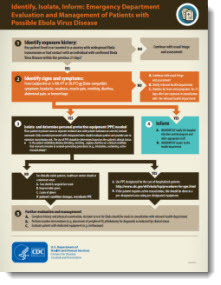 </td> <td align="left" valign="top"> CDC released new guidance for Emergency Departments (ED) on evaluating and managing patients presenting with possible Ebola Virus Disease. Because early symptoms of Ebola Virus Disease are similar to other febrile illnesses, triage and evaluation processes in the ED should consider and systematically assess patients for the possibility of the disease.
Identify exposure history and Ebola-compatible symptoms:
Take a relevant patient history, including exposure criteria of whether the patient lived in or traveled to a country with widespread Ebola transmission or had contact with an individual with confirmed Ebola Virus Disease within the previous 21 days. Check patient for fever (subjective or >100.4?F or 38.0?C) or Ebola-compatible symptoms: headache, weakness, muscle pain, vomiting, diarrhea, abdominal pain, or hemorrhage (e.g., bleeding gums, blood in urine, nose bleeds, coffee ground emesis or melena).
</td> </tr> </tbody> </table> Isolate the patient and determine personal protective equipment (PPE) needed:
Place patient in private room or separate enclosed area with private bathroom or covered, bedside commode. Only essential personnel with designated roles should evaluate patient and provide care to minimize transmission risk. Choose the PPE recommended for the patient?s clinical status.
Inform health officials:
IMMEDIATELY notify the hospital infection control program and other appropriate staff, as well as the health department.
To read the full guidance, visit CDC?s Ebola website: http://www.cdc.gov/vhf/ebola/hcp/ed-management-patients-possible-ebola.html.
Related links:
Centers for Disease Control and Prevention (CDC) sent this bulletin at 10/28/2014 02:32 PM EDT Identify, Isolate, Inform: CDC Releases New Guidance for Emergency Department Evaluation and Management for Patients Presenting with Possible Ebola Virus Disease
<table border="0"> <tbody> <tr> <td align="left" valign="top">
</td> <td align="left" valign="top"> CDC released new guidance for Emergency Departments (ED) on evaluating and managing patients presenting with possible Ebola Virus Disease. Because early symptoms of Ebola Virus Disease are similar to other febrile illnesses, triage and evaluation processes in the ED should consider and systematically assess patients for the possibility of the disease.Identify exposure history and Ebola-compatible symptoms:
Take a relevant patient history, including exposure criteria of whether the patient lived in or traveled to a country with widespread Ebola transmission or had contact with an individual with confirmed Ebola Virus Disease within the previous 21 days. Check patient for fever (subjective or >100.4?F or 38.0?C) or Ebola-compatible symptoms: headache, weakness, muscle pain, vomiting, diarrhea, abdominal pain, or hemorrhage (e.g., bleeding gums, blood in urine, nose bleeds, coffee ground emesis or melena).
</td> </tr> </tbody> </table> Isolate the patient and determine personal protective equipment (PPE) needed:
Place patient in private room or separate enclosed area with private bathroom or covered, bedside commode. Only essential personnel with designated roles should evaluate patient and provide care to minimize transmission risk. Choose the PPE recommended for the patient?s clinical status.
Inform health officials:
IMMEDIATELY notify the hospital infection control program and other appropriate staff, as well as the health department.
To read the full guidance, visit CDC?s Ebola website: http://www.cdc.gov/vhf/ebola/hcp/ed-management-patients-possible-ebola.html.
Related links:
- Identify, Isolate, Inform: Emergency Department Evaluation and Management for Patients Who Present with Possible Ebola Virus Disease
- Algorithm for Emergency Department Evaluation and Management for Patients Presenting with Possible Ebola Virus Disease
- Guidance on Personal Protective Equipment To Be Used by Healthcare Workers During Management of Patients with Ebola Virus Disease in U.S. Hospitals, Including Procedures for Putting On (Donning) and Removing (Doffing)
- Interim Guidance for Environmental Infection Control in Hospitals for Ebola Virus