

Ronan Kelly
Retired 2020
Iceberg-glacier collision could trigger climatic changes
The ice masses are likely to lower oxygen levels in the oceans
? Photos: AFP
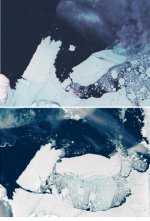
Danger afloat: This combo shows two satellite images released on Friday from the Australian Antarctic Division of the Mertz Glacier Tongue. (Top) A 160-km spit of floating ice protruding into the Southern Ocean from east Antarctica on January 7. (Bottom) On February 20, the Mertz Glacier Tongue broke off when it was dislodged by another, older iceberg, known as B9B (at right), which split off in 1987.
SYDNEY: An iceberg about the size of Luxembourg, which struck a glacier off Antarctica dislodging another massive block of ice, could lower oxygen levels in the world?s oceans, Australian and French scientists said on Friday.
The two icebergs are now drifting together about 100 to 150 km off Antarctica, following the collision on February 12 or 13, said Australian Antarctic Division glaciologist Neal Young.
?It gave it a pretty big nudge,? Mr. Young said of the 97- km-long iceberg that collided with the giant floating Mertz Glacier and shaved off a new iceberg. ?They are now floating right next to each other.?
The new iceberg is 78 km long and about 39 km wide and holds roughly the equivalent of a fifth of the world?s annual total water usage, Mr. Young said.
Experts are concerned about the effect of the massive displacement of ice on the ice-free water next to the glacier, which is important for ocean currents.
This area of water had been kept clear because of the glacier, said Steve Rintoul, a leading climate expert. With part of the glacier gone, the area could fill with sea ice and disrupt the ability for the dense and cold water to sink.
This sinking water is what spills into ocean basins and feeds the global ocean currents with oxygen.
As there are only a few areas in the world where this occurs, a slowing of the process would mean less oxygen into the deep currents that feed the oceans.
?There may be regions of the world?s oceans that lose oxygen, and then of course most of the life there will die,? said Mario Hoppema, a German-based chemical oceanographer. ? AP
http://www.hindu.com/2010/02/27/stories/2010022757422000.htm
The ice masses are likely to lower oxygen levels in the oceans
? Photos: AFP
Danger afloat: This combo shows two satellite images released on Friday from the Australian Antarctic Division of the Mertz Glacier Tongue. (Top) A 160-km spit of floating ice protruding into the Southern Ocean from east Antarctica on January 7. (Bottom) On February 20, the Mertz Glacier Tongue broke off when it was dislodged by another, older iceberg, known as B9B (at right), which split off in 1987.
SYDNEY: An iceberg about the size of Luxembourg, which struck a glacier off Antarctica dislodging another massive block of ice, could lower oxygen levels in the world?s oceans, Australian and French scientists said on Friday.
The two icebergs are now drifting together about 100 to 150 km off Antarctica, following the collision on February 12 or 13, said Australian Antarctic Division glaciologist Neal Young.
?It gave it a pretty big nudge,? Mr. Young said of the 97- km-long iceberg that collided with the giant floating Mertz Glacier and shaved off a new iceberg. ?They are now floating right next to each other.?
The new iceberg is 78 km long and about 39 km wide and holds roughly the equivalent of a fifth of the world?s annual total water usage, Mr. Young said.
Experts are concerned about the effect of the massive displacement of ice on the ice-free water next to the glacier, which is important for ocean currents.
This area of water had been kept clear because of the glacier, said Steve Rintoul, a leading climate expert. With part of the glacier gone, the area could fill with sea ice and disrupt the ability for the dense and cold water to sink.
This sinking water is what spills into ocean basins and feeds the global ocean currents with oxygen.
As there are only a few areas in the world where this occurs, a slowing of the process would mean less oxygen into the deep currents that feed the oceans.
?There may be regions of the world?s oceans that lose oxygen, and then of course most of the life there will die,? said Mario Hoppema, a German-based chemical oceanographer. ? AP
http://www.hindu.com/2010/02/27/stories/2010022757422000.htm