

Michael Coston
Editor, Senior Moderator
Hurricane Season Begins - June Climatology
[TABLE="class: tr-caption-container, cellpadding: 0, cellspacing: 0"]
[TR]
[TD] [/TD]
[/TD]
[/TR]
[TR]
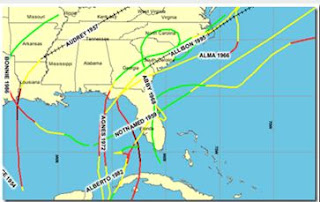
[TD="class: tr-caption"]June Areas of Tropical Storm Genesis - Credit NOAA[/TD]
[/TR]
[/TABLE]
Today, June 1st, is the official start to the Atlantic Tropical Season, which will run through the end of November. While June hurricanes are rare events (see chart below), they can and do happen, and they are most likely to form over the warm, relatively shallow waters of the Gulf of Mexico.

Further out to sea the Atlantic waters are still too cold, and the winds and Saharan dust conditions aloft too unfavorable, to promote much in the way of long-track storm development. But that generally changes at the summer progresses.
June hurricanes have a reputation for being mild, short-lived, and less dangerous. But there have been some notable exceptions.
While generally weaker than later season storms, June hurricanes can develop quickly, sometimes providing coastal residents with less than a day's warning. Which is one of the reasons why preparing in advance - instead of waiting for a storm to form - is advised.
So if you haven't done so already, plan a visit to NOAA's Weather-Ready Nation Hurricane Preparedness Week 2017 web page, and decide what you need to do now to keep you, your family, and your property safe during the coming tropical season.
While this blog, and many other internet sources, will cover this year's hurricane season your primary source of information should always be the National Hurricane Center in Miami, Florida.
http://afludiary.blogspot.com/2017/0...imatology.html
[TABLE="class: tr-caption-container, cellpadding: 0, cellspacing: 0"]
[TR]
[TD]
 [/TD]
[/TD][/TR]
[TR]
[TD="class: tr-caption"]June Areas of Tropical Storm Genesis - Credit NOAA[/TD]
[/TR]
[/TABLE]
Mariner’s Poem On Hurricanes
June too soon.
July stand by.
August look out you must.
September remember.
October all over.
June too soon.
July stand by.
August look out you must.
September remember.
October all over.
- Published in “Weather Lore” by R. Inwards in 1898
#12,504Today, June 1st, is the official start to the Atlantic Tropical Season, which will run through the end of November. While June hurricanes are rare events (see chart below), they can and do happen, and they are most likely to form over the warm, relatively shallow waters of the Gulf of Mexico.
Further out to sea the Atlantic waters are still too cold, and the winds and Saharan dust conditions aloft too unfavorable, to promote much in the way of long-track storm development. But that generally changes at the summer progresses.
June hurricanes have a reputation for being mild, short-lived, and less dangerous. But there have been some notable exceptions.
- Hurricane Audrey in 1957 was the only June storm in modern history known to reach CAT 4 strength, and it claimed 550 lives after it made landfall in eastern Texas and western Louisiana
- Catagory 1 Hurricane Agnes (1972), caused relatively little damage when it made landfall in Florida, but caused extensive inland flooding several days later in the Mid-Atlantic states, claiming 113 lives in New York and Pennsylvania.
- Slow moving tropical storm Allison - in June of 2001 – proved more than deadly producing 55 fatalities and causing in excess of $9 billion in damage to Southeast Texas - primarily due to its torrential rains.
- In 2010 Hurricane Alex – a strong CAT 2 hurricane – slammed into Mexican state of Tamaulipas after intensifying to hurricane strength on June 29th.

While generally weaker than later season storms, June hurricanes can develop quickly, sometimes providing coastal residents with less than a day's warning. Which is one of the reasons why preparing in advance - instead of waiting for a storm to form - is advised.
This year's forecast, released last week by NOAA (see 2017 Tropical Outlook: Above Normal Hurricane Season Expected)calls for between 11 and 17 named storms. How many of those might impact the United States, and of what severity, is unknown.
As we've discussed so often in the past you don't have to live right on the coast to be affected by a land falling hurricane. High winds, inland flooding, and tornadoes can occur hundreds of miles inland.So if you haven't done so already, plan a visit to NOAA's Weather-Ready Nation Hurricane Preparedness Week 2017 web page, and decide what you need to do now to keep you, your family, and your property safe during the coming tropical season.
While this blog, and many other internet sources, will cover this year's hurricane season your primary source of information should always be the National Hurricane Center in Miami, Florida.
These are the real experts, and the only ones you should rely on to track and forecast the storm.
If you are on Twitter, you should also follow @FEMA, @NHC_Atlantic, @NHC_Pacific and @ReadyGov.http://afludiary.blogspot.com/2017/0...imatology.html